You wake up with a throbbing toothache. It’s the weekend, the pain is radiating to your ear, and you know you need help—but you’re not sure you can afford a full root canal right this second. You call an emergency dentist, and they tell you they can see you today for “palliative treatment.”
What does that mean? And more importantly, what is the dental code for palliative treatment that will appear on your bill?
In the world of dental insurance and procedure documentation, that code is D9110. It’s one of the most commonly used—and sometimes misunderstood—codes in emergency dentistry. If you’ve ever received a bill with this code and wondered why you paid for a visit that didn’t result in a permanent filling or crown, you are not alone.
This guide is designed to walk you through everything you need to know about D9110. We’ll explore what palliative care in dentistry actually involves, when a dentist uses this code, how insurance typically handles it, and how it fits into your overall treatment plan. By the end, you’ll have a clear, realistic understanding of this essential service, empowering you to make informed decisions about your dental health.
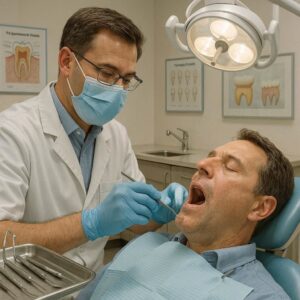
Dental Code for Palliative Treatment
What Exactly Is Palliative Treatment in Dentistry?
Before we dive into the code itself, let’s clarify the concept of palliative care. The word “palliative” comes from the Latin pallium, meaning “cloak.” In a medical context, it refers to treatment that cloaks or soothes symptoms without necessarily curing the underlying disease.
In dentistry, palliative treatment is all about relief. When a patient comes in with acute pain, swelling, or discomfort, the primary goal is to stop the suffering. The dentist is not performing a permanent restoration like a crown, filling, or root canal at that moment. Instead, they are stabilizing the situation to give you time.
Palliative treatment can include several actions:
-
Adjusting a high filling that is causing pain when you bite
-
Smoothing a sharp edge of a broken tooth or crown that is cutting your cheek or tongue
-
Placing a temporary sedative dressing or medication inside a cavity to calm the nerve
-
Prescribing antibiotics or pain medication to manage an infection or inflammation
-
Performing a gentle cleaning or irrigation of an area around a painful gum
Think of it as the dental equivalent of putting a bandage on a wound and taking pain relievers for a sprain. It’s the first step—the immediate care that makes it possible for you to function while a longer-term solution is planned.
The Official Dental Code: D9110
The current dental procedure code (CDT code) for palliative treatment is D9110. This code is part of the Code on Dental Procedures and Nomenclature, published by the American Dental Association (ADA). It is recognized by most insurance companies across the United States and Canada.
The official description for D9110 is: “Palliative (emergency) treatment of dental pain—minor procedure.”
Let’s break that down.
-
Palliative: As we discussed, this means symptom relief.
-
Emergency: This indicates that the treatment was unscheduled and intended to address an acute problem, not a routine check-up.
-
Minor procedure: This distinguishes it from major surgical or restorative procedures. It implies a shorter appointment focused on immediate relief.
It is crucial to understand that D9110 is a stand-alone code. When a dentist uses it, they are billing for their time, expertise, and the materials used to relieve your immediate pain. It is not a “bundled” service that includes a future root canal or extraction.
What D9110 Includes (and What It Does Not)
To avoid surprises on your bill, it’s helpful to know exactly what falls under this code.
| Typically Included in D9110 | Not Included in D9110 |
|---|---|
| Examination focused on the area of pain | Comprehensive oral exam (D0150) or periodic exam (D0120) |
| Diagnosis of the source of pain | Full-mouth X-rays (though a single X-ray of the painful area may be taken) |
| Application of topical or local anesthetic | Permanent restoration (filling, crown, root canal) |
| Placement of a sedative or medicated dressing | Surgical extraction of a tooth |
| Smoothing a sharp or broken tooth | Definitive treatment like a root canal or crown prep |
| Prescription for pain or infection (if needed) | Extensive surgical procedures |
In essence, D9110 is for the emergency visit that stops the immediate problem so you can get through the night, the weekend, or the time until a definitive procedure can be scheduled.
Common Scenarios Where D9110 Is Used
It helps to see this code in action. Here are three typical patient scenarios that result in the use of D9110.
Scenario 1: The Deep Cavity
A patient arrives with severe, spontaneous tooth pain that is keeping them awake at night. The dentist examines the area, takes a small X-ray, and finds a deep cavity that has nearly reached the nerve. A full root canal is needed, but the dentist’s schedule is full for the next two weeks.
The dentist cleans out the decay, places a medicated sedative filling to calm the nerve, and prescribes an antibiotic if there are signs of infection. The dentist bills D9110 for this emergency visit and schedules the patient for a follow-up appointment to complete the root canal (D3310) and crown (D2740).
Scenario 2: The Fractured Tooth
A patient bites down on a popcorn kernel and feels a sharp crack. A piece of an existing filling has broken off, leaving a jagged edge that is constantly cutting their tongue. There is no nerve pain, but the soft tissue irritation is making it difficult to eat and talk.
The dentist sees the patient, smooths the sharp edge with a finishing bur, and polishes the area so it is no longer abrasive. Because no permanent restoration is placed, the dentist bills D9110 for the palliative smoothing procedure.
Scenario 3: The High Filling
A patient had a new filling placed a week ago. Since then, they’ve been experiencing pain every time they chew on that side. The filling feels “too high.” The patient returns to the office for a quick adjustment.
The dentist identifies the high spot using articulation paper and adjusts the filling until the bite feels comfortable. Since this is a minor correction to relieve pain and prevent further issues (like a cracked tooth or TMJ discomfort), the dentist may use D9110 to bill for the adjustment visit.
Insurance Coverage for D9110: What to Expect
This is where things can get confusing for patients. Insurance coverage for palliative treatment varies significantly between plans. Here’s a realistic look at how D9110 is typically processed.
Deductibles and Frequency
Most dental insurance plans are designed to cover preventive care (cleanings, exams) and restorative care (fillings, crowns). Emergency palliative care falls into a gray area.
-
Deductible: Many plans require you to meet your annual deductible before they start paying for services like D9110. If you haven’t had any other dental work that year, you may be responsible for the full cost of the visit until the deductible is met.
-
Frequency Limitations: Some plans have a specific limit on how many times they will cover D9110 in a given year—often once or twice. This is because insurance companies expect that a definitive treatment will follow a palliative emergency visit.
How It Is Classified
Insurance companies often classify D9110 as a diagnostic or minor procedure. Depending on your plan’s benefit structure, it might be covered at a percentage similar to an exam (often 80% after the deductible) or it might be subject to your plan’s “basic services” coverage, which can range from 50% to 80%.
When Insurance May Deny D9110
It is possible for an insurance claim for D9110 to be denied. Common reasons include:
-
Lack of X-ray: Some insurers require a radiograph (X-ray) to justify the emergency code.
-
No Definitive Diagnosis: If the dentist’s notes don’t clearly explain the source of the pain, the insurer may deem the service not medically necessary.
-
Bundling with Other Codes: If the dentist performs a comprehensive exam and X-rays on the same day, the insurer might consider D9110 as part of the exam and not pay separately. A good dental office will often discuss this with you beforehand.
Important Note: Before any emergency treatment, don’t hesitate to ask the front desk staff, “Can you give me an estimate of what my out-of-pocket cost will be for today’s palliative visit?” A reliable dental office will be happy to provide this information based on your specific insurance benefits.
Cost of Palliative Treatment Without Insurance
If you don’t have dental insurance or your plan doesn’t cover D9110, you will be responsible for the full fee. The cost of a palliative treatment visit is not standardized and varies based on geography, the dentist’s experience, and the complexity of the emergency.
On average, you can expect the fee for D9110 to range from $75 to $200. This fee typically includes:
-
The emergency-focused evaluation
-
The application of anesthetic (if needed)
-
The placement of any temporary or sedative materials
-
The dentist’s time and expertise
If X-rays are taken, that is a separate code (such as D0220 for a single intraoral X-ray), which will add to the total cost. A single X-ray usually adds between $20 and $50 to the bill.
It’s always a good practice to ask for the fee before treatment. Legitimate emergency dental offices will be transparent about their emergency visit fee.
D9110 vs. Other Common Dental Codes
One of the biggest sources of confusion is distinguishing D9110 from other codes that may appear on an emergency dental bill. Let’s clear that up.
| Code | Description | Key Difference from D9110 |
|---|---|---|
| D9110 | Palliative (emergency) treatment of dental pain—minor procedure | Focus is solely on relieving pain or irritation; no permanent restoration. |
| D0120 | Periodic oral evaluation (established patient) | A routine check-up, not for an emergency. It includes a full evaluation of oral health, not just the problem area. |
| D0140 | Limited oral evaluation—problem focused | This code is for an exam that focuses on a specific problem. Some offices use D0140 for emergency exams. The difference is that D9110 includes treatment (like placing medication), while D0140 is for the exam only. |
| D0220 | Intraoral periapical first radiographic image | A single X-ray of a specific tooth. This is often taken in addition to D9110 to diagnose the problem. |
| D3310 | Endodontic therapy, anterior tooth (root canal) | This is a definitive, permanent treatment for a tooth with infected or damaged pulp. D9110 is often used as a first step before a root canal. |
It is common to see D9110 billed alongside D0220 or D0230 (additional X-rays) on an emergency visit. You might also see D9110 billed on the same day as a definitive procedure, but this is less common and often requires special documentation to be covered by insurance.
The Role of Palliative Care in a Complete Treatment Plan
One of the most important things to understand about D9110 is that it is rarely the final step. It is a bridge.
Dentists have a professional and ethical obligation to relieve pain. When you arrive in distress, their primary focus is to get you out of pain. However, palliative care does not fix the underlying problem. The cavity is still there. The cracked tooth is still cracked. The infection, if only temporarily soothed, will likely return.
After a palliative visit, your dentist should provide you with a clear treatment plan for the definitive solution. This plan will outline the recommended procedure (such as a filling, crown, root canal, or extraction), the associated costs, and the timeline.
For example, a sedative filling placed under D9110 is a temporary material that will eventually break down, leak, or fall out. It is designed to last for a few weeks or months—just long enough to get you to your scheduled definitive appointment. Ignoring the problem after palliative care will likely lead to a recurrence of pain and potentially a more complex (and expensive) issue down the road.
How to Prepare for an Emergency Palliative Visit
Knowing what to expect can make the process smoother and less stressful. Here’s a simple checklist.
-
Know Your Insurance: If you have insurance, have your member ID card ready. If you can, call the office ahead of time to ask if they are in-network and to get a general idea of the emergency visit fee.
-
Bring a List of Medications: Note any medications you are currently taking, including over-the-counter drugs and supplements. Also, note any allergies, especially to local anesthetics (like lidocaine) or antibiotics (like penicillin).
-
Be Clear About the Problem: When you speak to the front desk or the dentist, clearly describe where the pain is, when it started, and what makes it better or worse.
-
Ask Questions: Don’t be afraid to ask:
-
“Is this a palliative treatment today?”
-
“What is the code you’ll be using, and what does it cover?”
-
“What is my estimated out-of-pocket cost?”
-
“What will the definitive treatment be, and when should I schedule it?”
-
A Note on Ethics and Realistic Expectations
In the world of online dental information, you might come across forums or articles suggesting that D9110 is a “cheat code” to get a full root canal for the price of an emergency visit. This is not accurate.
Dentists adhere to strict ethical and legal standards when documenting treatment. Billing for a palliative visit when a definitive procedure was performed is insurance fraud. Conversely, using D9110 for a visit that only involved a consultation (without any treatment to relieve symptoms) would also be incorrect.
The system is designed to be honest. When you receive a bill with D9110, it reflects a specific type of service: a minor, emergency procedure aimed at symptom relief. If you ever feel your bill does not accurately reflect the treatment you received, your first step should be to have a calm conversation with the dental office’s billing coordinator. Most misunderstandings can be resolved with clear communication.
Why This Code Matters for Your Dental Health Journey
Understanding the dental code for palliative treatment empowers you in several ways. It helps you:
-
Budget Accurately: You know that an emergency visit may have a separate fee from the final crown or root canal.
-
Communicate Effectively: You can ask informed questions about your treatment and billing.
-
Follow Through: Recognizing that palliative care is a temporary fix reinforces the importance of returning for definitive treatment. This prevents a small problem from becoming a dental crisis later.
Your oral health is a long-term journey. An emergency is just a detour. By understanding the steps along the way—starting with the immediate relief provided by D9110—you can navigate that detour with confidence and clarity.
Conclusion
The dental code D9110 represents a critical service in dentistry: immediate, palliative care to relieve pain and stabilize a dental emergency. It is a minor procedure focused on symptoms, not permanent solutions. Understanding what this code covers, how insurance typically handles it, and its role as a first step in a larger treatment plan helps you avoid billing surprises and make better decisions for your oral health. Remember, while palliative treatment provides essential relief, following up with your dentist for definitive care is the key to a long-term healthy smile.
Frequently Asked Questions (FAQ)
1. Is D9110 the same as an emergency exam?
Not exactly. An emergency exam (often billed as D0140) is just the evaluation. D9110 includes the exam plus a minor treatment to relieve pain, such as placing a sedative filling or smoothing a sharp tooth.
2. Will my insurance cover D9110?
It depends on your specific plan. Many plans cover it as a basic service, often at 50% to 80% after your deductible is met. Some plans may have a limit on how many times they will cover it per year. Always check with your insurance provider or dental office beforehand.
3. How much does palliative treatment cost without insurance?
The fee typically ranges from $75 to $200, depending on the dental office and your location. This does not include the cost of X-rays, which are often billed separately.
4. Can I just get palliative treatment and not come back for the permanent fix?
You can, but it is not recommended. Palliative treatments like sedative fillings are temporary. They are designed to give you relief until a definitive treatment (like a filling or root canal) can be completed. If you delay, the problem will likely worsen, potentially leading to more pain and a more complex, expensive procedure.
5. Why did I get charged for D9110 when I had a root canal on the same tooth later?
Because D9110 covered the emergency visit to relieve your immediate pain and stabilize the tooth. The root canal (D3310) is a separate, definitive procedure performed at a different appointment. Each service is documented and billed according to what was done.
6. What should I do if I think the D9110 code was used incorrectly on my bill?
Start by contacting the dental office’s billing manager. Politely explain your concern. In many cases, they can clarify the notes and explain why the code was used. If an error was made, a reputable office will correct the claim.
Additional Resource
For the most current and official information on dental procedure codes, you can visit the American Dental Association (ADA) Center for Dental Benefits, Coding, and Quality. They provide authoritative resources on CDT codes.
Link to ADA Coding Resources: https://www.ada.org/en/publications/cdt
Disclaimer: This article is for informational purposes only and does not constitute medical, dental, or legal advice. Dental codes and insurance coverage vary by region and provider. Always consult with your dentist and insurance carrier for information specific to your situation.
Author: Dental Resource Team
Date: March 24, 2026