If you have ever looked at a dental bill and felt your eyes glaze over, you are not alone. Rows of five‑character codes, strange numbers, and abbreviations that look like a secret language.
Those codes are called American Dental Association procedure codes. Officially, they are known as the CDT code set (Current Dental Terminology). Every year, the American Dental Association (ADA) updates them. Dentists, insurers, and billing specialists use these codes to describe exactly what treatment you received.
This guide is different. No boring textbook language. No confusing jargon. Instead, you will learn:
- What these codes actually are (in plain English)
- How to read them like a pro
- The most common codes you will see on your statement
- Why the ADA updates them every year
- How to spot errors and protect yourself
Whether you are a dental patient, a front desk coordinator, or a new dental assistant, this article will make you feel confident the next time you see a dental claim.
Let us begin.
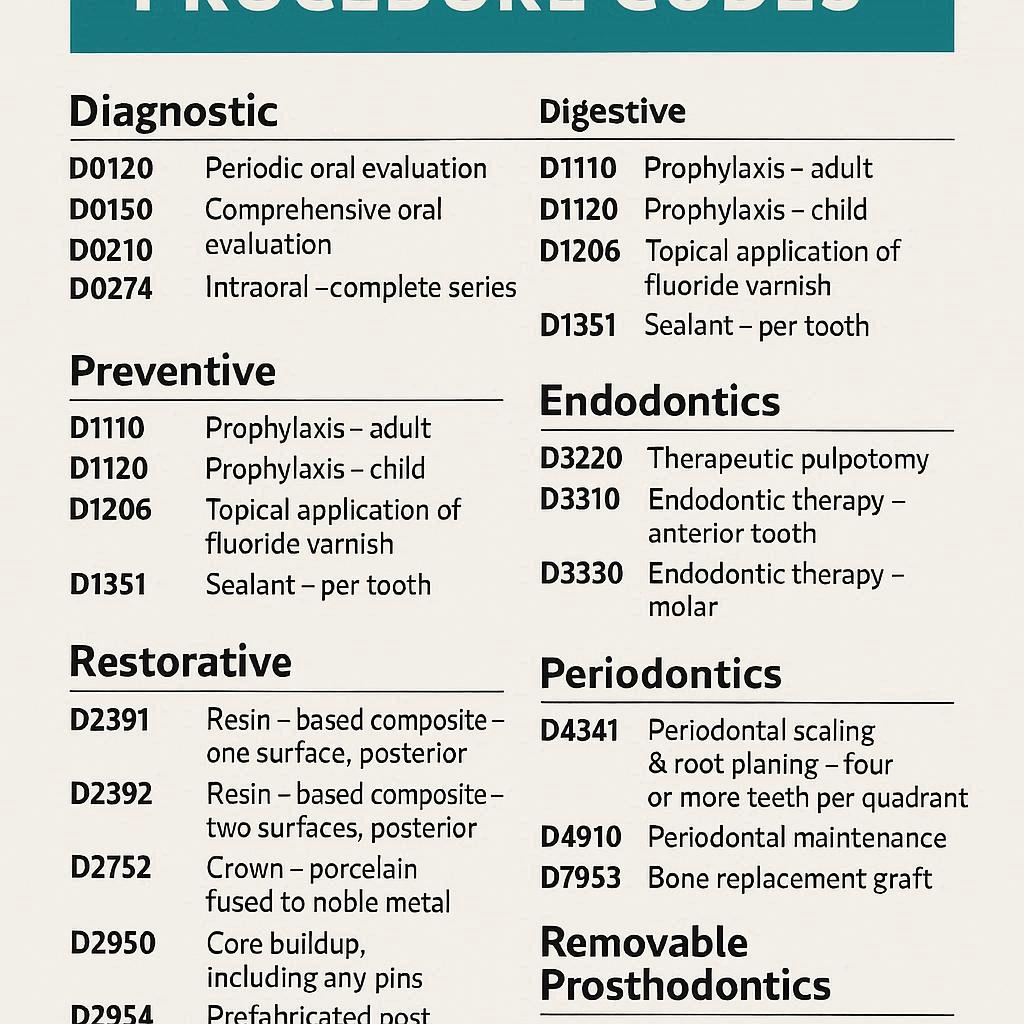
What Exactly Are American Dental Association Procedure Codes?
Think of these codes like a universal language for teeth.
A dentist in Florida and an insurance adjuster in Oregon need to agree on what a “filling” means. Is it a small filling? A large one? On a front tooth or a back tooth? The codes remove all the guesswork.
American Dental Association procedure codes are alphanumeric codes. Each one starts with the letter D (for dental) followed by four numbers. For example:
- D0120 – Periodic oral evaluation (routine check‑up)
- D1110 – Adult prophylaxis (regular cleaning)
- D2140 – Amalgam filling, one surface, permanent tooth
The ADA first published these codes in the 1960s. Back then, the list was short. Today, the CDT manual contains hundreds of codes. They cover everything from a simple x‑ray to full mouth reconstruction under general anesthesia.
Who Uses Them and Why?
| User | Why They Need the Codes |
|---|---|
| Dentists | To document treatment and submit claims |
| Dental hygienists | To record preventive services |
| Insurance companies | To decide what they will pay for |
| Patients (you!) | To understand bills and dispute errors |
| Billing software | To automatically process claims |
| Researchers | To track public dental health trends |
Without these codes, dental billing would be chaos. You would receive a bill that says “work on tooth” with no way to compare prices or file an appeal.
The Organization Behind the Codes
The American Dental Association is the official keeper of the CDT code set. They do not create codes randomly. Every change goes through a strict process:
- Anyone can suggest a new code (dentists, insurers, patients, even equipment makers)
- The ADA’s Code Maintenance Committee reviews the request
- They study if the code is truly needed
- If approved, it appears in the next year’s manual
This process happens every year. That is why you will sometimes hear “new CDT codes for 2026” or similar updates.
Important note: The codes themselves are copyrighted by the ADA. You cannot legally copy and republish the full code set without permission. But you can absolutely learn how to read and use them.
How the Code Structure Works (Easy to Follow)
Each code has five characters. The first is always D. Then four numbers.
D 2 1 4 0
- D = Dental
- 2 = Category (Restorative, meaning fillings and crowns)
- 1 = Subcategory (Direct restorations – amalgam)
- 4 = Specific service (One surface, permanent tooth)
- 0 = Usually a placeholder or variation
But you do not need to memorize the number meanings. What matters is the category structure.
The Main Categories of CDT Codes
The ADA divides all codes into twelve main categories. Here is a simple breakdown:
| Category | Code Range | What It Covers |
|---|---|---|
| I. Diagnostic | D0100 – D0999 | Exams, x‑rays, tests |
| II. Preventive | D1000 – D1999 | Cleanings, fluoride, sealants |
| III. Restorative | D2000 – D2999 | Fillings, inlays, onlays |
| IV. Endodontics | D3000 – D3999 | Root canals |
| V. Periodontics | D4000 – D4999 | Gum treatments |
| VI. Prosthodontics (removable) | D5000 – D5899 | Dentures and partials |
| VII. Maxillofacial prosthetics | D5900 – D5999 | Facial prostheses |
| VIII. Implant services | D6000 – D6199 | Implants and abutments |
| IX. Prosthodontics (fixed) | D6200 – D6999 | Bridges and crowns |
| X. Oral surgery | D7000 – D7999 | Extractions, biopsies |
| XI. Orthodontics | D8000 – D8999 | Braces, aligners |
| XII. Adjunctive general services | D9000 – D9999 | Anesthesia, sedation, emergency visits |
When you see a code like D7210 (extraction, erupted tooth, surgical), you know it falls under Oral Surgery (D7000 range). That alone tells you it is more involved than a simple extraction.
Why Categories Help You
Imagine you receive an insurance denial. The reason says “service not covered under preventive category.” Now you look at the code: D4341 (periodontal scaling – a gum treatment). That is in the Periodontics category, not Preventive. Now you understand why your plan might treat it differently.
Knowing the categories gives you power. You can quickly see what type of service was billed.
The Most Common Codes You Will Actually See
Let us be real. You will probably never need to know code D9630 (other drugs or medicaments, by report). But you will see cleaning, exam, filling, and crown codes all the time.
Here are the top codes you will encounter on real dental statements.
Diagnostic Codes (Exams)
| Code | Full Name | When It Is Used |
|---|---|---|
| D0120 | Periodic oral evaluation | Routine check‑up (usually every 6‑12 months) |
| D0140 | Limited oral evaluation | Problem‑focused visit (toothache or broken tooth) |
| D0150 | Comprehensive oral evaluation | New patient exam or major treatment planning |
| D0180 | Comprehensive periodontal evaluation | Full gum exam with probing |
Preventive Codes (Cleanings & Fluoride)
| Code | Full Name | When It Is Used |
|---|---|---|
| D1110 | Prophylaxis – adult | Regular cleaning for healthy gums |
| D1120 | Prophylaxis – child | Cleaning for patients under 14 |
| D1206 | Topical fluoride varnish | Fluoride painted on teeth (billed per session) |
| D1351 | Sealant – per tooth | Plastic coating on back teeth to prevent cavities |
Restorative Codes (Fillings)
| Code | Material | Surfaces | Tooth Type |
|---|---|---|---|
| D2140 | Amalgam (silver) | One | Permanent |
| D2150 | Amalgam (silver) | Two | Permanent |
| D2160 | Amalgam (silver) | Three | Permanent |
| D2330 | Resin (tooth‑colored) | One – anterior (front tooth) | Permanent |
| D2331 | Resin (tooth‑colored) | Two – anterior | Permanent |
| D2391 | Resin (tooth‑colored) | One – posterior (back tooth) | Permanent |
| D2392 | Resin (tooth‑colored) | Two – posterior | Permanent |
What does “surfaces” mean? A tooth has five surfaces: top (occlusal), front (facial/buccal), back (lingual), and two sides (mesial and distal). A one‑surface filling is small. A three‑surface filling is large.
Crown and Bridge Codes
| Code | Service |
|---|---|
| D2740 | Crown – porcelain/ceramic |
| D2750 | Crown – porcelain fused to high noble metal |
| D2783 | Crown – 3/4 porcelain/ceramic |
| D6240 | Pontic (false tooth in a bridge) – porcelain fused to metal |
Oral Surgery (Extractions)
| Code | Description |
|---|---|
| D7111 | Extraction – primary (baby) tooth |
| D7140 | Extraction – erupted tooth (simple) |
| D7210 | Extraction – erupted tooth, surgical |
| D7220 | Removal of impacted tooth – soft tissue |
| D7230 | Removal of impacted tooth – partial bony |
| D7240 | Removal of impacted tooth – complete bony |
Anesthesia and Sedation
| Code | Service |
|---|---|
| D9222 | Deep sedation/general anesthesia – first 15 minutes |
| D9223 | Deep sedation/general anesthesia – each additional 15 minutes |
| D9239 | Intravenous moderate sedation – first 15 minutes |
| D9243 | Intravenous moderate sedation – each additional 15 minutes |
Important: Many dental plans do not cover sedation unless medically necessary. Always ask before treatment.
How to Read a Dental Claim Like a Detective
Let us walk through a real‑world example. You receive an Explanation of Benefits (EOB) from your insurance. It looks like this:
| Date | Code | Description | Billed | Allowed | Paid | Patient owes |
|---|---|---|---|---|---|---|
| 04/10/26 | D0120 | Periodic exam | $65 | $45 | $45 | $0 |
| 04/10/26 | D1110 | Adult cleaning | $98 | $72 | $72 | $0 |
| 04/10/26 | D2740 | Crown – porcelain | $1,250 | $950 | $665 | $285 |
Here is what each column means:
- Billed = What the dentist charges (retail price)
- Allowed = What your insurance says is “reasonable” for your area
- Paid = What the insurance actually sends to the dentist
- Patient owes = Allowed minus paid (plus any deductible or coinsurance)
Now you can see exactly why you owe $285 for the crown. Your insurance covered 70% of the allowed amount. You pay the other 30%.
Red Flags to Watch For
- Same code billed twice on the same day – Usually a mistake (except for timed services like anesthesia)
- Code for a permanent tooth on a child – Possible upcoding (billing for a more expensive service)
- Code with “by report” (like D9630) – Those require a written explanation. If none is attached, question it.
- Code that does not match the treatment – Example: D1110 (routine cleaning) when you had deep gum cleaning (D4341)
You have the right to ask your dentist to explain any code on your bill. Most billing errors are honest mistakes, not fraud. But you should still catch them.
Why the ADA Updates Codes Every Year
You might think: “If it ain’t broke, don’t fix it.” But dentistry changes fast.
New materials appear. New procedures emerge. New research shows old codes do not accurately describe modern care.
Recent Examples of Code Changes
- 2021: Added codes for teledentistry (virtual consultations)
- 2022: Revised implant codes to separate surgical and prosthetic phases
- 2023: New codes for silver diamine fluoride (a liquid cavity stopper)
- 2024–2026: More precise codes for sleep apnea oral appliances
Every October, the ADA releases the new CDT manual for the following year. Dentists and billing staff must train on the changes. If they use an old code that was deleted, the claim will be rejected.
How to Stay Current (Without Going Crazy)
You do not need to buy the $200+ manual every year. But if you work in a dental office, here is a simple system:
- Subscribe to the ADA’s email updates on CDT codes
- Attend one free webinar each year (many are offered)
- Check your billing software’s annual update notes
- Bookmark the ADA’s official “CDT Code Changes” page
For patients: You do not need to track yearly changes. But if you see a code you do not recognize, a quick online search with the year can help.
The Difference Between ADA Codes, CPT Codes, and ICD‑10 Codes
People often confuse three different code sets. Here is the cheat sheet.
| Code Set | Who Uses It | Example | Purpose |
|---|---|---|---|
| CDT (ADA codes) | Dentists only | D2740 (crown) | What dental procedure was done |
| CPT | All other doctors | 99213 (office visit) | What medical procedure was done |
| ICD‑10 | All healthcare | K02.51 (cavity) | Why the procedure was needed (diagnosis) |
Why This Matters for You
Sometimes a dental procedure should be billed to your medical insurance, not your dental plan. Examples:
- Dental trauma from an accident (ICD‑10 code S03.2 for jaw dislocation)
- Oral surgery for a tumor (ICD‑10 code D16.5 for benign jaw neoplasm)
- Sleep apnea oral appliance (ICD‑10 code G47.33)
In those cases, the dentist uses the same CDT dental code but attaches a medical diagnosis code and sends the claim to your medical plan. This is called medical necessity coding.
Pro tip: If your dentist says “this might be covered by your medical insurance,” ask for a copy of the claim. Make sure they included an ICD‑10 code that matches your condition.
How to Find the Current ADA Procedure Codes (Legally)
You cannot just download the full CDT manual for free. It is copyrighted. But you have several legitimate options.
For Dental Professionals
- Purchase the official CDT manual from the ADA Store (print or digital)
- Subscribe to an online coding tool (many dental billing software include the full code set)
- Check with your state dental association – some offer discounted access
- Attend ADA coding workshops – participants often get temporary access
For Patients
You do not need the full manual. You just need to look up one or two codes at a time. Try these free resources:
- Your dental insurance portal – Many plans include a code lookup tool
- The ADA’s public “Code on Dental Procedures and Nomenclature” page – They publish the category structure and some examples
- Reputable dental school websites – Some universities publish patient guides to common codes
- Ask your dentist’s front desk – They can print a description for any code on your estimate
What to Avoid
- Websites offering “free full CDT download” – Those are often outdated or pirated
- PDFs from unknown sources – They may contain errors or malware
- Old manuals (from 3+ years ago) – Deleted codes can cause claim denials
A safe rule: If a code seems suspicious, ask two different sources. Your dentist’s office and your insurance customer service should agree on the code’s meaning.
Common Billing Mistakes (And How to Catch Them)
Even experienced offices make errors. Here are the most frequent mistakes with ADA procedure codes.
Mistake #1: Wrong Tooth Number
Many codes require a tooth number (1‑32 for permanent teeth) or tooth surface (MO, DO, MOD, etc.). If the dentist forgets to add the tooth number, the claim will be rejected.
Fix: On your claim, look for a box labeled “Tooth” or “Surface.” If it is blank, ask the office to resubmit.
Mistake #2: Code Not Valid for That Date of Service
Each code is valid only for a specific year range. Using a deleted code from 2022 on a 2026 claim guarantees a denial.
Fix: If your claim is rejected for “invalid procedure code,” ask if the office used the current year’s CDT manual.
Mistake #3: Unbundling
Some procedures include smaller steps. For example, a crown (D2740) includes the impression and temporary crown. An honest office will not bill separately for D2999 (temporary crown) on the same day.
Fix: If you see many small codes instead of one comprehensive code, ask: “Is this normally included in the main procedure?”
Mistake #4: Frequency Limits Ignored
Most plans allow only two D0120 (exams) and two D1110 (cleanings) per year. If the office bills a third one, it will be denied.
Fix: Keep a personal log of your service dates. If your plan denies a code for “frequency,” compare with your log.
Mistake #5: Missing a Required Attached Code
Some codes need a “parent” code. For example, D9222 (anesthesia) must be billed with the surgical code it supports.
Fix: If your claim shows sedation but no surgery code, ask for the complete submission.
What to Do If Your Claim Is Denied Because of a Code
Denials are frustrating. But they are often fixable. Follow this step‑by‑step plan.
Step 1: Read the Denial Reason Code
Insurance companies use standard denial codes. Look for phrases like:
- “Procedure code not covered”
- “Invalid code for date of service”
- “Code requires prior authorization”
- “Frequency limitation exceeded”
Step 2: Call Your Dentist’s Billing Coordinator
Do not call the insurance first. The dentist’s office has the original records. Ask them:
- “Was the correct code used?”
- “Is there a more appropriate code for this service?”
- “Can you send a corrected claim?”
Step 3: Request a Coding Review
If the dentist insists the code is correct, ask them to put it in writing. Then call your insurance and ask for a coding review. This is a formal process where a clinical reviewer checks if the code matches the documentation.
Step 4: Appeal in Writing
If the coding review upholds the denial, you can appeal. Your appeal letter must include:
- Patient name and ID number
- Date of service
- The code that was denied
- Why you believe it should be paid
- A copy of the dentist’s notes (ask the office for these)
Send it by certified mail. Keep a copy.
Step 5: Contact Your State Insurance Commissioner
If your appeal is denied and you believe the code is correct, file a complaint. Many states have a consumer assistance program for health and dental insurance.
Important: You usually have only 180 days from the date of service to appeal. Do not wait.
How Dental Offices Choose the Right Code (Behind the Scenes)
If you have ever wondered why two similar fillings have different codes, here is the decision tree a billing specialist uses.
Step 1: Identify the Category
Is it preventive? Restorative? Surgical? The category determines the first digit.
Step 2: Identify the Tooth Type
Primary (baby) or permanent? Anterior (front) or posterior (back)? This changes the code range.
Step 3: Identify the Number of Surfaces or Units
- Filling: 1, 2, 3, or 4+ surfaces
- Cleaning: timed units (usually 1 unit = 15 minutes)
- Anesthesia: first 15 minutes, then additional
Step 4: Identify the Material
Amalgam? Resin? Glass ionomer? Porcelain? Gold?
Step 5: Check for Exclusions
Some codes cannot be used together. For example, you cannot bill a crown (D2740) and a filling (D2391) on the same tooth on the same day.
Example Decision Walkthrough
A patient needs a small cavity filled on the top surface of a lower back tooth. The dentist uses tooth‑colored resin.
- Category: Restorative (D2000 range)
- Tooth type: Permanent posterior
- Surfaces: One (occlusal)
- Material: Resin composite
- Correct code: D2391 (resin – one surface – posterior)
If the same dentist used D2330 (anterior resin), the claim would be rejected. The tooth type is wrong.
The Future of ADA Procedure Codes
Dentistry is changing faster than ever. Here is what experts expect for the next five to ten years.
Artificial Intelligence in Coding
Some dental software can now suggest codes based on clinical notes. The dentist types “MOD resin filling on tooth 19” and the software suggests D2392. This reduces human error.
More Codes for Prevention
As dental insurance shifts toward prevention, expect new codes for:
- Genetic testing for cavity risk
- AI‑assisted decay detection
- At‑home teledentistry monitoring
Codes for New Materials
Bioactive materials, 3D‑printed restorations, and stem cell therapies will need their own codes. Currently, they are often billed under generic codes, which causes confusion.
Integration with Medical Records
Hospitals and dental schools are pushing for a single electronic health record. If that happens, CDT codes might be mapped directly to medical CPT codes for easier billing.
Possible Changes to the Code Structure
The current D**** format is decades old. Some experts want a six‑character system to allow more specificity. Others want to remove material‑based codes (amalgam vs. resin) and focus only on the procedure.
Nothing is decided yet. But if you work in dental billing, pay attention to ADA announcements after 2026.
Frequently Asked Questions (FAQ)
1. Are American Dental Association procedure codes the same as CDT codes?
Yes. The official name is CDT (Current Dental Terminology). They are published by the ADA, so people call them “ADA procedure codes” interchangeably.
2. Can I look up a code online for free?
You can look up individual codes using free tools from some dental schools or insurance portals. You cannot download the full copyrighted manual for free legally.
3. What happens if my dentist uses the wrong code?
The claim will likely be denied. Ask the office to submit a corrected claim with the right code. Most insurance plans allow corrections within 90 to 180 days.
4. Why did my insurance pay less than the code’s fee?
Insurance companies set their own “allowed amounts” for each code. The dentist can charge $500 for D1110, but if the plan’s allowed amount is $72, that is all they will pay or count toward your deductible.
5. How often are the codes updated?
Every year. The new manual is released in October for the following calendar year.
6. Do all dentists use the same codes?
Yes, in the United States. The ADA’s CDT codes are the national standard. Some states require them by law.
7. What is the difference between D1110 and D4341?
D1110 is a regular cleaning (prophylaxis) for healthy gums. D4341 is periodontal scaling and root planing for active gum disease. They are very different procedures.
8. Can a dentist bill a code that is not in the current manual?
No. Using a deleted or outdated code will result in an automatic denial. Some clearinghouses will reject the claim before it even reaches the insurer.
9. What does “by report” mean after a code (e.g., D9630)?
It means the code requires a written attachment explaining the service. Without that attachment, the claim will be denied.
10. Where can I report suspected code fraud?
Contact your insurance company’s fraud hotline or the National Dental Fraud Hotline (run by the National Association of Dental Plans). You can also call your state’s Attorney General office.
Additional Resource
For the most current and official information on American Dental Association procedure codes, visit the ADA’s official CDT page:
🔗 https://www.ada.org/en/publications/cdt
(Open in a new tab – this is the authoritative source for code updates, manual purchases, and coding news.)
Conclusion
American Dental Association procedure codes do not have to be a mystery. They are just a logical system of five‑character labels that help dentists, insurers, and patients speak the same language. Remember the three big ideas from this guide: (1) Each code’s first digit tells you the category of care (exam, cleaning, filling, surgery, etc.). (2) You have the right to ask about any code on your bill. (3) Codes change every year, so always check the current manual for accuracy. With this knowledge, you can read dental claims with confidence and catch errors before they cost you money.