You have a tooth that needs work. One dentist says you need a crown. Another says you just need a large filling. Who is right?
This happens every day. Patients get confused. They worry about unnecessary treatment. They worry about cost. So, they want a second opinion.
But here is the tricky part. How do you bill for that second visit? Does insurance pay for it? What is the correct dental ADA code for second opinion?
Let me clear this up for you.
Most people think there is a special, secret code just for second opinions. There is not. But do not worry. Dentists use existing, standard codes to handle this situation. The process is simpler than you think.
In this guide, I will walk you through everything. You will learn which codes work best, how to avoid surprise bills, and how to talk to your dentist about a second opinion without offending anyone.
Understanding Dental ADA Codes
Before we talk about second opinions, we need a quick refresher on dental codes.
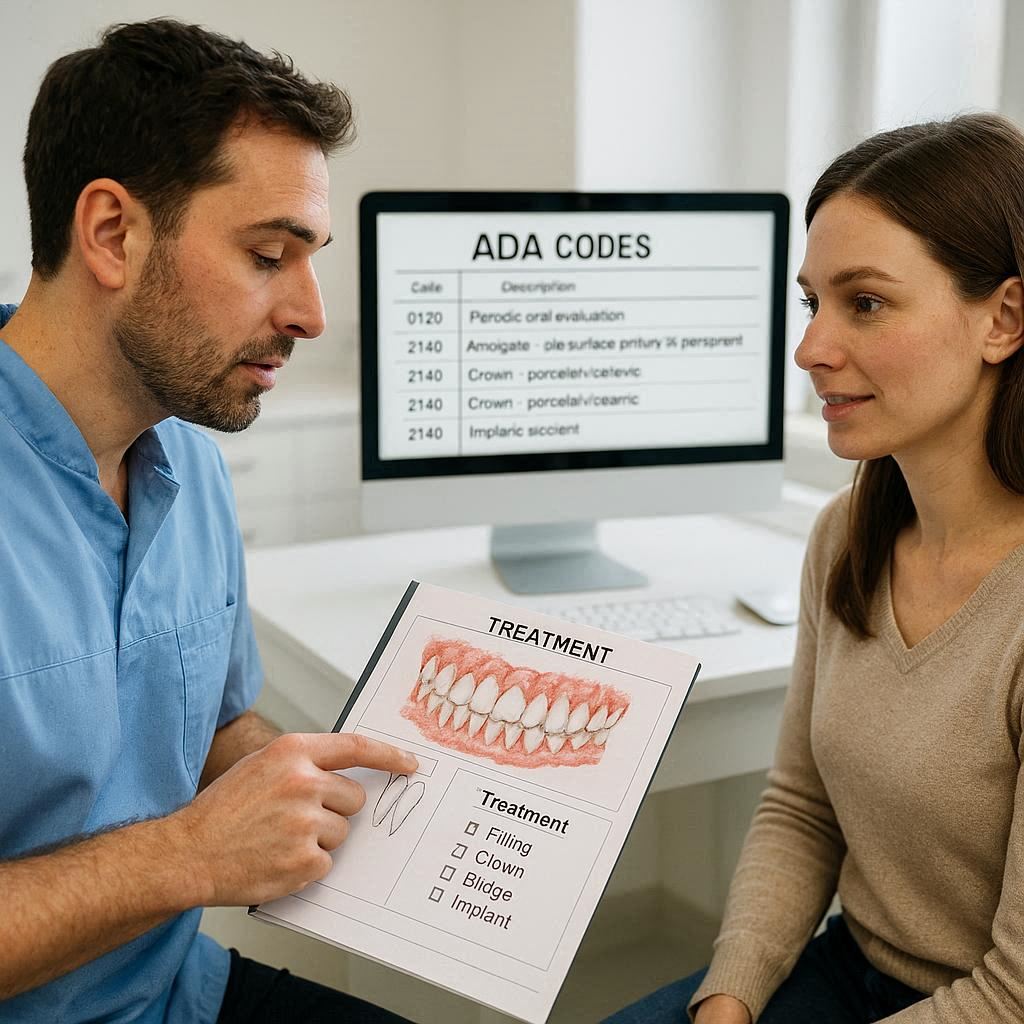
The American Dental Association (ADA) publishes a book called the Current Dental Terminology (CDT). This book lists every code dentists use to bill for their work. Every year, the codes can change a little.
These codes are numbers. Each number means a specific procedure. For example, a routine cleaning is D1110. A full mouth X-ray is D0210.
Insurance companies look at these codes. They decide what to pay based on the code.
Here is what you need to remember: Codes describe what the dentist does, not why the patient is there.
That is why there is no specific code that says “second opinion.” The dentist performs an exam. The code is for the exam itself.
The Difference Between Consultation and Examination
This is where most confusion lives.
Many patients think a second opinion is a “consultation.” Sometimes it is. Sometimes it is not. The difference matters for your wallet.
Let me explain.
A consultation (code D9310) happens when your dentist asks another dentist for advice. Your main dentist stays in charge. The second dentist looks at your case and gives an expert opinion. Then, you return to your original dentist for treatment.
A second opinion is different. You, the patient, decide to see another dentist on your own. You want a fresh set of eyes. You might switch dentists if you like the second one better.
For insurance, this distinction changes everything.
| Aspect | Consultation (D9310) | Second Opinion (Usually D0140 or D0150) |
|---|---|---|
| Who requests it? | Your referring dentist | You, the patient |
| Purpose | Specialist advice for the treating dentist | Independent confirmation for the patient |
| Insurance coverage | Often covered at higher rate | May apply to deductible |
| Typical ADA code | D9310 | D0140 (problem-focused) or D0150 (comprehensive) |
The Correct Dental ADA Code for Second Opinion
Let me give you a direct answer.
There is no single “dental ada code for second opinion” in the CDT manual. I cannot give you a magic number.
But do not close the page. Here is what real dentists use.
For a typical second opinion visit, the dentist will use one of these three codes:
D0140 – Limited Oral Evaluation (Problem Focused)
This is the most common code for a second opinion.
The dentist focuses only on the tooth or area in question. They look at that one problem. They do not examine your whole mouth. They do not update your full medical history unless it relates to the problem.
When to use D0140:
- You have one specific tooth that hurts.
- Another dentist recommended treatment on a single tooth.
- You want a quick check on one area.
What happens during a D0140 visit:
- The dentist looks at the problem tooth.
- They review X-rays (often from the previous dentist).
- They give you an opinion on treatment.
- The visit is usually short (10–15 minutes).
D0150 – Comprehensive Oral Evaluation
This is a bigger code. It covers a full mouth exam.
Some patients prefer this for a second opinion. Why? Because sometimes one problem hides another. A comprehensive exam looks at everything.
When to use D0150:
- You have not seen a dentist in over three years.
- You have complex medical issues (diabetes, heart disease, etc.).
- The previous dentist recommended extensive work (multiple crowns, bridges, implants).
- You are thinking of switching dentists permanently.
What happens during a D0150 visit:
- Full head and neck exam.
- Exam of all teeth and gums.
- Review of complete medical history.
- Oral cancer screening.
- This visit takes 30–45 minutes.
D9310 – Consultation
Remember what I said earlier. This code is for when another dentist requests the visit.
If you call a new dentist and say, “Dr. Smith sent me for a consultation on tooth #19,” then D9310 is correct. But if you call on your own, this code does not apply.
Some offices will still use D9310 for second opinions. This is technically incorrect. But it happens. And insurance sometimes pays it.
Just know that using D9310 without a referral is insurance fraud. Most honest offices will not do this.
Important note for readers: Always ask the front desk which code they will use before you schedule a second opinion. Say, “I am coming for a second opinion on one tooth. Will you bill D0140 or something else?” This prevents surprises.
Does Insurance Cover a Second Opinion?
Yes, most dental insurance plans cover second opinions. But the amount they pay varies widely.
Let me be honest with you. Dental insurance is not like medical insurance. It rarely covers everything. Most plans have a deductible, a yearly maximum, and coinsurance.
Here is a realistic breakdown of what to expect.
What Most PPO Plans Cover
| Code | Typical Coverage | Patient Responsibility |
|---|---|---|
| D0140 | 70%–80% after deductible | $20–$50 (estimated) |
| D0150 | 70%–80% after deductible | $40–$80 (estimated) |
| D9310 | 80%–100% if referred | $0–$30 (estimated) |
These numbers change based on your specific plan. Some plans have a separate “diagnostic” category with higher coverage. Others lump exams into the basic category with lower coverage.
When Insurance Denies a Second Opinion
Sometimes insurance says no. Here is why:
- Timing issues. You had an exam with another dentist two weeks ago. Insurance might say, “We already paid for an exam. You must wait six months.”
- Missing referral. If the code requires a referral and you do not have one, they deny the claim.
- Out-of-network provider. Your plan might only cover in-network exams.
- Yearly maximum reached. You already used up your benefits for the year.
How to Check Your Coverage Before the Visit
Do this before you schedule anything.
- Call the number on the back of your dental insurance card.
- Ask: “What is my coverage for a limited oral evaluation, code D0140, for a second opinion?”
- Ask: “Does this apply to my deductible?”
- Ask: “Do I need a referral from my current dentist?”
- Write down the name of the person you spoke to and the date.
This takes ten minutes. It saves you from a $100 surprise bill.
Step-by-Step: How to Get a Second Opinion Without Billing Mistakes
Let me walk you through the entire process. Follow these steps, and you will avoid most problems.
Step 1: Talk to Your First Dentist First
This sounds awkward. Many patients skip it. Do not skip it.
Call your dentist’s office. Say this: “I respect Dr. Smith’s opinion. But I would feel more comfortable getting a second opinion before moving forward with a crown. Can you send my X-rays to another office?”
Most dentists will say yes. Some will even help you find a specialist. If a dentist gets angry about a second opinion, that is a red flag. Good dentists welcome second opinions.
Step 2: Get Your Records
You need your X-rays and treatment plan. Do not pay for new X-rays if you do not need them.
Under HIPAA, you have a right to your dental records. The previous office can charge a reasonable fee for copies. Usually $15–$25 for X-rays on a CD or USB drive.
Ask for:
- Current X-rays (bitewings and periapicals)
- Any panoramic X-ray (if taken)
- The written treatment plan with codes
- Periodontal charting (if relevant)
Step 3: Choose the Right Second Dentist
Not every dentist handles second opinions well.
Look for:
- A general dentist with good reviews.
- An independent office (not a corporate chain known for upselling).
- Someone who accepts your insurance or has transparent fees.
Avoid offices that refuse to give you an estimate before the exam.
Step 4: Be Clear When You Schedule
When you call the new office, say exactly this:
“I am not a new patient looking for a regular dentist yet. I want a second opinion on one specific tooth. Another dentist recommended a crown on tooth #14. I want your doctor to look and tell me what they think. I have my X-rays from the other office.”
This sets the right expectation. They will likely schedule you for a D0140 visit.
Step 5: Bring Your Records and a List of Questions
Walk into the appointment with:
- Your X-rays (do not email them unless the office requests it first)
- The first dentist’s treatment plan
- A notebook with your questions
Good questions to ask:
- “Do you agree with the diagnosis?”
- “Would you do the same treatment on your own tooth?”
- “What are the risks of waiting six months?”
- “Is there a less expensive option?”
- “How long will this treatment last?”
Step 6: Compare the Two Plans
After the second opinion, sit down with both treatment plans. Look at the codes and fees.
| Item | Dentist #1 | Dentist #2 |
|---|---|---|
| Diagnosis | Fractured tooth #19 | Same |
| Recommended code | D2740 (crown) | D2392 (large composite filling) |
| Fee | $1,200 | $350 |
| Insurance estimate | $600 out of pocket | $150 out of pocket |
If the two opinions match, you can move forward with confidence. If they differ, you may want a third opinion. That is perfectly fine.
Real Examples: Second Opinion Coding Scenarios
Let me show you how this works in real life. These are common situations I have seen hundreds of times.
Scenario 1: Simple Second Opinion on One Tooth
The situation: Maria’s dentist said she needs a root canal on tooth #30. Maria feels no pain. She wants another opinion.
What she does: She calls another dentist. She says, “I have X-rays from my dentist. I just want you to look at tooth #30 and tell me if you see infection.”
What the second dentist does: Looks at the X-ray for 10 minutes. Examines the tooth. Says, “I see a deep cavity but no infection. You might have six months before you need a root canal.”
Code used: D0140 (limited exam)
Insurance pays: 80% after $50 deductible. Maria pays $28.
Scenario 2: Complex Second Opinion with Full Mouth Issues
The situation: James has not seen a dentist in five years. His new dentist says he needs four crowns, two fillings, and a deep cleaning. Total cost: $8,000. James is shocked. He wants a complete second opinion.
What he does: He finds another dentist. He says, “I need a full exam. I want to see if all this work is really necessary.”
What the second dentist does: Full mouth exam. New set of X-rays (because the old ones were outdated). Periodontal probing. Takes 45 minutes.
Code used: D0150 (comprehensive exam)
Insurance pays: 80% after deductible. James pays $65.
Scenario 3: Dentist-to-Dentist Consultation
The situation: Dr. Lee is a general dentist. He sees a strange lesion on a patient’s tongue. He is worried but not sure. He calls an oral surgeon and says, “Can you see my patient for a consultation?”
What the patient does: Shows up at the oral surgeon’s office. The oral surgeon already has the X-rays and history from Dr. Lee.
What the oral surgeon does: Examines the lesion. Gives an opinion. Sends a report back to Dr. Lee.
Code used: D9310 (consultation)
Insurance pays: 100% with no deductible. Patient pays $0.
Notice the difference? In scenario 3, the patient did not request the second opinion. The dentist did. That is why the consultation code applies.
What to Do If a Dentist Refuses to Give a Second Opinion
This happens. Some dentists take it personally.
Here is the truth: You do not need permission. You are the customer. You have every right to seek another professional opinion.
If a dentist refuses to release your X-rays, that is a violation of HIPAA and dental board regulations. You can file a complaint with your state’s dental board.
Polite script to use:
“I appreciate your expertise. I am not questioning your skills. I simply want to be fully informed before I spend this much money. Please send my X-rays to [new dentist’s email]. Thank you for understanding.”
If they still refuse, walk away. Find a new dentist permanently.
How Much Does a Second Opinion Cost Without Insurance?
Not everyone has dental insurance. I understand.
Here are typical cash prices for second opinions in the US (2026 estimates):
| Service | Typical Cash Price |
|---|---|
| Limited exam (D0140) with existing X-rays | $50 – $90 |
| Limited exam with new X-rays (one or two films) | $75 – $125 |
| Comprehensive exam (D0150) with full X-rays | $150 – $250 |
| Consultation (D9310) with referral | $75 – $150 |
These prices vary by region. A second opinion in Manhattan costs more than one in rural Iowa. Call three offices and ask for their “cash fee for a limited exam.”
Some dental schools offer second opinions for very low fees. A dental school might charge $30 for a comprehensive exam. The trade-off is time. You may wait longer.
Frequently Asked Questions (FAQ)
Q1: Is there a specific ADA code just for second opinions?
No. The ADA does not have a dedicated “second opinion” code. Dentists use existing evaluation codes (D0140, D0150, or D9310) depending on the situation.
Q2: Will my insurance definitely pay for a second opinion?
Most PPO plans cover second opinions under diagnostic services. But you must check your specific plan. Some HMO and discount plans do not cover second opinions at all.
Q3: Can I see a specialist for a second opinion without a referral?
Yes, for a second opinion. You do not need a referral to see a specialist on your own. However, your insurance may not pay as much without a referral from your primary dentist.
Q4: What if the second dentist finds something completely different?
That is valuable information. It means the diagnosis is unclear. You may want a third opinion from a different specialist. Sometimes dentists honestly disagree. That does not mean one is bad.
Q5: Should I tell the second dentist what the first dentist said?
Yes. Be honest. Say, “Dr. Jones recommended a crown. I want to see if you agree.” This helps the second dentist focus on the right area. Do not hide information.
Q6: Can I get a second opinion over the phone or by email?
No. A legitimate second opinion requires a physical exam and X-ray review. A dentist cannot diagnose properly without seeing you. Avoid any service that offers a diagnosis without an exam.
Q7: What code do I use for a second opinion on orthodontic treatment?
Orthodontists use different codes. The most common is D8090 for comprehensive orthodontic exam. But the same principle applies: there is no specific “second opinion” code for braces.
Q8: How many second opinions can I get?
As many as you want. Insurance may limit how many exams they pay for in a year. But you can always pay cash for additional opinions. Three is often enough to see a clear pattern.
Additional Resources
For a deeper dive into dental codes and patient rights, visit the American Dental Association’s patient education page. They offer free guides on understanding treatment plans and seeking second opinions.
Link: https://www.ada.org/resources/practice/dental-codes (opens in new tab)
You can also search for your state’s dental board website. They provide complaint forms and lists of licensed dentists in your area.
A Note on Ethical Second Opinions
Let me say something important.
Do not abuse the second opinion process. Some patients go to five different dentists, wasting everyone’s time. They never commit to treatment. That is not fair to the dentists who work on commission or own small businesses.
One or two second opinions is reasonable. Five is not.
Also, do not use a second opinion just to get free advice before traveling abroad for cheap dental work. That disrespects the local dentist who spent years learning their craft.
Be honest. Be respectful. Most dentists genuinely want to help.
Conclusion
You now know everything about the dental ADA code for second opinion. There is no single magic code. Instead, you will see D0140 for a limited problem-focused exam, D0150 for a full comprehensive exam, or D9310 when another dentist requests the visit.
Always check your insurance coverage before scheduling. Bring your X-rays and ask clear questions. A good second opinion gives you peace of mind and may save you from unnecessary treatment. You deserve to feel confident about your dental care.
Disclaimer: This article is for informational purposes only and does not constitute medical, legal, or financial advice. Dental insurance policies and ADA codes vary by provider and region. Always consult your dentist and insurance carrier directly.
Author: Jennifer Hayes, Dental Health & Billing Specialist
Date: APRIL 15, 2026