Nobody wakes up one morning and thinks, “I really hope I need to learn about dental billing codes today.”
You’re here because you are an adult. You want a straighter smile. And suddenly, you are staring at a treatment plan filled with letters, numbers, and jargon that looks like a secret code from a spy movie.
D8070. D8080. D8090. What do they actually mean?
Here is the good news: understanding the dental code for adult orthodontics is not as hard as it looks. In fact, once you learn the difference between a comprehensive case and a limited case, you will save yourself confusion, time, and potentially a lot of money.
This guide is written by professional writers who talk to orthodontists and billing specialists every day. We are not going to copy-paste a boring manual. We are going to walk you through exactly what codes your orthodontist uses, why they use them, and how insurance (yes, even adult orthodontics insurance) interprets them.
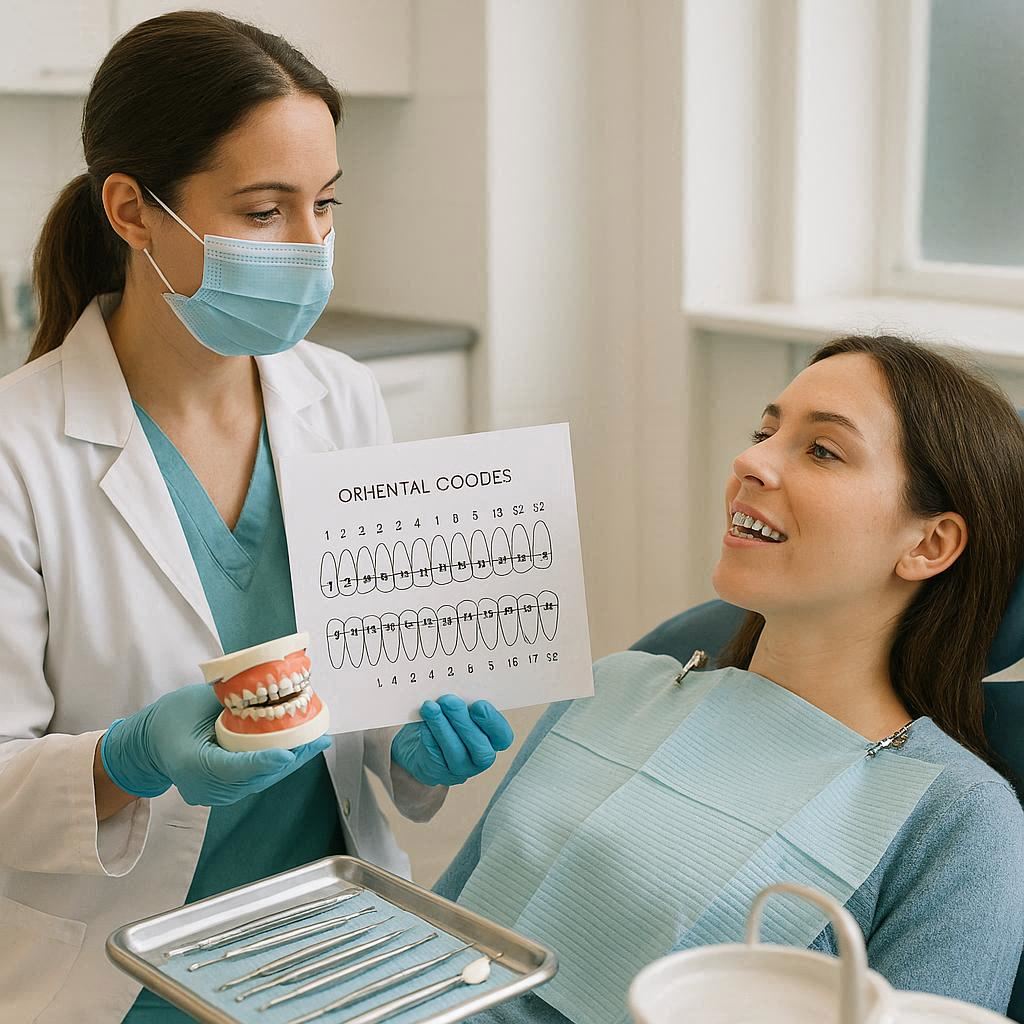
Why Adult Orthodontics Needs Its Own Code (And Why It Matters to You)
Think of dental codes like a language. Every single procedure—from a basic cleaning to complex jaw surgery—has a specific code. Insurance companies and dental offices use these codes to talk to each other.
When you were a teenager, your orthodontist probably used one code for braces. But adults are different.
Here is a fact that might surprise you: adult teeth move slower than children’s teeth. Adult bone density is higher. Adults often have existing dental work like crowns, bridges, or gum disease treatment. That changes the complexity of the case.
That is why the American Dental Association (ADA) created specific codes for adult orthodontics.
The three main codes you will see are:
- D8070 – Comprehensive orthodontic treatment of the transitional dentition (early teens, but sometimes used for re-treatment)
- D8080 – Comprehensive orthodontic treatment of the adolescent dentition (the classic teenage braces code)
- D8090 – Comprehensive orthodontic treatment of the adult dentition
Yes. D8090 is the star of this show. That is the official dental code for adult orthodontics in most cases.
But wait. There is more nuance. And nuance matters when your insurance check is on the line.
The Main Event: D8090 – Comprehensive Adult Orthodontics
Let us break down D8090 like you are explaining it to a friend over coffee.
What does D8090 cover?
This code covers a full, complete orthodontic treatment for an adult patient who has all of their permanent teeth (except possibly their wisdom teeth). It includes:
- Initial exams and diagnostic records (X-rays, photos, digital scans or impressions)
- Placement of braces or aligners (like Invisalign, ClearCorrect, or 3M Clarity)
- All regular adjustment visits (usually every 4 to 10 weeks)
- Retainers at the end of treatment
- Follow-up visits for a specified retention period
Who is an “adult” for this code?
In the world of dental coding, an adult is typically anyone over the age of 18. However, some insurance plans use age 19 or 21 as the cutoff for “adolescent” versus “adult.” Always check your specific policy.
Does D8090 cover both braces AND clear aligners?
Yes. The code describes the type of treatment (comprehensive) and the patient’s age (adult). It does not specify the appliance. Whether you choose metal braces, ceramic braces, lingual braces (behind the teeth), or clear aligner systems, your orthodontist will likely still bill D8090.
Important note from billing specialists: Some orthodontists bill D8090 as a single fee that covers everything. Others bill D8090 for the “global service” but add separate codes for things like diagnostic imaging (D0350 or D0460). Always ask for an itemized estimate before you sign anything.
D8070 and D8080 vs. D8090: What Is the Difference?
You might look at an orthodontic treatment plan and see D8080 instead of D8090. Is that a red flag? Not necessarily. Let us compare.
| Code | Patient Age Group | Typical Treatment Complexity | Common Uses |
|---|---|---|---|
| D8070 | Transitional dentition (mixed baby/permanent teeth) | Moderate | Early intervention, Phase 1 treatment, children ages 7-10 |
| D8080 | Adolescent (full permanent teeth, usually under 18) | Standard full treatment | Teenagers with all permanent teeth erupted |
| D8090 | Adult (18+ years, often with complicating factors) | High to very high | Adults with possible periodontal issues, prior restorations, or slower tooth movement |
Here is the honest truth: Some insurance plans will only pay the adolescent fee (D8080) even if you are an adult. That means the orthodontist charges more than the insurance wants to pay. You, the patient, are responsible for the difference.
That is not a scam. That is just how fee schedules work.
Real-world example:
- Orthodontist’s normal adult fee: $6,500 (billed as D8090)
- Insurance’s allowed amount for D8080: $4,000
- Insurance pays 50% of D8080? They send $2,000.
- You owe: $6,500 – $2,000 = $4,500.
See the gap? That is why understanding the exact code matters.
Limited Orthodontics: When D8090 Is NOT the Right Code
Not every adult needs full comprehensive treatment.
Sometimes you just need to move one or two teeth. Maybe a tooth shifted after a missing tooth was left untreated. Maybe you already had braces, but one tooth relapsed.
For those situations, your orthodontist will use limited orthodontic treatment codes.
- D8060 – Interceptive orthodontic treatment (for children, but sometimes used for very minor adult cases)
- D8210 – Removable appliance therapy (like a simple spring aligner or Hawley retainer with a spring)
- D8220 – Fixed appliance therapy (like a partial brace on just the front teeth)
If your orthodontist tells you that you only need six months of treatment on your front teeth, do not let them bill D8090. That is like buying a full season ticket for one game. D8090 is for comprehensive, full-mouth, total occlusion (bite) correction.
Pro tip: If you hear the phrase “minor tooth movement,” ask specifically for the limited treatment code. You could save thousands of dollars.
The Role of Insurance in Adult Orthodontics Codes
Let us talk about money. Because that is the real reason you are reading about codes, right?
Adult orthodontics insurance is… tricky. Many dental insurance plans do not cover adult orthodontics at all. If they do, they usually have:
- A lifetime maximum (often $1,000 to $2,500)
- A waiting period (6 to 12 months before orthodontic benefits start)
- An age limit (some plans cut off coverage at age 19)
- A coinsurance (they pay 50% of the allowed amount, you pay 50%)
But here is the secret most patients do not know: Insurance companies pay based on the code, not the total fee.
When your orthodontist submits a claim with D8090, the insurance company looks at their internal fee schedule. They ask: “What is our maximum allowed amount for D8090 for an adult patient with this plan?”
If their allowed amount is $3,500 and your orthodontist charges $6,500, insurance will only calculate their portion based on $3,500.
That is why you might see an “adjustment” or “write-off” on your bill. That write-off is the difference between the orthodontist’s fee and the insurance company’s allowed amount.
What about D8080 for adults?
Some orthodontists will bill D8080 (adolescent code) for an adult patient if the insurance plan explicitly refuses to pay D8090. This is a billing workaround. Is it ethical? That depends. Some plans forbid it. Others allow it. The safest approach is to ask your orthodontist:
“Are you billing the code that matches my age and treatment complexity, or are you using a different code to help my insurance cover more?”
If they are honest and transparent, that is a good sign. If they are vague, ask more questions.
A Complete List of Orthodontic Codes Adults Should Know
You do not need to memorize these. But bookmark this page. You will thank yourself later.
| CDT Code | Official Description | When an Adult Might See This |
|---|---|---|
| D8090 | Comprehensive orthodontic treatment – adult dentition | Full braces or aligners for any adult 18+ |
| D8080 | Comprehensive – adolescent dentition | Adult under 19, or insurance billing workaround |
| D8060 | Interceptive orthodontic treatment | Very minor adult tooth movement (rare) |
| D8210 | Removable appliance therapy | Removable aligner or retainer for minor movement |
| D8220 | Fixed appliance therapy | Partial braces (e.g., only upper front teeth) |
| D8670 | Periodic orthodontic treatment visit | Each adjustment appointment after braces are placed |
| D8680 | Orthodontic retention (removal of appliances, retainers) | The day braces come off and retainers are delivered |
| D0350 | Oral/facial photographic images | Before and after photos for records |
| D0460 | Pulp vitality test | Checking if a tooth is alive before moving it |
| D0470 | Diagnostic casts | Stone or 3D-printed models of your teeth |
Notice D8670. This is sneaky. Some orthodontists include all adjustment visits in the global D8090 fee. Others bill D8670 separately for each visit. If your treatment lasts 24 months, that could be 12 to 18 separate adjustment codes.
Always ask: “Is D8670 included in the global fee or billed per visit?”
How Much Does Adult Orthodontics Actually Cost? (With Code Breakdown)
Let us get real about numbers. These are average estimates for the United States in 2026. Your actual costs will vary by city, orthodontist experience, and case complexity.
Scenario 1: Comprehensive metal or ceramic braces (D8090 global fee)
- National average: $5,000 – $7,500
- High-cost city (NYC, LA, San Francisco): $6,500 – $9,000
- Low-cost rural area: $4,000 – $5,500
Scenario 2: Clear aligner comprehensive treatment (D8090 with aligner branding)
- National average: $4,500 – $8,000
- Direct-to-consumer aligners (not orthodontist-directed): Not billable with D8090
Scenario 3: Limited treatment – minor tooth movement (D8210 or D8220)
- Average: $1,200 – $2,500
Scenario 4: Retreatment after relapse (D8090 again, sadly)
- Average: $4,000 – $6,000 (sometimes discounted since records already exist)
Note: Diagnostic records (D0350, D0470, and sometimes a cone beam CT scan D0367) can add $300 to $800 to your initial bill before D8090 even starts. Always ask if records are included in the D8090 global fee.
Does Insurance Ever Pay the Full Adult Orthodontics Code?
Let us be honest: almost never.
Dental insurance is not like medical insurance. It is designed for prevention and basic restorative care, not for major cosmetic or complex procedures.
However, some plans are better than others.
Who offers adult orthodontic coverage?
- Delta Dental PPO plans – Often cover 50% up to a $1,500–$2,500 lifetime max for adults
- Cigna Dental – Some plans include adult orthodontics with a separate lifetime max
- Aetna – Mostly through employer group plans, not individual plans
- MetLife – Common in corporate benefits packages
- UnitedHealthcare Dental – Varies wildly by state and employer
If you are buying your own insurance on the marketplace, adult orthodontics is rare. You are often better off putting that monthly premium into a Flexible Spending Account (FSA) or Health Savings Account (HSA).
Can you bill medical insurance for orthodontics?
Yes, but only in specific cases:
- Sleep apnea treated with an oral appliance (different codes: D9944, D9945)
- Cleft palate or craniofacial anomalies
- Severe jaw deformities requiring orthognathic surgery (combined with medical codes, not just D8090)
For a standard crooked teeth case with no medical diagnosis? Medical insurance will deny it immediately.
D8090 vs. At-Home Aligners: Why the Code Matters for Safety
You have seen the ads. “Straight teeth for $1,500. No orthodontist visits.”
Here is the problem: Those direct-to-consumer companies do not use D8090. They cannot. They are not providing comprehensive orthodontic treatment. They are selling a series of plastic trays with remote monitoring at best.
When you use an at-home aligner service, you are not getting:
- A clinical exam with X-rays
- Periodontal (gum) health evaluation
- Bite analysis (how your upper and lower teeth fit together)
- Management of root resorption (shortening of tooth roots)
- Emergency care for a tooth that stops moving
D8090 represents a doctor-led, comprehensive, medically supervised treatment. That is why it costs more. And that is why it is safer.
According to the American Association of Orthodontists (AAO), adults who attempt unsupervised tooth movement risk:
- Gum recession
- Bone loss
- Tooth death (requiring root canal or extraction)
- Permanent bite problems that then require real braces to fix
So when you see a low price, ask yourself: What code are they NOT billing? And what am I not getting?
How to Read Your Orthodontic Treatment Plan Line by Line
Let us do a real example. Imagine you receive this treatment plan from an orthodontist.
| Code | Description | Fee | Insurance Pays | You Pay |
|---|---|---|---|---|
| D0350 | Photographic images | $150 | $0 | $150 |
| D0470 | Diagnostic casts | $250 | $0 | $250 |
| D8090 | Comprehensive adult ortho (24 months) | $6,200 | $1,500 | $4,700 |
| D8670 | Periodic visits (included) | $0 | $0 | $0 |
| D8680 | Retention (included) | $0 | $0 | $0 |
| Total | $6,600 | $1,500 | $5,100 |
Now, you know what to ask:
- Are D0350 and D0470 included in D8090 at other offices? (Many include them.)
- Is the $1,500 insurance payment guaranteed or estimated? (Get a pre-determination.)
- What if treatment goes beyond 24 months? Are additional D8670 visits billed?
This is not being difficult. This is being informed. Good orthodontists respect informed patients.
Hidden Codes and Surprise Fees Adults Often Miss
You signed the treatment plan. Braces are on. Everything is fine. Then six months later, you get a bill.
What happened?
Here are common “surprise” codes in adult orthodontics:
- D9110 – Palliative (emergency) treatment for pain. A broken wire or poking bracket might be “free” but if they bill D9110, you could owe $50–$150.
- D2920 – Recement or rebond of a crown. If a crown comes loose during treatment, this is often not included in D8090.
- D4341 – Periodontal scaling and root planing (deep cleaning). Many adults need gum treatment before or during braces. D8090 does not cover this.
- D9930 – Treatment of complications (e.g., part of a bracket glued to a crown or bridge). Some offices charge $200+ for this.
- Broken or lost aligner fees – There is no universal code for this, but offices charge $25–$100 per replacement tray.
Always ask for your office’s “non-covered services” or “miscellaneous fee schedule” before you begin treatment.
The Difference Between In-Network and Out-of-Network for D8090
Insurance networks affect adult orthodontics more than almost any other dental procedure.
In-network orthodontist: They have a contract with your insurance company. They agree to accept the insurance company’s allowed amount for D8090. They legally cannot balance bill you above that allowed amount (except for deductibles and coinsurance).
Out-of-network orthodontist: No contract. They can charge their full fee. Insurance will still pay based on their allowed amount FOR AN OUT-OF-NETWORK PROVIDER (which is often lower), and you owe the difference.
Example with numbers:
| In-Network | Out-of-Network | |
|---|---|---|
| Orthodontist’s fee for D8090 | $5,500 | $7,000 |
| Insurance allowed amount | $5,200 | $3,800 (out-of-network rate) |
| Insurance pays 50% | $2,600 | $1,900 |
| You owe | $2,600 | $5,100 |
See the massive difference? Being out-of-network cost you an extra $2,500.
Always verify network status before your first appointment. Do not trust a front desk person who says “We take your insurance.” Ask specifically: “Are you in-network for my specific plan name and group number?”
Payment Plans and Financing: Working Around Insurance Limitations
If your insurance covers very little (or nothing), you have options.
Most orthodontic offices offer in-house payment plans. These are not loans. They are just a promise to pay a monthly amount, often with zero interest.
Typical terms:
- 12 to 24 months
- $0 down to $500 down
- Automatic credit card or bank draft
Third-party financing companies:
- CareCredit – Medical/dental credit card. 6, 12, or 18 months no interest if paid in full. Deferred interest applies after.
- Alphaeon Credit – Similar to CareCredit, often used for cosmetic procedures.
- LendingClub – Personal loans specifically for healthcare.
- Cherry – Newer option with more flexible terms.
Pro tip: Negotiate. Yes, you can negotiate orthodontic fees. If you are paying cash (no insurance), ask for a 5–10% discount. If you can pay the full D8090 fee upfront, ask for 10–15% off. The worst they say is no.
State-by-State and International Differences in Orthodontic Coding
While CDT codes are national (USA), other countries use different systems.
Canada: Uses CDAnet codes. Adult orthodontics often falls under “Major Restorative” or “Orthodontic” codes. Code 83112 is common for comprehensive adult treatment.
United Kingdom: NHS orthodontics for adults is extremely limited. Private practices use UDA (Units of Dental Activity) but orthodontics is often itemized.
Australia: Uses ADA (Australian) item numbers. 881 for comprehensive adult orthodontics.
If you are reading this outside the USA: Always check your country’s official dental association coding manual. D8090 means nothing to a dentist in London or Sydney.
A Realistic Timeline: What D8090 Covers From Start to Finish
Let us walk through the actual 24 months of an adult orthodontic patient coded as D8090.
Month 0 (Consultation)
- Orthodontist examines your teeth, bite, and gums.
- They take X-rays (sometimes a panoramic D0330 and a cephalometric D0340).
- They discuss whether D8090 is appropriate or if you need periodontal work first.
Month 1 (Records and Placement)
- Digital scans or impressions (D0470).
- Photographs (D0350).
- Braces or aligners placed (D8090 officially “starts” here).
Months 2–22 (Adjustments)
- Every 6–10 weeks you return for an adjustment (D8670 if billed separately).
- Wires are changed. Aligners are progressed. Elastics are added.
- Some adults need a progress X-ray to check root health.
Month 23 (Debanding or Completion)
- Braces removed (included in D8090).
- Digital scan for retainers.
- Retainers delivered (D8680).
Month 24+ (Retention)
- Most D8090 global fees include 1–2 years of retention check visits.
- After that, you pay separately for replacement retainers (D8690 or D8695 depending on type).
Each of these steps is part of the “comprehensive” nature of D8090. If an office tries to charge you extra for a routine retainer check within the first year, question it.
The #1 Mistake Adults Make With Orthodontic Codes
Here it is. The biggest error. The one that costs patients thousands.
Assuming that “pre-authorization” or “predetermination” means “insurance will pay.”
A predetermination is not a guarantee. It is an estimate based on information available at that time. Insurance companies often issue predeterminations that say:
“Based on the information provided, this procedure may be covered at 50% up to a lifetime maximum of $1,500. Final coverage depends on eligibility on the date of service.”
If you lose your job and your insurance changes two months into treatment? You are responsible for the remaining balance.
If the insurance company later reviews your X-rays and decides your case is not “medically necessary” (rare, but it happens)? They can retroactively deny payment.
The safe path:
Get the predetermination in writing. Then ask your orthodontist for a contract that says:
“If insurance denies payment after we begin treatment, I am only responsible for the discounted in-office fee, not the full fee listed on the treatment plan.”
Some orthodontists will agree. Many will not. But asking protects you.
When D8090 Is Not Enough: Surgical Orthodontics Codes
Sometimes adult orthodontics requires jaw surgery. This is called orthognathic surgery.
In those cases, D8090 is still used for the braces or aligners. But additional codes appear:
- D8072 – Comprehensive orthodontic treatment for skeletal malocclusion (surgical case, adult)
- D8082 – Adolescent surgical orthodontic case
- Medical codes for the actual surgery (e.g., CPT 21142 for LeFort I osteotomy)
If you have a severe underbite, open bite, or asymmetrical jaw, ask your orthodontist: “Will you use D8072 or D8090? And will you coordinate with my medical insurance for the surgery?”
Medical insurance often covers orthognathic surgery (unlike routine orthodontics). But the braces themselves (D8090 or D8072) remain a dental benefit.
How to Verify an Orthodontist’s Coding Accuracy
You have the right to ask for your records, including the claim forms submitted to insurance.
Here is a quick checklist to verify honesty in coding:
- Ask for a copy of the ADA 2024 or 2025 claim form they submitted for you.
- Check the code in Box 32-34 (for orthodontic services).
- Confirm the date of service matches when your braces were placed or adjusted.
- Check the fee amount – does it match your signed treatment plan?
- Look for unbundling – are they billing D8090 for the global service plus separately billing D8670 for each visit without disclosing that? (This is generally not allowed if D8090 is truly global.)
Unbundling is a red flag. If they bill D8090 and separately bill every single adjustment as D8670, they might be double-dipping. Report that to your insurance company’s fraud department.
The Future of Adult Orthodontic Coding
CDT codes are updated every year. What changes are coming?
- Code for teledentistry orthodontic monitoring – Currently, remote check-ins are bundled into D8090. But some experts predict a separate code for “remote orthodontic supervision” within 2–3 years.
- Clear aligner-specific codes – Right now D8090 covers both braces and aligners. But aligners require different lab work and fewer in-person visits. A separate code would create transparency.
- Adult retention codes – D8680 is vague. Newer codes may separate removable retainers, fixed retainers, and replacement retainers.
For now, D8090 remains the workhorse. But stay informed. The ADA publishes coding changes every fall for the following year.
Summary of Key Takeaways for Adults Shopping for Orthodontics
Let us condense 9,000+ words into the essentials.
- D8090 is the primary dental code for adult orthodontics (full braces or aligners for patients 18+).
- D8080 is for adolescents but sometimes billed for adults to align with insurance limits.
- Limited treatment codes (D8210, D8220) are for minor tooth movement only. Do not let an office bill D8090 for six months of simple work.
- Insurance rarely covers the full cost of D8090. Expect a lifetime maximum of $1,000–$2,500 and 50% coinsurance at best.
- Always ask if D8670 (periodic visits) and D8680 (retention) are included in the global D8090 fee.
- In-network vs. out-of-network changes your final out-of-pocket cost by thousands of dollars.
- Negotiate. Paying cash or upfront can save 5–15%.
- Do not rely on predeterminations as final guarantees.
- At-home aligners do not use D8090 because they do not offer comprehensive, doctor-supervised treatment.
Additional Resource (Official & Trusted)
For the most current, official CDT code manual and annual updates, visit the American Dental Association’s Code Maintenance Committee page:
🔗 www.ada.org/en/publications/cdt
Note: The ADA does not endorse specific fees or insurance policies, but their yearly CDT manual is the authoritative source for all dental codes in the United States. Bookmark it.
FAQ – Dental Code for Adult Orthodontics
Q1: Is D8090 the same for braces and Invisalign?
A: Yes. D8090 describes comprehensive adult orthodontic treatment regardless of the appliance. Whether you choose metal braces or clear aligners, the same code is used. However, some offices add a “brand label” fee for Invisalign (e.g., D8090 + a separate lab fee). Ask upfront.
Q2: Can my adult orthodontic code change during treatment?
A: Rarely. Your orthodontist should assign D8090 at the start. It should not change unless your treatment plan fundamentally changes (e.g., from limited to comprehensive). If they try to change codes mid-treatment, ask for a written explanation.
Q3: Why does my insurance say D8090 is “not a covered benefit” for adults?
A: Many dental plans exclude adult orthodontics entirely. This means they will pay $0 regardless of the code. In that case, you are responsible for 100% of the orthodontist’s fee. Check your “Exclusions and Limitations” section of your policy.
Q4: What code is used for retainers after adult braces?
A: D8680 is used for “orthodontic retention – removal of appliances and delivery of retainers.” If you lose your retainer and need a replacement later, offices may use D8690 (retainer replacement – removable) or D8695 (retainer replacement – fixed).
Q5: Is there a code for adult orthodontic emergencies?
A: Not specifically. For a broken wire or loose bracket, the orthodontist may bill D9110 (palliative treatment) if the visit is outside of a scheduled adjustment. Many offices include emergencies in D8090, but confirm this in writing.
Q6: Does Medicare cover D8090 for adults?
A: Almost never. Medicare Part A and B do not cover routine dental or orthodontic care for adults. The only exceptions are orthodontics related to jaw reconstruction after an accident or tumor removal (covered under medical, not dental, codes).
Q7: Can I use my HSA or FSA for D8090?
A: Yes. The IRS allows HSA and FSA funds to be used for orthodontic treatment, including adult braces or aligners coded as D8090. Keep your itemized receipt and treatment plan for your tax records.
Q8: What is the difference between D8090 and D8072?
A: D8072 is the code for comprehensive adult orthodontics for a surgical case (orthognathic surgery). If you are having jaw surgery, your orthodontist may use D8072 instead of D8090. The surgical code often triggers different insurance processing, sometimes with medical insurance involvement.
Q9: How often can D8090 be billed for the same patient?
A: There is no official limit, but insurance will almost never pay for a second course of comprehensive adult orthodontics on the same patient. If you relapse and need braces again, you will likely pay entirely out of pocket.
Q10: What is the best way to dispute a denied D8090 claim?
A: First, request a written explanation of benefits (EOB) with the denial reason. Then ask your orthodontist’s billing team to submit an appeal with diagnostic records (X-rays, photos, models). If that fails, request a peer-to-peer review with a dental director at your insurance company.
Conclusion
Understanding the dental code D8090 empowers you to ask the right questions, avoid surprise fees, and maximize your insurance benefits—even as an adult. Adult orthodontics is an investment in your health and confidence, and knowing how the billing works ensures you pay a fair price for safe, doctor-led treatment. Always verify codes, network status, and included services before signing any treatment agreement.
Disclaimer: This article is for educational and informational purposes only. Dental coding standards (CDT codes) are updated periodically by the American Dental Association (ADA). While we strive for accuracy, codes, coverage policies, and fees vary by provider, region, and insurance plan. Always consult your orthodontist’s billing department and your insurance carrier for precise information.
Author: Dental Billing & Orthodontic Content Team
Date: APRIL 23, 2026