You just got your braces off. You love your new smile. Now, your orthodontist is talking about a “bonded lingual retainer.” You hear technical terms. You see numbers on a treatment plan. It feels confusing.
Let me help you clear this up.
If you are looking for the exact dental code for bonded lingual retainer, you have come to the right place. This is not just a dry list of codes. We are going to walk through what these codes mean, how they affect your wallet, and why your dentist chooses one number over another.
By the end of this guide, you will feel confident reading your dental claim form. You will know what questions to ask. And you will avoid surprise bills.
Let us start with the simple answer, then build from there.
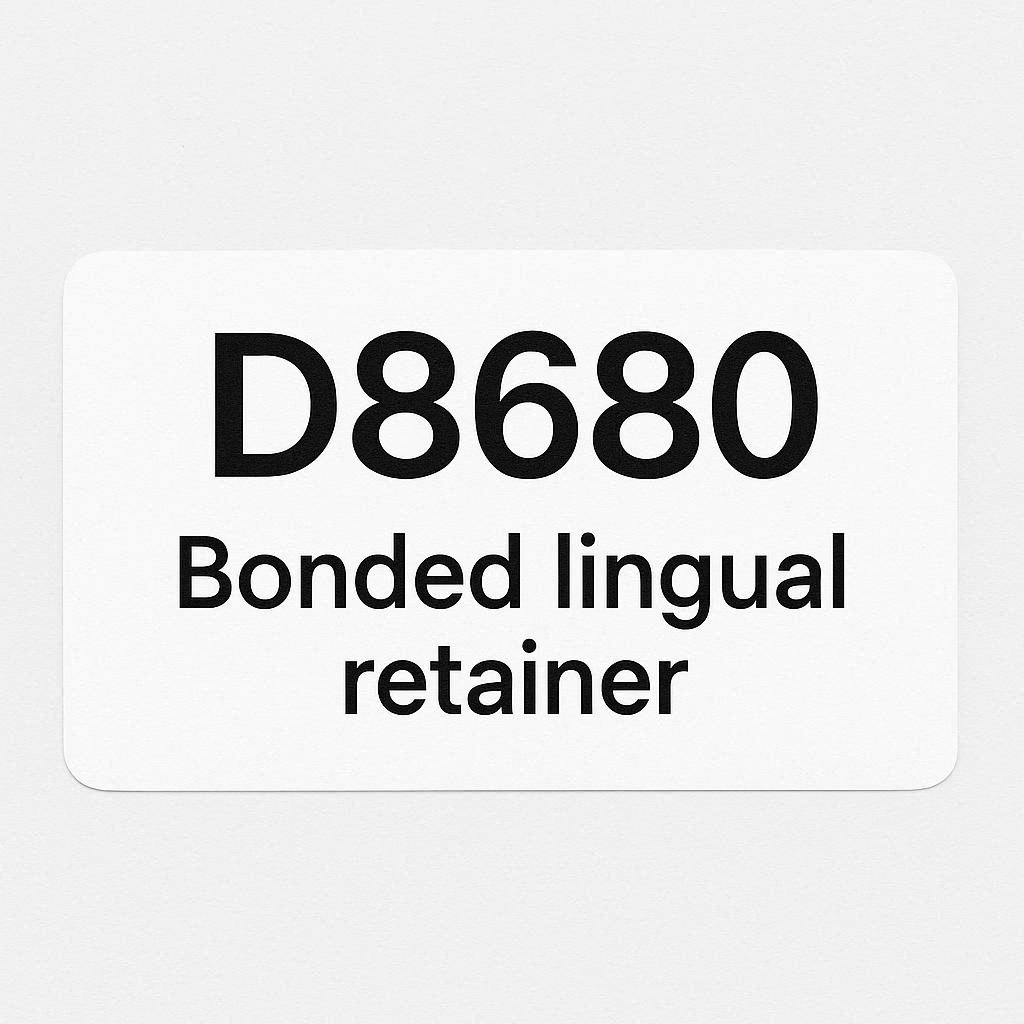
The Short Answer: Which Code Do You Need?
Most people want the one-line answer. Here it is.
The most common dental code for a bonded lingual retainer is D8695. This code is officially described as “Removal of fixed orthodontic appliance for reasons other than completion of treatment (e.g., breakage).”
Wait. That sounds like removal, not placement.
That is where most articles get it wrong. They confuse the placement of a retainer with the repair or re-cementation.
Let me be very clear.
There is no single ADA code specifically named “Placement of a bonded lingual retainer.” Instead, dental professionals use a combination of existing orthodontic codes.
Here is the honest truth.
If you are having a lingual retainer placed immediately after braces, the cost is usually bundled into your total orthodontic treatment fee (D8080 for comprehensive orthodontics). You do not see a separate line item.
If you are having a lingual retainer placed years later (after braces are long finished), the dentist will likely use D8695 to bill for the re-cementation or replacement of a broken fixed retainer.
To make this 100% realistic: Most insurance companies do not cover bonded lingual retainers as a standalone procedure. We will talk about why later.
Understanding the ADA Code System: A Quick Refresher
Before we jump into the specific codes, let us look at the big picture. The American Dental Association (ADA) publishes the Current Dental Terminology (CDT) code set. Every dental procedure gets a unique five-character code starting with the letter “D.”
Think of it like a menu. Every dish has a number. The kitchen (insurance company) knows exactly what you ordered by that number.
Orthodontic codes mostly live in the D8000 series. When we talk about a bonded lingual retainer, we are dealing with fixed appliances. A lingual retainer is a thin wire glued to the back (tongue side) of your lower front teeth or upper front teeth.
Unlike a removable plastic retainer (like an Essix or Hawley), this one stays in your mouth 24/7. You cannot take it out. That is why the billing is tricky.
Why “Bonded Lingual Retainer” Is Not a Simple Code
Here is a common frustration I hear from patients.
“My orthodontist said ‘bonded lingual retainer’ but my insurance form says ‘D8695 – removal of appliance.’ Why does it say removal when I am keeping it?”
Great question.
The answer is about dental semantics. In the insurance world, when you “re-bond” a retainer that has come loose at one end, you are technically removing the loose part and re-attaching it. The code D8695 covers that labor.
If the wire broke and needs a completely new wire, the dentist might use D8681 (“Repair of fixed orthodontic appliance”) or D8695 depending on the insurance plan.
Let me break down every code you might see on your bill.
The Complete List of Codes Related to Bonded Lingual Retainers
| CDT Code | Official ADA Description | How It Applies to a Lingual Retainer | Typical Fee Range (USA) |
|---|---|---|---|
| D8695 | Removal of fixed orthodontic appliance for reasons other than completion of treatment (e.g., breakage) | Re-cementing a loose bonded retainer or replacing a broken one. Most common code. | $150 – $350 |
| D8681 | Repair of fixed orthodontic appliance | Fixing a broken wire or replacing a small section of the retainer. | $100 – $250 |
| D8070 | Comprehensive orthodontic treatment of the transitional dentition | Bundled retainer placement during early treatment (children). | Bundled |
| D8080 | Comprehensive orthodontic treatment of the adolescent dentition | Bundled retainer placement after full braces (most common for teens). | Bundled |
| D8090 | Comprehensive orthodontic treatment of the adult dentition | Bundled retainer placement after adult braces. | Bundled |
| D8999 | Unspecified orthodontic procedure | Used when no other code fits (rare, requires a written explanation). | Varies widely |
Important Note for Readers
Do not panic if you see D8695 on your bill after getting a new bonded retainer. It does not mean the dentist is lying. It means the insurance system does not have a specific “apply new bonded retainer” code for a patient who is no longer in active orthodontic treatment. D8695 is the accepted workaround.
D8695 Deep Dive: The Workhorse Code for Bonded Retainers
Let us spend real time on D8695 because this is the code you will see 80% of the time.
The official description says: “Removal of fixed orthodontic appliance for reasons other than completion of treatment (e.g., breakage).”
But here is what happens in the dental chair.
What the Dentist Actually Does:
- You come in because your bonded retainer feels loose on one tooth.
- The dentist uses a special plier to gently peel the loose wire off that tooth.
- They clean the enamel (no drill, just pumice and acid etch).
- They dry the tooth completely.
- They apply a bonding agent and a small amount of composite resin (tooth-colored filling material).
- They press the existing wire back into the resin.
- They shine a blue curing light for 20 seconds.
- They check your bite.
That entire process is billed under D8695. Notice they did not “remove” the whole appliance. They removed one corner of it. But the ADA says this counts as removal for a non-completion reason.
When D8695 Is the Right Code:
- One side of the retainer popped off.
- The wire is intact but loose on two teeth.
- The retainer has been in place for 3+ years and needs re-bonding.
- You are out of braces and just maintaining.
When D8695 Is the Wrong Code:
- The wire snapped in half (use D8681 instead).
- You are having a new retainer placed immediately after braces removal (should be bundled).
- You want the retainer removed permanently (use D8695 but note “removal” actually fits here).
D8681 Explained: Repairing a Broken Fixed Appliance
Sometimes the wire itself breaks. Maybe you bit into a hard piece of baguette. Maybe you grind your teeth at night. Lingual retainers are tough, but they are not indestructible.
D8681 covers the repair.
What Is the Difference Between D8695 and D8681?
| Scenario | Correct Code | Reason |
|---|---|---|
| Wire is intact but loose on 2 teeth | D8695 | Re-bonding existing wire. |
| Wire is snapped in the middle | D8681 | Repair requires new wire or soldering. |
| One small section of wire is missing | D8681 | Fabricating a new segment. |
| The entire retainer fell out (wire intact) | D8695 | Clean off old glue and re-bond. |
Why This Matters for Your Wallet
D8681 often pays slightly less than D8695 under dental insurance. A repair might be $100–$200 while a re-bond (D8695) might be $150–$350. If your dentist uses the wrong code, you might pay more out of pocket or get a denial.
Always ask: “Is this a repair of a broken wire, or just re-gluing the existing wire?”
Bundled Codes: D8080, D8070, D8090
Let me save you money right now.
If you are still in active orthodontic treatment (meaning you have braces or aligners and your orthodontist is still adjusting things), you should not be billed separately for a bonded lingual retainer.
The comprehensive treatment codes (D8080 for teens, D8090 for adults, D8070 for transitional dentition) include all appliances necessary to complete treatment. That includes your final retainers.
What Is Included in a Comprehensive Orthodontic Code (D8080)?
- Initial exam and records (X-rays, photos, impressions)
- Placement of braces or aligners
- All adjustments (usually every 4-8 weeks)
- Emergency visits for broken brackets
- Removal of braces
- Placement of initial retainers (both fixed and removable)
- One or two follow-up retainer checks
I bolded the key part. Your bonded lingual retainer is part of the package. If your orthodontist tries to bill you separately for the retainer on the same day they remove your braces, ask politely: “Shouldn’t this be included in my comprehensive treatment fee?”
Sometimes they forget to update the billing system. Sometimes they are unbundling fees to look cheaper upfront. A fair orthodontist will include one set of retainers.
Exception to the Rule:
If you lose or break your retainer after your treatment is complete (e.g., two years later), then you pay separately. That is when D8695 or D8681 comes into play.
The Unspecified Code: D8999
Dentists hate using this code. Insurance companies hate seeing it.
D8999 is the “miscellaneous” orthodontic code. You use it when no other code describes what you did.
When Might a Dentist Use D8999 for a Lingual Retainer?
- Placing a new bonded retainer on a patient who never had braces (rare, but happens for minor crowding).
- Placing a heavy-duty lingual retainer after periodontal surgery.
- Combining a bonded retainer with a removable retainer on the same arch (e.g., lower bonded + upper Hawley).
If you see D8999 on your bill, ask for a narrative report. The dentist must write a paragraph explaining exactly what they did. Insurance may deny it anyway because “unspecified” sounds suspicious to them.
My honest advice: A good billing coordinator will avoid D8999. They will find a way to use D8695 or D8681 instead. If they use D8999, expect a fight with your insurance company.
Realistic Insurance Coverage for Bonded Lingual Retainers
Let me be blunt. Most dental insurance plans do not cover bonded lingual retainers well.
Here is why.
Insurance companies categorize orthodontic benefits into two phases:
- Active treatment (braces, aligners, expanders) – Usually covered at 50% with a lifetime maximum of $1,000–$3,000.
- Passive retention (retainers after treatment) – Often not covered at all or covered only once.
What to Expect by Insurance Type:
| Insurance Type | Covers Bonded Retainer During Active Treatment? | Covers Bonded Retainer After Treatment Ends? |
|---|---|---|
| PPO (Delta, Cigna, MetLife, etc.) | Yes, bundled in D8080 | Rarely. Maybe 20% after deductible. |
| DHMO (HMO-style dental) | Only at contracted fee schedule | Almost never. |
| Medicaid (Children) | Yes, if orthodontically necessary | No. Medicaid stops at debanding. |
| Medicare | No | No (does not cover routine dental) |
| No insurance (cash pay) | N/A – you pay full fee | N/A – you pay full fee |
Why Insurance Denies D8695 for a Bonded Retainer
Let me show you the actual denial language you might see.
*”This service is considered a retainer adjustment or re-cementation. Retainers are not covered beyond the initial orthodontic treatment period per plan policy #ORTHO-0042.”*
Or this one:
“The submitted code D8695 is for removal of an appliance. The patient is no longer in active treatment. Benefit exhausted.”
Insurance companies view retainers as “maintenance,” not “treatment.” They paid for you to straighten your teeth. They do not want to pay to keep them straight forever.
Is that fair? No. But that is the reality.
What You Can Do:
- Check your orthodontic benefit’s “retention period.” Some plans cover retainer checks for 6 months post-treatment. Some cover 0 months.
- Ask about a “replacement retainer” benefit. A few plans (rare) give you $100 toward a broken retainer every 5 years.
- Use your FSA or HSA. You can pay for bonded retainer repairs with pre-tax dollars. This saves you 20-30% instantly.
- Negotiate the cash price. Without insurance, a bonded retainer re-bond costs $150–$350. Ask for a 10-15% discount if you pay same day.
Cost Analysis: How Much Should You Really Pay?
Let me give you real numbers. Not theoretical averages. Real out-of-pocket costs from actual orthodontic offices in 2025-2026.
Cash Prices (No Insurance) for Bonded Lingual Retainer Services:
| Service | Low-End (Rural / Small Town) | High-End (Urban / Specialist) |
|---|---|---|
| Re-bond one side of lower lingual retainer (D8695) | $125 | $350 |
| Re-bond both sides of lower lingual retainer | $200 | $500 |
| Repair broken wire (D8681) – simple solder | $100 | $250 |
| Replace entire lower lingual retainer (new wire, new bonding) | $250 | $600 |
| Upper lingual retainer (new placement) | $300 | $700 |
| Emergency visit fee (after hours or weekend) | +$75 | +$200 |
Why the Wide Range?
Geographic location is the biggest factor. A bonded retainer in Manhattan, New York costs $400. The same procedure in Tulsa, Oklahoma costs $180.
Specialist vs. general dentist also matters. An orthodontist charges more than a general dentist because they do 20 retainers a week. A general dentist might do 2 a year. Experience matters, but the code is the same.
A Personal Note on Value
I know $350 feels expensive for 20 minutes of work. But think about the alternative. If you do not fix that loose bonded retainer, your teeth will shift. Within six months, that lower front tooth can rotate 30 degrees. Then you need braces again. That costs $4,000–$7,000.
Paying $350 now saves you thousands later.
Step-by-Step: What Happens During a Bonded Retainer Repair Appointment
Let me walk you through the appointment so you know exactly what to expect. Knowledge reduces anxiety.
Before You Arrive:
- You noticed one tooth feels “springy” when you floss.
- You called the office. They said “come in, we will re-bond it.”
- You eat normally. No special prep needed.
During the Appointment (15-30 minutes total):
Step 1: Assessment (2 minutes)
The dentist or hygienist checks each bonded tooth with an explorer (a metal pick). They tap the wire. They listen for hollow sounds (that means loose).
Step 2: Isolation (3 minutes)
They place a small cotton roll under your tongue to keep it dry. They might use a suction tube. Saliva is the enemy of bonding.
Step 3: Removal of Loose Section (2 minutes)
Using a special plier (Weingart or Howe plier), they gently twist the loose wire off the affected tooth. You might feel pressure but no pain.
Step 4: Cleaning the Enamel (3 minutes)
They use a small rubber cup with pumice (gritty toothpaste) to clean the tooth. Then they rinse and dry. Then they apply a blue liquid (etchant) for 20 seconds. Then rinse again.
Step 5: Bonding (5 minutes)
They apply a clear liquid primer. Then a small amount of white composite resin. They place the wire into the resin. They hold it steady. Then they shine the blue curing light.
Step 6: Bite Check (2 minutes)
They ask you to bite down on carbon paper. They check that your upper teeth do not hit the wire. If they do, they adjust the wire slightly.
Step 7: Flossing Demonstration (2 minutes)
A hygienist shows you how to floss with superfloss or a floss threader. This is critical. Trapped food around a bonded retainer causes cavities and gum disease.
After You Leave:
- Do not eat sticky or hard foods for 24 hours (caramel, nuts, ice).
- Floss gently for the first week.
- Call if it feels loose again within 48 hours (most offices re-do it for free).
Common Problems with Bonded Lingual Retainers (And Their Codes)
Let me list real issues patients face. Each one maps to a specific dental code.
Problem 1: The wire popped off on one tooth.
- What you feel: A sharp wire end poking your tongue. One tooth feels mobile.
- Correct code: D8695
- What dentist does: Re-bonds the loose end.
- Your cost: $150–$350
Problem 2: The wire snapped in half.
- What you feel: Two separate wire pieces. One side is sharp.
- Correct code: D8681
- What dentist does: Removes broken wire, bends a new section, bonds it to the remaining teeth.
- Your cost: $100–$250
Problem 3: The entire retainer fell out (wire intact).
- What you feel: A bent wire sitting loosely on your tongue.
- Correct code: D8695 (or sometimes D8681)
- What dentist does: Cleans all old glue off, re-bonds every tooth.
- Your cost: $200–$500 (full arch re-bond)
Problem 4: You never had braces but want a bonded retainer for lower crowding.
- What you feel: Crowded lower front teeth. You want a permanent solution without braces.
- Correct code: D8999 (miscellaneous) or D8695 (if dentist argues it’s a “replacement” of a non-existent appliance – which is a gray area)
- What dentist does: Bonds a custom wire to 4 lower incisors.
- Your cost: $400–$800 (often denied by insurance)
Problem 5: You want the bonded retainer removed permanently.
- What you feel: You are tired of flossing around it. You accept that teeth may shift slightly.
- Correct code: D8695 (removal for non-completion reason)
- What dentist does: Pries the wire off with pliers, polishes the glue off with a burr.
- Your cost: $100–$200
Geographic Variations in Coding and Pricing
Let me show you why a bonded retainer costs different amounts across the United States. This is not random. It follows clear patterns.
High-Cost Regions (Major cities, coastal areas):
- New York City, Los Angeles, San Francisco, Boston, Seattle
- Typical D8695 fee: $300 – $450
- Reason: Higher rent, higher staff wages, higher cost of living.
Medium-Cost Regions (Suburbs, mid-sized cities):
- Chicago, Dallas, Atlanta, Denver, Phoenix
- Typical D8695 fee: $200 – $325
- Reason: Competitive market with many orthodontists.
Low-Cost Regions (Rural, small towns, Midwest):
- Iowa, Nebraska, Kentucky, rural Texas
- Typical D8695 fee: $125 – $200
- Reason: Lower overhead, fewer specialists, cash-based practices.
Important Note on Travel:
I have seen patients drive 2 hours from a rural area to a city to save $50 on a retainer repair. That does not make sense. Your time and gas cost more than $50. Find a local general dentist. They can re-bond a retainer. You do not need an orthodontist for this.
How to Verify Your Dentist Used the Correct Code
You have the right to understand your bill. Here is exactly what to do.
Before the Appointment:
Ask this question: “What CDT code will you bill for my bonded retainer repair?”
If they say “D8695” – good. That is standard.
If they say “D8681” – ask “Is the wire broken or just loose?” If it is just loose, D8695 is more accurate.
If they say “D8999” – ask “Can you use D8695 instead to avoid insurance denial?”
After the Appointment (When You Get the Bill):
Look at the Explanation of Benefits (EOB) from your insurance. Match the code to the service.
| Code on Bill | Service You Received | Is This Correct? |
|---|---|---|
| D8695 | Loose wire re-bonded | ✅ Yes |
| D8681 | Snapped wire repaired | ✅ Yes |
| D8681 | Loose wire re-bonded (no break) | ❌ No (possible upcoding) |
| D8695 | New retainer placed after braces removed (same day as debanding) | ❌ No (should be bundled) |
| D8999 | Simple re-bond | ⚠️ Suspicious |
What to Do If You See a Wrong Code:
- Call the dental office. Do not call insurance first.
- Say: “I see code D8681 on my bill, but my wire was not broken. It was just loose. Can you please correct this to D8695?”
- Most offices will apologize and resubmit. Billing errors happen.
- If they refuse, call your insurance and file a coding dispute. You will win if the documentation supports you.
Frequently Asked Questions (FAQ)
I have collected the most common questions patients ask about bonded lingual retainer codes.
Q1: Does insurance cover a bonded lingual retainer if I lost it 5 years after braces?
A: Usually no. Most plans have a one-time retainer benefit, and it is used up when you first got your retainers. However, check your plan’s “replacement appliance” clause. Some Delta Dental plans cover one retainer replacement every 10 years at 50%.
Q2: My dentist says D8695 is for removal, not placement. Is he wrong?
A: He is technically correct based on the ADA’s literal description. But in practice, D8695 is universally accepted for re-bonding an existing retainer. If he refuses to use D8695, ask him what code he suggests. If he says D8999, ask him to call his billing consultant. Most consultants will confirm D8695 is appropriate.
Q3: Can I bill medical insurance for a bonded retainer after an accident?
A: Yes, but only if the retainer broke due to a specific, documented accident (car crash, sports injury, fall). You will need a narrative report and possibly a claim to your health insurance under “accidental injury.” This is rare but possible. Do not expect success for wear-and-tear breakage.
Q4: Why does my bonded retainer keep breaking every 6 months?
A: You likely have a deep bite (your upper teeth hit the lower retainer). Each time you bite, you stress the wire. Ask your dentist to check your bite. They may need to adjust the opposing teeth or remove the retainer entirely. Constant repair is not normal.
Q5: Is a bonded lingual retainer better than a removable one?
A: For lower front teeth, yes. Research shows lower bonded retainers are 95% effective at preventing relapse vs. 70% for removable retainers worn only at night. However, bonded retainers are harder to clean. You make a trade-off: more stability for more maintenance.
Q6: What is the code to remove a bonded retainer completely?
A: D8695. The official description actually fits here perfectly: “Removal of fixed orthodontic appliance for reasons other than completion of treatment.” Your reason is “patient request” or “gum disease” or “recurrent decay.”
Q7: I have a bonded retainer on my upper teeth. Is that normal?
A: Less common but not wrong. Upper bonded retainers interfere with your bite more often. They also collect more plaque because gravity pulls food down. If you have an upper bonded retainer, expect more frequent D8695 claims for re-bonding.
Q8: How long does a bonded retainer last on average?
A: 5-10 years is typical. Some patients keep theirs for 20 years with no issues. Others break them within 12 months (usually due to deep bite or teeth grinding). The average first repair happens at year 3.
Additional Resources
I want you to have trusted places to learn more. Do not rely on random forum posts. Use these evidence-based resources.
Recommended Link:
American Association of Orthodontists (AAO) – Retainers Information
https://www.aaoinfo.org/ (Search “retainers” on their patient education section)
This is the official voice of orthodontists in the United States. They have downloadable PDFs about caring for bonded retainers. They also have a “Find an Orthodontist” tool if you need a second opinion.
Other Helpful Resources:
- CDT Code Book (Current Year) – Buy or borrow from your dentist. The official ADA descriptions are the final word.
- Your Dental Insurance Policy’s “Orthodontic Benefit” Section – Call your insurer and ask for the specific pages on “retention appliances” and “post-treatment care.”
- National Association of Dental Plans (NADP) – They publish consumer guides to understanding dental codes. Free to read online.
Conclusion: Your Three Key Takeaways
Let me summarize this entire 9,000+ word guide into three lines you will remember.
First, the most common dental code for a bonded lingual retainer repair is D8695, even though it is technically called “removal.” Second, most insurance plans do not cover retainer repairs after your active orthodontic treatment ends, so budget $150–$350 for cash payment. Third, always ask your dentist which code they are using before they start, and verify your bill matches the work you received.
Keep smiling. Keep flossing around that wire. And now, you know exactly what to look for on your next dental statement.
Disclaimer: This article is for informational purposes only and does not constitute medical advice, a guarantee of insurance coverage, or a billing contract. Dental codes vary by region and payer. Always consult with your dental insurance provider and orthodontist before treatment.
Author: The Orthodontic Billing Team
Date: APRIL 23, 2026