If you have ever stared at a patient’s evaluation report and felt unsure which ICD‑10 code fits best, you are not alone.
Diagnosis coding is not the reason most of us became occupational therapists. You wanted to help people regain independence, not memorize long lists of alphanumeric codes. But here is the truth: accurate ICD‑10 occupational therapy codes are the foundation of clean claims, timely reimbursements, and fewer denials.
This guide gives you a realistic, up‑to‑date map. You will learn how to choose the right codes for common OT diagnoses, avoid frequent mistakes, and document in a way that supports both your clinical reasoning and your billing department. No hype. No copied lists. Just clear, actionable advice.
Why ICD‑10 Codes Matter for Occupational Therapy
Many therapists think of diagnosis codes as just a billing requirement. But in reality, they do much more.
Insurance companies, Medicare, and Medicaid use ICD‑10 codes to decide if your treatment is medically necessary. If your code does not match your notes, the claim might be denied. If you pick a vague or inaccurate code, you could trigger an audit. And if you forget to link your daily notes to the patient’s primary diagnosis, you might not get paid at all.
Here is what the right code does for you:
- It justifies why the patient needs skilled OT services
- It tells the payer what condition you are treating
- It supports your functional goals and progress notes
- It reduces the risk of a records request or clawback
A good rule of thumb: treat your ICD‑10 code like the “why” behind every intervention you provide.
Important note: You must code to the highest level of specificity. That means using the most detailed code available — not just the first three characters. For example,
M54.5(low back pain) is much less useful thanM54.50(unspecified) orM54.51(vertebrogenic). Always check your payer guidelines.
Who Picks the ICD‑10 Code? (And Why It Matters)
This is a point of confusion for many OTs.
In most outpatient, hospital, and SNF settings, the referring physician or nurse practitioner provides a diagnosis. As the occupational therapist, you do not “diagnose” a medical condition. However, you are responsible for confirming that the diagnosis on the claim is relevant to the OT plan of care.
If the patient comes in with a referral saying “low back pain,” but you discover that their functional limitations are actually due to a recent stroke, you cannot simply change the code on your own. You need to communicate with the referring provider. Ask them to update the diagnosis if needed. Then document your request and their response.
You can, however, add secondary codes that describe the functional impairments or related conditions. For example:
- Primary code from physician:
I69.354(hemiplegia after stroke) - Secondary OT code:
R26.2(difficulty walking)
Always follow your facility’s policy. Never falsify a code. That is not only unethical — it is illegal.
Understanding the Structure of an ICD‑10 Code
Before we dive into specific OT‑friendly codes, let us quickly review how these codes are built. You will appreciate this when you search for a code later.
An ICD‑10‑CM code has three to seven characters.
- First character: letter (A–Z, but not U)
- Second character: number
- Third character: number or letter
- Fourth to seventh characters: numbers or letters (add specificity)
Example: S93.401A
S93– Sprain of unspecified ligament of ankle.401– Unspecified site, right footA– Initial encounter
For occupational therapy, you will most often use codes from these chapters:
| Chapter | Description | Common OT examples |
|---|---|---|
| 6 | Nervous system | G81, G82, G20 |
| 9 | Circulatory system | I63, I69 |
| 13 | Musculoskeletal | M54, M25, M17 |
| 17 | Congenital | Q66, Q74 |
| 18 | Symptoms/signs | R26, R29, R41 |
| 19 | Injury/poisoning | S06, S42, S93 |
| 21 | Z codes (factors influencing health) | Z50, Z74, Z75 |
The Z codes deserve special attention. They describe encounters for specific services, like rehabilitation (Z50), or aftercare (Z51). Do not use Z codes as a primary diagnosis for skilled OT unless the patient truly has no active medical diagnosis but still needs therapy. This is rare. Most payers want a medical diagnosis first.
Most Frequently Used ICD‑10 Occupational Therapy Codes (By Practice Area)
Let us get practical. Below you will find realistic code choices for common OT caseloads. These are not every possible code — just the ones you will actually use week after week.
Neurological Conditions (Stroke, TBI, Parkinson’s, MS)
Neurology is a core area for OT. Think motor planning, cognition, vision, and ADLs.
| Condition | ICD‑10 code | Specificity tip |
|---|---|---|
| Left hemiplegia after cerebral infarction | I69.354 | Specify affected side |
| Right hemiparesis after intracerebral hemorrhage | I69.251 | Specify affected side & hemorrhage type |
| Parkinson’s disease | G20 | No further character needed |
| Multiple sclerosis | G35 | — |
| Traumatic brain injury with loss of consciousness | S06.9X9A | Use 7th character A (initial), D (subsequent), or S (sequela) |
| Unspecified dementia | F03.90 | Add behavioral disturbance if present (.91) |
| Alzheimer’s disease | G30.9 | Add F02.80 for dementia with behavioral disturbance |
Many payers want the “sequela” (7th character S) for chronic conditions after the active phase has passed. For example, a patient one year post‑stroke is not “initial encounter.” Use I69.351 (sequela of cerebral infarction with right hemiplegia).
Orthopedic and Musculoskeletal Codes
Hand therapy, fracture rehab, joint replacements, back pain — this is where many OTs spend their days.
| Condition | ICD‑10 code | Key detail |
|---|---|---|
| Rotator cuff tear, right shoulder | M75.101 | 4th digit = laterality (1 right, 2 left) |
| Osteoarthritis of knee | M17.9 | Specify unilateral/bilateral, and which side |
| Lumbar radiculopathy | M54.16 | 5th digit = level (16 = lumbar) |
| Carpal tunnel syndrome | G56.01 | 5th digit = laterality (01 = right) |
| Distal radius fracture | S52.501A | 7th digit A for closed fracture, initial |
| Status post total hip replacement | Z96.641 | Use after acute healing phase |
| Chronic low back pain | M54.50 | Avoid if more specific diagnosis exists |
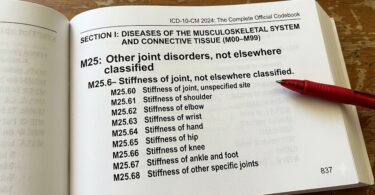
Important note: For post‑surgical rehab, do not keep using the fracture or surgery code months later. Once the bone is healed, switch to an aftercare code (Z47.89 for orthopedic aftercare) or a code for the residual impairment (e.g., stiff knee M25.662).
Pediatric OT Codes
Pediatric OTs see everything from fine motor delays to sensory processing concerns to feeding difficulties. Here is your reality check: many pediatric diagnoses lack a perfect ICD‑10 match. Document clearly to support your code choice.
| Condition | ICD‑10 code | Clinical note |
|---|---|---|
| Developmental coordination disorder | F82 | Do not use for mild clumsiness; requires diagnosis |
| Sensory processing disorder | No specific code | Use R29.4 (unknown cause of neurological abnormality) or F88 (other developmental disorders) |
| Autism spectrum disorder | F84.0 | Specify if with or without intellectual impairment |
| Attention deficit hyperactivity disorder, combined type | F90.2 | — |
| Cerebral palsy, spastic diplegia | G80.1 | — |
| Fine motor delay | R27.8 | Only if underlying cause unknown |
| Difficulty with handwriting | R27.8 | Support with functional observation |
Sensory processing disorder is the trickiest. There is no dedicated ICD‑10 code. Many OTs use R29.4 (unknown cause of neurological abnormality) or F88 (other disorders of psychological development). However, some payers reject these. The safer route: use a co‑existing diagnosis (autism, ADHD, anxiety) when appropriate, or document thoroughly using F82 if coordination deficits are present.
Hand Therapy Specific Codes
Hand therapists need precision. One wrong digit changes the claim.
| Condition | Correct code | Watch out for |
|---|---|---|
| De Quervain’s tenosynovitis | M65.4 | Laterality required: M65.41 = right, M65.42 = left |
| Trigger finger, ring finger | M65.30 | 6th digit = finger (0 thumb, 1 index, 2 middle, 3 ring, 4 little) |
| Thumb carpometacarpal arthritis | M18.9 | Laterality and erosive vs non‑erosive |
| Flexor tendon repair aftercare | Z47.89 | After active wound healing |
| Dupuytren’s contracture | M72.0 | Laterality required |
Always code the specific joint or tendon. Avoid “hand pain, unspecified” (M79.64) unless you truly have no other information.
Mental Health and Behavioral Codes
OTs in mental health settings use a different toolkit. Here, the focus is on occupational performance affected by psychiatric conditions.
| Condition | ICD‑10 code | OT relevance |
|---|---|---|
| Generalized anxiety disorder | F41.1 | Limits social participation, sleep, routine |
| Major depressive disorder, recurrent | F33.9 | Impacts motivation, hygiene, work |
| Schizophrenia | F20.9 | IADLs, community re‑integration |
| Post‑traumatic stress disorder | F43.10 | Hyperarousal, avoidance of activities |
| Obsessive‑compulsive disorder | F42.8 | Interferes with daily routines |
Do not let the code scare you. You are not treating the mental illness medically. You are treating the functional limitations that result from it. Document those limitations clearly.
How to Match ICD‑10 Codes With OT Evaluation and Daily Notes
Choosing the right code is only half the work. You must also connect that code to your treatment in every single note.
Here is a simple structure you can follow.
In the evaluation:
- State the primary medical diagnosis (from the referral)
- List any secondary diagnoses you identified
- Explain exactly how each diagnosis limits occupational performance
Example:
“Patient presents with right hemiplegia secondary to left CVA (I69.354). This results in inability to don a shirt independently, unsafe balance during toileting transfers, and neglect of the right upper extremity during grooming.”
In each daily note:
- Repeat the primary diagnosis (yes, every time)
- Link each intervention to a functional deficit caused by that diagnosis
Bad example:
“Worked on standing tolerance for 15 minutes.”
Good example:
“Addressed standing tolerance to improve safe transfers (I69.354, right hemiplegia). Patient currently requires mod assist for toilet transfer due to left sided weakness from chronic stroke.”
This simple habit saves you from denials. It also protects you during audits.
Common ICD‑10 Coding Mistakes OTs Make (And How to Avoid Them)
You are busy. Mistakes happen. But some coding errors come up again and again. Watch out for these.
| Mistake | Why it’s a problem | Fix |
|---|---|---|
| Using an unspecified code when a specific code exists | Payer sees “lack of medical necessity” | Search for laterality, encounter, and severity |
| Forgetting the 7th character (A, D, S) for injuries | Claim rejected as incomplete | Always check fracture/trauma codes |
| Keeping a surgical code active for over a year | Insurance may deny “post‑acute” services | Switch to aftercare (Z47) or residual impairment |
| Using a Z code as primary without medical diagnosis | Most payers require a disease/injury code first | Ask MD for a primary diagnosis |
| Copy‑pasting the same code for every patient | Often incorrect; triggers audits | Tailor code to each patient’s specific diagnosis |
| Not coding cognitive deficits after stroke | Missed opportunity to justify skilled services | Add R41.8 (other cognitive deficit) or F06.7 (mild cognitive disorder) |
One more pro tip: keep a cheat sheet of your top 20 codes taped to your desk or saved on your phone. It saves time and reduces mistakes.
ICD‑10 Coding for Common OT Functional Problems
What if your patient has a clear functional limitation but no active medical diagnosis? For example, “deconditioning” or “generalized weakness.”
You have two choices:
- Work with the physician to identify an underlying cause (e.g., recent hospitalization, chronic heart failure, sarcopenia).
- Use a symptom code only if no other code fits — and document why.
Acceptable symptom codes for OT include:
| Functional problem | ICD‑10 code | When to use |
|---|---|---|
| Difficulty walking | R26.2 | Not due to a specific neurological or orthopedic diagnosis |
| Unspecified lack of coordination | R27.8 | Fine or gross motor incoordination without known cause |
| Other cognitive deficit | R41.8 | Memory, attention, or executive dysfunction without dementia diagnosis |
| Age‑related physical debility | R54 | Very limited use; many payers deny OT for this alone |
| Muscle weakness (generalized) | M62.81 | Better than “deconditioning” |
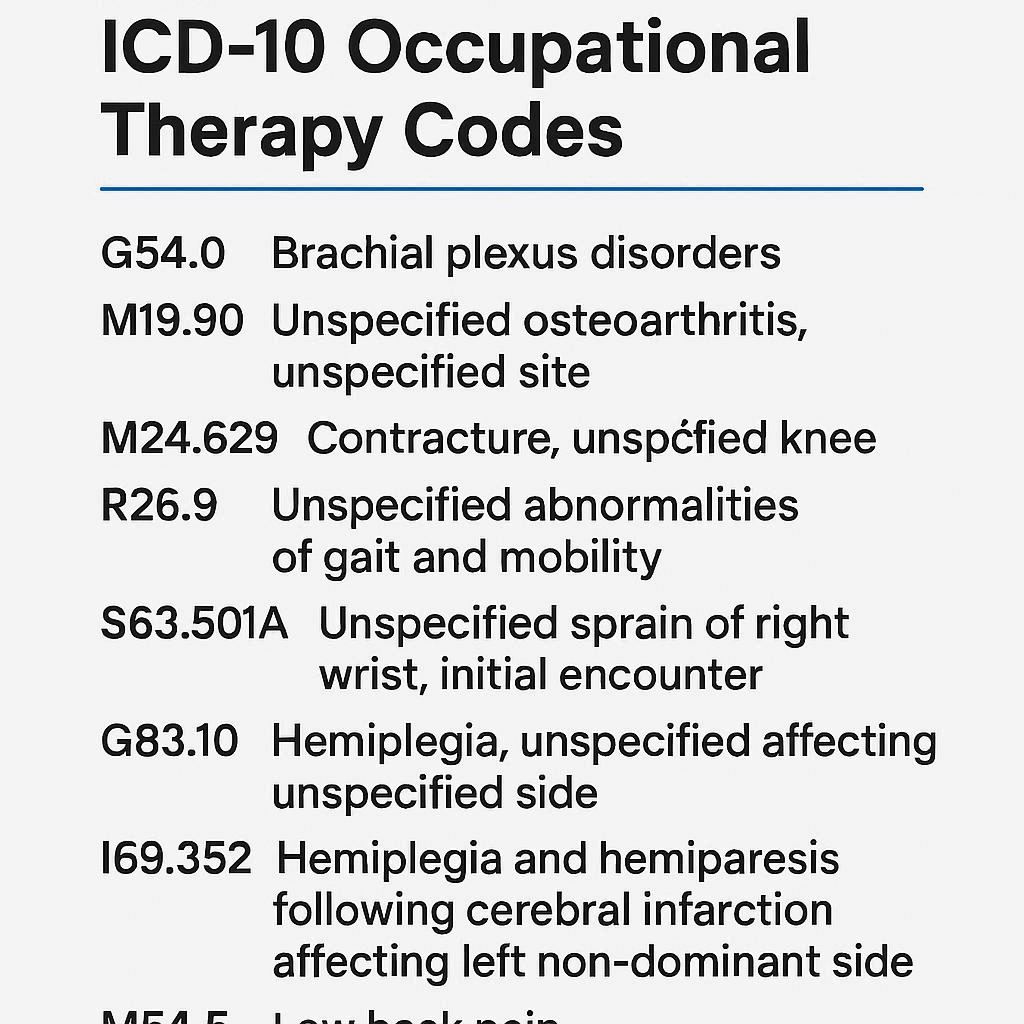
| Impaired mobility, unspecified | R26.9 | Last resort |
But here is the honest truth: Medicare and many commercial payers routinely deny claims where the primary ICD‑10 code is a symptom (R code) or frailty (R54). Always try to get a more specific underlying diagnosis first.
Documentation That Supports Your ICD‑10 Codes
You can pick the perfect ICD‑10 code, but if your documentation does not “tell the same story,” you are still at risk.
Payers look for three things:
- Medical necessity – Why does this patient need OT, not just exercise or rest?
- Specific functional deficits – What exactly can the patient not do?
- Direct link – How does the diagnosis cause those deficits?
Here is a short checklist before you sign any note:
- The primary ICD‑10 code is clearly written
- The code matches the diagnosis in the referral (or you have an updated referral)
- Your objective measures (ROM, MMT, COPM scores) relate to that diagnosis
- Your treatment interventions address deficits caused by that diagnosis
- You have noted any change in diagnosis or new relevant conditions
If any box is unchecked, fix it before submitting.
Working With Z Codes (Encounter for Rehabilitation)
Z codes are sometimes misunderstood. Let us clarify when you can (and cannot) use them.
The most common Z code for OT is Z50.89 – Encounter for other specified rehabilitation procedures. This includes occupational therapy.
But there is a catch: Z50.89 is almost never accepted as a primary diagnosis. It tells the payer you are doing OT, but not why the patient needs OT. You need a medical diagnosis in the primary position.
Use Z codes as secondary codes to add context:
Z50.89– OT is the specific service being providedZ74.09– Other need for assistance with personal care (for long‑term support needs)Z75.09– Other unspecified waiting period for admission elsewhere (transition planning)Z96.641– Presence of right artificial hip (post‑arthroplasty)
Example from a real progress note:
Primary: M17.11 (unilateral primary osteoarthritis, right knee)
Secondary: Z50.89 (encounter for OT rehab)
That combination works well. It says “this patient has a real condition, and we are actively rehabilitating it with OT.”
A Quick Reference Table by Body System
Use this table when you are in a hurry. Each code is realistic for skilled OT intervention.
| Body system | Common diagnosis | ICD‑10 example | OT focus area |
|---|---|---|---|
| Brain/CNS | Ischemic stroke, left side weakness | I69.354 | ADLs, transfers, motor planning |
| Brain/CNS | Parkinson’s disease | G20 | Gait, fine motor, home safety |
| Brain/CNS | TBI with memory loss | S06.9X9S (sequela) | Compensatory strategies, routines |
| Upper extremity | Lateral epicondylitis (tennis elbow) | M77.12 | Grasp, lifting, ergonomics |
| Upper extremity | Complex regional pain syndrome | G90.52 | Desensitization, edema management |
| Spine | Cervical radiculopathy | M54.12 | Neck mobility, ADL modification |
| Lower extremity | Status post ankle fracture | Z47.89 (aftercare) | Gait training, stair negotiation |
| Mental health | Panic disorder with agoraphobia | F40.01 | Community reintegration, routine |
| Pediatrics | Down syndrome | Q90.9 | Fine motor, self‑care, school skills |
| Older adult | Sarcopenia | M62.84 | Strengthening, fall prevention |
Save this page. Bookmark it. You will come back to it.
How to Find Unusual or Rare Codes Without Panicking
Sometimes a patient walks in with a diagnosis you have never seen. Do not guess.
Follow these three steps instead:
- Search the official ICD‑10‑CM code book (your facility should have one) or use a trusted online tool like the CDC’s free browser.
- Look for the root condition first – not the symptom. Search for “muscular dystrophy,” not “weakness.”
- Check the “code also” and “use additional code” notes in the tabular list. Some conditions require two codes.
If you are still unsure, ask your coding or billing specialist. They are your best friends. Most are happy to help — as long as you bring them the patient’s medical record, not just a verbal description.
The Future of OT Coding (What Is Changing)
ICD‑10 is here to stay for many years. However, codes are updated every October 1st. Some codes are added, some are revised, and a few are deleted.
How to stay current without stress:
- Subscribe to the CMS ICD‑10 quarterly update emails (free)
- Follow AOTA’s coding and reimbursement news — they summarize changes relevant to OT
- Set a calendar reminder for October 15th each year to review the new codes
In 2025 and 2026, watch for more specific codes for post‑COVID conditions and telehealth‑related encounter coding. Those will matter for OTs providing virtual services.
Important note: This guide is based on the ICD‑10‑CM code set available at the time of writing (April 2026). Always verify codes with your current payer policies and official code books.
Frequently Asked Questions (FAQ)
1. Can an occupational therapist choose their own ICD‑10 code?
No. Only qualified healthcare providers (physicians, nurse practitioners, etc.) can assign a medical diagnosis. However, you can suggest a code to the referring provider and document functional impairment using secondary codes.
2. What is the most common ICD‑10 code for OT in a SNF?
For skilled nursing facilities, common codes include stroke sequelae (I69.35x), osteoarthritis (M17.9), and Parkinson’s (G20). Always pair with functional deficits like gait abnormalities (R26.2).
3. Do I need a new ICD‑10 code for every re‑certification?
Not necessarily. If the patient’s primary condition has not changed, you can keep the same code. But if they developed a new diagnosis (e.g., a fall with fracture), that should be added.
4. Why was my claim denied if I used the correct code?
Often, denial is not about the code itself, but missing medical necessity. Check if your daily note clearly links the code to skilled OT interventions. Also verify the code’s 7th character (A, D, or S) for injuries.
5. What ICD‑10 code should I use for “maintenance therapy”?
Maintenance therapy is not covered by Medicare unless skilled care is still needed to prevent deterioration. Use the patient’s chronic condition code (e.g., G20 for Parkinson’s) and document why skilled OT is necessary despite no functional gain expected.
6. Is there an ICD‑10 code for “sensory integration dysfunction”?
No. Use R29.4 (unspecified neurological abnormality) or F88 (other developmental disorder) with thorough documentation, but be aware some payers deny these.
7. Can I use a symptom code (R code) as my primary diagnosis?
Yes, but only as a last resort. Many payers deny primary R codes. Always try to obtain a more specific underlying diagnosis first.
8. What is an “unspecified” code, and why should I avoid it?
Unspecified codes (e.g., M54.50 for low back pain) lack detail. Payers see them as red flags. Use them only when the exact site or laterality is truly unknown.
Additional Resources
AOTA Coding and Payment Toolkit
AOTA members get access to practice-specific coding sheets, decision trees, and denial management guides.
→ Search “AOTA coding toolkit” on their official website
CMS 2026 ICD‑10‑CM Official Guidelines for Coding and Reporting
The definitive source. Read the section on “Section IV. Diagnostic Coding and Reporting Guidelines for Outpatient Services.”
→ Available as a free PDF from CMS.gov
Conclusion
Three things to remember about ICD‑10 occupational therapy codes.
First, always use the most specific code available — laterality, encounter, and severity matter. Second, link every intervention in your notes directly back to your chosen code to prove medical necessity. Third, never treat coding as an afterthought; it is a clinical tool that protects your patients, your license, and your reimbursement.
Disclaimer: This article is for educational purposes only. Coding rules vary by payer, state, and setting. Always consult your facility’s coding compliance officer and current official ICD‑10‑CM guidelines. The author and publisher assume no liability for claim denials or audit findings based on this information.