If you have ever sat down to bill for an IVIG (Intravenous Immune Globulin) infusion, you already know the first question that comes to mind: Which CPT code do I use?
The answer is not always a single number. In fact, billing for IVIG infusion usually requires three different types of codes: one for the drug itself, one for the infusion administration, and sometimes one for the initial supplies.
Do not worry. You do not need to be a certified professional coder to get this right.
This guide walks you through everything you need to know about the IVIG infusion CPT code process. We will cover the most common codes, how to choose between initial and sequential hours, what payers expect, and how to avoid claim denials.
What Is IVIG Infusion? A Quick Overview for Coders
Before we jump into the codes, let us make sure we understand the procedure.
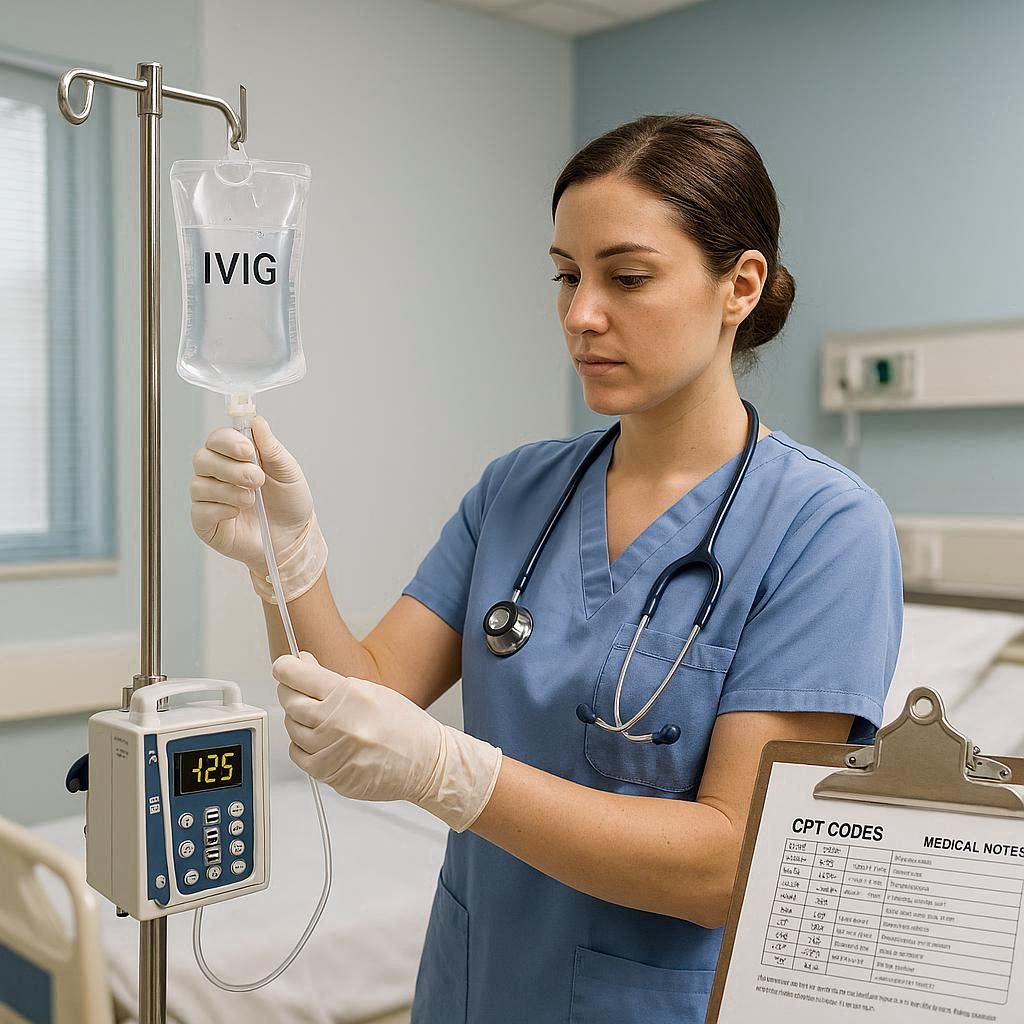
IVIG stands for Intravenous Immune Globulin. It is a sterile solution made from human plasma that contains concentrated antibodies. Doctors use it to treat patients with immune deficiencies, autoimmune disorders, and certain inflammatory conditions.
The infusion itself is administered through a vein. A nurse or infusion specialist runs the IVIG solution slowly over several hours. Some patients complete their treatment in two hours. Others need eight hours or more.
Because IVIG is a biologic drug with a high risk of reactions (like headache, fever, or blood pressure changes), medical coders must pay close attention to time and monitoring.
From a coding perspective, you need to report:
- The drug (IVIG product)
- The administration (the actual infusion work)
- Any prolonged services (if the infusion runs beyond the first hour)
The Main IVIG Infusion CPT Code: 96365
Let us answer the biggest question first.
The primary CPT code for IVIG infusion administration is 96365.
96365 stands for: Intravenous infusion, for therapy, prophylaxis, or diagnosis (specify substance or drug); initial, up to 1 hour.
Here is what that means in plain English:
- Initial – This code covers the first hour of the infusion. You can only bill it once per encounter, even if the patient receives multiple drugs.
- Up to 1 hour – If the infusion takes 16 minutes or 51 minutes, 96365 still applies. The cutoff is 60 minutes.
- Therapy – IVIG is almost always a therapeutic infusion, not a diagnostic one.
Important note: 96365 is for the administration work. It does not include the cost of the IVIG drug itself. You must bill the drug separately using a J code (which we cover in the next section).
IVIG Drug Codes (J Codes): Which One Do You Need?
The phrase “IVIG” refers to a category of drugs, not a single product. Different manufacturers make different brands of immune globulin. Each brand has its own J code.
Here is a comparative table of the most common IVIG J codes in 2026.
| Drug Brand / Type | CPT/HCPCS Code | Description |
|---|---|---|
| Octagam, Gammagard Liquid, Privigen | J1459 | Injection, immune globulin (privigen), intravenous, non-lyophilized (e.g., liquid), 500 mg |
| Gammagard S/D (lyophilized) | J1566 | Injection, immune globulin, intravenous, lyophilized (e.g., powder), 500 mg |
| Gammaplex, Flebogamma, Bivigam | J1561 | Injection, immune globulin, (gammaplex), intravenous, non-lyophilized (e.g., liquid), 500 mg |
| Carimune, Gamunex-C | J1569 | Injection, immune globulin, (gamunex-c/gammaked), non-lyophilized (e.g., liquid), 500 mg |
| Cuvitru (subcutaneous, but sometimes confused) | J1555 | Injection, immune globulin (cuvitru), subcutaneous, 100 mg |
Most common code you will see: J1459. Many private insurers and Medicare contractors recognize J1459 for liquid IVIG products like Privigen and Octagam.
How to calculate units:
All these J codes are billed per 500 mg.
- If your patient receives 40 grams (40,000 mg) of IVIG, you divide 40,000 by 500 = 80 units of J1459.
Always double-check the specific brand your facility uses. Do not guess. Your pharmacy or purchasing department can confirm the correct J code.
What About Infusion Time? The 31-Minute Rule
Time is the number one reason for denied IVIG claims. Let us clear up the confusion.
CPT guidelines for infusion administration follow a 31-minute rule:
- Less than 16 minutes – You cannot bill 96365. You may need to bill an injection code (96372) instead, but this is rare for IVIG. Most payers expect you to report no separate administration if the infusion is extremely short. Realistically, IVIG infusions rarely last less than 16 minutes.
- 16 to 60 minutes – Bill 96365 (initial hour).
- 61 to 90 minutes – Bill 96365 for the first hour, plus +96366 for the additional hour (see below).
- 91 to 150 minutes – Bill 96365 + 96366 (first additional hour) + +96366 for each subsequent hour.
Think of it like parking your car. You pay for the first hour (96365). Then you pay for every extra hour after that (96366). You do not pay another “first hour” fee.
Add-On Code: +96366 for Each Additional Hour
When an IVIG infusion runs longer than 60 minutes, you need an add-on code.
+96366 stands for: Intravenous infusion, for therapy, prophylaxis, or diagnosis (specify substance or drug); each additional hour (List separately in addition to code for primary procedure).
Important details:
- This is an add-on code. You never bill it alone.
- You bill +96366 for each additional hour beyond the first hour.
- Partial hours count as a full hour for billing purposes if they exceed 30 minutes.
Example 1: 2-hour infusion
- First hour: 96365
- Second hour (minutes 61-120): +96366
- Total: 96365, +96366
Example 2: 3.5-hour infusion (210 minutes)
- First hour: 96365
- Second hour: +96366
- Third hour (minutes 121-180): +96366
- Fourth hour? No. At 180-210 minutes, that is a partial fourth hour. Since it exceeds 30 minutes, you can bill a fourth +96366.
- Total: 96365, +96366, +96366, +96366
Be careful: Some payers (like certain Medicare Administrative Contractors) require you to bill only one +96366 per 60 minutes, and they do not round up for partial hours. Always check your local coverage determination.
Initial vs. Sequential Hour: Why Order Matters
The word “initial” confuses many people. Let me give you a real example.
A patient receives IVIG for 90 minutes, then immediately after receives IV saline (normal saline) for 30 minutes.
Do you bill:
- Option A: 96365 (IVIG initial) + 96366 (IVIG second hour) + 96361 (saline initial)?
- Option B: 96365 (IVIG initial) + 96366 (IVIG second hour) + 96360 (saline initial)?
Correct answer: Option A – but with a twist. You cannot bill a second “initial” service (96360 for saline) because the patient is already in an infusion encounter. You instead bill 96361 for the saline if the saline is the only infusion running after the IVIG stops.
But wait. Many coders miss this: If the saline runs concurrently with the IVIG (in the same line, at the same time), you do not bill the saline separately. You only bill the primary therapeutic infusion (IVIG).
The golden rule: In a single encounter, you can only bill one initial infusion code (96365). All other infusions are either add-on or concurrent.
Prolonged Infusion Codes: When to Use 96367, 96368, and 96369
CPT codes for infusions can feel like alphabet soup. Here is a quick cheat sheet for other codes you may see alongside IVIG.
| CPT Code | Description | When to use for IVIG |
|---|---|---|
| 96365 | Initial hour, first infusion | Always for the first hour of IVIG |
| +96366 | Each additional hour | For hour 2, 3, 4+ of the same IVIG bag |
| 96367 | Additional sequential infusion | When you switch from IVIG to a different drug in the same line (rare for IVIG alone) |
| 96368 | Concurrent infusion | When you run two different IV fluids at the same time in different lines (e.g., IVIG + IV magnesium) |
| 96361 | IV push, additional hour (hydrating) | For plain IV fluids (like saline) given after the IVIG ends |
For standard IVIG infusions (one drug, one bag, one line), you will almost never use 96367 or 96368. Stick to 96365 + 96366.
IVIG Infusion Billing Example Scenarios
Let us walk through real-world cases. These examples assume you are billing for the administration only (the drug J code would be separate).
Scenario 1: Short Infusion – 45 minutes
- Time: 45 minutes
- Code: 96365 only
- Units: 1
- Explanation: The infusion did not exceed 60 minutes. One initial hour code covers it.
Scenario 2: 2 hours and 15 minutes (135 minutes)
- Time breakdown:
- 0–60 min: first hour
- 61–120 min: second hour
- 121–135 min: partial third hour (15 minutes over 120)
- But CPT says you can only bill a full additional hour if the partial hour exceeds 30 minutes. 15 minutes does not.
- Correct codes: 96365, +96366 (two units of 96366? No. One unit of 96366 covers minutes 61-120. Minutes 121-135 are not billable.)
- Total: 96365, +96366 (1 unit)
Scenario 3: 3 hours and 10 minutes (190 minutes)
- 0–60 min: 96365
- 61–120 min: +96366
- 121–180 min: +96366 (third hour)
- 181–190 min: partial fourth hour = 10 minutes. Not enough to bill a fourth +96366.
- Total: 96365, +96366, +96366
Scenario 4: 4 hours exactly (240 minutes)
- 0–60: 96365
- 61–120: +96366
- 121–180: +96366
- 181–240: +96366 (fourth hour)
- Total: 96365, +96366, +96366, +96366
Medicare and Payer-Specific Rules for IVIG CPT Codes
Private insurance companies and Medicare do not always follow the same rules.
Medicare
Medicare covers IVIG for specific diagnoses like primary immune deficiency disease (PIDD). For billing:
- Use 96365 and +96366 as described above.
- Modifier JW – If any IVIG drug is wasted (e.g., you open a 10g vial but only use 7.5g), you must report the unused portion with modifier JW on the J code.
- Modifier JA – Required for IVIG administered intravenously (versus subcutaneous).
- Medicare does not pay separately for IVIG administration in all settings. In hospital outpatient departments (HOPD), it is bundled into the ambulatory payment classification (APC).
Commercial Payers (e.g., UnitedHealthcare, Aetna, Cigna)
- Most follow CPT guidelines for 96365 and 96366.
- Some require prior authorization for IVIG itself. Do not assume the administration codes are automatically approved.
- Many commercial plans use the 31-minute rule strictly. If your documentation shows 59 minutes, you bill 96365. If it shows 61 minutes, you bill 96365 + 96366.
Medicaid
State-specific. Some states require separate HCPCS codes for home infusion versus outpatient clinic. Always check your state Medicaid provider manual.
Documentation Requirements You Cannot Ignore
Payers deny IVIG claims more often for missing documentation than for wrong codes. Protect your revenue with these five documents:
- Physician order – Must include: drug name (e.g., Gammagard Liquid), dose (grams or mg), route (IV infusion), frequency, and duration (e.g., “infuse over 4 hours”).
- Start and stop times – Document exact times (e.g., 09:15 – 13:15). Do not write “4 hours.” Write the clock times.
- Infusion flow sheet – Record rate changes, vital signs, and any adverse reactions.
- Nursing notes – Describe the site, patient tolerance, and any interruptions (e.g., “IV infiltrated at 10:30, restarted at 10:45”). Interruptions pause the infusion clock.
- Waste documentation (if using modifier JW) – You must document the exact amount wasted and the reason (e.g., “Patient weighed less than expected, 2g discarded from 10g vial”).
Pro tip: If your documentation does not show a clear start and stop time, you cannot bill 96365. It is that simple.
Common Billing Mistakes with IVIG Infusion CPT Codes
Let us review the most frequent errors I see in real-world claims.
Mistake #1: Billing 96365 for every hour
Wrong: 96365, 96365, 96365 for a 3-hour infusion.
Right: 96365, +96366, +96366.
Mistake #2: Forgetting to round partial hours correctly
If a patient receives a 3-hour and 35-minute infusion, some bill three hours. You should bill four hours because 35 minutes > 30 minutes (for most payers). Always check your payer’s rounding policy.
Mistake #3: Billing the drug J code without the correct units
Billing J1459 with 1 unit for a 40g dose is a serious error. Calculate units: (total grams x 1000) / 500 = number of units.
Mistake #4: Not using modifier JW for waste
Medicare and many commercial plans now deny the entire drug claim if you do not report waste correctly. When in doubt, append JW.
Mistake #5: Billing administration when the patient did not receive at least 16 minutes of infusion
If you start the IVIG and the patient has a severe reaction within 5 minutes, you stop. You cannot bill 96365. You may bill an evaluation and management (E/M) code instead.
Hospital Outpatient vs. Physician Office vs. Home Infusion
The same CPT codes (96365, etc.) apply across settings. However, reimbursement and billing rules differ.
| Setting | Who bills | Typical codes | Special rules |
|---|---|---|---|
| Hospital outpatient | Hospital facility | 96365, +96366, J code | Paid under OPPS; separate professional fee for MD supervision |
| Physician office | Practice | 96365, +96366, J code | May need to bill drug at invoice cost + markup (depending on payer) |
| Home infusion | Home health agency or specialty pharmacy | 96365, +96366, J code, plus S codes (S9342, etc.) for home visit | Many payers prefer S codes for home infusion nursing visits |
| Ambulatory infusion center | Center | 96365, +96366, J code | Similar to physician office, but watch for site-of-service differentials |
Important: In a hospital outpatient setting, do not bill 96365 for a patient who receives IVIG in the emergency room and is then admitted. The infusion becomes part of the inpatient stay.
How to Check Your Local Coverage Determination (LCD)
Every Medicare Administrative Contractor (MAC) publishes an LCD for immune globulin administration. These documents tell you exactly:
- Which IVIG brands are covered
- What diagnosis codes (ICD-10) support medical necessity
- What time rounding rules to follow
- Whether pre-authorization is required
For example, Noridian Medicare (Jurisdiction E) requires IVIG for PIDD to have a specific ICD-10 code like D80.0 (Hereditary hypogammaglobulinemia). If you use a non-covered diagnosis, even the correct 96365 will be denied.
How to find your LCD:
- Go to the CMS Medicare Coverage Database (cms.gov/medicare-coverage-database).
- Search for “Immune Globulin IV.”
- Select your MAC (e.g., Novitas, Palmetto GBA, WPS).
- Read the LCD and any related Local Article.
Do not skip this step. LCDs change every year.
Subcutaneous IG (SCIG) vs. IVIG: Different Codes
Some patients receive immune globulin subcutaneously (under the skin) rather than intravenously. Do not confuse the codes.
| Route | Administration code | Drug code example |
|---|---|---|
| IV (IVIG) | 96365, +96366 | J1459 (per 500mg) |
| Subcutaneous (SCIG) | 96372 (injection, SC/IM) | J1555 (Cuvitru, per 100mg) or J1556 (Hizentra) |
Never use 96365 for a subcutaneous injection. This will trigger an automatic denial.
The Role of Modifier 59 (Distinct Procedural Service)
In rare cases, you may need modifier 59 with your IVIG infusion codes.
Example: A patient receives IVIG in the morning (96365) and returns in the afternoon for a completely different IV antibiotic (96365 again). Because the same CPT code (96365) is used twice on the same day for different, unrelated procedures, you append modifier 59 to the second 96365.
For IVIG alone, you will rarely use modifier 59. But if your documentation supports separate encounters, use it.
10 Quick Answers to Common “IVIG CPT Code” Questions
1. What is the CPT code for IVIG infusion?
The primary code is 96365 for the first hour.
2. What is the J code for IVIG?
The most common is J1459 (liquid IVIG, per 500mg). Always verify by brand.
3. Can I bill 96365 for a 30-minute infusion?
Yes. 96365 covers infusions between 16 and 60 minutes.
4. What code do I add after the first hour?
+96366 for each additional hour.
5. Does Medicare cover IVIG infusion?
Yes, for medically necessary indications like primary immune deficiency. Check your LCD.
6. What if the patient has a reaction and we stop at 45 minutes?
Still bill 96365. You performed the service. Document the reaction.
7. Do I need a separate CPT for the IV start?
No. IV start (catheter placement) is included in 96365.
8. How do I bill IVIG given in a patient’s home?
Use same 96365 and +96366 plus a home visit code (e.g., G0499 for Medicare, or S codes for commercial plans).
9. What ICD-10 code supports IVIG?
Common codes: D80.0, D80.1, D83.0, G61.0, M33.20. Never use a non-specific code like Z00.00.
10. Can a nurse bill 96365?
No. A nurse can perform the service, but the billing provider is the supervising physician or the facility.
Additional Resource: Where to Go for Official Updates
CPT codes change. Do not rely on a single article forever. Bookmark these official resources:
- AMA CPT Network – www.ama-assn.org/cpt – For official CPT code descriptors and guidelines.
- CMS HCPCS Quarterly Updates – www.cms.gov/medicare/coding-billing/hcpcs-coding-guidelines – For J code changes.
- CODING Clinic for HCPCS – Published by AHA – For real-world coding guidance on IVIG infusions.
- IVIG Payer Policy Database – Many specialty pharmacy organizations maintain free directories of payer policies by state.
Final Checklist Before Submitting Your IVIG Infusion Claim
Run through this checklist for every IVIG claim:
- Did you document exact start and stop times?
- Did you bill 96365 only once per encounter?
- Did you use +96366 for each additional full or partial hour (over 30 mins)?
- Did you use the correct J code for the specific IVIG brand?
- Did you calculate units correctly (total mg ÷ 500)?
- Did you add modifier JA for IV route (if required by payer)?
- Did you append modifier JW for any wasted drug?
- Did you confirm the ICD-10 code matches your payer’s medical necessity policy?
- Is the place of service (POS) code correct (11=office, 19=outpatient hospital, 12=home)?
- Did you check your payer-specific time rounding rule?
If you answered “yes” to all ten, submit with confidence.
Conclusion (Summarized in three lines)
The primary CPT code for IVIG infusion administration is 96365 for the first hour, with +96366 for each additional hour. Always pair these with the correct IVIG drug J code (commonly J1459) and document exact infusion times to avoid denials. Check your local Medicare LCD and payer policies, because time rounding and medical necessity rules vary.
Frequently Asked Questions (FAQ)
1. What is the difference between 96365 and 96366?
96365 is the initial hour of an IV infusion. 96366 is an add-on code for each additional hour beyond the first. You cannot bill 96366 alone.
2. Can I bill 96365 for subcutaneous immune globulin?
No. Subcutaneous administration requires 96372 (injection). IVIG specifically means intravenous.
3. How many units of J1459 do I bill for 25 grams of IVIG?
25 grams = 25,000 mg. 25,000 mg ÷ 500 mg per unit = 50 units of J1459.
4. What if my patient’s IVIG infusion takes 55 minutes? Do I bill 96365 or 96366?
Only 96365. 55 minutes is less than 60 minutes, so you bill the initial hour code only.
5. Does insurance always pay for IVIG infusion?
No. Many payers require prior authorization and a specific diagnosis. Always verify medical necessity before administering.
6. Is there a CPT code for IVIG infusion push (fast infusion)?
No. IVIG should never be given as an IV push (manual injection). It is always an infusion over time. If someone bills an IV push code (96374) for IVIG, the claim is fraudulent.
7. What modifier goes with the IVIG drug J code?
Most commonly JA (for IV administration) and JW (for drug waste).
8. Can I bill an E/M code (office visit) on the same day as 96365?
Yes, but only if the patient has a separately identifiable, significant problem that requires a physician’s evaluation and management before or after the infusion. Append modifier 25 to the E/M code.
9. What is the CPT code for IVIG in a hospital inpatient setting?
Do not use 96365 for inpatients. Inpatient IVIG is captured in the Diagnosis Related Group (DRG) payment. Hospitals report the drug with the J code and the administration with an ICD-10-PCS code (e.g., XW0GX71 for infusion of immunoglobulins).
10. Where can I find a free IVIG coding calculator?
Many coding websites offer free time calculators. However, the safest method is manual calculation: (Total minutes – 60) ÷ 60, rounding up if the remainder exceeds 30 minutes (for most commercial payers).
Disclaimer: This article is for educational and informational purposes only. Medical coding rules, CPT codes, and payer policies change frequently. Always consult your current CPT manual, your payer contracts, and a certified professional coder before submitting claims. The author is not responsible for claim denials based on information provided here.
Author: [Your Name / Your Organization Name – e.g., Infusion Coding Network]
Additional Resource Link:
Centers for Medicare & Medicaid Services – IVIG Coverage and Coding Resources (Direct link to search for your state’s IVIG Local Coverage Determination)