If you have ever tried to figure out the correct billing for an ankle-brachial index study, you already know it can feel a bit like solving a puzzle. You are not alone. Many medical coders, billers, and even clinicians find themselves pausing when they need to select the right ABI test CPT code.
The good news is that once you understand the logic behind each code, the choice becomes much clearer.
This guide walks you through everything you need to know. We will look at the differences between each code, when to use them, and how to avoid common mistakes that lead to denied claims. Let us get started.
What Is an ABI Test?
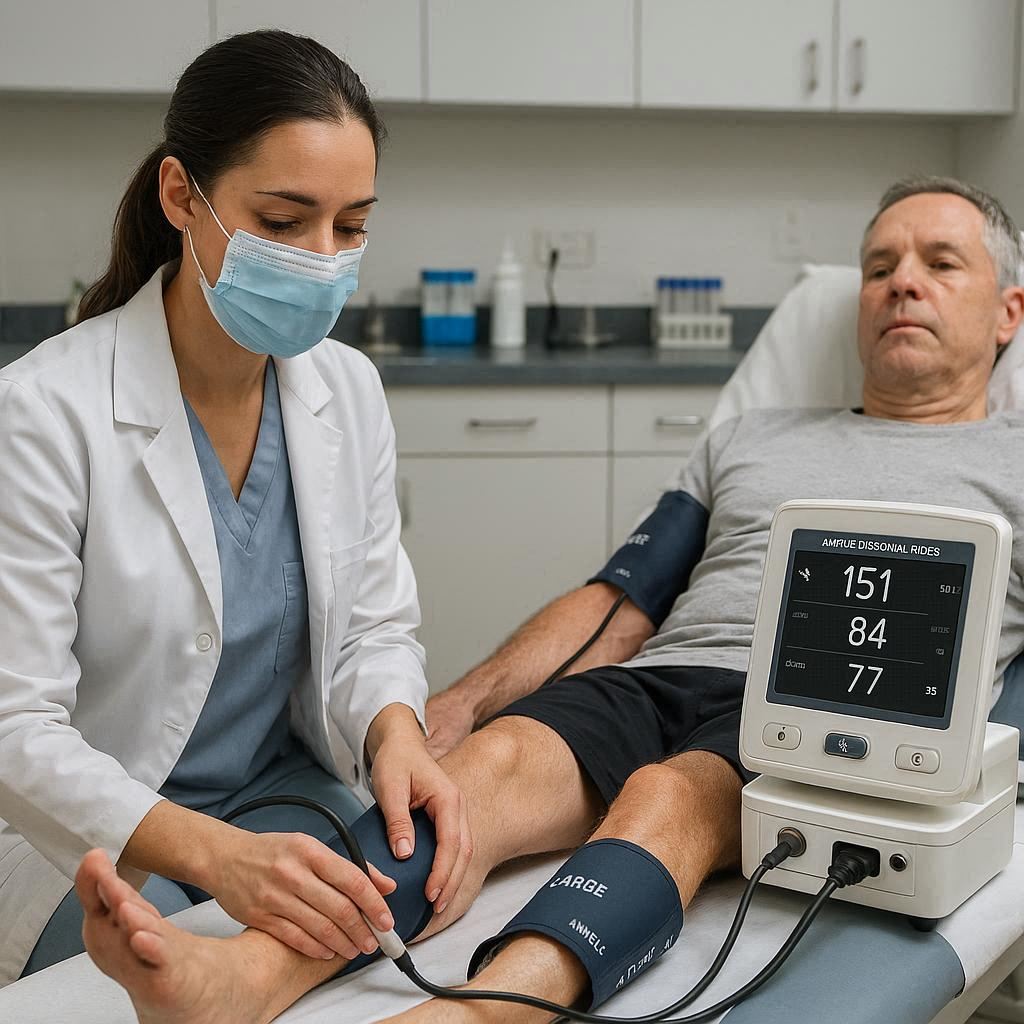
Before we talk about codes, it helps to remember what an ABI test actually does. The ankle-brachial index is a simple, non-invasive test. It compares the blood pressure in your ankle with the blood pressure in your arm.
Doctors use this test primarily to check for peripheral artery disease (PAD). PAD narrows the arteries in your legs, which reduces blood flow. The ABI test is quick, painless, and very useful for catching circulation problems early.
A normal ABI result falls between 1.0 and 1.4. A lower number suggests possible PAD. A higher number may indicate stiff, non-compressible arteries, which is common in some patients with diabetes or kidney disease.
Why the Correct ABI Test CPT Code Matters
Choosing the wrong CPT code can cause a few problems. Insurance companies may deny your claim. Or they might pay less than they should. In some cases, using the wrong code can even trigger an audit.
Every code represents a specific level of work. Some ABI tests are very basic. Others include complex exercises or multiple measurements. Billing for a complex test when you did a simple one is not honest. Billing for a simple test when you did a complex one leaves money on the table.
Getting it right matters for your practice and your patients.
The Main ABI Test CPT Codes at a Glance
There are three main codes you will use for ABI testing. Here is a quick look at each one.
| CPT Code | Description | Typical Use Case |
|---|---|---|
| 93922 | Limited bilateral non-invasive physiologic study | One or two levels, unilateral or bilateral, with resting measurements |
| 93923 | Complete bilateral non-invasive physiologic study | Three or more levels, with resting measurements and provocative testing (exercise or postural) |
| 93924 | Complete bilateral study with continuous monitoring | Same as 93923 but adds continuous recording of pressures with provocative testing |
Let us break these down in more detail.
CPT Code 93922: Limited Study
This is the simplest of the three codes. It covers a limited bilateral non-invasive physiologic study. In plain English, that means you measure blood pressure at one or two levels on the legs.
What Does 93922 Include?
- Segmental measurements at one or two levels.
- Measurements may be unilateral (one leg) or bilateral (both legs).
- Resting measurements only. No exercise or postural changes.
- Usually includes ankle pressures and brachial pressures.
- May include segmental pressures if performed.
When Should You Use 93922?
Use 93922 when the physician only needs a basic screening. For example, a patient with mild symptoms who just needs a quick check. Or a patient who cannot perform exercise due to other health issues.
This code is also appropriate when the clinical question is very narrow. Perhaps the doctor only wants to know if the ankle pressures are lower than the arm pressures. Nothing more.
Realistic Example for 93922
A 65-year-old patient with a history of smoking comes in for a routine check-up. She has no leg pain but has risk factors for PAD. The doctor orders a basic ABI screening at rest. The technician measures ankle pressures on both legs and brachial pressures on both arms. No exercise is performed.
In this case, 93922 is the correct code.
Limitations of 93922
You cannot use 93922 if you performed three or more levels of measurement. You also cannot use it if you did any kind of exercise or postural testing. And you should not use it for continuous monitoring.
CPT Code 93923: Complete Study
This code represents a more thorough examination. It covers a complete bilateral non-invasive physiologic study. That means you measure pressures at three or more levels on the legs.
What Does 93923 Include?
- Segmental measurements at three or more levels (for example, upper thigh, lower thigh, calf, and ankle).
- Bilateral measurements (both legs).
- Resting measurements.
- Provocative testing such as exercise or postural changes. This is a key difference from 93922.
When Should You Use 93923?
Use 93923 when the physician needs a complete picture of the patient’s arterial circulation. This is common for patients with known PAD who need to see how their condition responds to exercise. It is also used when resting ABIs are normal but the patient still has symptoms like leg pain with walking.
The provocative testing is important here. The patient may walk on a treadmill or do toe raises. Then the technician measures pressures again. This can reveal blockages that only show up when the muscles need more blood.
Realistic Example for 93923
A 58-year-old man has pain in his calves when he walks two blocks. His resting ABI is normal at 1.1. The doctor suspects exercise-induced PAD. The patient walks on a treadmill for five minutes or until his symptoms appear. Then the technician repeats the pressure measurements at three levels on both legs.
This scenario fits 93923 perfectly.
What Is Postural Testing?
Sometimes exercise is not possible. In that case, the doctor may use postural testing. The patient lies flat, then sits up, or changes leg positions. This can also change blood flow and reveal blockages. Postural testing counts as provocative testing for 93923.
CPT Code 93924: Complete Study with Continuous Monitoring
This is the most complex code. It covers a complete bilateral study, but with an important addition: continuous monitoring of pressures with provocative testing.
What Does 93924 Include?
- All the elements of 93923 (three or more levels, bilateral, provocative testing).
- Continuous recording of segmental pressures before, during, and after provocative testing.
Think of it this way. Code 93923 measures pressures at specific moments: before exercise and after exercise. Code 93924 measures pressures continuously throughout the process. That requires more equipment, more time, and more interpretation.
When Should You Use 93924?
Use 93924 when the physician needs to see exactly how pressures change in real time. This is less common in routine practice. It may be used in specialized vascular labs or for complex cases. For example, a patient with unclear symptoms where spot measurements do not tell the full story.
Important Note on 93924
This code is often overused. Many payers will expect to see clear documentation that continuous monitoring was actually performed. If you simply took a before and after measurement, use 93923, not 93924.
Note for readers: Always check your local payer policies. Some insurers do not cover 93924 at all. Others require prior authorization. Do not assume that a more complex code automatically means higher payment.
Side-by-Side Comparison Table
| Feature | 93922 | 93923 | 93924 |
|---|---|---|---|
| Number of levels | 1 or 2 | 3 or more | 3 or more |
| Laterality | Unilateral or bilateral | Bilateral | Bilateral |
| Resting measurements | Yes | Yes | Yes |
| Provocative testing (exercise or postural) | No | Yes | Yes |
| Continuous monitoring | No | No | Yes |
| Typical reimbursement | Lowest | Medium | Highest |
| Documentation required | Basic | Detailed | Very detailed |
How to Choose the Right ABI Test CPT Code
Choosing the correct code comes down to three questions. Answer these honestly, and you will usually land on the right code.
Question 1: How many levels did you measure?
Count the number of distinct segments where you recorded pressures. If you only measured the ankle and brachial levels, that is two levels (one level on the leg plus the arm). That points to 93922. If you measured three or more leg levels (such as upper thigh, calf, and ankle), you are looking at 93923 or 93924.
Question 2: Did you perform provocative testing?
If you only measured at rest, you cannot use 93923 or 93924. Those codes require exercise or postural changes. Resting only means 93922 is your only option, unless you measured three or more levels. But remember, 93922 only allows one or two levels. So if you did three levels at rest only, you have a problem. That scenario is not covered by any standard ABI code. You would need to check with your payer.
Question 3: Did you monitor continuously?
If you performed provocative testing but only took spot measurements before and after, use 93923. If you recorded pressures continuously throughout the test, use 93924. When in doubt, document exactly what you did. The documentation will support your code choice.
Common Billing Mistakes and How to Avoid Them
Even experienced billers make mistakes with these codes. Here are the most common errors.
Mistake 1: Using 93923 for a Resting Study
This is very common. A technician measures three levels on both legs but does no exercise. Someone bills 93923 because they think “complete” means more levels. That is incorrect. Without provocative testing, you cannot use 93923 or 93924. If you performed three or more levels at rest only, most payers expect you to use an unlisted code or bill 93922 with a modifier. Check your local policy.
Mistake 2: Using 93924 Without Continuous Monitoring
Some billers see 93924 as a way to get higher reimbursement. But if you did not actually perform continuous monitoring, this is upcoding. It is not honest, and it can lead to audits and penalties.
Mistake 3: Billing for Unilateral When You Did Bilateral
Code 93922 allows unilateral or bilateral. Codes 93923 and 93924 require bilateral. If you performed a complete study on only one leg, those codes do not apply. You may need to use a modifier or an unlisted code.
Mistake 4: Forgetting the Interpretation Component
These CPT codes include the technical component (performing the test) and the professional component (interpreting the results). If a non-physician performs the test and a physician interprets it later, you may need to use modifiers -TC and -26. This depends on your billing setup.
A Quick List: Documentation Must-Haves
To support your chosen ABI test CPT code, your documentation should include the following items.
- Patient’s symptoms and reason for the test.
- Resting brachial pressures (right and left).
- Resting ankle pressures (right and left).
- Segmental pressures if performed, with the exact levels noted.
- Method used (Doppler, plethysmography, or other).
- If provocative testing was done, describe the method (treadmill, toe raises, postural changes).
- Duration of exercise or type of postural change.
- Pressures measured after provocative testing.
- If 93924, include continuous recording strips or tracings.
- Interpretation and final ABI values.
- Signature of the interpreting physician.
Without these elements, your claim may be denied. Or worse, an auditor may ask for a refund.
Medicare and Private Payer Policies
Medicare has specific coverage guidelines for ABI testing. Generally, Medicare covers ABI testing for patients with symptoms of PAD or for those at high risk. But coverage rules vary by region.
Medicare Local Coverage Determinations (LCDs)
Each Medicare Administrative Contractor (MAC) issues its own LCD. These documents spell out exactly when each code is covered. Some MACs do not cover 93922 at all. Others require specific indications for 93923.
Always check your MAC’s LCD before billing. You can find these on the CMS website or your MAC’s portal.
Private Insurers
Private payers often follow Medicare rules, but not always. Some commercial insurers consider ABI testing part of a preventive visit. Others require prior authorization for 93923 or 93924.
Before performing a complete study with provocative testing, call the insurer. Ask if they cover 93923 or 93924 for the patient’s specific diagnosis. Get a prior authorization number if required.
Realistic Reimbursement Expectations
Reimbursement varies widely. It depends on your location, payer, and contract rates. But here are rough estimates to give you an idea.
| CPT Code | Medicare National Average (Facility) | Typical Private Payer Range |
|---|---|---|
| 93922 | 40−60 | 50−90 |
| 93923 | 90−130 | 110−200 |
| 93924 | 130−180 | 160−250 |
These are estimates only. Your actual reimbursement may be higher or lower. Remember that these amounts often include both technical and professional components. If you split the components, each party bills separately.
When Not to Bill an ABI Test CPT Code
Sometimes an ABI test is not the right service to bill. Here are a few scenarios.
In Office During a Preventive Visit
If the doctor performs a quick, informal ABI using a handheld Doppler during a routine exam, that may not be separately billable. The service may be considered part of the evaluation and management (E/M) visit.
Repeat Testing Too Soon
Most payers do not cover ABI testing more than once every 12 months for the same indication. If a patient needs more frequent testing, document the medical necessity clearly. Include why a repeat test is needed.
Screening Without Symptoms
For asymptomatic patients with risk factors, some payers cover a one-time ABI screening. Others do not. Check your local policy. For truly asymptomatic patients with no risk factors, insurance is unlikely to pay.
FAQ: ABI Test CPT Code
Q1: Can I use 93922 if I only test one leg?
Yes. CPT 93922 allows unilateral measurements. Codes 93923 and 93924 require bilateral studies.
Q2: What if I do three levels on one leg and two on the other?
You have performed a bilateral study with at least three levels on one side. Most coders would use 93923 if provocative testing was done, or they would look for guidance from their payer. This is a gray area. Document carefully.
Q3: Does toe-brachial index use the same codes?
No. Toe-brachial index (TBI) has its own CPT code: 93926. Do not use ABI codes for TBI studies.
Q4: What diagnosis codes support ABI testing?
Common ICD-10 codes include I73.9 (peripheral vascular disease, unspecified), I70.20 (atherosclerosis of native arteries of extremities), and R02.0 (gangrene, not elsewhere classified). Always link the diagnosis to the patient’s symptoms.
Q5: Can a medical assistant perform the ABI test?
Yes, under appropriate supervision. The supervising physician must be immediately available. The interpretation must be performed by a qualified provider.
Q6: Is there a separate code for exercise ABI?
No. Exercise ABI is included in 93923 and 93924. There is no standalone code for the exercise portion alone.
Q7: What modifier do I use for bilateral on 93922?
Modifier 50 (bilateral procedure) is not typically required for 93922 because the code description already includes bilateral. However, some payers want modifier 50. Check your payer’s policy.
Q8: How do I bill if the test is incomplete?
If the patient cannot complete the test due to pain or other issues, bill for the work performed. Append modifier 52 (reduced services) and document why the test was incomplete.
Additional Resources
For more detailed information, visit the American Medical Association (AMA) CPT® Code Lookup tool. You can find official code descriptors, guidelines, and updates directly from the source.
👉 AMA CPT Code Lookup (External Link)
You can also check your local Medicare Administrative Contractor’s website for specific LCDs related to non-invasive vascular studies.
Final Summary (Conclusion)
Choosing the correct ABI test CPT code comes down to three factors: the number of levels measured, whether provocative testing was performed, and if continuous monitoring was used. Use 93922 for limited resting studies, 93923 for complete studies with exercise or postural testing but spot measurements, and 93924 only when you truly monitor pressures continuously. Always document thoroughly and check payer policies before billing.
Disclaimer: This article is for educational purposes only. Coding and billing rules change frequently. Always verify current codes and payer policies before submitting claims. This information does not constitute legal or medical advice.