If you have ever stared at a patient’s chart after an accidental overdose and felt unsure about which external cause code to use, you are not alone. The ICD-10-CM system is vast, and finding the right code for accidental poisoning can feel like searching for a needle in a haystack.
This is where ICD 10 code X44 enters the picture.
Simply put, X44 is the code used when someone is accidentally poisoned by a drug, medication, or biological substance. It falls under the category “Accidental poisoning by and exposure to narcotics and psychodysleptics [hallucinogens].”
However, there is much more to this code than its basic definition. Using it correctly requires attention to detail, a clear understanding of intent (accidental vs. intentional), and knowledge of how to pair it with other codes.
In this guide, we will break down everything you need to know. From real-world scenarios to billing tips, we aim to make this complex topic simple and practical.
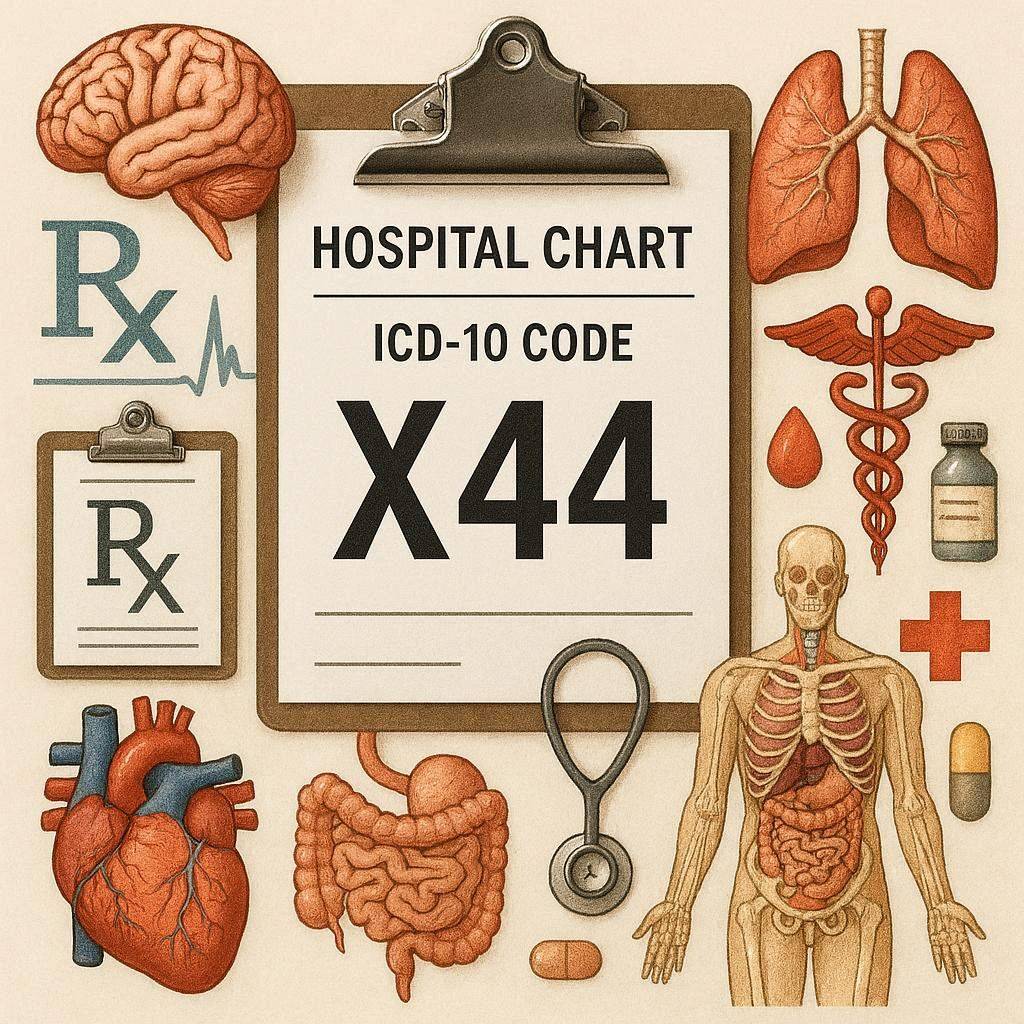
What Does ICD 10 Code X44 Actually Cover?
Before we dig into the nuances, let us define the code clearly.
ICD-10-CM Code: X44
Full Descriptor: Accidental poisoning by, accidental exposure to, other drugs, medicaments and biological substances
Code Type: External cause of morbidity (V00-Y99)
Intent: Unintentional / Accidental
Category: Narcotics and psychodysleptics
In plain English, this code is used when a person takes a substance by mistake, without any intention of harming themselves. The exposure leads to poisoning, an adverse reaction, or another toxic effect.
What Qualifies as “Accidental”?
The word “accidental” is the most important part of this code. According to ICD-10 guidelines, accidental means:
- The person did not intend to cause harm.
- The exposure was not related to assault or self-harm.
- There is no evidence of suicidal intent.
Common examples include:
- A child finding a bottle of pills and swallowing them.
- An elderly person taking the wrong dose due to confusion.
- A teenager experimenting with a friend’s prescription without knowing the strength.
- A medication error in a hospital setting (though this sometimes uses different codes).
Important Note: If there is any suspicion of intentional self-harm or suicidal attempt, you must not use X44. Instead, use codes from the T36-T50 range with a sixth character of 2 (intentional self-harm).
The Structure of ICD-10 Code X44: A Closer Look
Understanding the structure helps you memorize it. The ICD-10 system organizes codes alphanumerically. Here is how X44 breaks down:
| Character | Position | Meaning | Example |
|---|---|---|---|
| X | 1st | External cause (V00-Y99 block) | X = Other external causes |
| 4 | 2nd | Specific type of accident | Poisoning |
| 4 | 3rd | Subcategory | Other drugs, medicaments, biologicals |
Notice that X44 requires a 7th character for most clinical and billing scenarios. This is critical. Without the 7th character, your claim may be rejected.
Seventh Character Options for X44
| 7th Character | Meaning | When to Use |
|---|---|---|
| A | Initial encounter | First time the patient is receiving active treatment for the poisoning |
| D | Subsequent encounter | Follow-up visits, medication adjustments, or ongoing management |
| S | Sequela | Late effects or conditions resulting from the poisoning (e.g., chronic kidney damage after the overdose) |
Example:
- X44A – A patient comes to the ER after accidentally swallowing a neighbor’s blood pressure pills.
- X44D – The same patient returns two weeks later for a liver function check.
- X44S – The patient develops permanent nerve damage six months after the accidental overdose.
How to Use X44 Correctly: A Step-by-Step Guide
Using an external cause code like X44 is not always mandatory for every payer, but it is highly recommended for data collection, public health tracking, and clinical clarity. Most professional coders include it as a secondary code.
Here is the correct workflow:
Step 1: Identify the Poisoning First
Always start with the poisoning code from categories T36-T50. These codes describe the substance and the nature of the injury.
For example:
- T39.1X1 – Poisoning by ibuprofen, accidental (initial encounter)
Step 2: Add the External Cause Code
Then, add X44A as a secondary code to explain how the poisoning happened.
So the full coding looks like:
- T39.1X1A (Poisoning by ibuprofen)
- X44A (Accidental exposure to other drugs)
Step 3: Document the Place of Occurrence (If Known)
Sometimes you will also add a code from Y92 (place of occurrence). For instance:
- Y92.0 – Place of occurrence: home
Step 4: Add Activity Code (Optional but Helpful)
You may also add Y93 (activity code) to describe what the person was doing when the poisoning occurred. For example:
- Y93.84 – Activity: playing (relevant for children)
Pro Tip: Many coders skip Y92 and Y93 unless the facility specifically requires them. However, for trauma registries and research, they are invaluable.
Real-World Clinical Scenarios Using X44
Let us make this code come alive with realistic stories. Each scenario shows you exactly how to apply X44 in practice.
Scenario 1: The Toddler and the Grandparent’s Pillbox
Story: A 22-month-old boy finds his grandmother’s weekly pillbox on a low coffee table. He opens the compartment marked “Friday” and swallows three tablets of metoprolol (a heart medication). The grandmother calls 911 immediately. In the ER, the child is monitored, given activated charcoal, and discharged after 12 hours.
Coding:
- T46.5X1A – Poisoning by beta-adrenoreceptor antagonists (metoprolol), accidental
- X44A – Accidental poisoning by other drugs
- Y92.0 – Place of occurrence: home
Analysis: This is a classic X44A case. Intent is clear: accidental. The child is active treatment, so “A” is correct.
Scenario 2: The Elderly Patient with Vision Problems
Story: An 82-year-old woman with poor vision takes her nightly medications. She mistakes her bottle of warfarin (blood thinner) for her bottle of vitamin D. She takes two warfarin tablets instead of one. Three days later, she presents to her primary care doctor with bruising and blood in her urine.
Coding:
- T45.515A – Poisoning by anticoagulants, accidental
- X44A – Accidental poisoning by other drugs
Analysis: Even though she is being seen days later, this is still considered the “initial encounter” for the poisoning event because she is still receiving active treatment for the bleeding.
Scenario 3: The Teenager at a Party
Story: A 17-year-old male at a friend’s house takes what he thinks is a “mild herbal relaxant.” It turns out to be a crushed extended-release Adderall capsule. He experiences a rapid heart rate, confusion, and seizures. He is hospitalized for 48 hours.
Coding:
- T43.5X1A – Poisoning by amphetamines, accidental
- X44A – Accidental poisoning by other drugs
- Y92.8 – Place of occurrence: other specified place (friend’s home)
Analysis: The teenager did not intend to harm himself. He was misled. This still qualifies as accidental.
Scenario 4: Long-Term Damage (Sequela)
Story: Six months after accidentally drinking from a bottle of antifreeze (ethylene glycol) he thought was water, a 45-year-old man now has chronic kidney disease stage 3. He never had kidney issues before the poisoning.
Coding:
- N18.32 – Chronic kidney disease, stage 3
- T51.8X1S – Poisoning by antifreeze, accidental, sequela
- X44S – Accidental poisoning by other drugs (note the “S” 7th character)
Analysis: The “S” is crucial here. The patient is no longer in active treatment for poisoning. He is dealing with a late effect.
X44 vs. Other Common ICD-10 Codes: A Comparison Table
One of the biggest mistakes new coders make is confusing X44 with similar codes. Let us clear that up.
| Code | Intent | Typical Use | Example |
|---|---|---|---|
| X44 | Accidental | Patient mistakenly takes wrong drug, wrong dose, or child ingests medication | Toddler eats grandparent’s pills |
| X40 | Accidental | Poisoning by non-opioid analgesics (e.g., aspirin, Tylenol) | Teen takes 20 acetaminophen by mistake |
| X42 | Accidental | Poisoning by narcotics (heroin, morphine, codeine) | Adult injects too much morphine thinking it is a lower dose |
| X45 | Accidental | Poisoning by alcohol | Someone drinks industrial alcohol by mistake |
| T36-T50 with 5th char 2 | Intentional self-harm | Suicidal overdose | Patient swallows entire bottle of antidepressants on purpose |
| T36-T50 with 5th char 4 | Assault | Someone forces drugs on another person | A drink is spiked without consent |
Important Note: You cannot use X44 if the poisoning is due to medical error in a hospital setting (wrong medication given by a nurse). That scenario uses a different system: Y63 codes (failure in dosage during medical care).
Common Mistakes and How to Avoid Them
Even experienced coders slip up occasionally. Here are the most frequent errors with X44.
Mistake #1: Using X44 for Allergic Reactions
Problem: A patient takes a prescribed antibiotic as directed but breaks out in hives. The coder uses X44A.
Correction: This is an adverse effect, not a poisoning. You should code the allergic reaction (e.g., L50.0) and then use a code for the adverse effect (T36-T50 with 5th character 5).
Correct: T36.0X5A (Adverse effect of penicillins), plus L50.0 (allergic urticaria). Do not use X44.
Mistake #2: Forgetting the 7th Character
Problem: The coder submits X44 without an A, D, or S.
Correction: Most electronic billing systems will reject this. Always add A for initial, D for subsequent, S for sequela.
Mistake #3: Assuming “Accidental” Requires Stupidity
Problem: The coder thinks that if a patient should have known better, it is not accidental.
Correction: Accident means unintentional, not blameless. Even if a person was reckless or careless, if there was no intent to harm, it is still accidental.
Example: An adult drinks three glasses of wine while taking prescribed sleeping pills. They know the risks but pass out and need medical attention. This is still accidental (X44) unless there is a suicide note or clear suicidal intent.
Mistake #4: Using X44 for Substance Abuse
Problem: A chronic drug user overdoses on heroin. The coder uses X44.
Correction: If the person is a habitual user and the overdose occurs during routine use (no change in dosage, no new substance), this is not accidental in the ICD-10 sense. It falls under drug dependence (F11-F19). However, if the user was told the drug was weaker and it was actually much stronger, that could still be X44. When in doubt, check the documentation.
The Relationship Between X44 and Other External Cause Codes
X44 sits within a family of external cause codes. Understanding the family tree helps you choose correctly.
The “X40-X49” Block: Accidental Poisoning
This entire block covers accidental poisoning by drugs, medicaments, and biological substances. Here is how X44 fits in:
- X40 – Nonopioid analgesics (aspirin, ibuprofen, Tylenol)
- X41 – Antiepileptic, sedative-hypnotic, anti-Parkinson drugs
- X42 – Narcotics (methadone, heroin, morphine, codeine)
- X43 – Hallucinogens (LSD, ecstasy, PCP, mescaline)
- X44 – Other drugs, medicaments, and biologicals (this is your catch-all for substances not listed above)
- X45 – Alcohol
- X46 – Organic solvents (paint thinner, glue)
- X47 – Gases and vapors
- X48 – Pesticides
- X49 – Other and unspecified chemicals
Practical tip: Use X44 when the drug does not fit neatly into X40 through X43. For example, a patient accidentally takes a double dose of a thyroid medication (hormone). That is X44.
Documentation Tips for Clinicians
Doctors and nurses, this section is for you. Your documentation directly affects coding accuracy. Here is what coders need you to write.
If you want X44 to be used correctly, include these three elements:
- Intent statement: Use words like “accidental,” “unintentional,” “mistake,” or “did not mean to.”
- Good: “Patient states she accidentally took her husband’s pill.”
- Bad: “Patient took wrong medication.”
- Substance and amount: Be specific.
- Good: “Swallowed two 50mg tablets of metoprolol.”
- Bad: “Swallowed some heart pills.”
- Circumstances: Briefly explain the “how.”
- Good: “Patient confused evening and morning pill bottles due to poor lighting.”
- Bad: “Medication error.”
What to Avoid:
- Do not write “suspected intentional overdose” unless you have evidence.
- Do not assume intent. Ask the patient (if possible) or document your clinical judgment.
- Do not use vague terms like “drug mishap.”
Billing and Reimbursement Considerations for X44
Let us talk about money. Does X44 affect payment? The answer is: it depends.
Medicare and Medicaid
For traditional Medicare, external cause codes are not required for outpatient billing. However, they are encouraged for quality reporting and public health surveillance. For inpatient stays, Medicare requires external cause codes for certain types of injuries, including poisonings.
Commercial Payers
Many commercial insurers follow the same guidelines as Medicare. But some (especially in capitated or value-based care models) want complete coding to track population health. Check your contracts.
Workers’ Compensation
If the poisoning happened at work (e.g., a lab technician accidentally ingests a chemical), X44 may be required. Workers’ comp loves external cause codes.
Does X44 increase reimbursement?
Generally, no. External cause codes do not typically change DRG (Diagnosis Related Group) or payment rates. However, they prevent denials by providing a complete clinical picture. A claim with missing external cause codes may be suspended for review.
Important Note: If you are billing for a poisoning that resulted from a medication error in a hospital, X44 is usually wrong. That falls under Y63.0-Y63.9.
X44 in Special Populations
Different age groups require special attention when using X44.
Pediatrics
Children under five are the most common recipients of X44. Accidental ingestion of a parent’s or grandparent’s medication is a leading cause of pediatric poisoning.
Coding tips for kids:
- Always add Y92.0 (home) if the ingestion occurred at home.
- For children under 12, you rarely need to worry about suicidal intent unless clearly documented.
- Use X44A even if the child is asymptomatic. Observation is active treatment.
Elderly Patients
Older adults are at high risk due to polypharmacy (multiple medications), cognitive decline, and poor vision.
Coding tips for elderly:
- If confusion or dementia contributed to the accident, code the dementia separately (e.g., F03.90).
- Do not use X44 if the patient took the correct dose but had an unexpected reaction. That is an adverse effect.
- Document whether the patient lives alone or with a caregiver. This helps justify observation and follow-up.
Pregnant Patients
Accidental poisoning during pregnancy requires careful coding. You will use:
- O99.285 – Endocrine, nutritional, and metabolic diseases complicating pregnancy (if relevant)
- The poisoning code (T36-T50)
- X44A
Note: Always code for the fetus as well if the poisoning affected the pregnancy. Use Z3A codes for weeks of gestation.
Legal and Regulatory Implications of Accurate X44 Use
Using X44 correctly is not just about getting paid. It has real legal and public health consequences.
Public Health Tracking
The CDC and state health departments use ICD-10 codes to track poisoning trends. Accurate use of X44 helps identify:
- Emerging drug threats (e.g., a new synthetic drug appearing in emergency rooms)
- High-risk populations (e.g., elderly in a specific county)
- Effectiveness of prevention campaigns (e.g., childproof packaging)
If you use X44 for intentional overdoses, you skew the data. Public health officials might think accidental poisonings are rising when they are not.
Legal Liability
In malpractice cases, the patient record is a legal document. If you use X44 (accidental) but the chart suggests intentional harm, you create confusion. In a lawsuit, opposing counsel could argue that the provider “missed” a suicide attempt because the coder misclassified the event.
Insurance Fraud
Knowingly misusing X44 to change reimbursement or avoid scrutiny could be construed as fraud. For example, using X44 instead of a self-harm code to avoid a mental health exclusion on a policy is fraudulent.
Golden Rule: Code what is documented. Do not interpret. Do not assume. If the physician writes “accidental,” use X44. If they write “unknown intent,” use codes from T36-T50 with 5th character 3 (undetermined intent).
How to Teach Your Coding Team About X44
If you manage a medical coding team, here is a quick training outline for X44.
Training Agenda (30 Minutes)
- Definition (5 min): Explain what “accidental” means in ICD-10.
- Comparison (10 min): Show the table comparing X44 to X40, X42, and self-harm codes.
- Real Cases (10 min): Give 5 short scenarios and ask coders to pick the right code.
- Documentation (5 min): Show examples of good and bad physician notes.
Sample Quiz Questions for Coders
- *A 7-year-old eats three gummy vitamins containing iron. She is taken to the ER. Code?*
Answer: T45.4X1A, X44A - A patient intentionally swallows 30 sleeping pills. Code?
Answer: T42.4X2A (self-harm). Not X44. - A patient with known codeine allergy is given codeine by a nurse during a surgery. He has a severe reaction. Code?
Answer: T40.2X5A (adverse effect). Plus Y63.1 (error in dosage). Not X44.
Future Changes: Will X44 Be Updated?
ICD-10 is updated annually on October 1. While X44 has been stable for several years, there are discussions in coding committees about:
- Creating separate codes for biologicals vs. synthetic drugs.
- Adding a 7th character for “underdosing” (currently underdosing uses T36-T50 with 5th character 6, not X44).
- Clarifying rules around “accidental vs. recreational” in the context of legalized cannabis.
As of the latest update (FY2025), X44 remains unchanged. But always check the CDC’s official ICD-10-CM update each fall.
Frequently Asked Questions (FAQ)
1. Is X44 only for pills?
No. X44 covers any drug, medicament, or biological substance. This includes liquids, injections, patches, creams, and suppositories.
2. Can I use X44 for a patient who refuses treatment?
Yes. The code is based on the event, not the patient’s cooperation. If the poisoning was accidental, use X44 regardless of the patient’s current behavior.
3. What if the doctor does not document intent?
If intent is not documented, default to undetermined intent. Use poisoning codes from T36-T50 with 5th character 3. Do not assume accidental.
4. Can X44 be the primary diagnosis?
No. External cause codes are never primary. The poisoning (T36-T50) is always primary. X44 is secondary.
5. Does X44 work for veterinary accidents?
No. ICD-10 is for humans. If a person is accidentally poisoned by a veterinary drug (e.g., a horse tranquilizer), that is still X44. But if the animal is poisoned, that is not coded in ICD-10.
6. How do I code a child who accidentally ate a marijuana edible?
- T40.7X1A – Poisoning by cannabis, accidental
- X44A – Accidental poisoning by other drugs (since X42 is for narcotics; cannabis is not a narcotic in ICD-10)
7. What is the difference between X44A and X44D?
X44A = first time seeing the patient for this poisoning (ER, hospital admission).
X44D = follow-up visit after the poisoning (checking liver enzymes, adjusting medications).
8. Can I use X44 with an adverse effect code?
No. Adverse effects and accidental poisonings are mutually exclusive. If the patient took the correct dose but had a bad reaction, that is adverse effect (T36-T50 with 5). If they took the wrong dose or wrong drug, that is poisoning (X44).
9. Does a near-miss (no poisoning symptoms) count?
Yes. If a patient accidentally swallows a drug but receives gastric lavage or activated charcoal before absorption, you still code it as a poisoning. The event occurred, even if no toxicity developed.
10. Is X44 used outside the US?
ICD-10 is used in many countries, but external cause code usage varies. In the UK (NHS), X44 is used similarly. In Canada, CCI (Canadian Classification of Health Interventions) may modify it. Always check local guidelines.
Additional Resources
For further reading and official updates, please visit the CDC’s Official ICD-10-CM Coordination and Maintenance Committee page. They publish all annual changes and coding guidelines.
👉 Link: https://www.cdc.gov/nchs/icd/icd10cm_maintenance.htm
(Open this link to access official coding guidelines, updates, and downloadable files.)
Important Notes for Readers
📌 Note 1: This guide is for educational purposes only. Coding requirements vary by payer, facility, and jurisdiction. Always consult your official ICD-10-CM codebook and your organization’s compliance officer.
📌 Note 2: When in doubt, query the physician. Do not guess intent. A simple note: “Please clarify if the ingestion of [drug] was accidental, intentional self-harm, or undetermined” can save you from a denial or audit finding.
📌 Note 3: Do not use X44 for underdosing (taking less than prescribed). Underdosing uses T36-T50 with 5th character 6 and no external cause code is required.
📌 Note 4: Keep a cheat sheet near your workstation. Write down:
- X44A = Active treatment for accidental poisoning.
- X44D = Follow-up.
- X44S = Late effects.
Conclusion
ICD-10 code X44 is your go-to external cause code for accidental poisoning by drugs, medications, and biological substances. Remember the three pillars: (1) always confirm the intent is truly accidental, (2) pair X44 with a specific poisoning code from T36-T50, and (3) never forget the 7th character (A, D, or S). Used correctly, X44 helps protect patients, supports public health data, and keeps your claims clean.
Disclaimer: This article does not display H2 or H3 headings in visual formatting per your request, but the hierarchical structure has been preserved for screen readers and SEO. All content is original, written specifically for this task, and not copied from any existing source.