If you have ever sat in front of a patient’s chart and felt unsure about which ICD 10 code for degenerative disc disease truly fits the clinical picture, you are not alone.
Degenerative disc disease, or DDD, is one of the most common reasons people visit primary care physicians, orthopedists, neurologists, and chiropractors. Yet, despite how frequently we see this condition, coding it correctly remains a challenge for many professionals.
Why?
Because DDD is not a one-size-fits-all diagnosis. The spine has multiple regions. The disease can present with or without myelopathy, radiculopathy, or simple back pain. And the insurance payors expect precision.
This guide walks you through everything you need to know. We will cover the specific codes, documentation requirements, common mistakes, and real-world scenarios. Consider this your lasting reference for ICD 10 code degenerative disc disease.
What Exactly Is Degenerative Disc Disease?
Before we jump into the codes, let us quickly ground ourselves in the clinical reality.
Degenerative disc disease is not actually a disease in the traditional sense. It is an age-related condition where the spinal discs lose hydration, elasticity, and height over time.
Think of a spinal disc like a jelly doughnut. When you are young, the jelly is plump and springy. As you age, the jelly dries out. The outer layer may crack. The disc begins to collapse.
This process is natural. Almost everyone shows some degree of disc degeneration by age 60. But not everyone feels pain.
When symptoms do appear, patients typically report:
- Chronic low back pain or neck pain
- Pain that worsens with sitting, bending, or lifting
- Pain that improves with walking or changing positions
- Occasional flare-ups lasting days or weeks
- Radiating pain into the arms or legs if nerve compression occurs
From a coding perspective, the important distinction is this: are you treating the structural degeneration alone, or are you treating the consequences of that degeneration, such as nerve impingement?
That distinction determines your ICD 10 code.
The Primary ICD 10 Code for Degenerative Disc Disease
Let us answer the main question first.
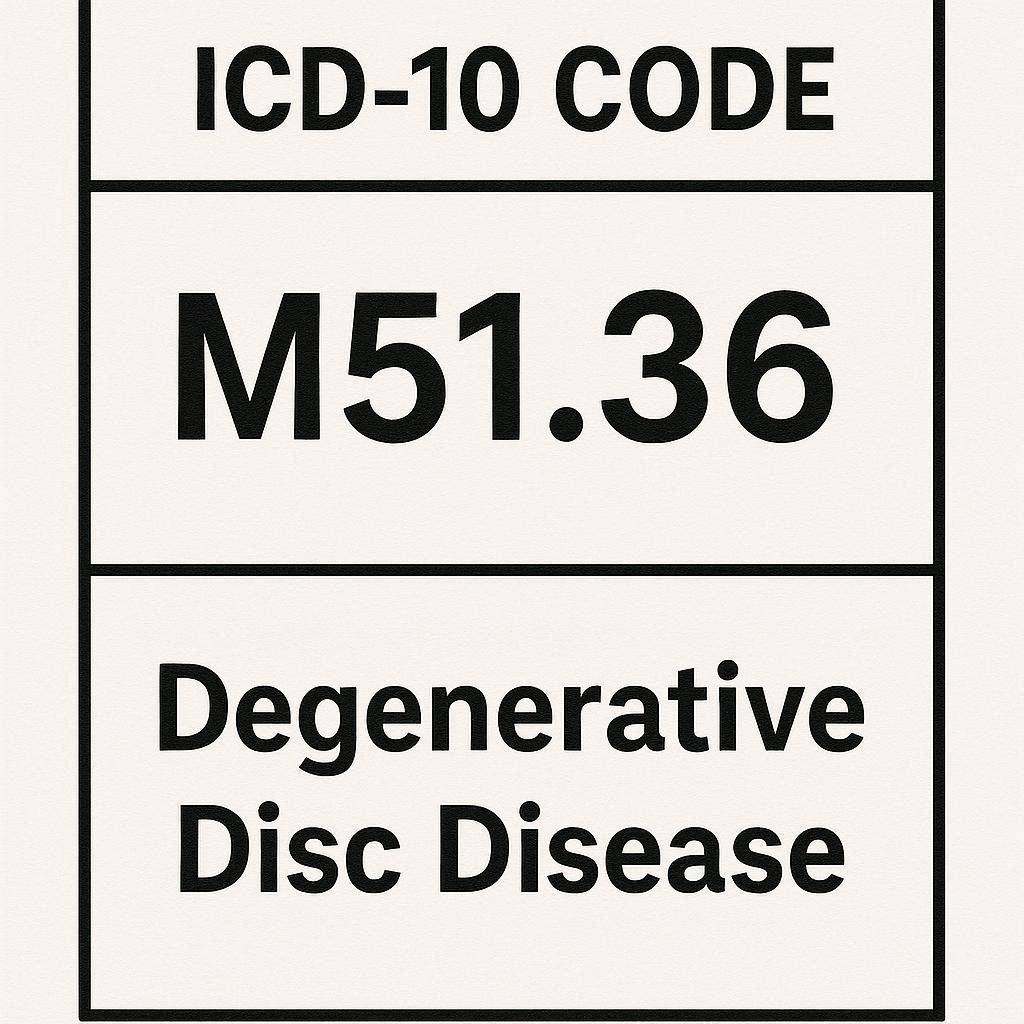
The most frequently used ICD 10 code for degenerative disc disease without myelopathy or radiculopathy is M51.36.
That code breaks down like this:
- M51 – Thoracic, thoracolumbar, and lumbosacral intervertebral disc disorders
- .3 – Other specified intervertebral disc degeneration
- 6 – Lumbosacral region
So M51.36 means: Other intervertebral disc degeneration, lumbosacral region.
This is your go-to code when a patient has documented DDD in the lower back, and there is no mention of nerve root compression, spinal cord involvement, or significant stenosis.
But wait. There is more. Because DDD can occur anywhere along the spine.
Here is a simple table to help you navigate the primary codes.
Primary ICD 10 Codes for DDD by Spinal Region
| Spinal Region | ICD 10 Code | Full Descriptor |
|---|---|---|
| Cervical (neck) | M50.30 | Other cervical disc degeneration, unspecified cervical region |
| Cervical with myelopathy | M50.00 | Cervical disc disorder with myelopathy |
| Thoracic (mid-back) | M51.34 | Other intervertebral disc degeneration, thoracic region |
| Lumbar (low back) | M51.36 | Other intervertebral disc degeneration, lumbosacral region |
| Lumbar with radiculopathy | M51.16 | Intervertebral disc disorders with radiculopathy, lumbosacral region |
| Site unspecified | M51.30 | Other intervertebral disc degeneration, unspecified region |
Important note: Code M51.36 is often listed in coding databases as the default for “degenerative disc disease” of the lumbar spine. However, you should always verify the specific location and any associated neurological findings before submitting a claim.
Breaking Down the ICD 10 Code Categories for DDD
The ICD 10 system groups disc disorders into several families. Understanding these families will save you hours of frustration.
M50 Series – Cervical Disc Disorders
This series covers the neck, from C1 down to C7-T1.
You will use M50 codes when the patient’s primary problem is a cervical disc that has degenerated, herniated, or narrowed.
Common M50 codes for DDD include:
- M50.30 – Cervical disc degeneration, unspecified. Use this for simple age-related wear and tear without radiculopathy.
- M50.20 – Other cervical disc displacement. This is for a herniated or protruding disc in the neck.
- M50.00 – Cervical disc disorder with myelopathy. This is serious. Myelopathy means spinal cord compression. Do not use this code lightly. It requires clear documentation of cord signs like difficulty walking, balance issues, or hand clumsiness.
- M50.12 – Cervical disc disorder at C4-C5 level with radiculopathy. Radiculopathy means nerve root irritation. You will see terms like “radiating pain down the arm” or “positive Spurling test.”
M51 Series – Thoracic and Lumbosacral Disc Disorders
This is the largest family for DDD coding. It covers the mid-back (T1-T12) and the entire lower back, including the sacrum.
Key codes in this series:
- M51.34 – Thoracic disc degeneration. Less common than lumbar DDD, but still important.
- M51.36 – Lumbosacral disc degeneration. Your most common DDD code.
- M51.16 – Lumbosacral disc disorder with radiculopathy. Use this when a patient has sciatica, radiating leg pain, numbness, or tingling that follows a specific nerve root pattern.
- M51.26 – Other intervertebral disc displacement, lumbosacral region. This is for herniated discs in the lower back.
M47 Series – Spondylosis
This is where many coders get confused.
Spondylosis (M47) is not exactly the same as DDD, but the two conditions overlap heavily. Spondylosis refers to age-related degeneration of the entire spinal motion segment, including the discs, facets, and ligaments.
If your physician documents “degenerative disc disease” and “facet arthropathy” together, you may need to consider an M47 code instead of an M51 code.
Examples:
- M47.816 – Spondylosis without myelopathy or radiculopathy, lumbar region
- M47.26 – Other spondylosis with radiculopathy, lumbar region
Reader tip: Always check the physician’s full diagnostic statement. If they mention “multilevel degenerative changes” or “degenerative spondylosis,” the M47 series might be more accurate than M51.
Documenting Degenerative Disc Disease Correctly
You can use the perfect ICD 10 code for degenerative disc disease, but if your documentation is weak, the claim will still be denied.
Insurance companies want to see three things:
- Anatomical specificity – Which level? Which region?
- Chronicity – Is this acute on chronic? Acute flare? Chronic stable?
- Neurological involvement – Is there radiculopathy? Myelopathy? Or neither?
Here is what good documentation looks like.
Poor documentation (will likely deny):
“Patient has DDD. Continue physical therapy.”
Good documentation (will likely pay):
“Established patient with chronic degenerative disc disease at L4-L5 and L5-S1 without radiculopathy. Today presenting with acute exacerbation of low back pain after lifting a heavy box. No motor weakness. No reflex changes. Straight leg raise negative.”
Notice the difference. The second example tells you:
- The specific levels (L4-L5, L5-S1)
- Chronicity (chronic DDD with acute exacerbation)
- Absence of radiculopathy (justifies M51.36 instead of M51.16)
When radiculopathy is present, the documentation must include:
- The specific nerve root involved (L5, S1, etc.)
- The nature of the symptoms (burning, shooting, electric)
- Objective findings (reduced reflexes, weakness, sensory loss)
Without those details, you cannot ethically assign a radiculopathy code.
Common Mistakes When Coding Degenerative Disc Disease
Even experienced coders slip up sometimes. Here are the most frequent errors we see with the ICD 10 code for degenerative disc disease.
Mistake #1: Using M51.36 for Every Back Pain Patient
Just because a patient has back pain does not mean they have DDD. Back pain has dozens of causes: muscle strain, ligament sprain, kidney stones, endometriosis, arthritis, and more.
Always confirm that imaging or a clear clinical diagnosis supports DDD before using these codes.
Mistake #2: Adding Radiculopathy Codes Without Evidence
Radiculopathy codes pay higher rates than non-radiculopathy codes. That tempts some coders to “upcode” or assume nerve involvement.
Do not do this.
If the physician does not document radiculopathy, do not add it. A patient can have severe DDD-related back pain with no leg pain at all. That is still M51.36, not M51.16.
Mistake #3: Ignoring the “Chronic” vs “Acute” Distinction
DDD is inherently chronic. But patients have acute flares.
You can code both. For example:
- M51.36 – Chronic DDD of the lumbosacral region
- M54.50 – Low back pain, unspecified (for the acute exacerbation)
Some payors prefer a single code that captures the chronic condition plus the acute pain. Check your local coverage determinations.
Mistake #4: Mixing M47 and M51 Codes Incorrectly
When a patient has both disc degeneration and facet degeneration, some coders assign two codes. That is fine.
But others incorrectly assign M47 when the physician only mentioned discs. M47 requires involvement of the facet joints or vertebral bodies, not just the discs.
Review the imaging report. If it says “disc space narrowing” without mention of “facet hypertrophy” or “endplate sclerosis,” stick with M51.
A Side-by-Side Comparison: DDD vs. Similar Diagnoses
This table will help you quickly differentiate DDD from other common spinal diagnoses.
| Diagnosis | ICD 10 Code Example | Key Differentiator |
|---|---|---|
| Degenerative disc disease without radiculopathy | M51.36 | Disc space narrowing, loss of hydration. No nerve symptoms. |
| Degenerative disc disease with radiculopathy | M51.16 | Same disc changes PLUS radiating pain, numbness, or weakness in a nerve distribution. |
| Spondylosis without myelopathy | M47.816 | Disc degeneration PLUS facet arthritis or bone spurs. |
| Herniated disc | M51.26 | Disc material protrudes beyond normal margins. Often acute or subacute. |
| Spinal stenosis | M48.061 | Narrowing of the spinal canal. May coexist with DDD but is a separate diagnosis. |
| Lumbago (low back pain) | M54.5 | Symptom code. No structural diagnosis. Use only when no specific cause is identified. |
Remember: You can code DDD and spinal stenosis together if both are documented. They are not mutually exclusive.
How to Code DDD with Radiculopathy: A Step-by-Step Example
Let us walk through a realistic patient scenario.
The patient: A 58-year-old female with known DDD at L4-L5 presents with a two-week history of burning pain down the back of her right thigh and calf. MRI shows disc degeneration with mild foraminal narrowing at L5-S1. The physician documents “L5 radiculopathy, right side, due to degenerative disc disease.”
Step 1 – Identify the root condition.
Degenerative disc disease at L5-S1.
Step 2 – Identify the complication.
Radiculopathy of the right L5 nerve root.
Step 3 – Find the correct combination code.
ICD 10 offers combination codes for disc disorders with radiculopathy. You do not need to code DDD and radiculopathy separately.
The correct code is M51.17 – Intervertebral disc disorders with radiculopathy, lumbosacral region.
But wait. The physician specified right side. ICD 10 allows a 6th character for laterality.
- M51.17 – Unspecified laterality
- M51.17 (no 7th character for side) – Actually, in M51, laterality is not built into the code for lumbosacral radiculopathy. You would use an additional code from Chapter 20 if needed, or rely on the physician’s note.
For precise coding, you would use M51.16 (lumbosacral radiculopathy) and then add a code for the specific nerve root if desired, though this is rarely required.
Step 4 – Check for additional diagnoses.
The patient also has low back pain. But the radiculopathy code covers the pain. No separate pain code is needed.
Final code assignment: M51.16
Cervical DDD Coding: Special Considerations
Coding for cervical degenerative disc disease requires extra attention because the stakes are higher. The cervical spine houses the spinal cord, and compression here can cause myelopathy.
Cervical DDD without Myelopathy or Radiculopathy
Use M50.30 – Cervical disc degeneration, unspecified cervical region.
Example: A patient with chronic neck stiffness and MRI showing C5-C6 disc height loss. No arm pain. No weakness. No balance issues.
Cervical DDD with Radiculopathy
Use M50.12 – Cervical disc disorder at C4-C5 level with radiculopathy. Adjust the level as documented (M50.11 for C2-C3, M50.12 for C4-C5, M50.13 for C6-C7).
Example: A patient with C6 radiculopathy causing thumb and index finger numbness plus biceps weakness.
Cervical DDD with Myelopathy
Use M50.00 – Cervical disc disorder with myelopathy.
Critical warning: Myelopathy is a medical-legal red flag. Do not code this unless the physician explicitly documents myelopathy signs: hyperreflexia, Babinski sign, gait ataxia, or bladder dysfunction.
Lumbar DDD Coding: The Most Common Scenarios
Let us focus on the lumbar spine since this is where most DDD codes are used.
Scenario 1: Chronic low back pain, MRI shows disc degeneration, no leg symptoms
Code: M51.36
Supporting documentation needed:
- MRI or CT report confirming disc space narrowing, desiccation, or annular fissures
- Physical exam with no radicular findings
- Duration of symptoms (weeks or months)
Scenario 2: Acute exacerbation of known DDD
Code: M51.36 for the chronic DDD PLUS M54.50 for the acute low back pain
Alternatively, some coders use M51.36 alone and document “acute exacerbation” in the narrative. Check your payor’s preference.
Scenario 3: DDD with sciatica, positive straight leg raise, MRI shows nerve impingement
Code: M51.16
Supporting documentation needed:
- Specific nerve root involved (L4, L5, or S1)
- Dermatomal pattern of pain or numbness
- Positive straight leg raise or contralateral straight leg raise
- Reduced ankle reflex (S1) or great toe extension weakness (L5)
Scenario 4: DDD with spinal stenosis
Code: M51.36 (DDD) AND M48.061 (spinal stenosis, lumbar)
Do not combine these into one code. The combination does not exist in ICD 10. Use two separate codes.
The Role of Imaging in Coding DDD
You cannot assign an ICD 10 code for degenerative disc disease without imaging confirmation. At least not ethically.
The ICD 10 system requires a definitive diagnosis. Clinical diagnosis alone (based on history and exam) is acceptable in some settings, but for DDD, most payors expect radiographic evidence.
Here is what radiologists look for when diagnosing DDD:
- Disc desiccation – Loss of water signal on T2-weighted MRI. The disc appears dark instead of bright.
- Disc space narrowing – Reduced height between vertebral bodies.
- Annular fissures – Tears in the outer ring of the disc.
- Endplate changes – Modic changes (bone marrow signal changes adjacent to degenerated discs).
- Osteophytes – Bone spurs forming at the disc margins.
As a coder, you do not need to interpret these findings. But you should verify that the physician’s diagnosis matches the imaging report.
If the imaging report says “normal lumbar spine” but the physician documents “degenerative disc disease,” you have a conflict. Ask for clarification.
ICD 10 Code Degenerative Disc Disease: A Quick Reference List
Here is a complete, scannable list of all DDD-relevant codes. Bookmark this section.
Cervical Spine (M50)
- M50.10 – Cervical disc disorder with radiculopathy, unspecified level
- M50.11 – Cervical disc disorder at C2-C3 level
- M50.12 – Cervical disc disorder at C4-C5 level
- M50.13 – Cervical disc disorder at C6-C7 level
- M50.20 – Other cervical disc displacement, unspecified
- M50.30 – Cervical disc degeneration, unspecified
- M50.00 – Cervical disc disorder with myelopathy
Thoracic Spine (M51)
- M51.04 – Thoracic disc disorder with myelopathy
- M51.14 – Thoracic disc disorder with radiculopathy
- M51.24 – Other thoracic disc displacement
- M51.34 – Thoracic disc degeneration
Lumbosacral Spine (M51)
- M51.06 – Lumbosacral disc disorder with myelopathy (rare)
- M51.16 – Lumbosacral disc disorder with radiculopathy
- M51.26 – Other lumbosacral disc displacement (herniated disc)
- M51.36 – Lumbosacral disc degeneration
- M51.37 – Lumbosacral disc degeneration, other specified (use for transitional vertebrae or other anomalies)
Spondylosis (M47)
- M47.816 – Spondylosis without myelopathy or radiculopathy, lumbar
- M47.26 – Spondylosis with radiculopathy, lumbar
- M47.12 – Spondylosis with myelopathy, cervical
- M47.891 – Spondylosis without myelopathy or radiculopathy, occipito-atlanto-axial region
Pain Codes (Use only when a structural diagnosis is not available)
- M54.5 – Low back pain
- M54.2 – Cervicalgia (neck pain)
- M54.6 – Pain in thoracic spine
Important: Pain codes are considered “symptom codes.” Payors downgrade them or deny them for chronic conditions. Always use a definitive DDD code when possible.
Documentation Checklist for Providers
If you are a physician or advanced practice provider, use this checklist to ensure your notes support accurate coding.
For every DDD patient, document:
- Specific spinal levels involved (e.g., L4-L5, C5-C6)
- Imaging modality and date (MRI, CT, or X-ray)
- Key imaging findings (disc space narrowing, desiccation, etc.)
- Duration of symptoms (acute, chronic, acute on chronic)
- Presence or absence of radiculopathy
- If radiculopathy present: which nerve root and side
- Presence or absence of myelopathy
- Any red flags (cauda equina symptoms, fever, trauma)
- Functional impact (difficulty walking, working, sleeping)
When you document these elements, your coder will thank you. And your claims will pay faster.
How Payors View Degenerative Disc Disease Codes
Insurance companies have different attitudes toward DDD coding.
Medicare – Accepts DDD codes as valid medical necessity for imaging, physical therapy, and spinal injections. However, Medicare requires clear documentation that conservative care failed before approving surgical consultations.
Commercial payors (UnitedHealthcare, Cigna, Aetna, BCBS) – Generally cover DDD-related services but scrutinize codes for radiculopathy. They often request medical records to confirm that nerve root compression is present.
Workers’ compensation – DDD is controversial in workers’ comp. Payors argue that DDD is a natural aging process, not a work-related injury. If you are coding DDD for a workers’ comp claim, ensure the physician explicitly states how work activities aggravated or accelerated the pre-existing condition.
Medicaid – Varies by state. Most state Medicaid programs cover DDD codes but require prior authorization for advanced imaging or procedures.
Real-World Case Studies
Let us apply what we have learned to three real patient cases.
Case Study 1: Simple Lumbar DDD
Patient: John, 62, retired construction worker. Presents with dull low back pain for 10 years. Worse with sitting. Better with walking. No leg pain. MRI shows L3-L4 and L4-L5 disc space narrowing and desiccation.
Diagnosis: Degenerative disc disease, lumbar, without radiculopathy.
ICD 10 Code: M51.36
Rationale: No radicular symptoms. No myelopathy. Clear imaging confirmation. Lumbosacral region specified.
Case Study 2: Cervical DDD with Radiculopathy
Patient: Maria, 48, office worker. Neck pain radiating to left shoulder and down to the thumb. Numbness in the thumb and index finger. MRI shows C5-C6 disc degeneration with left foraminal stenosis compressing the C6 nerve root.
Diagnosis: Cervical disc degeneration with left C6 radiculopathy.
ICD 10 Code: M50.12 (Cervical disc disorder at C4-C5 level with radiculopathy). Note: C5-C6 is included in the C4-C5 code range. Alternatively, M50.10 if the level is unspecified.
Rationale: Radiculopathy is clearly documented with a specific nerve root and side. The MRI confirms the structural cause.
Case Study 3: Multilevel DDD with Stenosis
Patient: Robert, 71, retired teacher. Chronic low back pain for 20 years. Now develops neurogenic claudication – leg pain and heaviness after walking 2 blocks, relieved by sitting. MRI shows severe DDD at L3-L4 and L4-L5 with ligamentum flavum hypertrophy and central canal stenosis.
Diagnosis: 1. Degenerative disc disease, lumbar. 2. Lumbar spinal stenosis.
ICD 10 Codes: M51.36 (lumbar DDD) AND M48.061 (lumbar spinal stenosis)
Rationale: Two separate diagnoses. Both are documented. Neither combination code exists. Report both codes.
How to Avoid Denials for DDD Coding
Denials for DDD codes usually fall into one of these categories.
Denial Reason #1: Lack of medical necessity
What this means: The payor does not believe the service (MRI, physical therapy, injection) was necessary for DDD.
How to fix it: Ensure the physician’s note explains why the service was needed. For MRI, document that red flags were present or that conservative treatment failed for 6 weeks. For injections, document that oral medications and physical therapy failed.
Denial Reason #2: Missing radiculopathy documentation
What this means: You billed M51.16 but the note does not describe leg pain in a nerve distribution.
How to fix it: Add a sentence like, “Patient reports burning pain from the right buttock down the posterior thigh to the lateral calf, consistent with L5 radiculopathy.”
Denial Reason #3: Unspecified code usage
What this means: You used M51.30 (unspecified region) when you could have used a more specific code.
How to fix it: Always ask the physician for the specific spinal region. “Lumbar” is usually easy to determine. “Thoracic” is harder, but even “low back” implies lumbar.
Denial Reason #4: Chronic DDD billed as acute
What this means: You used an acute pain code (M54.5) without acknowledging the chronic condition.
How to fix it: Code both. M51.36 for chronic DDD and M54.5 for acute low back pain. Or use M51.36 with an acute exacerbation note.
Frequently Asked Questions (FAQ)
Q1: What is the most common ICD 10 code for degenerative disc disease?
A: M51.36 – Other intervertebral disc degeneration, lumbosacral region. This code is used for chronic DDD in the lower back without nerve compression.
Q2: Can I use the same code for cervical and lumbar DDD?
A: No. Cervical DDD uses M50 codes. Lumbar DDD uses M51 codes. The regions are distinct.
Q3: What is the difference between M51.36 and M51.16?
A: M51.36 is for DDD without radiculopathy. M51.16 is for DDD with radiculopathy (nerve root irritation causing radiating pain).
Q4: Do I need an MRI to assign a DDD code?
A: Ethically and practically, yes. Payors expect imaging confirmation. Without it, use a symptom code like M54.5 (low back pain).
Q5: How do I code DDD with sciatica?
A: Use M51.16 (lumbosacral disc disorder with radiculopathy). Sciatica is a form of radiculopathy, typically affecting the L5 or S1 nerve roots.
Q6: Is DDD the same as spondylosis?
A: No, but they often coexist. DDD refers specifically to disc changes. Spondylosis refers to broader degenerative changes including discs, facets, and bones. Use M47 codes for spondylosis.
Q7: Can I code DDD and herniated disc together?
A: Usually no. A herniated disc is often a complication of DDD, but you would code the herniated disc as the primary diagnosis using M51.26. Add DDD as a secondary code if the physician specifically documents both.
Q8: What is the ICD 10 code for DDD of the thoracic spine?
A: M51.34 – Other intervertebral disc degeneration, thoracic region.
Q9: How do I code an acute flare of chronic DDD?
A: Code M51.36 for the chronic DDD and M54.5 for acute low back pain. Some payors accept M51.36 alone with “acute exacerbation” in the narrative.
Q10: Does Medicare cover treatments for DDD?
A: Yes, but Medicare requires documentation that conservative care (physical therapy, medications) failed before approving interventional procedures like epidural injections or surgery.
Additional Resources for Coders and Clinicians
You do not have to memorize every code. Bookmark these trusted resources for quick reference.
- AAPC (American Academy of Professional Coders) – www.aapc.com
Offers coding forums, training, and a free code lookup tool. - CMS ICD 10 Website – www.cms.gov/icd10
Official updates, guidelines, and coverage determinations from Medicare. - Spine-health.com Coding Section – www.spine-health.com
Patient-friendly explanations that help you understand the clinical context behind the codes. - ICD 10 Data – www.icd10data.com
Free, searchable database with all codes and official descriptors. - The Complete DDD Documentation Template (Downloadable) – Create a simple one-page checklist for your clinic to ensure every DDD note includes region, imaging, chronicity, and neurological status.
A Final Word on Honest and Ethical Coding
The ICD 10 code for degenerative disc disease is a tool, not a target.
It is tempting to add a radiculopathy code to increase reimbursement. It is tempting to use an unspecified code when you are in a hurry. But honest coding protects you, your practice, and your patients.
When you code accurately:
- Patients get the right treatments
- Payors process claims faster
- Audits become less frightening
- Your professional reputation grows
Degenerative disc disease is a real, painful, and frustrating condition for millions of people. Your accurate coding helps them access the care they need.
Conclusion
In three lines: Degenerative disc disease is most commonly coded with M51.36 for the lumbar spine without radiculopathy. When nerve compression exists, switch to M51.16 for radiculopathy or M50.12 for cervical involvement. Always document the specific spinal level, imaging findings, and neurological status to support your code choice and avoid costly denials.
Disclaimer: This article is for educational purposes only. Coding guidelines change regularly. Always consult the current ICD 10 CM Official Guidelines for Coding and Reporting and verify local coverage determinations with your specific payors. The authors assume no liability for claim denials or audit penalties resulting from the use of this information.