Let’s be honest for a second. Medical coding can feel like trying to read a foreign language without a dictionary. You walk into your doctor’s office for a routine checkup—nothing fancy, just the usual weight check, blood pressure reading, and a quick chat about your health. Then, weeks later, you get an explanation of benefits from your insurance company, and you see a string of numbers and letters that makes no sense.
That string is likely an ICD-10 code.
If you are searching for the icd 10 code yearly physical exam, you are probably either a medical coder trying to stay compliant, a doctor who wants to bill correctly, or a patient who wants to understand why their “free” physical wasn’t entirely free.
You have come to the right place.
In this guide, we will break down everything you need to know about coding for annual physical exams. We will keep the language simple, the examples real, and the advice practical. No fluff. No confusing medical jargon. Just clear, honest information that helps you get the coding right the first time.
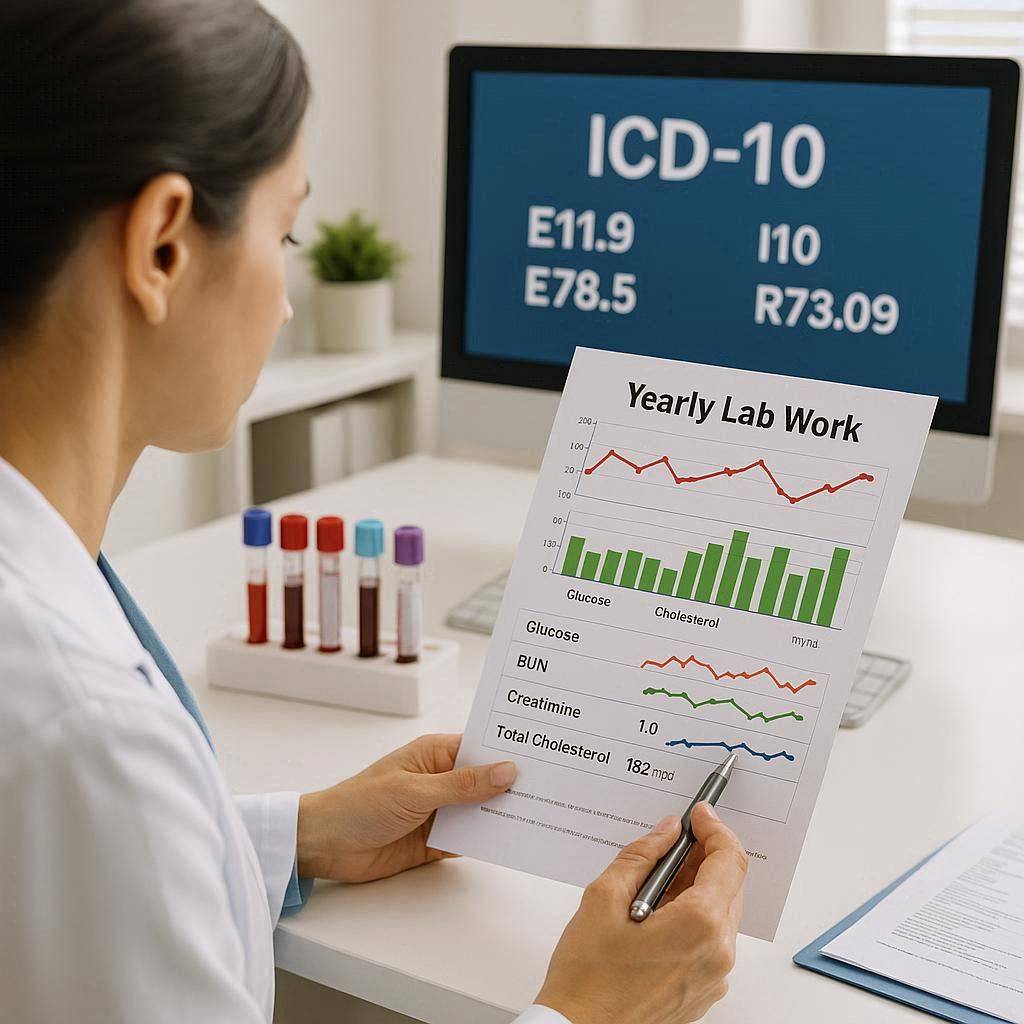
What Exactly Is an ICD-10 Code?
Before we dive into the specific codes for physical exams, let’s take thirty seconds to understand what an ICD-10 code actually is.
ICD-10 stands for the International Classification of Diseases, 10th Revision. These codes are alphanumeric combinations that healthcare providers use to describe a diagnosis, symptom, or reason for a visit. Insurance companies use these codes to decide what they will pay for.
Think of it this way: if the medical bill is a movie, the ICD-10 code is the plot. The CPT code (Current Procedural Terminology) is the action—the service the doctor performed. You need both to get paid correctly.
For a yearly physical exam, the plot is usually very simple: “I am here for a routine checkup, and I have no specific health complaint.”
But as you will see, even that simple plot has a few different versions.
The Main ICD 10 Code for a Yearly Physical Exam
Here is the short answer you came for.
The most common icd 10 code yearly physical exam used for an adult routine checkup is:
Z00.00
Let’s spell that out clearly: Z00.00 – Encounter for general adult medical examination without abnormal findings.
That code tells the insurance company, “This patient came in for a routine annual physical. We examined them. We found no new health problems. This was purely preventive.”
If you are a coder or a provider, this will be your bread-and-butter code for healthy patients who come in once a year just to stay on top of their wellness.
But wait. There is a close relative to this code that you also need to know.
When to Use Z00.01 Instead
Not every yearly physical goes perfectly. Sometimes, the doctor finds something unexpected.
Maybe your blood pressure is a little high. Maybe the doctor hears a heart murmur that wasn’t there last year. Maybe a routine blood test shows elevated cholesterol.
When that happens, you cannot use Z00.00 anymore. Why? Because Z00.00 specifically says “without abnormal findings.”
In that situation, you will use:
Z00.01 – Encounter for general adult medical examination with abnormal findings.
This code tells the insurance company, “We did a routine physical, and we found something that needs attention.”
Now, here is a very important point. Z00.01 does not replace the diagnosis code for the abnormal finding itself. You will use Z00.01 in addition to the specific code for the problem.
Real-world example:
- A patient comes in for a yearly physical.
- Their blood pressure reads 148/92.
- You diagnose them with essential hypertension (I10).
- You would bill: Z00.01 (the reason for the encounter was a routine physical, but we found something) plus I10 (the specific problem).
This distinction matters hugely for insurance reimbursement. Many preventive visits get denied or partially paid because the wrong primary diagnosis code was used.
Important Note for Readers: If you are a patient and your doctor finds a problem during your “free” annual physical, do not be surprised if you receive a separate bill for addressing that problem. The preventive visit remains covered, but the diagnosis and management of a new condition often falls under sick visit billing.
A Quick Comparison Table: Z00.00 vs. Z00.01
Let’s make this crystal clear.
| Code | Full Description | When to Use | Example Scenario |
|---|---|---|---|
| Z00.00 | Encounter for general adult medical examination without abnormal findings | The patient is healthy. No new issues are discovered. All vitals and exam findings are normal. | A 32-year-old woman comes in for her annual checkup. She feels great. Her exam is normal. Her labs are normal. |
| Z00.01 | Encounter for general adult medical examination with abnormal findings | The patient came for a routine physical, but the exam or tests revealed something unexpected. | A 55-year-old man comes for a routine physical. His lung exam reveals wheezing that was not present before. |
Other Related Z Codes You Might Need
The Z00 category is not the only game in town. Depending on the patient’s age and the reason for the visit, you might need a different code entirely.
Let’s walk through the most common alternatives.
Z00.1 – Encounter for newborn health examination
This is for babies within the first 28 days of life. It usually happens within 24 to 72 hours after birth. Do not confuse this with an adult yearly physical.
Z00.2 – Encounter for examination for period of rapid growth in childhood
Think of this as a pediatric well-child visit. Children grow and change fast, so these visits happen more often than once a year. This code covers routine checkups for kids without any specific complaint.
Z00.8 – Encounter for other general examination
This is a catch-all code. Use it when a patient needs a general exam for a specific reason that is not illness or routine prevention.
Examples include:
- A sports participation physical.
- A camp entry physical.
- An employment or pre-employment exam.
- An insurance medical examination.
Z02.6 – Encounter for general examination for participation in sports
This is a more specific code for school sports physicals. Some coders prefer Z00.8. Others prefer Z02.6. Check with your specific payer guidelines. Many insurance plans do not cover sports physicals at all under preventive benefits.
Preventive Medicine Codes vs. Sick Visit Codes
This is where many people get confused. And honestly? The confusion is reasonable.
A yearly physical exam is not the same as a problem-focused visit.
Let me give you an example.
Scenario A: You schedule a “yearly physical.” You feel great. You just want your routine labs and a once-over from your doctor. The doctor spends 20 minutes with you reviewing your lifestyle, checking your vitals, and ordering routine blood work. This is preventive care.
Scenario B: You schedule a “yearly physical,” but you also mention that your knee has been hurting for two weeks. The doctor spends 15 minutes on the routine physical and another 15 minutes examining your knee, ordering an X-ray, and discussing treatment options. This is now a mixed visit.
In Scenario B, you cannot bill the whole visit under Z00.00 or Z00.01 alone. You may need to bill a preventive visit and a separate sick visit. This is called a modifier -25 situation.
The ICD-10 code tells why the patient came. The CPT code tells what the doctor did.
For a true yearly physical exam, the most common CPT codes are:
- 99381-99387 (new patient preventive visits, based on age)
- 99391-99397 (established patient preventive visits, based on age)
These CPT codes work hand-in-hand with Z00.00 or Z00.01.
Real-World Billing Examples (For Coders and Billers)
Let’s look at three common scenarios. These will help you apply the icd 10 code yearly physical exam correctly in your daily work.
Example 1: The Healthy Young Adult
- Patient: 28-year-old male, no chronic conditions, no complaints.
- Services: Vital signs, general physical exam, review of systems, counseling on diet and exercise.
- Findings: All normal.
- ICD-10 Code: Z00.00
- CPT Code: 99395 (established patient, age 18-39)
- Result: Clean claim. Insurance typically covers at 100% under preventive benefits.
Example 2: The Patient with Known Controlled Hypertension
- Patient: 62-year-old female with hypertension that is well-managed on medication.
- Services: She comes for her yearly physical. She is not here to discuss her blood pressure as a problem. It is stable.
- Findings: Blood pressure is 118/76. No other abnormal findings.
- ICD-10 Code: Z00.00
- Secondary ICD-10 Code (optional but recommended): Z79.4 (long-term use of antihypertensive) or I10 if the payer requires it.
- Important: Many payers will still cover Z00.00 as primary for patients with stable chronic conditions. The patient is not seeking treatment for hypertension today. They are seeking prevention. The fact that they have hypertension does not disqualify them from a preventive visit.
Example 3: The Physical That Uncovers a New Problem
- Patient: 45-year-old male, no prior issues.
- Services: Routine annual physical.
- Findings: Skin exam reveals an irregular mole that the doctor biopsies.
- ICD-10 Code: Z00.01 (primary) + D22.5 (melanocytic nevi of trunk) or the appropriate skin lesion code.
- Result: The preventive portion of the visit may still be covered. The biopsy and the evaluation of the mole may be subject to deductible and coinsurance.
Why Does the Correct ICD-10 Code Matter So Much?
You might be thinking, “Does it really matter if I use Z00.00 or Z00.01? It’s just a code.”
It matters for three big reasons.
1. Insurance Payment
Insurance companies are strict. If you use Z00.00 but the doctor’s notes mention an abnormal finding, the claim can be denied. If you use Z00.01 without a linked abnormal diagnosis code, the claim can be denied.
2. Medical Necessity
The ICD-10 code proves medical necessity. Z00.00 proves that a preventive exam was necessary for a healthy person. If you try to bill a preventive exam for a patient who clearly came in for a sore throat, the insurance company will rightfully reject the claim.
3. Patient Satisfaction
When you use the wrong code, the patient gets a confusing bill. They call your office upset. You spend twenty minutes on the phone explaining. Everyone is frustrated. Correct coding from the start prevents these headaches.
A friendly note to patients: If you receive a bill after a yearly physical, do not panic. First, check if your doctor found and treated a new problem. If yes, the extra charge may be legitimate. If no, call your provider’s billing office and ask why Z00.00 was not used.
Common Mistakes to Avoid with Yearly Physical Coding
Even experienced coders make errors sometimes. Here are the most frequent mistakes we see.
Mistake #1: Using Z00.00 for a Follow-Up Visit
A patient with diabetes comes in for a diabetes check. The doctor checks their A1C and adjusts their insulin. This is NOT a yearly physical. Do not use Z00.00. Use the appropriate diabetes code (E11.9 for type 2 without complications) plus a follow-up Z code.
Mistake #2: Using Z00.00 for a Sick Visit Disguised as a Physical
The patient schedules a “physical” but spends the entire visit complaining about back pain. The doctor does not perform a full preventive exam. This is not a physical. Bill an office visit (99213 or similar) with the back pain code (M54.5 or specific code).
Mistake #3: Forgetting to Link Z00.01 to an Abnormal Finding
Z00.01 must be paired with at least one additional code for the abnormal finding. If you bill Z00.01 alone, the claim will likely reject. The insurance company will ask, “Abnormal how? What did you find?”
Mistake #4: Using Outdated Codes
Yes, ICD-10 has been around for years now. But codes are updated annually. Always check that you are using the current year’s version. For 2026, the codes above remain correct, but always verify with your coding software.
A Complete List of Preventive Exam ICD-10 Codes by Age Group
Let’s put everything into one simple reference table.
| Age Group | Purpose | ICD-10 Code | Notes |
|---|---|---|---|
| Newborns (0-28 days) | Newborn exam | Z00.1 | Usually done before hospital discharge |
| Infants and children (0-17) | Well-child visit | Z00.2 | For routine growth and development checks |
| Adults (18+) | Routine physical, no findings | Z00.00 | Most common code for healthy adults |
| Adults (18+) | Routine physical, with findings | Z00.01 | Must be paired with abnormal diagnosis |
| Any age | Sports physical | Z02.6 | Often not covered by insurance |
| Any age | Employment physical | Z00.8 | Employer often pays directly |
| Any age | Preoperative exam | Z01.81 | For surgery clearance |
| Any age | Gynecological exam (routine) | Z01.411 | Encounter for routine Pap smear |
How to Explain Yearly Physical Coding to Patients (For Providers)
You are a doctor, not a billing specialist. But patients will ask you questions. Here is how to answer them in plain English.
Patient asks: “Why am I getting a bill? You said my physical was free.”
You say: “Your physical was free under your preventive benefits. However, during the physical, we discussed your knee pain. That counts as a medical problem visit. Insurance treats prevention and problem-solving separately. The portion of the visit related to your knee is subject to your regular copay and deductible.”
Patient asks: “Can you just use the yearly physical code for everything?”
You say: “I wish I could, but insurance laws do not allow it. Using the wrong code is actually insurance fraud. We have to be honest about what we did and why.”
Patient asks: “What is the icd 10 code yearly physical exam that I should see on my paperwork?”
You say: “If you were completely healthy and we found nothing wrong, you should see Z00.00. If we found a new issue, you might see Z00.01 plus another code for that issue.”
Honesty builds trust. Trust keeps patients coming back.
Documentation Tips for Providers
Your coding is only as good as your documentation. Here is what your notes must include to support Z00.00 or Z00.01.
For Z00.00, document:
- That the patient requested a routine annual physical.
- That the patient has no specific complaint today.
- That a comprehensive preventive exam was performed.
- That no abnormal findings were discovered.
- A statement like: “No abnormal findings on exam. Patient is healthy.”
For Z00.01, document:
- All of the above, plus:
- A clear description of the abnormal finding.
- The specific diagnosis code for that finding.
- A plan for the abnormal finding (e.g., “Will repeat blood pressure in one week” or “Referred to dermatology for mole biopsy”).
Without this documentation, your codes will not survive an audit.
The Difference Between a Physical Exam and a Wellness Visit
Here is something that confuses both patients and new coders.
In traditional Medicare, there is no “yearly physical” benefit. Instead, Medicare covers an Annual Wellness Visit (AWV) . It sounds similar. It is not the same.
- A yearly physical (Z00.00) includes a hands-on exam. The doctor listens to your heart, looks in your ears, and palpates your abdomen.
- An Annual Wellness Visit (Z00.00 is not used for Medicare AWV) focuses on creating a prevention plan. There is no traditional physical exam.
For Medicare AWVs, you will use:
- G0438 (initial AWV)
- G0439 (subsequent AWV)
And the ICD-10 code is Z00.00? Actually, no. For Medicare AWV, the correct code is often Z13.89 (encounter for screening for other disorder) or simply the Z00.00 if the physician performs a full exam. This is a gray area. When in doubt, follow your Medicare Administrative Contractor (MAC) guidelines.
Important: If you bill traditional Medicare for a Z00.00 physical, Medicare will deny the claim. Medicare does not cover routine physical exams. They cover the AWV. Do not make this expensive mistake.
Frequently Asked Questions (FAQ)
Let’s answer the questions that come up again and again in clinics and billing offices.
Q1: Can I use Z00.00 for a patient who takes medication for high blood pressure?
Yes, as long as the patient is here for prevention, not for management of hypertension. If the patient is stable and the visit is truly a routine physical, Z00.00 is appropriate. Some coders add Z79.4 (long-term drug therapy) as a secondary code.
Q2: What is the ICD-10 code for a physical exam for school or sports?
Use Z02.6 (encounter for general examination for participation in sports) or Z00.8 (other general examination). Check with the school or sports league. Many require a specific form, not just a code.
Q3: My patient had a normal physical but mentioned they are feeling sad. Can I still use Z00.00?
It depends. If the sadness is a passing comment and you do not diagnose depression, Z00.00 may still work. If you diagnose depression or spend significant time counseling on mental health, consider Z00.01 plus a mental health code like Z13.89 for screening.
Q4: What code do I use for a DOT physical?
DOT physicals are employment exams. Use Z00.8. Do not use Z00.00. DOT physicals have specific federal requirements. The patient is not there for routine prevention. They are there to meet a regulatory requirement.
Q5: Is Z00.00 ever used for children?
No. For children under 18, use Z00.2 for routine well-child exams. Z00.00 is specifically for “general adult medical examination.”
Q6: What happens if I accidentally use Z00.00 when I should have used Z00.01?
You risk a denial or a post-payment audit. If an auditor reviews the chart and sees an abnormal finding but Z00.00 was billed, they may recoup the payment and issue a fine for incorrect coding.
Q7: Do I need a separate ICD-10 code for each lab test ordered during a physical?
No. The Z00.00 or Z00.01 covers the reason for the encounter. The labs themselves are reported with CPT codes (e.g., 80061 for lipid panel). The ICD-10 code supports medical necessity for those labs.
Additional Resources for Medical Coders
Coding guidelines change. What is true today may shift next year. Stay updated with these trusted resources.
- CMS.gov Preventive Services – The official source for Medicare preventive coverage.
- AAPC Knowledge Center – Articles, forums, and training for professional coders.
- ICD-10-CM Official Guidelines for Coding and Reporting – The definitive rulebook. Updated annually.
Link to additional resource:
🔗 CMS Preventive Services List (Official Government Resource)
Bookmark this page. It lists every preventive service covered by Medicare and the correct codes to use.
A Realistic Look at Insurance Coverage
Let’s be honest with your patients. And let’s be honest with yourselves, providers.
Even with the correct icd 10 code yearly physical exam, insurance coverage is not always straightforward.
- Some plans cover one physical per calendar year.
- Some plans cover one physical per 365 days.
- Some plans cover the physical but not the routine labs.
- Some plans cover the physical only if you use an in-network provider.
Patients often assume “free physical” means everything done during that appointment is free. That assumption is often wrong.
As a provider or coder, you cannot control insurance company policies. But you can set realistic expectations.
A script for front desk staff:
“Your insurance covers a yearly preventive exam. That means the doctor’s time for the physical is covered. However, if the doctor finds a problem and treats it, or if you ask about a specific symptom, there may be additional costs. Also, routine lab work is sometimes covered and sometimes not. Would you like us to check your specific benefits before we proceed?”
This five-second conversation saves hours of billing headaches later.
Summary of Key Takeaways
We have covered a lot of ground. Let’s bring it all together.
- The primary icd 10 code yearly physical exam for a healthy adult with no abnormal findings is Z00.00.
- If the physical reveals a new health problem, use Z00.01 plus the specific diagnosis code.
- For children, use Z00.2 for well-child visits.
- For sports or employment physicals, use Z02.6 or Z00.8.
- Always document thoroughly to support your chosen code.
- Medicare does not cover Z00.00 for routine physicals. Use the Annual Wellness Visit codes instead.
- Setting patient expectations about coverage prevents billing disputes.
Conclusion
Yearly physical exams use Z00.00 for healthy patients with no abnormal findings, while Z00.01 signals that a new issue was discovered during the routine checkup. Correct coding ensures proper reimbursement from insurance companies and protects your practice from audits or denials. Always pair your ICD-10 code with thorough documentation and clear communication with patients about what their insurance will actually cover.