Life has a way of throwing curveballs. A sudden job loss, a messy divorce, a serious illness, or even a big move to a new city. Sometimes, you feel overwhelmed. You might cry more than usual. You might feel anxious, hopeless, or just stuck.
If you have felt this way, you are not alone. And you are not weak. These feelings have a name in the medical world. Doctors call it adjustment disorder.
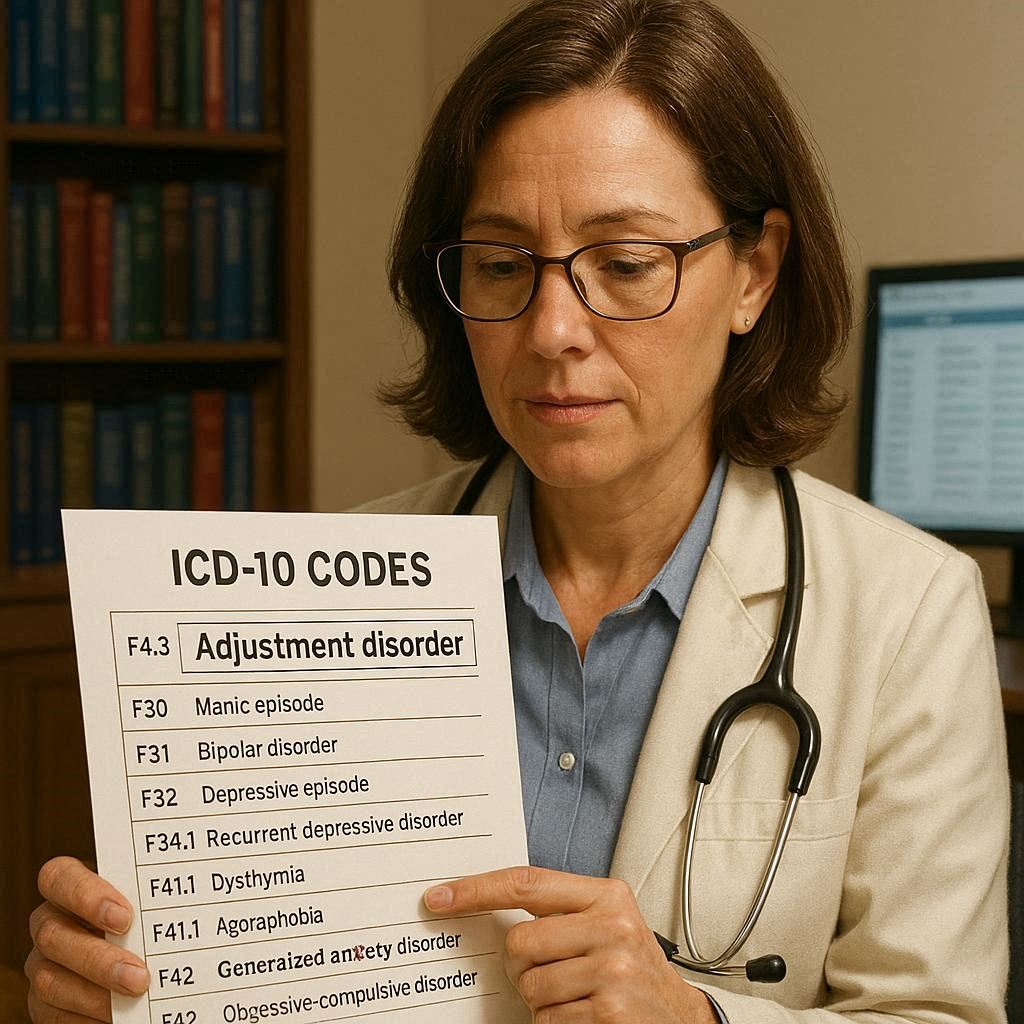
But what does that really mean? And what is that strange code – the ICD-10 code – that appears on medical bills and insurance papers?
Let us break it down together. This guide will walk you through everything you need to know. We will use simple, clear language. No confusing medical terms. Just honest, helpful information.
By the end of this article, you will know exactly what the ICD-10 code for adjustment disorder is. You will also understand the symptoms, the different types, and how doctors help people feel better.
What Is Adjustment Disorder? A Simple Explanation
Imagine you are an emotional boat. Most days, the water is calm. But when a big stressor hits – a wave – your boat rocks. For most people, the boat settles quickly.
But with adjustment disorder, the boat keeps rocking. You have trouble getting back to normal.
Adjustment disorder is a mental health condition. It happens when you have a strong emotional or behavioral reaction to a stressful event. This reaction is bigger than what you would expect. And it causes real problems in your daily life – at work, at school, or in your relationships.
The key here is timing. Symptoms usually start within three months of the stressful event. And unlike major depression or anxiety disorders, adjustment disorder does not last forever. Once the stressor goes away – or you learn to cope – the symptoms usually fade within six months.
Important note: Adjustment disorder is not a sign of weakness. It is a recognized medical condition. Seeking help is a sign of strength, not failure.
The Official ICD-10 Code for Adjustment Disorder
Let us get straight to the point. The main ICD-10 code for adjustment disorder is:
F43.2
This code lives under a larger category: F43 – Reaction to severe stress, and adjustment disorders.
But here is the thing. F43.2 is like a big umbrella. Under that umbrella, there are smaller, more specific codes. Each one describes a different type of adjustment disorder.
Why does this matter? Because doctors use these specific codes to show exactly how the condition is affecting you. This helps with treatment plans and insurance claims.
The Full List of Adjustment Disorder ICD-10 Codes
Here is a simple table to help you see the different codes. Do not worry – we will explain each one right after.
| ICD-10 Code | Description |
|---|---|
| F43.20 | Adjustment disorder, unspecified |
| F43.21 | Adjustment disorder with depressed mood |
| F43.22 | Adjustment disorder with anxiety |
| F43.23 | Adjustment disorder with mixed anxiety and depressed mood |
| F43.24 | Adjustment disorder with disturbance of conduct |
| F43.25 | Adjustment disorder with mixed disturbance of emotions and conduct |
| F43.29 | Adjustment disorder with other symptoms |
Let us walk through each one.
F43.20 – Adjustment Disorder, Unspecified
This code is used when the symptoms are clear, but they do not fit neatly into one specific category. Maybe the person feels a mix of things – sad, worried, and a little angry – but no single feeling dominates. Doctors use this code as a starting point or when the picture is not completely clear.
F43.21 – Adjustment Disorder with Depressed Mood
This is one of the most common types. The main feeling here is sadness. The person might feel hopeless, tearful, or lose interest in things they used to enjoy. It looks a lot like depression. But the key difference is the trigger. There is a clear stressful event that started these feelings. And the feelings usually improve when life calms down.
F43.22 – Adjustment Disorder with Anxiety
Here, the main feeling is worry or nervousness. The person might feel on edge, jittery, or have trouble concentrating. They might worry constantly about the future or what might go wrong. Physical symptoms can include a racing heart or sweaty palms. It feels like anxiety, but again, it is tied directly to a specific life stressor.
F43.23 – Adjustment Disorder with Mixed Anxiety and Depressed Mood
Life is rarely simple. Sometimes, you feel both sad and worried at the same time. This code is for exactly that situation. The person has a mix of depressive symptoms (like low energy and crying) and anxiety symptoms (like restlessness and worry). Neither feeling is strong enough to be its own separate disorder, but together, they make daily life hard.
F43.24 – Adjustment Disorder with Disturbance of Conduct
This type looks different. Instead of feeling sad or worried, the person acts out. This is more common in teenagers and young adults, but adults can experience it too. Symptoms include:
- Fighting or arguing a lot
- Reckless driving
- Skipping school or work
- Stealing or vandalizing property
- Breaking rules on purpose
The person is not “bad.” They are struggling to cope. The behavior is their way of expressing emotional pain.
F43.25 – Adjustment Disorder with Mixed Disturbance of Emotions and Conduct
This code combines both worlds. The person has emotional symptoms (like sadness or anxiety) and behavioral problems (like acting out or breaking rules). This can be a very hard state to be in. The person feels terrible inside, and their actions cause problems on the outside.
F43.29 – Adjustment Disorder with Other Symptoms
Sometimes, the symptoms do not fit any of the above patterns. This code is for those “other” symptoms. For example, a person might have physical complaints like stomach aches or headaches. Or they might withdraw completely from other people. If the symptoms are real and linked to a stressor, but not listed elsewhere, this code applies.
How Is Adjustment Disorder Different from Other Mental Health Conditions?
This is a very common question. People often confuse adjustment disorder with major depression, generalized anxiety disorder, or post-traumatic stress disorder (PTSD). Let us clear that up.
| Condition | Key Difference from Adjustment Disorder |
|---|---|
| Major Depressive Disorder | Depression can happen without a clear trigger. It also lasts much longer – often months or years. Adjustment disorder with depressed mood usually fades within 6 months of the stressor ending. |
| Generalized Anxiety Disorder (GAD) | GAD involves excessive worry about many things – even small, everyday issues. Adjustment disorder with anxiety is tied to one specific stressor. |
| PTSD | PTSD follows a traumatic, life-threatening event. The symptoms are more severe (flashbacks, nightmares, avoiding reminders). Adjustment disorder follows any stressful event – not just trauma – and has milder symptoms. |
| Normal stress reaction | Feeling sad or worried for a few days after a hard event is normal. If the feelings last longer than three months or cause big problems in your life, it may be adjustment disorder. |
A helpful way to think about it: Adjustment disorder is like a sprained ankle. It hurts, it limits you, but with the right care, it heals completely. Major depression or PTSD is more like a broken bone. It needs more intensive treatment and takes longer to heal.
What Causes Adjustment Disorder? Common Triggers
Almost any major life change – good or bad – can trigger adjustment disorder. Yes, even positive events! Getting married, having a baby, or starting a dream job are happy events. But they are still stressful. Your brain has to work hard to adapt.
Here are some common triggers:
Relationship issues:
- Divorce or separation
- Breaking up with a partner
- Marriage problems
- Having a baby (postpartum adjustment)
Work or school stress:
- Losing a job
- Starting a new job
- Being fired or laid off
- Failing an important exam
- Bullying at school or work
Health problems:
- Being diagnosed with a serious illness (cancer, diabetes, heart disease)
- Having surgery
- Living with chronic pain
Life changes:
- Moving to a new city or country
- Losing your home
- Retirement
- Financial problems or debt
Family issues:
- Death of a loved one (although grief is different)
- Caring for a sick parent
- A child leaving home (empty nest)
- Family conflict
Other stressors:
- Surviving a natural disaster
- Being a victim of crime
- Legal problems or jail time
Notice that some of these are very serious. Others are just “normal” life events. That is the point. Adjustment disorder can happen to anyone after any kind of stressor. There is no “right” or “wrong” reason to struggle.
What Are the Symptoms of Adjustment Disorder?
Symptoms vary from person to person. They also depend on which subtype you have (depressed, anxious, conduct, etc.). But here are the most common signs to look for.
Emotional Symptoms:
- Feeling sad, hopeless, or trapped
- Crying often for no clear reason
- Feeling nervous, tense, or on edge
- Feeling overwhelmed – like you cannot handle basic tasks
- Lack of joy or pleasure in life
- Feeling worthless or like a failure
- Suicidal thoughts (this is an emergency – get help immediately)
Behavioral Symptoms:
- Withdrawing from family and friends
- Skipping work or school
- Fighting or arguing more than usual
- Acting impulsively or recklessly
- Ignoring important responsibilities (bills, chores, self-care)
- Changes in eating habits (eating too much or too little)
- Changes in sleeping habits (insomnia or sleeping all day)
Physical Symptoms:
- Headaches or body aches
- Stomach pain or digestive issues
- Racing heartbeat
- Shaking or trembling
- Extreme tiredness (fatigue)
To meet the official diagnosis, these symptoms must:
- Start within three months of a clear stressor.
- Cause real distress (more than expected).
- Harm your daily life (work, relationships, school).
- Not be part of normal grief or another mental health disorder.
How Do Doctors Diagnose Adjustment Disorder?
If you think you might have adjustment disorder, you might feel nervous about seeing a doctor. Please do not be. It is a very straightforward process.
There is no blood test or brain scan for adjustment disorder. Instead, a doctor or mental health professional will do something called a clinical interview. This is just a conversation.
Here is what they will ask you:
- What stressful event happened recently?
- When did you start feeling different?
- What specific symptoms are you having?
- How long have the symptoms lasted?
- How are they affecting your work, school, or relationships?
- Have you felt this way before?
- Do you have any other medical or mental health conditions?
They will also check to make sure your symptoms are not caused by a physical problem (like a thyroid issue) or a different mental health condition.
The doctor will then see if you meet the official criteria from the DSM-5 (the mental health manual used in the US) or the ICD-10 (used in many other countries).
Once diagnosed, they will assign the right ICD-10 code – like F43.21 for depression or F43.22 for anxiety.
Important: Only qualified professionals (psychiatrists, psychologists, licensed therapists, or family doctors) can officially diagnose adjustment disorder. Do not try to diagnose yourself based on internet research. Use this guide to understand – not to label.
Treatment Options for Adjustment Disorder
Here is the really good news. Adjustment disorder is highly treatable. Most people feel much better within a few weeks to a few months. You do not need to suffer in silence.
Treatment usually falls into three categories: therapy, lifestyle changes, and sometimes medication.
Therapy (Counseling)
Talking to a professional is the most effective treatment. The most common type is:
Cognitive Behavioral Therapy (CBT) – This helps you identify negative thought patterns. For example, after losing a job, you might think, “I am a total failure.” CBT helps you replace that thought with, “I lost a job. That is hard. But I have skills and I will find another opportunity.”
Other helpful therapy types include:
- Problem-solving therapy – You learn practical steps to tackle the stressor directly.
- Interpersonal therapy – You focus on improving relationships and communication.
- Supportive counseling – You simply get a safe, non-judgmental space to talk.
Lifestyle Changes (What You Can Do Today)
You do not have to wait for a therapy appointment. These small actions make a real difference:
- Talk to someone you trust. Isolation makes everything worse. Call a friend, join a support group, or talk to a family member.
- Move your body. Even a 15-minute walk lowers stress hormones.
- Sleep well. Aim for 7 to 9 hours. Lack of sleep makes anxiety and depression much worse.
- Eat regular meals. Low blood sugar can mimic anxiety symptoms.
- Reduce caffeine and alcohol. Both can worsen anxiety and disrupt sleep.
- Break big problems into small steps. Do not try to fix everything at once. Just do one small thing today.
Medication
Doctors do not usually prescribe medication as the first treatment for adjustment disorder. Therapy and lifestyle changes often work very well on their own.
However, if symptoms are severe – for example, if you cannot sleep at all or feel panicked every day – a doctor might suggest short-term medication. This could include:
- Low-dose antidepressants (like SSRIs) – to help with depressed mood or anxiety.
- Anti-anxiety medications (like benzodiazepines) – but only for a few days or weeks, because they can be habit-forming.
- Sleep aids – for short-term insomnia.
The medication is usually stopped once the stressor passes or therapy starts working. Most people take it for less than six months.
How Long Does Adjustment Disorder Last?
This is a very common question. Let us be honest and realistic.
Adjustment disorder is temporary by definition. Here is the general timeline:
- Symptoms begin: Within 3 months of the stressor.
- Duration: Usually less than 6 months after the stressor ends.
- If the stressor is ongoing (like a chronic illness or a difficult marriage), the disorder can last longer. But it still usually resolves within 6 months of the stressor stopping.
For most people, with proper support or treatment, symptoms start improving within 2 to 4 weeks. Full recovery often happens within 3 to 6 months.
That is the good news. The bad news? If you ignore the symptoms and do not get help, adjustment disorder can sometimes turn into a more serious condition like major depression or an anxiety disorder. That is why early help matters.
Adjustment Disorder in Children and Teens
Adjustment disorder does not only affect adults. Children and teenagers experience it too. But the signs often look different.
In younger children:
- Clinginess or separation anxiety
- Bedwetting (after being dry for a long time)
- Thumb-sucking again
- Temper tantrums or meltdowns
- New fears (of the dark, of monsters, of being alone)
- Stomach aches or headaches with no physical cause
In teenagers:
- Acting out or rebelling against rules
- Withdrawing from family
- Dropping grades at school
- Changing friend groups
- Reckless behavior (drinking, drugs, risky driving)
- Talking about feeling empty or misunderstood
If your child is struggling after a stressful event – a move, a divorce, a death in the family – do not dismiss it as “just a phase.” Get them help. Pediatricians, school counselors, and child therapists are all good places to start.
The good news for children? They often recover faster than adults with the right support. A stable routine, extra patience, and a few therapy sessions are often enough.
Adjustment Disorder vs. Prolonged Grief Disorder
This is a newer distinction that many people do not know about. Grief after losing a loved one is not the same as adjustment disorder. But sometimes, grief can trigger adjustment disorder.
Here is the difference:
- Normal grief – Comes in waves. You still have moments of joy. You can still function. It does not follow a strict timeline.
- Prolonged grief disorder – Intense, disabling grief that lasts more than 12 months for adults (6 months for children). The person is stuck in a state of yearning or preoccupation with the deceased.
- Adjustment disorder – Can follow a death, but the symptoms are less specific to grief. You might feel depressed or anxious, not just sad about the loss.
If you lost someone close to you more than a year ago and still feel completely unable to function, ask your doctor about prolonged grief disorder. It has its own ICD-10 code (F43.8). It requires different treatment.
Practical Tips for Coping with Adjustment Disorder Right Now
You do not need to wait for a diagnosis to start feeling better. Try these simple, science-backed strategies today.
1. Name your stressor.
Write down the event that triggered your feelings. Be specific. “I lost my job on March 15th.” Naming it takes away some of its power.
2. Use the 5-4-3-2-1 grounding technique.
When you feel overwhelmed with anxiety, do this:
- 5 things you can see
- 4 things you can touch
- 3 things you can hear
- 2 things you can smell
- 1 thing you can taste
This pulls your brain out of the worry cycle and into the present moment.
3. Schedule “worry time.”
Give yourself 15 minutes each day to worry on purpose. Write down everything that is bothering you. Then, when worries pop up at other times, tell yourself, “I will think about that during worry time.” This sounds strange, but it really works.
4. Do one small, kind thing for yourself every day.
Not a big thing. A small thing. Make a cup of tea. Listen to one song you love. Stretch for two minutes. These small acts rebuild your sense of control.
5. Limit news and social media.
If your stressor is related to world events (pandemic, war, political chaos), reduce your exposure. Check the news once per day – not ten times. Your brain needs a break.
When to Get Emergency Help
Adjustment disorder can sometimes lead to suicidal thoughts. If you are thinking about hurting yourself or ending your life, this is an emergency.
Do not wait. Do not suffer alone.
- Call or text 988 (the Suicide and Crisis Lifeline in the US) – available 24/7, free, and confidential.
- Go to your nearest emergency room.
- Call a trusted friend or family member and tell them you need help immediately.
There is no shame in this. Thousands of people have been where you are. They got help. They got better. You will too.
Frequently Asked Questions (FAQ)
1. Is adjustment disorder a real mental illness?
Yes. It is officially recognized in both the DSM-5 and ICD-10. It has a specific code (F43.2 and its sub-codes). It is just as real as depression or anxiety – but it is usually shorter in duration.
2. Do I need medication for adjustment disorder?
Most people do not. Therapy and lifestyle changes are very effective. Medication is only used for severe symptoms or short-term relief.
3. Can adjustment disorder turn into depression?
Yes, if left untreated. That is why early treatment matters. Getting help for adjustment disorder can prevent it from becoming a long-term condition.
4. What is the difference between F43.2 and F43.20?
F43.2 is the general category. F43.20 is the specific code for “unspecified” adjustment disorder. In medical billing, providers usually use the more specific code (F43.21, F43.22, etc.) if possible.
5. How is adjustment disorder treated in children?
With family therapy, play therapy, and creating a stable routine at home. Medication is very rarely used in children for adjustment disorder.
6. Can I get disability benefits for adjustment disorder?
Possibly, but only for a short time. Because adjustment disorder is expected to resolve within 6 months, long-term disability is rare. Short-term disability or medical leave from work is more common. Talk to your doctor and HR department.
7. Is adjustment disorder the same as “situational depression”?
Yes, many doctors use those terms interchangeably. Situational depression is an older, less formal name for adjustment disorder with depressed mood (F43.21).
8. How do I find a therapist for adjustment disorder?
Start with your primary care doctor. They can give a referral. You can also search on Psychology Today, BetterHelp, or Talkspace. Look for someone trained in CBT or short-term counseling.
Additional Resources
This guide is a great starting point. But you might want to learn more or find professional help.
- National Institute of Mental Health (NIMH) – Free, science-based information on adjustment disorder and other conditions.
Link: www.nimh.nih.gov - Anxiety & Depression Association of America (ADAA) – Offers therapist directories, support groups, and free webinars.
Link: www.adaa.org - Psychology Today Therapist Directory – Search by your zip code, insurance type, and specialty (including adjustment disorder).
Link: www.psychologytoday.com - SAMHSA National Helpline – Free, confidential, 24/7 treatment referral service. Call 1-800-662-4357.
Note: Always talk to a real doctor or therapist before making decisions about your health. Online resources are helpful, but they cannot replace professional medical advice.
Conclusion
Let us wrap this up in three simple lines:
Adjustment disorder (ICD-10 code F43.2) is a temporary, treatable condition triggered by a specific life stressor. Symptoms start within three months and usually resolve within six months with proper support. Therapy, lifestyle changes, and sometimes short-term medication can help you feel like yourself again – and you do not have to face it alone.