Navigating the world of durable medical equipment (DME) billing can feel like learning a foreign language. You are not just dealing with complex machinery; you are also facing a maze of codes, modifiers, and insurance guidelines. Among the most searched-for pieces of equipment in home care is the patient lift, universally recognized by the brand name Hoyer. When you need to secure funding for this essential device, finding the correct HCPCS code for Hoyer lift is the critical first step.
This comprehensive resource goes far beyond simply stating the code. We will walk you through what the code means, why insurance coverage is so strict, how to document medical necessity, and what pitfalls to avoid. Whether you are a caregiver, a medical biller, a therapist, or a family member seeking to bring a loved one home safely, this article will serve as your authoritative guide. We will ensure you understand the distinction between manual and electric lifts, the specific coverage criteria for Medicare and private insurers, and how to build a bulletproof claim.
Understanding HCPCS: The Language of Medical Billing
Before we dive into the specific numbers, it is essential to grasp the system that governs them. The acronym HCPCS stands for the Healthcare Common Procedure Coding System. You will often hear it pronounced as “hick-picks.” This system is the standardized coding structure used by Medicare, Medicaid, and private health insurance plans to process claims for medical services, procedures, and supplies.
HCPCS Level I vs. Level II
The world of HCPCS breaks down into two primary levels.
HCPCS Level I consists of the Current Procedural Terminology (CPT) codes. The American Medical Association maintains these codes. Doctors and other healthcare professionals use CPT codes to bill for clinical procedures, evaluation and management visits, surgeries, and diagnostic tests.
HCPCS Level II is where you will find the HCPCS code for Hoyer lift. These codes primarily identify products, supplies, and services not covered by Level I codes. This includes durable medical equipment, prosthetics, orthotics, supplies (DMEPOS), ambulance services, and certain drugs. The Centers for Medicare & Medicaid Services (CMS) maintains the Level II codes. The codes consist of a single alphabetical letter followed by four numbers.
Understanding this division clarifies why a patient lift falls here. A Hoyer lift is a piece of durable medical equipment, not a procedure a doctor performs. Therefore, the billing process relies on the Level II alphanumeric structure.
The Primary HCPCS Code for Hoyer Lift: E0630
The primary code that will dominate your paperwork is E0630. You must memorize it, but you must also understand exactly what it covers.
E0630: Patient Lift, Hydraulic (Manual)
HCPCS Code: E0630
Official Description: Patient lift, hydraulic, with seat or sling.
Coverage Category: Durable Medical Equipment (DME).
This code applies to the standard, manually operated Hoyer lift. These devices rely on a hydraulic pump mechanism. The caregiver physically operates a handle or lever to generate pressure, which raises the boom and lifts the patient. Lowering the patient usually involves a gentle release valve. These lifts do not require a battery or an electrical outlet.
When you submit a claim for a manual Hoyer lift, you will use code E0630. This represents the baseline technology that has been a staple of safe patient handling for decades. The code inherently assumes the lift includes a sling, so you will not typically bill the sling separately if it arrives as part of a complete system sold as a unit.
Key Clarification: Brand names rarely, if ever, appear in the HCPCS code description. You will not see “Hoyer” in the CMS manual. The code E0630 covers any brand of hydraulic patient lift that meets the definition of a seat or sling-based transfer device, including Invacare, Drive Medical, Medline, and genuine Joerns Hoyer lifts.
What E0630 Covers and Excludes
A billing specialist must dissect the code descriptor “with seat or sling” carefully. This phrasing indicates the code covers the mechanical lifting device and the fabric interface. However, standard business practices and Medicare guidelines draw a critical line.
- Covered: The frame, the hydraulic pump, the boom, the spreader bar, and a standard universal or divided-leg sling provided in the original package.
- Not Covered Separately Under E0630: A replacement sling purchased a year after the lift. A specialty sling, such as a mesh bathing sling, a stand-up sling, or a hammock-style comfort sling, will require its own HCPCS code, which we will discuss shortly.
If your supplier bills you for the lift using E0630, the included sling is part of that payment. Do not let a supplier double-bill you by adding a sling code to the initial purchase unless you are acquiring a distinct, specialized sling for a separate, documented medical purpose.
Manual vs. Electric: Understanding E1036
The evolution of patient lift technology created a billing distinction you must not overlook. While E0630 rules the manual world, a different code governs the heavy lifters in the electric category.
The Electric Patient Lift Code
HCPCS Code: E1036
Official Description: Patient lift, electric, with seat or sling.
Coverage Category: Durable Medical Equipment (DME).
E1036 describes a lift system where an electric motor, powered by a rechargeable battery, performs the lifting action. Instead of pumping a hydraulic handle, the caregiver presses a button on a pendant control. These systems drastically reduce the physical strain on the caregiver. They often feature a wider base for stability and, in many modern designs, a powered base-spreading function for navigating around bulky furniture like bariatric chairs or wheelchairs.
Comparative Analysis: E0630 vs. E1036
Your choice between these two codes depends entirely on the equipment you are purchasing. Making an error here will lead to a swift claim denial. Study this table closely.
| Feature | E0630 (Hydraulic/Manual) | E1036 (Electric) |
|---|---|---|
| Power Source | Manual hydraulic pump (hand/foot lever) | Rechargeable battery pack (DC motor) |
| Caregiver Effort | High. Requires repetitive physical pumping. | Low. Push-button operation. |
| Clinical Indication | Standard transfer needs; caregiver capable of pumping. | Caregiver has physical limitations; patient requires frequent transfers; bariatric care. |
| Portability | Lighter; no charging required. | Heavier base; requires access to a wall outlet for the charger. |
| Base Spreading | Typically manual spreader bar handles. | Often includes powered base spreading via the hand pendant. |
| Typical Cost | Lower initial investment. | Higher initial investment due to motor and battery. |
| Repair Complexity | Low. Hydraulic seals and rams. | Higher. Actuators, control boards, batteries. |
You cannot simply choose E1036 because you think an electric lift is “nicer.” Medicare and most insurers view electric lifts as an upgrade over a manual hydraulic lift, unless specific, documented medical necessity criteria establish that the manual lift is contraindicated. We will examine that coverage logic deeply in a later section.
The Supporting Cast: Codes for Slings and Accessories
A Hoyer lift is useless without a sling, and a sling is deeply personal to the patient’s body and clinical condition. The HCPCS code for Hoyer lift (E0630) alone does not tell the whole story. Often, you need to separately bill the sling, particularly for replacements or specialized versions.
Sling HCPCS Codes
A sling is not just a sling in the eyes of a DME auditor. The shape, the material, and the patient’s weight determine the correct code.
- E0621: Sling or seat, patient lift, canvas or nylon. This represents the standard, general-use sling. It is made of fabric, usually with padded leg sections.
- E0625: Sling or seat, patient lift, mesh. You must use this code for a sling designed for bathing. The open mesh fabric allows water and soap to pass through and dries quickly. It is often made of polyester mesh, which resists mildew.
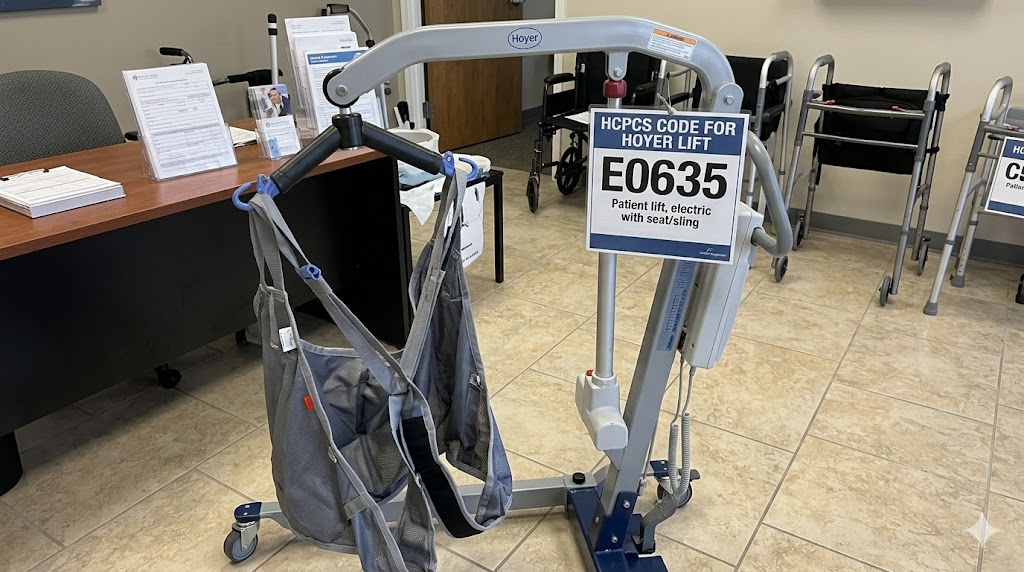
- E0635: Sling or seat, patient lift, for patient weight capacity up to and including 400 pounds.
- E0636: Sling or seat, patient lift, for patient weight capacity over 400 pounds, up to and including 600 pounds.
- E0637: Sling or seat, patient lift, for patient weight capacity over 600 pounds.
- E0640: Patient lift, commode sling or seat. This specialized sling features a large, reinforced opening at the bottom. It allows the patient to be lifted and positioned over a toilet or commode chair without removing the sling. This is vital for patients who are dependent on lifts for all mobility.
The Weight-Capacity Link
Notice how codes E0635, E0636, and E0637 stratify by weight. This is not arbitrary. Bariatric slings require heavier-duty stitching, stronger webbing, and reinforced D-rings. They are more expensive to manufacture. Therefore, they have unique codes. When billing a sling for a patient weighing 450 pounds, you must not use E0621. You must select E0636 to accurately represent the equipment provided.
Essential Accessory Codes
Beyond slings, other components complete the safe patient handling ecosystem.
- E0940: Trapeze bar, freestanding, complete with grab bar. This is not a lift, but a device a patient uses independently to reposition in bed or assist in transferring. It is often used alongside a lift.
- E0990: Wheelchair accessory, elevating leg rest, rigid, platform type.
- K0108: Wheelchair component or accessory, not otherwise specified. (Sometimes used for specialized spreader bars, though DME MACs increasingly scrutinize this).
- E1399: Durable medical equipment, miscellaneous. Billers use this as a last resort when no specific code exists. You must include a detailed narrative description of the item. Expect requests for additional documentation. Do not use E1399 simply because you forgot the correct code.
Critical Billing Rule: If you purchase a manual hydraulic lift and a standard canvas sling together as a single unit from a manufacturer, use E0630. If you purchase a lift frame only and then add a separate commode sling because the patient has incontinence and needs toileting transfers, you will bill E0630 for the frame and E0640 for the commode sling.
Medicare Coverage: The Deciding Factor for E0630 and E1036
You cannot understand the HCPCS code for Hoyer lift without understanding Medicare’s strict coverage framework. Medicare does not cover convenience items. It covers medically necessary devices that serve a practical purpose within the home.
Defining Medical Necessity for a Patient Lift
Medicare defines a patient lift as a transfer device. It is covered if the patient is unable to transfer safely between a bed and a chair, wheelchair, or commode. Simply saying the patient “needs” a lift is not enough. The medical records must prove the following.
- Severe Mobility Limitation: The patient cannot stand or pivot independently.
- Caregiver Inability: The caregiver(s) cannot safely transfer the patient using an alternative, less costly method, such as a manual assist (pivot transfer) or a gait belt. This point is crucial. If a single caregiver can safely pull the patient to a stand and pivot, Medicare may deny the lift.
- Documented Contraindication: The patient’s upper body strength or joint integrity makes a sit-to-stand lift (which often falls under a different code, E0631) clinically inappropriate, or the caregiver’s physical assessment shows high risk of injury without a full-body lift.
The Local Coverage Determination (LCD) Framework
Medicare Administrative Contractors (MACs) publish Local Coverage Determinations (LCDs). These documents dictate the precise clinical criteria for coverage in your specific region. You must consult the LCD for Patient Lifts active in your jurisdiction.
A standard LCD for lifts typically states:
“A patient lift (E0630, E1036) will be covered if the patient requires transfer between bed and a chair, wheelchair, or commode. Coverage requires documentation showing the patient cannot independently transfer and the caregiver is physically incapable of safely assisting the transfer.”
The LCDs draw a distinct line between full-body lifts (E0630, E1036) and sit-to-stand lifts (E0631). Medicare often considers a sit-to-stand lift before a full-body hydraulic lift, if the patient has some upper body strength and trunk control. You must show why E0631 is not suitable if you are seeking coverage for E0630.
The Myth of the “3-in-1” Commode
A common point of confusion arises from transfer systems that function as a wheeled shower chair and commode over a toilet, and also serve as a lift. Some of these are essentially rolling gantry lifts. The DME MACs have, in the past, issued guidance clarifying that certain multi-function transfer devices do not meet the statutory definition of a commode. This means you might not be able to bill them under standard commode or lift codes. You must check the most current Product Classification List and your local MAC’s published articles before purchasing a hybrid system expecting coverage under E0630.
The Advance Beneficiary Notice of Noncoverage (ABN)
If a supplier suspects Medicare will deny a lift based on medical necessity, they should issue an ABN. This notice tells you, the beneficiary, that you might have to pay out of pocket. Read the ABN carefully. If you sign it and accept the equipment, you accept financial responsibility. The supplier’s use of an ABN does not automatically mean the device is not needed; it means the documentation may not support coverage under current rules. You have the right to appeal, but the ABN protects the supplier’s financial interests.
Private Insurance and Other Payers
Medicare sets the standard, but you likely deal with a mosaic of insurance types. Your HCPCS code for Hoyer lift remains E0630 across these payers, but the prerequisite for approval can vary wildly.
Commercial Insurance Plans
Blue Cross Blue Shield, UnitedHealthcare, Aetna, Cigna, and others typically adopt Medicare’s HCPCS coding structure. They often apply similar medical necessity guidelines, but they may differ in one crucial aspect: caregiver safety. Where Medicare focuses predominantly on the patient’s condition, many commercial plans explicitly include caregiver health and safety as a covered benefit justification. This is a significant advantage.
Your letter of medical necessity for a commercial plan should directly address the physical demands on the family caregiver. Documenting the caregiver’s herniated disc diagnosis, shoulder impingement, or other musculoskeletal injury can support coverage for an electric lift (E1036), even if the patient might theoretically be transferred with a manual device by a perfectly healthy caregiver. You are arguing that the provision of the lift prevents secondary health crises for the family unit.
Medicaid Programs
Each state administers its Medicaid program under broad federal guidelines. Most state Medicaid programs cover patient lifts under their Home and Community-Based Services (HCBS) waivers or as part of the standard DME benefit.
- Waivers: Many lifts are funded through waivers like the Elderly, Blind, and Disabled (EBD) waiver or physical disability waivers. These programs often have separate prior authorization requirements.
- EPSDT: For beneficiaries under 21, the Early and Periodic Screening, Diagnostic and Treatment (EPSDT) benefit requires states to cover medically necessary services, even if not covered for adults. A hydraulic lift for a child with a severe congenital condition should trigger robust EPSDT advocacy if initially denied.
- State Specifics: You must use E0630, but the billing modifier may differ. Some state systems require an “NU” modifier (New Equipment) or specific location-of-service codes. Always check your state’s DME provider manual.
Workers’ Compensation
When an on-the-job injury leads to a severe mobility deficit, workers’ compensation insurers may authorize a patient lift. In these cases, the justification shifts again. The goal is to enable the injured worker to manage at home, prevent secondary complications like pressure injuries from bedrest, and, where possible, facilitate return-to-work milestones. Code E0630 remains the billing identifier, but the price negotiated in workers’ comp may be governed by a state-specific fee schedule that differs significantly from Medicare’s allowable.
Correct Billing and Modifiers: Getting the Claim Right
Obtaining the right equipment is half the battle. Submitting a clean claim is the other half. A single missing modifier can bounce a claim back, causing months of delay and threatening timely payment for your DME supplier.
Standard Modifier Use for E0630
Modifiers are two-digit codes appended to the HCPCS code to give specific context about the service or item provided.
- RR Modifier (Rental): This is the default assumption for many DME items under Medicare. A patient lift is often categorized as a “capped rental” item. You bill E0630 RR with your first month’s claim. Medicare pays a monthly rental fee for a period (typically 10 or 13 months), after which ownership transfers to the beneficiary. Using “RR” indicates a rental, not a purchase.
- NU Modifier (New Equipment Purchase): In some limited situations, or for certain insurance plans, you purchase the lift outright. You would bill E0630 NU. Medicare’s capped rental rules usually mean you do not start with an NU modifier; you start with RR. However, for slings (E0621, E0640) purchased separately, you will use the NU modifier, as slings are typically purchased items, not rentals.
- RA Modifier (Replacement): If a hydraulic lift is replaced because it is worn out, broken beyond economical repair, or lost due to a catastrophic event, you bill E0630 RA. You must include documentation explaining why the device, which was previously covered, needs replacement and why repair is not possible.
- UE Modifier (Used Equipment): If a supplier provides a refurbished or used patient lift, they must use the UE modifier. The price paid will be significantly lower than for a new unit.
- KX Modifier: This is the most critical modifier for coverage. By appending KX to a claim line, the supplier certifies that they have obtained specific, compliant documentation confirming the item meets all Medicare coverage criteria. The supplier is, in effect, guaranteeing the medical record supports medical necessity. If an audit reveals the KX modifier was used inappropriately, the supplier faces a significant overpayment demand.
Claim Sequencing for Lift Systems
A standard billing scenario for a new patient might look like this:
| Line Item | HCPCS Code | Modifier | Narrative |
|---|---|---|---|
| 1 | E0630 | RR, KX | Hydraulic patient lift, first month rental. |
| 2 | E0640 | NU, KX | Commode sling, separate medical necessity for toileting. |
You must not bundle the commode sling into the rental code E0630. Bill it separately. The diagnosis codes should link specifically to each line if appropriate. For the lift (E0630), you might use a general debility code. For the commode sling (E0640), you must link a diagnosis such as neurogenic bowel or immobility-related incontinence to justify the commode opening.
The Essential Letter of Medical Necessity: Your Key to Approval
The HCPCS code is the map, but the Letter of Medical Necessity (LMN) is the vehicle that carries you to an approval. A poorly written LMN results in denial, no matter how accurate the code is. You need to craft a narrative that meets the strict requirements of the LCD.
Anatomy of a Bulletproof LMN
Your LMN for a hydraulic Hoyer lift (E0630) should come from the treating physician or a physical/occupational therapist with the physician’s co-signature. It must include all of the following elements.
1. Patient Demographics and Diagnoses:
You must list the primary condition causing the immobility. “Weakness” is not a diagnosis. Advanced multiple sclerosis, C5 spinal cord injury, end-stage Parkinson’s disease, or severe contractures post-stroke are specific, actionable diagnoses.
2. Functional Assessment:
This section is the heart of the letter.
- Current Transfer Status: “Mr. Smith requires maximal assistance of two caregivers for all transfers from the bed to the wheelchair. He exhibits severe orthostatic hypotension, making a standing pivot transfer unsafe.”
- Weight-Bearing Capacity: “The patient is non-weight-bearing on the left lower extremity and partial-weight-bearing on the right.”
- Upper Body Strength: “Due to advanced rheumatoid arthritis, the patient has significantly reduced grip strength (2/5 bilaterally) and cannot reliably grasp a grab bar or sit-to-stand lift handles.”
3. Caregiver Assessment:
This is often the missing piece that triggers denials.
- Caregiver Capacity: “The primary caregiver is the patient’s 67-year-old spouse, who weighs 115 pounds and has a documented diagnosis of lumbar disc degeneration. The patient weighs 190 pounds. A gait belt transfer is contraindicated due to the high risk of patient falls and caregiver injury.”
4. Equipment Justification:
Here, you connect the functional deficit directly to the specific code E0630.
- “A sit-to-stand lift (E0631) was considered but is contraindicated because the patient lacks the trunk control to maintain a seated, upright position against gravity. A hydraulic full-body lift (E0630) is required to fully support the patient’s trunk and lower extremities during transfers, ensuring safe movement to a commode chair and wheelchair.”
5. Prescription Details:
- Device: Hydraulic Patient Lift, HCPCS E0630.
- Length of Need: “Lifetime” or “99 months” for chronic, progressive conditions.
- Accessories: “Mesh commode sling (E0640) is medically necessary for safe toileting transfers.”
Integrating Therapy Notes
Therapists are your most powerful allies. An OT performing a home evaluation can produce a progress note that is pure gold for a DME claim.
“Client assessed in home environment. Attempted pivot transfer with mod assist x2. Client’s knees buckled; caregiver reported significant back strain. Gait belt transfer is unsafe. Recommend hydraulic full body lift (E0630) with commode sling. Client demonstrates no ability to assist with sit-to-stand, ruling out E0631.”
This note directly addresses the contraindication for the cheaper option and the failure of less intensive interventions, which is precisely what the administrative law judge looks for in an appeal.
HCPCS Code for Hoyer Lift: Bariatric Considerations
The standard HCPCS code for Hoyer lift (E0630) typically supports patients up to a certain weight limit, often 400 or 450 pounds, depending on the manufacturer’s specifications. However, when the patient is bariatric, the entire framework of your order must shift. You must not use a standard code for a heavy-duty device.
The Bariatric Patient Lift Code
For bariatric patients requiring a lift, the standard hydraulic model is often insufficient. A heavy-duty, extra-wide lift is necessary. This equipment falls under codes specifically denoting higher weight capacities, primarily:
- E1036: As discussed, this electric lift frequently supports higher weight limits, commonly up to 600 pounds in standard bariatric models. Some heavy-duty E1036 models are rated for 1,000 pounds.
- E0639: This is a less common but important code. It stands for “Patient lift, hydraulic, with seat or sling, heavy duty, for patient weight capacity over 400 pounds up to and including 600 pounds.” You must verify if this code is active and payable in your MAC jurisdiction, as many suppliers default to E1036 for heavy-duty electric lifts which inherently meet bariatric needs.
Why the Code Matters for Safety
You cannot place a 550-pound patient in a standard E0630 lift rated for 400 pounds. The boom may fail. The casters may break. The hydraulic cylinder will face catastrophic overpressure. The HCPCS coding system reflects these engineering limits. Insisting on the correct bariatric code is not just a billing formality; it is a patient safety imperative.
The documentation for a bariatric lift must include the patient’s current, documented weight. An estimate is not sufficient. The clinical notes must show the weight exceeds the standard lift capacity. The bariatric diagnosis (e.g., morbid obesity due to excess calories, E66.01) must be on the claim form and linked to the lift code.
The Role of the Assistive Technology Professional (ATP)
In complex cases involving bariatrics, pediatrics, or multi-system diagnoses, you might encounter an Assistive Technology Professional. Also known as a Complex Rehab Technology (CRT) supplier, this specialist evaluates the patient’s environment, measures seat-to-floor heights, and determines the precise configuration of a lift system.
The ATP will often provide a detailed report that serves as a technical justification for the device. This report is an invaluable supplement to the physician’s LMN. The ATP does not prescribe the device, but their analysis of the home environment—doorway widths, floor surfaces, turning radii—provides the factual basis proving the prescribed device can actually be used. For a standard E0630, a basic supplier evaluation often suffices, but for customized slings and bariatric frames, an ATP assessment dramatically reduces the risk of post-payment audit failures.
Home Assessment and Environmental Fit
Medicare will not pay for equipment that cannot be used. This obvious principle has deep implications for your Hoyer lift code claim. A physical therapist or ATP must often confirm the home can physically accommodate the lift.
Space and Maneuverability Requirements
A standard hydraulic Hoyer lift (E0630) requires a base that opens to typically around 34 to 42 inches wide to fit around a standard wheelchair or commode. The legs themselves are often 24 inches long. You cannot use this lift in a cluttered room with narrow passages. The home assessment must verify:
- The bedroom floor space allows the lift base to open fully beside the bed.
- The pathway to the bathroom is unobstructed.
- The floor surface can support the combined weight of the lift, patient, and caregiver. (A 400-pound lift supporting a 350-pound patient exceeds 750 pounds on four small casters, which can punch through weak subflooring).
If the home environment fails these checks, a denial is appropriate because the equipment would be useless or dangerous. The OT or PT must document “Home environment assessed; floor plan supports safe utilization of an E0630 hydraulic lift.”
The Purchase vs. Rental Debate
For a HCPCS code for Hoyer lift, the decision between purchasing and renting is influenced heavily by payer policy and prognosis. Understanding this saves you thousands of dollars.
Medicare Capped Rental Rules
Medicare classifies standard patient lifts (E0630) under the capped rental payment category. You do not get to choose to buy it outright under standard Medicare Part B unless a specific exception applies. The supplier delivers the lift, bills monthly for 13 months, and Medicare pays a set rental amount each month.
After 13 months, you own the lift. The supplier must provide you with a formal notice. If the lift malfunctions after the 13-month point, you, as the owner, are responsible for repairs unless you purchased a separate service contract. The supplier cannot bill Medicare for routine service after the capped rental period ends.
When to Push for a Purchase
For pediatric patients covered by Medicaid, a purchase may be preferred because the child will need the device for many years, and a rental may eventually cost the state more. For patients with a permanent, non-progressive condition (like a complete spinal cord injury at a young age), the LMN should explicitly state the length of need as “Lifetime.” If the payer’s system allows, a purchase model (NU modifier) might be negotiated, though Medicare rarely deviates from capped rental for standard lifts.
The Specifics of Sit-to-Stand: A Critical Distinction
You must be aware of a closely related code because confusing it with E0630 will result in a denial that leaves the patient with an inappropriate device.
HCPCS Code E0631
E0631 represents a “Patient lift, stand-assist, with seat or sling.” This device does not lift a patient in a fully recumbent or seated sling. Instead, it has a foot platform, knee pads, and handles. The patient leans forward, places their feet on the platform, grabs the handles, and the device pivots them up into a near-standing, leaning-forward position.
Clinical Requirements for E0631:
- The patient must have sufficient trunk control to hold themselves upright.
- The patient must have the upper body strength to pull on the handles.
- The patient must be able to bear weight partially on their legs.
- The patient must have the cognitive ability to follow commands and participate.
If your patient cannot do these things, the LMN must state: “A stand-assist lift (E0631) is contraindicated due to the patient’s inability to reliably bear weight or maintain trunk support.” This justification then clears the way for the full-body lift (E0630).
Detailed Diagnosis Coding for Maximum Reimbursement
You submit the HCPCS code for Hoyer lift to describe what you provided, but you submit ICD-10-CM diagnosis codes to explain why you provided it. A disconnect here is a common source of denials.
Most Common ICD-10 Codes Supporting E0630
The primary diagnosis linked to the E0630 line item must be the most specific condition causing the transfer deficit. Do not use “R53.1” (Weakness) when “G82.20” (Paraplegia) more accurately describes the condition. Specificity not only satisfies medical necessity but also passes automated claims scrubbers that flag vague codes for manual review.
The “Z” Code for Aftercare
If the patient recently suffered a hip fracture and is non-weight-bearing during healing, you might use a Z code.
- Z47.1: Aftercare following joint replacement surgery.
- Z74.1: Need for assistance with personal care.
- Z99.3: Dependence on wheelchair.
Using a secondary Z code to indicate the duration and context of the need strengthens the claim. It tells the payer, “This is not a permanent paralysis, but during this three-month period of non-weight-bearing, the patient is functionally quadriplegic for transfer purposes, and the lift is essential to prevent a catastrophic fall.”
Technology Advances and Code E1036 Revisited
As home care technology advances, the line between E0630 (hydraulic) and E1036 (electric) blurs slightly in terms of caregiver demand, but the billing line remains razor-sharp. We must further explore E1036.
Power Features and Clinical Justification
Modern electric lifts often include a feature where the base legs can be opened and closed via the hand pendant control. This allows a single caregiver to position the lift around a large bariatric recliner without stooping down to manually spread the legs. The clinical justification for this feature centers on the caregiver’s inability to bend due to a back injury.
When writing an LMN for E1036, you must translate these engineering features into medical language.
- “Caregiver is status-post lumbar fusion and cannot flex/extend to manually operate the hydraulic pump of a standard E0630 lift. The powered lifting mechanism of E1036 eliminates this strain.”
- “The powered base spreader is required because the patient uses a specialty bariatric wheelchair (K0007) with a 28-inch overall width, and the caregiver lacks the leverage to open a manual base against the torque of plush carpet.”
Battery Management and Coverage
A point of confusion arises with batteries. The rechargeable battery for E1036 is generally considered part of the initial device package and cannot be billed separately during the rental period. A replacement battery, needed years later after the capped rental period ends (when the patient owns the lift), is the patient’s financial responsibility, unless a secondary insurance or a state waiver program specifically covers DME repairs and replacements. Some Medicare Advantage plans may cover replacement batteries, but original Medicare typically does not, as the item is owned by the beneficiary by that point.
When the Patient is a Child: Pediatric Hoyer Lift Coding
Pediatrics introduces unique challenges. A standard adult-sized hydraulic lift sling may be too large, creating a risk of the child slipping through. Pediatric-specific lifts and slings exist, but the HCPCS codes may remain the same.
Coding for Pediatric Lifts
The HCPCS Level II system does not have a strictly pediatric-specific code for standard hydraulic lifts. You will still bill E0630 for a pediatric hydraulic lift. However, the sling becomes the critical coded item. You must ensure the sling corresponds to the child’s weight and dimensions.
- A small mesh sling for a 40-pound child is still E0625 (mesh sling).
- You must attach a narrative to the claim or a KX modifier affirming the sling is sized for pediatric use.
The LMN for a child must specify the reasons a standard adult lift frame is inappropriate (if a pediatric frame is used) and focus on developmental goals. For example, “The patient lift will facilitate safe transfers from the wheelchair to the changing table, allowing the caregiver to perform skin integrity checks and hygiene without incurring repetitive strain injury, as the child has non-ambulatory spastic quadriplegia.”
Early and Periodic Screening, Diagnostic, and Treatment (EPSDT)
For Medicaid-covered children, EPSDT is your most powerful legal lever. If the state Medicaid agency denies a patient lift as not a covered benefit for adults, you must appeal citing the EPSDT mandate. This provision requires states to provide all medically necessary health care services to children under 21, regardless of whether the state covers the service for adults. A hydraulic lift is a mandatory EPSDT service if it corrects or ameliorates a condition. An LMN citing the child’s condition and the amelioration of transfer trauma triggers a robust federal right to coverage.
Documentation Excellence: Preparing for the Audit
You cannot simply obtain a prescription that says “Hoyer lift – E0630.” You must build a fortress of documentation that withstands a pre-payment review or a post-payment audit by a Zone Program Integrity Contractor (UPIC) or a Recovery Audit Contractor (RAC).
The Seven-Element Order
CMS requires specific elements for a DME order. Ensure your dispensing order contains these seven elements. A missing element invalidates the claim.
- Beneficiary Name
- Item of DME Ordered: “Hydraulic patient lift, HCPCS E0630, with mesh commode sling, HCPCS E0640.”
- Quantity: “1 lift, 1 sling.”
- Order Date
- Treating Physician Name and NPI
- Physician Signature and Date
- Supporting Documentation Reference: A statement linking the order to the specific evaluation in the medical record.
Proof of Delivery
The supplier must provide a proof of delivery that goes far beyond a FedEx tracking number. The delivery slip must include:
- The patient’s name and delivery address.
- A detailed description of the item delivered (“Joerns Hoyer Advance Hydraulic Lift”).
- The HCPCS code provided (E0630).
- The signature of the patient, caregiver, or designee.
- The delivery date.
Do not accept a delivery slip that merely says “lift.” Insist the supplier list the model and code.
Common Denial Reasons and How to Overturn Them
Even with perfect coding, denials happen. You must treat a denial as the start of a negotiation, not the final word. Here are the five most common denial reasons for E0630, and your counter-strategy.
- “Not Medically Necessary / Patient Could Use a Gait Belt.”
Your counter: Submit the detailed therapy assessment showing the specific failed trial of a gait belt. Provide the caregiver’s medical records documenting their inability to perform a pivot transfer. Cite the LCD’s language on caregiver incapacity. - “The Lift is a Convenience Item / Primarily for Caregiver.”
Your counter: Reframe the argument. An unsafe transfer harms the patient. A caregiver injury causes the patient to be dropped. Thus, the lift is a safety device for the patient. Include a peer-reviewed article on patient falls during transfers to elevate your clinical argument. - “Insufficient Documentation of the Patient’s Condition.”
Your counter: Schedule a specific visit for the doctor or PT to perform a comprehensive “Transfer Assessment.” Do not rely on a single checkbox form. Submit detailed progress notes and a revised, narrative LMN. - “Stand-Assist Lift (E0631) is the Appropriate Device.”
Your counter: Provide the section of the medical record demonstrating the patient’s upper extremity deficits. A grip strength test showing 10 pounds of force bilaterally is a strong physiological argument against a device requiring pulling and sustained grip. - “Duplicate Service” (when replacing an old lift).
Your counter: Provide photographs of the old lift. Show the cracked weld, the leaking hydraulic cylinder, or the frayed steel cable. Include a letter from a certified repair technician stating the unit is irreparable. Submit the new order with the RA modifier.
The International Perspective: A Note on Usage
While this guide focuses on the U.S. HCPCS system, readers from Canada, the UK, or Australia often search for “HCPCS code for Hoyer lift” to understand U.S. billing or to find equivalent codes in their own systems.
In Canada, patient lifts often fall under the provincial Assistive Devices Program (ADP), which uses its own product category codes, not HCPCS. In the UK, Hoyer lifts are provided through the National Health Service community equipment services, using an internal ordering system rather than U.S. billing codes. If you are an international reader trying to source a lift, do not use the code E0630 for purchase in a non-U.S. system. Instead, describe the device functionally: “A portable, full-body hydraulic patient lift with a 400 lb capacity, compatible with loop-style slings.” This functional description translates globally far better than the administrative code.
Technology Shifts and Future Codes
The HCPCS system evolves. As ceiling-mounted lifts become more common in home modifications, you may see increased use of codes like E1399 or specific new codes. At the time of writing, dedicated codes for permanent ceiling track lifts installed in private homes are not distinct from portable lifts in a universally accepted way by all MACs, often leading suppliers to use the portable lift code or a miscellaneous code. Always verify with your current-year HCPCS manual.
The Rise of the “Smart Lift”
Some electric lifts now include Bluetooth modules that log transfer frequency, dwell time, and patient weight. These provide objective data proving the equipment is being used and reducing caregiver injury risk. While the billing code remains E1036, the value proposition in an LMN for a bariatric or high-risk patient shifts. You can argue the data-logging capability enables remote monitoring by a home health agency to verify adherence to a pressure-injury prevention protocol (frequent repositioning via the lift), tying the equipment directly to a skilled nursing need.
Financial Considerations for the Family
If all appeals fail, and the family must purchase a lift out-of-pocket, understanding the HCPCS code for Hoyer lift still holds value. It allows you to comparison-shop effectively. A supplier may quote you a “cash price” for an E0630 lift. By knowing the code, you can call multiple providers and request a quote for “a hydraulic patient lift, E0630.” This standardizes the specifications, ensuring you are comparing apples to apples. You also protect yourself from “bait and switch” tactics where a supplier offers a low price for a non-coded, non-medical-grade device that might not hold up to daily use.
Maintenance, Repairs, and Billing for Parts
Over the lifetime of a Hoyer lift, you will face the question of how to handle repairs. This is a distinct billing scenario from the initial provision.
Billing for Repairs Under Warranty
A supplier must repair a rented lift at no charge to the beneficiary during the capped rental period. The cost of parts and labor is bundled into the monthly rental payment. If a supplier asks a Medicare beneficiary to pay for a repair on a capped rental item, they are in violation of their supplier agreement.
Billing for Repairs After Ownership Transfer
Once the capped rental period ends and the beneficiary owns the lift, the beneficiary pays for repairs. However, the repair itself may use specific labor codes if a third-party payer steps in (such as a liability insurance settlement). The replacement hydraulic pump, sealed properly in a service center, would still be identified as a part for an E0630 device. Keep your original sales receipt, which shows the base equipment code, to facilitate these repair orders years later.
Comparative Table of Sling Choices and Their Codes
Choosing the correct sling is as critical as choosing the lift. This table provides a quick-reference decision matrix.
| Clinical Situation | Recommended Sling Type | HCPCS Code | Key Feature |
|---|---|---|---|
| Standard daily transfers from bed to chair. | Universal divided-leg sling (fabric). | E0621 | Quick fitting; padded legs. |
| Shower or bath transfer. | Mesh bathing sling. | E0625 | Water-permeable; quick drying. |
| Toileting; the patient stays in the sling. | Commode sling with aperture. | E0640 | Open bottom; requires careful positioning. |
| Patient has a high risk of skin breakdown. | Breathable spacer-fabric sling. | E0621 (often by default, confirm with supplier) | Low-shear, microclimate management. |
| Patient weight is 450 lbs. | Heavy-duty, padded sling. | E0636 | Reinforced loops; wider fabric distribution. |
| Amputee patient (bilateral). | Amputee sling with full back support. | E0621 (specialty, verify code) | Prevents forward tipping; custom configuration. |
Compliance Programs: The Supplier’s Obligation
A reputable DME supplier maintains a comprehensive compliance program. When choosing a supplier to provide your E0630 lift, ask about their accreditation and compliance infrastructure. They should be accredited by a CMS-deemed organization, such as the Accreditation Commission for Health Care (ACHC) or The Joint Commission.
An ethical supplier will perform an internal audit of your file before submitting the claim. They will verify:
- The physician’s order matches the delivery slip.
- The LMN is dated before the delivery date (a common technical denial reason).
- The KX modifier is supported by a signed attestation in the file.
If a supplier offers to “just bill it and see what happens” without requesting medical records, walk away. Their gamble with Medicare’s rules becomes your problem if the claim is audited years later and Medicare issues a demand letter to you as the beneficiary.
Practical Steps Before You Order
Let’s distill this immense amount of information into a practical workflow. If you are a caregiver or a case manager, follow these steps to ensure a clean transaction using the correct HCPCS code for Hoyer lift.
- Obtain a Comprehensive Clinical Evaluation: Do not just ask the doctor for a prescription. Ask for a “Physical Therapy Transfer Evaluation” or an “OT Home Assessment.”
- Draft the LMN Template: Don’t leave the writing solely to a busy physician. Draft a detailed letter that addresses all the functional deficits, the failure of lesser interventions, and the contraindication for a stand-assist lift. Present this for the physician’s review and signature.
- Select a Qualified Supplier: Find a supplier with the “NU” or “RR” billing capability and ask them directly: “Do you audit your files internally for LCD compliance for code E0630?”
- Verify the Codes on the Delivery Slip: Before signing, confirm the delivery slip lists E0630, E0640, or whatever configuration was ordered.
- Secure a Copy of Everything: Keep a physical or digital folder with the signed LMN, the 7-element order, the delivery ticket, and the supplier’s KX attestation. This is your insurance against future audit liability.
Navigating the Appeals Process
You have followed every step, but the red tape has produced a denial. The appeals process offers five levels of review.
Level 1: Redetermination
A request for the MAC that processed the claim to re-examine the decision. You have 120 days to file.
Level 2: Reconsideration
An independent Qualified Independent Contractor (QIC) reviews the case. This is your best chance to introduce new clinical evidence, such as a more detailed OT evaluation from a home visit.
Level 3: Administrative Law Judge (ALJ) Hearing
The amount in controversy must meet a threshold. For a Hoyer lift, the rental value often does not meet the ALJ threshold immediately, but if bundled with a high-end electric lift or bariatric bed, it can. An ALJ offers a live hearing, where your testimony about the caregiver’s experience becomes critical evidence.
Level 4: Medicare Appeals Council
Review within the Departmental Appeals Board. This focuses on whether the ALJ made a legal error.
Level 5: Federal District Court
Judicial review. Rarely pursued for a single piece of DME, but a class-action or a widespread LCD challenge may reach this level.
The most common mistake is missing the deadline. At each level, you have a strict time limit, typically 60 to 180 days from the date of the denial letter. Do not let the clock run out while you gather documents. File the appeal on time, and state that additional documentation will follow.
The Link Between Hoyer Lifts and Safe Patient Handling Legislation
A broader context strengthens your LMN. Eleven states have enacted Safe Patient Handling laws or regulations. These laws often mandate healthcare facilities to utilize lifts to prevent worker injuries. While home care is often less regulated, citing this legislative trend frames the lift as a standard of care.
“Consistent with Safe Patient Handling initiatives adopted by multiple state legislatures, and the American Nurses Association’s Safe Patient Handling Standards, this hydraulic lift is prescribed not as a convenience but as a fundamental safety intervention to prevent patient falls and caregiver musculoskeletal injury.”
This type of statement adds a layer of institutional authority to your request. It signals to the reviewer that the prescription aligns with current healthcare safety quality indicators.
The Hidden Cost of Low-Price Suppliers
The internet is awash with cheap “patient lifts.” Many of these are coded as E0630, but they lack the engineering precision of a genuine Hoyer or equivalent medical-grade brand. A lifting device that jerks, has a poor-quality hydraulic release valve, or flexes dangerously under load introduces a direct physical hazard. When seeking a lift, focus on lifetime cost and safety, not upfront price. A quality E0630 lift, properly maintained, can function safely for over a decade. A cheap, anonymous import might fail catastrophically in year two, with no replacement parts available.
The HCPCS code guarantees a functional category but not a quality standard. It is your responsibility to choose equipment that, while correctly coded for billing, actually provides a safe patient experience. Check that the lift has an FDA 510(k) clearance number. This clearance is a baseline safety requirement that most “online bargains” bypass.
Conclusion
The correct HCPCS code for a standard manual lift is E0630, while the electric equivalent is E1036.
Securing coverage depends entirely on detailed documentation proving medical necessity and ruling out less intensive transfer methods.
Always pair the lift code with the specific sling code, and verify your Local Coverage Determination to build a claim that withstands scrutiny from the start.
Frequently Asked Questions
What is the main HCPCS code for a standard manual Hoyer lift?
The main HCPCS code for a standard, hydraulic (manual) patient lift is E0630. This code covers a lift with a seat or sling and does not distinguish based on the manufacturer brand.
Does Medicare cover the cost of a Hoyer lift under code E0630?
Medicare Part B may cover a patient lift under E0630 if it meets strict medical necessity criteria. The patient must be unable to transfer safely, and the caregiver must be physically incapable of assisting without the device. It is typically billed as a capped rental item.
Can I bill the sling separately from the Hoyer lift?
If you purchase a lift that includes a standard sling as a complete unit, you bill it all under E0630. If you require a specialized sling, such as a mesh bathing sling (E0625) or a commode sling (E0640), you must bill that sling using its own separate HCPCS code.
What is the difference between HCPCS codes E0630 and E1036?
E0630 represents a manual hydraulic lift operated by a hand pump, while E1036 represents an electric lift powered by a rechargeable battery. The electric lift is often held to a higher standard of medical necessity, frequently centered on the caregiver’s physical inability to operate a manual pump.
What should I do if my claim for a Hoyer lift is denied?
Review the denial letter for the specific reason. You will usually need to submit a Letter of Medical Necessity that clearly details why a stand-assist lift (E0631) or a simple gait belt is contraindicated. Ensure you include detailed functional assessments and caregiver physical status reports, and appeal the decision within the stated deadline.
Additional Resources
To check the active coverage policies for your specific state, visit the Centers for Medicare & Medicaid Services (CMS) website.
Link: https://www.cms.gov
Copied from: HCPCS Rolling Walker Code Guide – DeepSeek – <https://chat.deepseek.com/a/chat/s/79af2a53-128a-4238-9645-693ca5a32757>