Medical billing is a complex landscape where a single alphanumeric code can halt your revenue cycle. The PR 31 Denial Code is one of the most frequent, yet often misunderstood, transaction codes in healthcare reimbursement. It represents a specific financial obligation that shifts payment responsibility from the payer to the patient. This guide cuts through the jargon to provide a crystal-clear roadmap for healthcare providers, billing managers, and administrative staff. We will explore the exact definition, root causes, and actionable steps to resolve and prevent this denial.
This is not just a definition; it is a strategic manual. We will dissect the patient responsibility concept, differentiate copayments from deductibles, and provide tactical advice for communicating with patients. By the end of this deep dive, you will transform how your practice handles the PR 31 Denial Code, turning a potential revenue loss into a streamlined collection process.
Understanding the PR 31 Denial Code
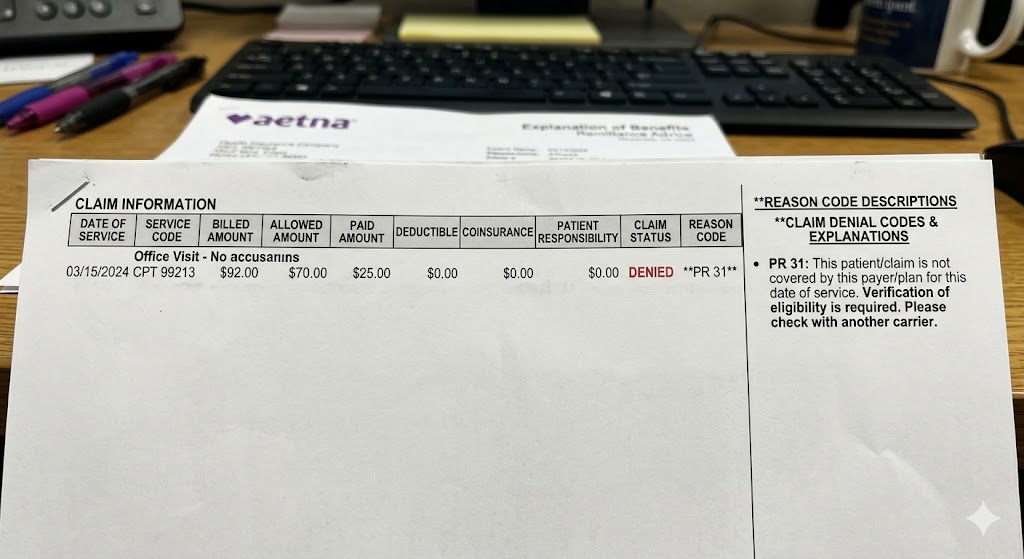
Before we dive into resolution tactics, we must establish a foundational understanding. The PR 31 Denial Code belongs to the Claim Adjustment Reason Code (CARC) family. CARCs communicate why a claim or service line was paid differently than billed. The “PR” prefix is the key to unlocking this code’s meaning.
A code starting with “PR” signifies Patient Responsibility. The insurance carrier has processed the claim and determined that the payment for this specific portion of the bill is not their liability. Instead, the patient owes this amount. The carrier is not saying the service was invalid; they are simply enforcing the terms of the patient’s health plan.
The numerical suffix “31” narrows this responsibility. It specifically indicates that the patient is responsible for a copayment or deductible. This is a contractual obligation between the patient and the insurer. The provider, as a contracted or out-of-network entity, must respect this determination and seek payment directly from the patient.
What Does PR 31 Mean in Medical Billing?
In practical terms, seeing a PR 31 code on your Explanation of Benefits (EOB) or Electronic Remittance Advice (ERA) means “Do not write this amount off. Do not appeal this amount to the insurance company. Bill the patient.” The payer has calculated the patient’s accumulated out-of-pocket expenses and applied a specific dollar value to the claim.
This denial is not a rejection of the service. It is an adjudication decision. The claim is finalized from the payer’s perspective. The allowed amount has been calculated, and the PR 31 segment is the portion that falls into the patient’s unmet deductible or a fixed copayment. Understanding this immediately saves your billing team hours of wasted effort on futile appeals.
The Financial Impact of Ignoring PR 31 Denials
Many practices treat PR 31 adjustments casually because the money is “still collectible.” This is a dangerous oversight. The cost of collecting a patient balance is exponentially higher than receiving an insurance check. Ignoring the systematic management of these denials creates a hidden financial sinkhole.
If your front desk fails to verify deductibles, a patient might receive a large, unexpected bill long after the service. This leads to confusion, anger, and a high rate of non-payment. Bad debt rises. The administrative cost of sending multiple statements and making collection calls eats into the original profit margin. An unmanaged PR 31 workflow is the primary driver of aging patient Accounts Receivable (A/R) over 90 days.
A Simple Scenario: The Birth of a PR 31 Code
A patient schedules a specialist visit. Their insurance card states a $40 copayment for specialist visits. The plan also has a $1,500 deductible. This is the patient’s first medical visit of the year. The specialist bills a level 3 visit (CPT 99213) for $200.
The insurance company processes the claim. The contracted allowable amount is $130. How does the payer apply the PR 31 Denial Code? First, it applies the $40 copayment. This is a fixed, upfront cost. The remaining $90 is applied to the patient’s $1,500 deductible because they haven’t met it yet. The EOB returns with a PR 31 amount of $130. The insurance pays $0. The practice is now fully responsible for collecting $130 from the patient, a task vastly different from collecting a simple $40 copay.
Deep Dive: Reasons for the PR 31 Denial Code
A single code masks multiple root causes. Effective resolution requires you to trace the denial back to its origin. A PR 31 Denial Code is a symptom of a specific benefit design. Identifying the exact reason allows you to frame the conversation accurately with the patient and avoid missteps. Let’s break down the three main catalysts: deductibles, copayments, and the less common Patient Responsibility Scenarios.
Reason 1: Application Toward the Annual Deductible
The deductible is the most common and financially significant driver of PR 31 denials. A deductible is a fixed amount a patient must pay for covered healthcare services before the insurance plan starts to pay its share. Plans often have separate deductibles for individuals and families. A high-deductible health plan (HDHP) can expose a patient to thousands of dollars in costs before any insurance payment is made, other than for preventive services.
When a claim hits a deductible, the entire allowed amount, minus any copay, shifts to PR 31. The insurance carrier pays $0.00. The billing system must be configured to treat these patient balances not as “small copays” but as significant financial liabilities. The timing of the service date is crucial. A March visit likely has a higher chance of hitting a deductible than a November visit, when the patient may have already met their out-of-pocket maximum.
Deductible Accumulator Programs and PR 31
A modern complexity is the Deductible Accumulator Maximizer program. Many payers now exclude manufacturer copay assistance cards from counting toward a patient’s deductible. If a patient uses a copay card for a specialty drug, the insurer may not credit that payment to the patient’s annual deductible.
The result is a false PR 31 determination. The insurer’s system sees the deductible as unmet because it ignored the third-party payment. The EOB will state the patient owes the full deductible amount, even though they thought the copay card covered their responsibility. Providers must be aware of this trap. The patient is technically responsible, but they may be unaware and unable to pay without the assistance they thought they had.
Reason 2: Fixed Copayment Amounts
A copayment, or copay, is a fixed dollar amount a patient pays for a specific covered service. The plan contract pre-defines these amounts. They are predictable and usually listed on the patient’s insurance ID card. A primary care visit might have a $25 copay, while a specialist visit has a $50 copay. An urgent care visit might be $75, and an emergency room visit could be $500.
The PR 31 Denial Code for a copay is black and white. The contract states the fee. The payer reduces the payment by the copay amount and codes it as PR 31. Unlike a deductible, which is a variable accumulation, a copay is a flat transaction per service. However, billing departments often fail to collect this at the time of service, turning a simple point-of-sale transaction into a costly billing cycle.
Misapplied Copayments in Specialist and Urgent Care Settings
A frequent error occurs when a patient’s plan design changes mid-year or the front desk misreads the card. A staff member may collect a $30 primary care copay for a visit that is actually classified as a specialist visit with a $60 copay. The claim processes, and the insurer deducts $60, leaving a $30 PR 31 balance.
The billing team now must chase $30. The cost to generate a statement, post a payment, and manage the phone call far exceeds the net revenue from that $30. This “underpayment at time of service” is a direct result of a front-end process failure. Training staff to read insurance cards accurately and verify benefits via a portal or phone is not an administrative cost; it is a revenue protection activity.
Reason 3: Specific Patient Responsibility Scenarios
Beyond the standard definitions, a PR 31 Denial Code can appear in more nuanced situations. A plan might have a benefit structure that includes coinsurance only after the deductible is met. If a service falls into a specific tier, like a Tier 4 drug on a formulary, the patient might be responsible for a percentage that the system codes as PR 31 until a certain threshold is reached.
Another scenario involves non-covered services that the patient signed a waiver for. While the main denial for a non-covered service is often a CO (Contractual Obligation) code or a PR (Patient Responsibility) code like PR-204, some payers incorrectly map the patient’s financial liability for a known non-covered service under a generic PR 31 umbrella. A careful review of the EOB is essential to confirm the code’s true meaning.
A Comparative Analysis: Copay vs. Deductible PR 31s
To manage your workflow, you must instantly recognize whether a PR 31 is a deductible or a copay. The collection strategy differs significantly for each. A copay is a small, expected, upfront amount. A deductible is a larger, often unexpected, post-service debt. The following table clarifies the operational differences.
Step-by-Step Resolution Guide for PR 31
Resolving a PR 31 denial does not mean getting the insurance company to pay. It means correctly transferring the liability to the patient account and establishing an efficient collection process. The resolution goal is to ensure the balance is accurate, permissible under your contract, and clearly communicated. An incorrect transfer creates a regulatory compliance risk and damages patient trust. Follow this systematic guide to handle every PR 31 with precision.
Step 1: Verify the EOB and Patient Liability Calculation
Never assume the payer’s math is correct. A manual or automated audit of the EOB is your first line of defense. Look at the column of adjustments. Confirm the sum of the PR 31 adjustments plus any insurance payment equals the allowed amount. A common payer error is double-applying a copay and a deductible incorrectly for the same service.
Review the patient’s plan summary on the EOB. Check the “Amount Applied to Deductible” field. Does this match the patient’s total accumulated deductible on the date of service? If the payer’s system lagged in posting a prior payment, they might incorrectly list a higher deductible remaining, inflating your PR 31 amount. A quick call to the provider services line can rectify this system lag.
“Trust, but verify. An EOB is a data output from an incredibly complex computer system. System synchronization errors between a patient’s deductible bank and the claims engine are a daily occurrence. Your five-minute verification can save a patient from a massive billing error.” — A seasoned Revenue Cycle Manager.
Step 2: Confirm Contractual Obligations and Allowed Amount
Your contract with the payer dictates how a PR 31 is applied. You cannot bill the patient for the difference between your billed charge and the allowed amount if you are in-network. This is called balance billing and is strictly prohibited by your payer contract. The PR 31 amount must be a direct pass-through of the contractually calculated copay, deductible, or coinsurance.
Analyze the allowed amount. If the contracted rate for a service is $100, and the plan has a 20% coinsurance after a copay, the PR 31 should be exactly $20 (or $20 plus a copay). If the payer applied a non-covered service denial but coded it as PR 31, you might have a liability issue. A non-covered service may be fully billable to the patient, often at the full billed charge, which is a separate calculation not represented by a standard PR 31 based on an allowed amount.
Step 3: Transfer the Balance to Patient Responsibility
This is a critical handoff point. The balance must move from the insurance A/R bucket to the patient A/R bucket in your practice management system. This transfer must include a narrative that the billing team and the patient can understand. Do not use the cryptic code “PR 31” as the only descriptor on a patient statement. A patient will not know what that means.
Post the adjustment using a clear, plain-English note. “Transfer to Patient: Annual Deductible” or “Transfer to Patient: Specialist Copay.” This simple step saves hundreds of hours of staff time spent explaining confusing bills. It also makes any subsequent patient phone call much smoother. The staff member answering the call can instantly see the why behind the charge.
Step 4: Generate and Send a Clear Patient Statement
The patient statement is the most important communication you will send. This is not a standard invoice. It is an educational tool about their health insurance plan. A confusing statement triggers an immediate “This is a mistake” reaction from the patient, leading to a defensive phone call. Design your statement to pre-empt this confusion.
Show a mini-summary of the claim. List the date of service, the service type, the total billed amount, the insurance adjustment, the insurance payment (even if $0), and the balance due. Include a specific line item: “Amount applied to your $1,500 deductible.” If the balance is a copay, state “Your $50 specialist copay per your insurance plan.” This level of transparency builds trust and increases the likelihood of prompt payment.
Step 5: Implement a Proactive Patient Collection Strategy
A single statement is rarely enough. You need a cadence of communication. However, the tone must be supportive, not aggressive. The goal is to help the patient fulfill their obligation without damaging the provider-patient relationship. A multi-channel strategy works best. This can include a follow-up text message reminding them a statement is in the mail.
Consider offering a payment portal where patients can self-serve 24/7. If the deductible amount is large, train your billing staff to proactively offer a no-interest payment plan before the patient calls to complain. By saying, “We know deductibles can be a surprise; we can set up a 6-month plan for you today,” you reset the conversation from a dispute to a solution.
A Tactical Phone Script for PR 31 Collections
When a patient calls about a PR 31 balance, the first two minutes of the call dictate the outcome. The billing team must use a consultative, non-defensive script. The patient is often confused and scared. The script should guide the patient from emotion to logic. Here is a proven framework.
Staff Member: “Good morning, thank you for calling about your recent statement. I can see here the balance is for your annual deductible. I know these plan designs can be a surprise. May I take a moment to walk you through how your insurance plan processed this claim so it makes perfect sense?”
Staff Member (after patient agrees): “On [Date of Service], we provided a [Service Name]. Your insurance plan, through [Payer Name], has a yearly deductible of $1,500. As of that visit, no major medical claims had been paid, so this $130 visit was applied entirely toward that deductible. The good news is, this now means you have $1,370 left to meet before your insurance starts sharing the cost.”
Staff Member (closing): “We can take a payment today if you wish, but many patients in your situation prefer a no-interest monthly plan. Would a plan of $45 a month for three months help make this manageable?” This script acknowledges, educates, and offers a concrete, scalable solution.
Proactive Prevention: Stopping PR 31 Surprises
The highest-performing medical billing operations do not just resolve denials; they prevent them from becoming surprises. A PR 31 is a “denial” in payment, but the liability is real and legal. Prevention in this context means eliminating the surprise element and collecting the money upfront or preparing the patient for the post-service bill. This requires a shift from a reactive back-end process to a proactive front-end intelligence operation.
Real-Time Eligibility Verification: Your Best Defense
Checking eligibility in real time is no longer a luxury; it is the standard of care for revenue cycle management. A basic eligibility check confirms if the policy is active. A comprehensive check returns the exact details needed to predict a PR 31. You need to pull the patient’s remaining deductible, their out-of-pocket maximum, and their specific copay amounts for the scheduled service type.
Integrate this check directly into your practice management or EHR system. When a front-desk coordinator enters the patient’s demographics for the day’s visit, the system should auto-run a 270 eligibility transaction. The response should flash a warning: “Alert: Patient has $1,200 remaining on a $2,000 deductible. Copay for specialist is $60. Collect $60 today. Counsel on potential $X balance for additional services.” This information transforms the front desk from a greeter into a financial clearance strategist.
Pre-Service Collection Strategies for Deductible Plans
Collecting a copay is easy. Collecting for a deductible before the service is an art. You cannot know the final allowable amount before the claim is generated. However, you can create a deposit strategy based on historical averages. For a standard new patient evaluation (e.g., 99204), you can run a report showing the average allowed amount for your top three payers.
You then explain this to the patient transparently. “Mr. Jones, for a new patient visit, your plan’s deductible applies. The contracted rate with your insurance is typically around $150. To reduce your post-visit balance, we recommend a $150 deposit today. We will reconcile this after the claim finalizes and refund any overpayment promptly.” A signed financial agreement form authorizing this deposit protects you and sets clear expectations.
Financial Clearance Form for Deductible Patients
A verbal conversation is not enough. You must document the patient’s acknowledgment of their financial responsibility. A dedicated Financial Clearance Form is a binding document that eliminates the “I wasn’t told” defense. This form should be separate from the general consent to treat. It must be a standalone financial document.
The form should clearly state: “I understand my insurance plan has an annual deductible of [Amount].Asoftoday,[Remaining] of this deductible has not been met. I understand the services I receive today will apply to this deductible. I agree to pay a deposit of $[Deposit] today and understand the final balance may be higher or lower. I agree to pay any remaining balance upon receipt of a statement or accept a refund for any overpayment.” This document secures a significant portion of your PR 31 revenue upfront.
Advanced Patient Education on Benefit Plans
Most patients do not know what a deductible is, let alone their remaining balance. They sign up for plans during open enrollment and choose based on the lowest monthly premium, often inadvertently taking on a $7,000 deductible. Your practice can become a trusted advisor by offering plain-language educational materials in your waiting room and on your website.
Create a one-page flyer titled “How Your Health Plan Works.” Use simple graphics to show the journey of a claim: Copay → Deductible → Coinsurance → Out-of-Pocket Max. Label the PR 31 Denial Code concept without using the code itself: “This is the portion your plan assigns to you.” An educated patient is a less angry patient. When they later receive a statement, the concept is not foreign. It clicks into place because they saw your flyer three weeks earlier.
Navigating Complex and Multi-Payer Scenarios
The simple single-payer scenario is becoming less common. Patients often have a primary and secondary insurance, or they have Medicare with a supplemental plan. When a PR 31 appears from a primary payer, the workflow changes. You cannot simply transfer the entire balance to the patient. You must first determine if a secondary payer will cover the patient responsibility amount.
PR 31 with Secondary Insurance (COB)
Coordination of Benefits (COB) dictates which plan pays first. The primary payer processes the claim and, if a deductible applies, issues a PR 31 Denial Code. Your billing system must automatically trigger a claim submission to the secondary insurance. You send the secondary payer the EOB from the primary, showing the PR 31 amount.
The secondary insurance may then pay some or all of that patient responsibility. Only after the secondary payer adjudicates and returns a remaining patient balance (often coded as PR 31 again, or a new PR code) can you bill the patient. Billing the patient before the secondary payer processes the claim is a compliance violation and creates a refund headache. A rigorous COB workflow is essential.
Medicare and the PR 31 Deductible
Medicare Part A and Part B have specific annual deductibles. When a claim applies to the Medicare Part B deductible, the Medicare Administrative Contractor (MAC) will issue a PR 31 Denial Code. The beneficiary is responsible for this amount. However, the rules about collecting it are strict. If the patient has a Medigap (Medicare Supplement) plan, you must submit the claim to the Medigap plan.
If the Medigap plan covers the Part B deductible, they will pay the PR 31 amount directly to you. If the patient is a Qualified Medicare Beneficiary (QMB), you cannot bill them for any Medicare cost-sharing, including the deductible. Billing a QMB patient is a federal violation. Your system must have a hard stop preventing a PR 31 balance from generating a patient statement for a verified QMB patient.
The Role of Out-of-Network Benefits
When a patient sees an out-of-network provider, the PR 31 Denial Code calculation changes dramatically. The “allowed amount” does not exist. Instead, the plan has a “usual, customary, and reasonable” (UCR) rate. The deductible is applied to this UCR amount, not your actual charge.
For example, you bill $500. The UCR is $300. The plan applies the patient’s deductible to $300, leaving a PR 31 of $300. The remaining $200 of your charge is not a PR 31; it is a balance billable amount. Your EOB will show the $300 as PR 31 and the $200 as a provider write-off or a non-covered charge. You must bill the patient for the full $500, but you must track the $300 deductible portion and the $200 balance-billed portion separately for accounting and collection purposes.
Technology and Automation Tools for PR 31 Management
Manual management of PR 31 denials is unsustainable for a growing practice. Technology bridges the gap between a chaotic billing operation and a streamlined revenue machine. Automation reduces human error, accelerates patient billing, and standardizes the patient experience. Investing in the right tools pays for itself by reducing days in patient A/R and lowering statement generation costs.
Payer Portals and Batch Eligibility Systems
Moving beyond a one-by-one payer website lookup saves hours of staff time daily. A batch eligibility system allows you to upload a roster of tomorrow’s appointments and return the complete benefit breakdown for every patient by the end of the day. This produces a proactive worklist for the financial counseling team.
These systems can flag high-risk accounts. A patient with a $50 remaining deductible is low risk. A patient with a $6,000 remaining deductible is a high-priority account requiring a pre-service phone call. The system can segment these patients. Your team can call the high-risk patients the day before to set financial expectations and secure a deposit, ensuring a calm, private conversation rather than a rushed one at a busy check-in window.
Automated Patient Statement and Payment Portals
Once a PR 31 balance is verified, the transfer to patient responsibility and the subsequent statement generation should be a hands-off, automated event. The practice management system should auto-generate and print or email the first statement five days after the EOB posting. This removes the variability of a billing clerk’s manual queue.
The integration of an online payment portal is non-negotiable. The statement must include a QR code and a short URL directing patients to a secure portal. The portal must display the detailed EOB-level breakdown we discussed earlier. It must allow patients to pay in full, set up auto-pay, or request a payment plan. Each of these self-service actions is a phone call that your billing staff never receives.
Table: Technology ROI for PR 31 Workflow
The upfront cost of technology often creates hesitation. However, quantifying the return on investment (ROI) from reducing bad debt and improving staff efficiency makes the decision clear. The table below provides a comparative ROI model for a medium-sized practice implementing PR 31 automation tools.
| Technology Component | Manual Process Cost/Time | Automated Process Cost/Time | Qualitative ROI |
|---|---|---|---|
| Eligibility Verification | 5 min/patient manual lookup. High error rate. Missed copays. | 0 min/patient batch auto-verification. Alerts generated for deductibles. | Pre-service cash collections increase by 25-40%. |
| Patient Statement Generation | Billing staff manually reviews and prints statements. 2-3 day delay. | Auto-generated on Day 5 post-EOB. Instant email and text notification. | Patient payment cycle time reduces by 10 days. Staff re-allocated to calls. |
| Payment Plans & Portal | Staff takes payment by phone, manually posts. Tracks recurring payments on a spreadsheet. | Patient self-enrolls in portal. Auto-pay debit/credit card. Auto-posting to ledger. | Bad debt write-offs from payment plans drop by over 50%. |
Legal and Compliance Deep Dive
Billing a patient for a PR 31 Denial Code is a legally protected action, but it comes with a minefield of compliance requirements. Federal and state laws, along with contractual agreements, strictly govern when, how, and how much you can collect. A single mistake, even an unintentional one, can lead to lawsuits, fines, and exclusion from insurance networks. The financial consequences of non-compliance are an order of magnitude higher than the PR 31 balance itself.
The No Surprises Act and Good Faith Estimates
The No Surprises Act fundamentally changed how a PR 31 deductible can be communicated and collected for uninsured and self-pay patients. If a patient schedules a service and explicitly chooses not to use their insurance, you must provide a Good Faith Estimate (GFE) of expected charges. This is a binding document.
If the final bill, including the full payment amount requested at the time of service, is $400 or more above the GFE, the patient has the right to initiate a dispute resolution process. If you collect a “deposit” for a deductible-applicable service but fail to provide a GFE to a self-pay patient, you are at severe risk. For insured patients, the act requires you to be mindful of balance billing protections, especially for emergency or ancillary services at an in-network facility.
State Prompt Payment and Billing Time Limits
Every state has laws governing the timely submission of medical claims and patient bills. You cannot hold a patient’s PR 31 balance indefinitely and then send a surprise bill three years later. Many states impose a “timely billing” requirement, such as within one calendar year of the service date. Failing to bill the patient within that window means you must write off the PR 31 balance.
This is critical for deductible balances. If the insurance EOB takes six months to arrive, your window to bill the patient is already half-closed. Your system must track the “patient billing deadline” separately from the insurance filing deadline. An internal policy of “bill the patient within 30 days of EOB receipt” is the safest harbor against violating these state-specific statutes of limitations.
A Billing Manager’s Warning: A True Lesson
Sometimes the most powerful lessons come from real-world failures. The following scenario is a composite of experiences from a billing manager with over 20 years in the field. It highlights how a system breakdown around a PR 31 code can trigger a catastrophic patient relationship failure.
“I remember a case where a patient came in for a life-threatening allergy screening. Our new system failed to verify her new plan’s $4,000 deductible. We collected a $30 copay, which was wrong. Ninety days later, she got a $1,200 statement. No one had warned her. She filed a complaint with the state insurance commissioner and posted a scathing review online. We won the dispute on the technicality of the PR 31 code being correct, but we lost the entire family’s business and the referrals of five other families. The PR 31 code was correct, but our communication was a total system failure.”
Building a Denial Management Team Protocol
Your software is only as good as the team using it. A specialized Denial Management Team, or at least a dedicated function within your billing department, is required to handle the volume and complexity of PR 31 denials. This team must be fluent in the language of CARC codes, payer contracts, and empathetic patient communication. They are the final quality checkpoint before a bill reaches a patient.
Creating a Standardized PR 31 Workflow Chart
A visual workflow chart ensures no step is skipped. Post this chart in the billing office and use it for new hire training. The chart begins with “EOB Received” and branches based on the PR 31 reason code. It dictates the exact sequence: Verify Patient Demographics → Verify Primary/Secondary Payer → Audit Allowed Amount vs. Contract → Confirm Accumulated Deductible → Transfer Balance with Plain-English Note → Hold for Statement Batch.
The flowchart must include a specific branch for “Secondary Insurance Present.” This branch routes the account to the COB team before any transfer to patient responsibility is made. The final step on the chart should be a quality assurance (QA) checklist. A separate billing team member should perform a 5% audit on all PR 31 transfers weekly, reviewing the patient ledger for accuracy and clear financial notes.
Training Staff for Empathetic Financial Communication
Telling a billing clerk to “be nice” is not training. You must provide them with the specific linguistic tools to de-escalate conflict and guide a patient toward payment. Role-playing exercises are the most effective method. Create scenarios based on real patient calls about high deductible PR 31s. Practice the “Acknowledge, Educate, Solve” script.
Teach staff to use collaborative language. “Let’s look at your EOB together” is infinitely more effective than “Your plan says you owe this.” Train them to listen for verbal cues of financial hardship. A statement like, “I just can’t pay $800 right now,” is an opportunity to immediately present the payment plan option. The team member who resolves this calmly saves the patient from the stress of a collection agency and saves the practice from a bad debt write-off.
Tracking and Trending PR 31 Data for Quality Improvement
Data is the foundation of a sustainable PR 31 management strategy. A monthly dashboard tracking key performance indicators (KPIs) will reveal whether your prevention strategies are working. Track the total dollar amount of PR 31 adjustments by payer. An unexpected spike in PR 31 from a specific payer might indicate a systemic claims processing error on their end that you can challenge.
More importantly, track your patient collection rate on PR 31 balances by time period and service location. If Location A collects 90% of PR 31 balances and Location B collects 40%, the problem is not the patients; it is a process failure at Location B. Location B’s front desk may be failing to collect copays or communicate deductibles. Data allows you to pinpoint the exact failure point and deploy targeted retraining instead of a blanket, ineffective new policy.
Table: KPI Dashboard for PR 31 Management
A monthly KPI dashboard transforms raw data into actionable intelligence. It provides a high-level snapshot of the financial health of your patient A/R. Use this table as a template for your own monthly review meeting.
| Key Performance Indicator (KPI) | Target | How to Calculate | Action for Red Flags |
|---|---|---|---|
| Time-to-Bill (Patient Statement) | < 5 days from EOB post | Date of Patient Statement – Date of EOB Posting. | Audit workflow for manual bottlenecks. Activate auto-statementing feature. |
| Point-of-Service (POS) Copay Collection Rate | > 95% | Total Copay Collections at POS / Total Copay Payments Expected. | Re-train front desk. Audit “tickets” where no payment was collected. |
| Patient A/R Over 90 Days (%) | < 15% of total Patient A/R | Total Patient Balances >90 Days Old / Total Outstanding Patient A/R. | Write off truly uncollectible accounts. Send final demand letters for remaining. |
| Deductible Pre-Collection Rate | > 30% of known deductible | Total Deposits Collected for Deductibles / Total Allowed Amount Applied to Deductibles. | Script re-training for financial counselors. Call eligible patients 48hrs before visit. |
Conclusion
The PR 31 Denial Code signifies a contractual transfer of financial responsibility from the payer to the patient for a copayment or deductible, not an unrecoverable payment rejection. Mastering this code requires a seamless integration of real-time front-end eligibility verification, transparent patient financial communication, and a rigorous back-end verification protocol before any balance is billed. A successful resolution transforms a potential point of patient friction into a structured, dignified, and efficient collection process that protects your practice’s financial health while preserving trust.
FAQ: Common Questions About PR 31 Denials
Q1: Can I simply write off a PR 31 Denial Code balance as a customer service gesture?
Routinely writing off a patient’s deductible or copayment is a direct violation of most payer contracts and can be considered an illegal inducement. This practice can trigger a false claims act investigation. You must make a good-faith effort to collect, and you can only write it off if you have a documented, well-defined financial hardship policy that is applied uniformly to all patients.
Q2: If a patient is on a payment plan for their PR 31 deductible, can I still send them to collections?
As long as the patient makes the agreed-upon monthly payments on time, you cannot send the active balance to a collections agency. The payment plan agreement is a legally binding contract. However, if they miss a payment and you follow the default terms outlined in your signed payment plan agreement (e.g., a 10-day cure notice), you can then place the remaining balance with a collection agency.
Q3: Does the PR 31 code mean the service was not medically necessary?
No. A PR 31 Denial Code is strictly a financial responsibility code related to the patient’s plan benefit structure (copay, deductible). It has absolutely no connection to the medical necessity of the service. If a service was not medically necessary, the payer would use a specific denial code, often a CO (Contractual Obligation) code, stating the reason, and your contract would likely prohibit you from billing the patient.
Q4: Why did I receive a PR 31 for a preventive visit that is supposed to be free?
This is a common issue. A preventive visit may include a separate, non-preventive service, or the payer incorrectly coded a preventive service. For example, if a patient has a preventive annual physical but also discusses a new problem like knee pain, the provider may bill a separate evaluation and management (E/M) code with a modifier 25. That separate E/M service is subject to the deductible and will generate a PR 31. You must review the claim detail to see if a diagnostic or problem-oriented code was billed alongside the preventive service.
Additional Resource:
For the official, complete listing and formal definitions of all Claim Adjustment Reason Codes, please refer to the Washington Publishing Company’s standard code list, which is the industry authority: X12 CARC Code List
Disclaimer: This article provides general information on medical billing codes and is intended for educational purposes only. It does not constitute legal, financial, or professional billing advice. Revenue cycle regulations and payer contracts vary significantly. Always consult with a certified medical coder, healthcare attorney, or your specific payer contracts to ensure full compliance.