Medical coding for procedures performed under anesthesia often creates confusion, even among seasoned healthcare professionals. One procedure that consistently generates questions is the pelvic examination performed under anesthesia. Many coders, billers, and providers find themselves searching for the correct way to report this service. This guide aims to eliminate that confusion entirely. You will learn the primary CPT code, understand the critical role of anesthesia codes, discover when and how to use modifiers, and review real-world clinical scenarios that bring these rules to life. This resource serves as a complete manual for accurate, compliant, and optimized medical coding for this specific service.
cpt code for pelvic exam under anesthesia
Understanding the Procedure: Why Perform a Pelvic Exam Under Anesthesia?
Before diving into the numerical codes, understanding the clinical purpose of the procedure provides essential context. A pelvic examination under anesthesia, often abbreviated as EUA, serves a distinct role in gynecologic care. A provider performs this examination when a patient cannot tolerate a thorough awake exam due to pain, anxiety, body habitus, or age. Pediatric patients and individuals with a history of trauma often require this approach. The anesthesia eliminates muscle guarding and voluntary tensing, allowing the clinician to palpate the pelvic organs with unprecedented precision.
This examination rarely occurs in isolation. It frequently precedes a planned surgical procedure, such as a dilation and curettage, hysteroscopy, or laparoscopy. The surgeon uses the EUA to confirm the preoperative findings, map the surgical field, and finalize the operative plan. The clinical notes must clearly document the medical necessity for performing the exam under anesthesia, distinguishing it from a routine office-based pelvic examination. Payers scrutinize these claims, looking for a clear justification for the increased resource utilization.
The examination itself follows a systematic approach. The provider inspects the external genitalia, performs a speculum examination of the vagina and cervix, and conducts a bimanual rectovaginal examination. The bimanual component assesses the size, shape, position, and mobility of the uterus and adnexa. Any nodularity, tenderness, or mass becomes a critical finding that guides the subsequent surgical steps. The depth of information gained during an EUA far exceeds what an awake examination can yield in challenging situations. This enhanced diagnostic capability justifies the procedure’s distinct coding status when documented correctly.
The Primary CPT Code: 57410
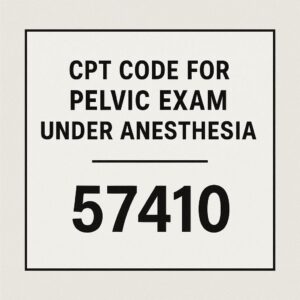
The specific CPT code for a pelvic examination under anesthesia is 57410. The official descriptor for this code states: “Pelvic examination under anesthesia (other than local).” The American Medical Association maintains this code within the Female Genital System subsection of the Surgery section in the CPT manual. This code represents the total work of performing the comprehensive pelvic exam while the patient receives anesthesia other than a local agent.
The phrase “other than local” is the key differentiator. If a provider performs a pelvic examination using only local anesthetic infiltration, you cannot report 57410. You would instead bundle that examination into the evaluation and management service or the primary surgical procedure. Code 57410 specifically carves out the added complexity and resource consumption of monitoring a patient under general, regional, or monitored anesthesia care for this diagnostic maneuver.
Crucial Note: Code 57410 describes a diagnostic procedure. When a surgeon performs this exam immediately before a planned surgical procedure, specific coding rules apply. You must append a modifier to indicate the exam’s relationship to the subsequent surgery. Failing to do so often results in a claim denial, as payers will bundle the exam into the global surgical package.
Key Documentation Elements to Support 57410
Proper documentation serves as the foundation for compliant billing. To support reporting 57410, the medical record must contain clear, convincing evidence. The note should specify the type of anesthesia used and confirm it was not local. It must detail why a routine, awake examination was insufficient or impossible. The provider should describe each step of the examination and list all abnormal findings. The record must link the EUA findings directly to the clinical decision-making for the planned surgery, if one follows. When the EUA is a stand-alone procedure, the documentation must spell out the compelling medical necessity that rendered an office exam inadequate.
The Anesthesia Side: Billing for Anesthesia Services During an EUA
When a separate anesthesia provider administers the anesthetic, their service requires distinct coding. The applicable anesthesia CPT code is 00940, described as “Anesthesia for vaginal procedures (including biopsy of labia, vagina, cervix or endometrium); not otherwise specified.” This code covers the anesthesia professional’s work during the pelvic examination under anesthesia. The anesthesia provider bills 00940 with the appropriate time units and physical status modifier.
Crosswalk codes also exist. Code 00940 directly crosswalks to surgical CPT 57410. This connection clarifies the billing pathway for the anesthesia care team. The anesthesia record must document the start and end times of anesthesia care, the total units, and the patient’s health status. The physical status modifier (P1 for a normal healthy patient up to P6 for a brain-dead organ donor) adds critical risk-adjustment information to the claim.
Payment and Billing Comparison: Surgeon vs. Anesthesia Provider
The revenue streams and coding logic for the surgeon and the anesthesiologist differ significantly. The table below clarifies these distinct pathways.
| Role | Primary CPT Code | Billing Unit | Key Modifiers | Typical Global Period |
|---|---|---|---|---|
| Surgeon / Proctoring Provider | 57410 | One unit (procedure) | -58, -59, -XU, -79 | 0-day (typically) |
| Anesthesia Provider | 00940 | Time units + base units | QS, QX, QZ, physical status (P1-P6) | N/A (time-based service) |
The surgeon reports a single unit of 57410, often with a modifier. The anesthesia provider reports base units for 00940 plus the total time spent in minutes divided by 15. The physical status modifier and qualifying circumstances, like extreme age or emergency conditions, add additional units. These two services, while connected clinically, travel on entirely separate billing tracks.
Modifier Strategies: The Key to Reimbursement
Modifiers play a make-or-break role in claims for CPT 57410. The most common and important modifier scenarios involve the exam performed as a distinct service from another procedure.
Using Modifier -59 or -XU for Distinct Procedural Services
When a surgeon performs a pelvic exam under anesthesia on the same day as another procedure, you must demonstrate that the EUA was a distinct and separate service. The classic scenario involves a diagnostic laparoscopy. The surgeon performs the EUA first, gains critical information that directs the laparoscopic approach, and then proceeds. Payers often incorrectly bundle 57410 into the laparoscopy code. Modifier -59 (Distinct Procedural Service) breaks this incorrect edit.
The more specific “X{EPSU}” modifiers offer a better alternative when applicable. Modifier -XU (Unusual Non-Overlapping Service) works well here because the internal pelvic exam does not overlap with the laparoscopic portion of the surgery. The documentation must support that the EUA was a separate diagnostic step with its own medical necessity. A simple statement like, “Exam under anesthesia findings dictated the decision to proceed with chromotubation,” can secure payment.
Important Warning: Never append modifier -59 to 57410 without rock-solid documentation. The Office of Inspector General (OIG) has flagged the misuse of modifier -59 as a major audit risk. The modifier must report a truly distinct service, not a routine pre-surgical check.
The Relationship Between 57410 and Major Surgical Procedures
The National Correct Coding Initiative (NCCI) bundles many code pairs. NCCI edits frequently bundle 57410 with major gynecologic surgical codes. When a surgeon performs an EUA as a routine prelude to a hysterectomy, you should not bill 57410 separately. The global surgical package includes this preoperative evaluation. To bill 57410 separately, the surgeon must document that the EUA provided diagnostic information beyond the standard preoperative assessment and significantly altered the surgical plan. A documented finding of a previously unknown mass or a fistula would justify the separate report.
Reporting 57410 Separately with an Unrelated Procedure
A different coding scenario occurs when the EUA is necessary for a diagnostic purpose entirely unrelated to the other procedure performed on the same day. For example, a patient presents for a scheduled vulvar biopsy under anesthesia for a suspicious lesion. During the anesthetic period, the provider also performs a pelvic exam under anesthesia to evaluate new-onset deep pelvic pain and an adnexal mass. Because the diagnostic question for the pelvic pain is separate from the biopsy site, the two procedures qualify as distinct. In this case, you would append modifier -59 (or -XU) to 57410.
The Postoperative Period: Modifier -79
If a patient in the global postoperative period of a prior surgery requires a pelvic exam under anesthesia for a new, unrelated problem, modifier -79 (Unrelated Procedure or Service by the Same Physician During the Postoperative Period) applies. The documentation must clearly establish the new problem’s separation from the original surgery’s expected recovery course. This scenario is less common but essential to code correctly when it occurs.
Staged Procedures: Modifier -58
Modifier -58 (Staged or Related Procedure by the Same Physician During the Postoperative Period) has a more limited role with 57410. It could apply if a surgeon planned the EUA prospectively as a diagnostic step before a major cancer surgery, but completed the EUA during a global period from a prior, related diagnostic procedure. The modifier -58 indicates that the EUA was planned, more extensive, or for therapy following the initial procedure. The medical record must contain the prospective treatment plan to support this modifier.
When You Should Never Use a Modifier
If the pelvic examination under anesthesia is the only service provided on that day and the patient is not in a global period, no modifier is necessary. Simply report 57410 with the appropriate diagnosis code. Over-modifying creates red flags on a claim. Coders should resist the temptation to add a modifier “just to be safe.” Modifiers carry specific, legal meanings and should only appear when the clinical documentation meets the strict definitional criteria.
Diagnosis Coding: Linking Medical Necessity to CPT 57410
Diagnosis codes provide the medical necessity link for the procedure. You must pair CPT 57410 with an ICD-10-CM code that tells the payer why the examination was medically necessary under anesthesia. A generic code often fails. The most successful claims feature specific, detailed diagnoses.
Common and compliant diagnosis codes that support 57410 include:
-
N94.6: Dysmenorrhea, unspecified
-
R10.2: Pelvic and perineal pain
-
N73.9: Female pelvic inflammatory disease, unspecified
-
F52.22: Genito-pelvic pain/penetration disorder (when anxiety precludes awake exam)
-
Z01.411: Encounter for gynecological exam with abnormal findings
-
N80.9: Endometriosis, unspecified
-
C56.9: Malignant neoplasm of unspecified ovary
The diagnosis code should appear in the narrative as the reason for the exam. For instance, “Patient with incapacitating pelvic pain, unable to tolerate in-office exam, taken to operating room for EUA to evaluate for endometriosis.” This statement tightly links N94.6 to 57410.
Audit-Proof Your Claim: The diagnosis code on the claim form must exactly match the diagnosis documented in the operative note as the reason for the EUA. An audit mismatch between the claim and the record is the fastest path to a repayment demand.
Clinical Scenario Workflows: From the OR to the Claim Form
Theoretical coding rules become much clearer when applied to realistic patient scenarios. Let’s walk through four common situations, detailing the clinical story, the coded solution, and the rationale.
Scenario 1: Stand-alone Diagnostic EUA
A 35-year-old patient has a two-year history of deep dyspareunia and chronic pelvic pain. Office pelvic exams have been non-diagnostic because the patient involuntarily guards and cannot tolerate the speculum or bimanual exam. The provider schedules a diagnostic pelvic exam under monitored anesthesia care in the ambulatory surgery center. The anesthesiologist administers propofol. The surgeon performs a thorough visual inspection, speculum exam, and bimanual rectovaginal exam, identifying a fixed, retroverted uterus and tender nodularity along the uterosacral ligaments. A diagnostic laparoscopy is now planned for the following week.
Coding Solution:
-
Surgeon: 57410
-
Diagnosis: N94.6 (Dysmenorrhea), N80.9 (Endometriosis)
-
Anesthesia Provider: 00940
Rationale: This represents a clean, stand-alone service. No modifier is required for the surgeon’s claim. The payer should process 57410 and pay it independently because no other procedure was performed on the same day.
Scenario 2: EUA Immediately Before a Laparoscopy (The Classic Modifier -59 Case)
A 28-year-old patient with severe pelvic pain and a suspicious ovarian cyst on ultrasound undergoes a combined procedure. In the operating room, under general anesthesia, the surgeon performs a pelvic exam and palpates a solid, irregular adnexal mass. This finding changes the surgical plan. The surgeon decides to perform an ovarian cystectomy via laparoscopy instead of a simple cyst aspiration, and also sends a pelvic wash for cytology.
Coding Solution:
-
Surgeon: 49321 (Diagnostic Laparoscopy), 58662 (Laparoscopic Ovarian Cystectomy), 57410-XU
-
Diagnosis for 57410-XU: R10.2 (Pelvic pain), C56.9 (Malignant neoplasm of ovary, suspected)
-
Anesthesia Provider: 00940, 00840 (Anesthesia for intraperitoneal lower abdominal procedures)
Rationale: The EUA provided a separate, distinct diagnostic finding (the solid mass) that directly altered the planned laparoscopy. Modifier -XU breaks the NCCI edit that would otherwise bundle 57410 into the major laparoscopy code. The operative report must explicitly state, “The EUA revealed an irregular solid mass, which led to the decision to perform a cystectomy and send washings.” Without that sentence, the modifier loses its support.
Scenario 3: EUA and an Unrelated Procedure
A 24-year-old patient is under general anesthesia for an extensive vulvar condyloma excision (CPT 56501). The patient also has a separate, long-standing complaint of left lower quadrant pain and irregular bleeding. The surgeon performs a pelvic exam under the same anesthetic to evaluate these unrelated symptoms.
Coding Solution:
-
Surgeon: 56501, 57410-59
-
Diagnosis for 57410-59: N93.8 (Other specified abnormal uterine and vaginal bleeding), R10.32 (Left lower quadrant pain)
-
Diagnosis for 56501: A63.0 (Anogenital warts)
Rationale: The condyloma excision and the diagnostic pelvic exam address separate complaints and separate anatomical sites. The diagnosis codes clearly differ. Modifier -59 communicates this distinction to the payer. This claim stands a high chance of clean adjudication because the documentation easily proves the distinct nature of the two services.
Scenario 4: EUA in the Global Period of a Hysterectomy
Eight weeks after a total abdominal hysterectomy, a patient reports new, severe pelvic pressure and a sensation of a vaginal bulge. An in-office exam is painful and inconclusive. The surgeon takes the patient back to the operating room for a pelvic exam under anesthesia to rule out a vaginal vault prolapse or an enterocele, as the office exam could not provide a definitive answer.
Coding Solution:
-
Surgeon: 57410-79
-
Diagnosis: N99.3 (Prolapse of vaginal vault after hysterectomy)
Rationale: The patient remains in the 90-day global period of the hysterectomy. The EUA is for a new, acute problem not part of the normal post-hysterectomy recovery. Modifier -79 unlocks the payment for this return to the operating room. The documentation must trace the chain of logic: a new complaint arose, an office exam failed, and the EUA was medically necessary to diagnose the cause.
CPT 57410 vs. E/M Services: A Clear Boundary
A distinct line separates the work of CPT 57410 from an Evaluation and Management (E/M) service that includes a pelvic exam. For established outpatients, an E/M code (99202-99215) bundles the clinical work of a pelvic exam. You cannot bill an E/M service and 57410 together for the same patient on the same date simply because you performed a pelvic exam during a clinic visit.
The trigger for using 57410 is not just the performance of a pelvic exam; it is the use of anesthesia (other than local) and the medical necessity for that anesthesia. If a patient tolerates a pelvic exam in an office setting, even with discomfort, the appropriate billing is the E/M service level. Billing 57410 for an office exam with mild sedation, such as an oral anxiolytic, is incorrect. The code requires anesthesia services typically provided and monitored by an anesthesia professional. The location of the service, typically an operating room or procedure suite, also reinforces the appropriate use of 57410.
Pediatric and Special Populations: Adapting the Coding
The principles for coding 57410 remain the same for pediatric patients, but the clinical context shifts significantly. A child who needs a gynecologic examination often cannot cooperate, regardless of the gentleness of the approach. Pre-pubertal girls with vulvovaginitis, suspected foreign bodies, or signs of precocious puberty frequently require an exam under anesthesia. The code remains 57410. The supporting diagnosis codes change to reflect the pediatric context, such as N76.0 (Acute vaginitis) or T19.2 (Foreign body in the vulva and vagina).
For patients with severe intellectual or developmental disabilities, the same logic applies. When a patient’s condition prevents a safe, comprehensive, awake examination, moving to an EUA with proper documentation is appropriate. The key is to document the failure of less invasive attempts and the specific patient factors that necessitate anesthesia.
Global Period, Billing Frequency, and RVU Analysis
CPT code 57410 has a global period designation of “000,” meaning it has zero global days. This “minor procedure” designation means that any E/M service performed on the same day as the EUA is separately billable only if the E/M service was a significant, separately identifiable service. The decision to proceed to the EUA is part of the preservice work and cannot be a separately billed E/M service. However, if a patient presents for an office visit for abdominal pain, and during that visit, the provider discovers a separate skin lesion that requires evaluation and management beyond the decision for the EUA, that separate E/M service could be billable with modifier -25.
There are no strict frequency limitations on 57410. A provider could bill this code multiple times per year for the same patient if the clinical circumstances justify repeat exams under anesthesia. However, multiple billings within a short timeframe will trigger payer scrutiny. The medical record must powerfully justify each separate operative encounter.
The work Relative Value Unit (wRVU) for 57410 is modest, reflecting the diagnostic nature of the procedure. The primary value in reporting this code lies in capturing the work that falls outside the global surgical package, not in generating a high-dollar claim. However, consistent, accurate reporting of distinct services like an EUA improves procedural statistics, supports resource allocation, and provides a truthful record of the work performed.
The Crucial Role of Documentation: What Auditors Demand
Auditors from Medicare, commercial payers, and the OIG look for a specific narrative structure when reviewing claims for 57410, especially those appended with modifier -59 or -XU. This structure is non-negotiable for a compliant claim.
An airtight operative note for 57410 includes:
-
A Clear Pre-Anesthesia Statement: “The patient was unable to tolerate a complete pelvic exam in the office due to severe pain and anxiety. A full exam under anesthesia was deemed medically necessary to evaluate the source of her chronic pelvic pain.”
-
Type of Anesthesia: “General endotracheal anesthesia was induced by the anesthesia team.”
-
Detailed Anatomical Findings: A systematic description of external genitalia, vagina, cervix, uterus, and adnexa. Normal findings get a brief note; abnormalities get a detailed description.
-
The Clinical Impact Statement: This is the most critical sentence for modifier -59 support. “The EUA findings of a fixed, tender adnexal mass directly informed the decision to proceed with a salpingo-oophorectomy rather than an ovarian cystectomy alone.”
-
Diagnosis: A clearly listed postoperative diagnosis matching the billed ICD-10 code.
A deficient note simply stating “EUA normal” invites denial. The auditor sees a lack of medical necessity and no justification for separate billing if the note lacks detail and the critical “impact statement.”
Common Denial Reasons and Effective Appeals Strategies
Even correctly coded claims can face denial. Understanding the most common denial reasons prepares your team for successful appeals.
| Denial Reason | Underlying Payer Logic | Appeal Strategy |
|---|---|---|
| Bundled into surgical procedure | Payer applies NCCI edit automatically; modifier -59 ignored or overridden. | Send operative note with highlighted text: show separate diagnosis, separate finding, and clinical impact statement. Cite NCCI modifier indicator ‘1’ which allows a modifier. |
| Not medically necessary | Diagnosis code lacks specificity or does not justify general anesthesia. | Submit a letter of medical necessity from the physician. Explain why in-office exam was impossible (documentation of previous failed attempts). Upgrade diagnosis code if supported by record. |
| Incorrect modifier usage | Payer states modifier -59 appended inappropriately. | Provide a detailed timeline of the procedure in the appeal. Prove the EUA was a separate, initial step that generated new information before the subsequent surgery began. |
| Duplicate claim | Claim for 57410 was submitted previously for the same date. | Confirm if a corrected claim is needed. If the service was genuinely performed twice on the same day (a rare event), documentation must support two separate anesthetic events. |
A successful appeal always rests on the clinical documentation, not just a recitation of coding rules. The most effective letters quote the provider’s own operative note and highlight the exact sentences that prove medical necessity and distinctness.
Integrating 57410 with Other Gynecologic Procedures
The pelvic exam under anesthesia often occurs in a constellation with other procedures. Understanding the coding hierarchy and bundling rules helps create a clean, accurate claim.
-
EUA and Hysteroscopy: Diagnostic hysteroscopy (58555) and 57410 are bundled under NCCI edits, but a modifier is allowed if distinct. If the EUA identifies a uterine wall irregularity that directs the hysteroscopist to a specific area, that supports distinctness.
-
EUA and D&C: Diagnostic dilation and curettage (58120) also has an NCCI edit with 57410. As always, a separate, significant diagnostic finding from the EUA that impacts the D&C plan is the key to overriding the edit.
-
EUA and Cystoscopy: When a surgeon performs a pelvic exam under anesthesia, a hysteroscopy, and a cystoscopy during the same session for a complete pelvic floor evaluation, report 57410-XU (or -59), the appropriate hysteroscopy code, and 52000 (Cystoscopy). Each must have a distinct diagnostic purpose and findings. A procedure log that timestamps and details findings for each step provides robust support.
The Modifier -59 and -XU Documentation Checklist
To consistently report 57410 with a distinct service modifier and survive an audit, create a pre-submission checklist for every claim.
-
A different diagnosis supports the EUA than the one primarily supporting the other procedure. (No, not always required, but a highly compelling best practice.)
-
The operative note explicitly states the patient could not tolerate an awake exam.
-
The note describes a separate written paragraph with unique findings for the EUA.
-
An “impact sentence” connects the EUA findings to a change in the plan for the other procedure.
-
The anesthesia record confirms the type of anesthesia was other than local.
-
A separate procedure note for the EUA is not required but a clearly delineated section in the main operative report with the above elements fulfills the same function.
Coding for Different Sites of Service
The CPT code 57410 does not change based on the location, but the payer’s reimbursement calculation does. The place of service codes matter.
-
Outpatient Hospital (POS 22): The facility bills for the operating room, recovery, and supplies; the physician bills 57410 with the lower professional fee schedule amount.
-
Ambulatory Surgical Center (POS 24): Similar to hospital outpatient, with distinct facility fee billing by the ASC.
-
Inpatient Hospital (POS 21): If an inpatient requires an EUA, the professional claim still uses 57410. The facility services are part of the DRG payment and not separately billed by the physician.
Ensure the POS code on the claim matches the actual location where the EUA took place. This field is a common target in post-payment audits.
Anesthesia Crosswalk Detail and Physical Status Modifiers
The crosswalk from 57410 to 00940 is the standard path, but coders must also know the anesthesia physical status modifiers. These modifiers affect payment and provide crucial risk adjustment data.
-
P1: A normal healthy patient. (Rare in this context unless the EUA is purely for anxiety inability.)
-
P2: A patient with mild systemic disease. (Common: well-controlled hypertension, obesity.)
-
P3: A patient with severe systemic disease. (Common: poorly controlled diabetes, severe COPD, morbid obesity with BMI >40.)
-
P4: A patient with severe systemic disease that is a constant threat to life.
-
P5: A moribund patient not expected to survive without the operation.
-
P6: A declared brain-dead patient whose organs are being removed for donor purposes.
The anesthesia provider appends this modifier to 00940, e.g., “00940-P2.” This action accurately communicates the added complexity of managing the patient’s underlying condition during the exam.
Emerging Trends and Considerations
The shift towards value-based care and scrutiny of Ambulatory Surgery Center volume has placed a spotlight on codes like 57410. Payers are running more sophisticated analyses to identify patterns of always reporting an EUA before certain major laparoscopic procedures. A practice that reports 57410-59 with 100% of its diagnostic laparoscopies will face an audit.
A sound risk-management strategy involves coding 57410 only when the clinical narrative genuinely demonstrates medical necessity and distinctiveness. Avoid creating a default template that auto-populates an EUA note with a separate bill. Instead, the surgeon should dictate a unique note each time, answering the question: “What new information did this EUA give me that I did not have from the pre-operative evaluation, and how did that information change my surgical plan today?” If the answer is compelling, the coding for 57410 with a modifier is appropriate. If the answer is “nothing new,” the exam is part of the global surgical package and should not be separately billed.
The rise of office-based procedural suites with moderate sedation also raises coding questions. The definition of 57410 hinges on anesthesia “other than local.” Moderate sedation, typically administered and monitored by the surgeon, falls into a gray zone. For most payers, general, spinal, epidural, or monitored anesthesia care provided by a separate anesthesia professional clearly qualifies. If the surgeon personally administers oral sedation or minimal IV anxiolysis in an office setting, that scenario does not meet the threshold for 57410. The safe harbor is to report the appropriate E/M service and not 57410 in these office-based cases.
Conclusion
Accurate coding for a pelvic exam under anesthesia demands a precise command of CPT code 57410, anesthesia code 00940, and the nuanced modifier rules that govern their interaction with other procedures. The distinction between a bundled preoperative exam and a separately billable, diagnostic EUA hinges entirely on the documentation of distinct medical necessity and a tangible impact on the surgical plan. Mastering the use of modifiers -59 and -XU, and avoiding common pitfalls, protects revenue and ensures compliance. This deep understanding transforms a seemingly simple code into a powerful tool for accurately representing the physician’s diagnostic work.
Frequently Asked Questions (FAQ)
Q: What is the difference between CPT 57410 and simply doing a pelvic exam in the office?
A: CPT 57410 is for a pelvic examination performed under general, regional, or monitored anesthesia (not local). An in-office pelvic exam, even if uncomfortable, is bundled into the Evaluation and Management (E/M) service code and never reported with 57410.
Q: Can I bill 57410 with a hysteroscopy (58555) on the same day?
A: Yes, but only if the EUA was a separate, distinct diagnostic service that provided new information, directing the hysteroscopic procedure. You must append modifier -59 or -XU to 57410 and have clear documentation supporting the modifier. Without this, the services are bundled.
Q: Which modifier is most commonly used with 57410?
A: Modifier -59 (Distinct Procedural Service) is the most common, though the more specific -XU (Unusual Non-Overlapping Service) is preferable. The key is that the EUA must be a separate diagnostic step, not a routine pre-surgical check.
Q: Is CPT 57410 only for gynecologists?
A: While primarily used by gynecologists and gynecologic oncologists, any qualified provider (such as an emergency physician in a rare consult, or a urologist) performing a pelvic exam under anesthesia can report 57410 if the documentation supports medical necessity.
Q: What anesthesia code does the anesthesiologist use when the surgeon performs a 57410?
A: The anesthesiologist reports CPT 00940 (Anesthesia for vaginal procedures), along with the appropriate physical status modifier and time units. This directly crosswalks to the surgical code 57410.
Additional Resource
For official coding guidance and up-to-date NCCI edits, always consult the definitive source: the American Medical Association’s CPT Professional Edition and the Centers for Medicare & Medicaid Services (CMS) website.
-
CMS NCCI Edits: https://www.cms.gov/medicare/coding-billing/national-correct-coding-initiative-edits
Disclaimer: This article provides general medical coding information for educational purposes only. It does not constitute legal, compliance, or specific billing advice. Payer policies, NCCI edits, and coding rules change frequently. Always verify the specific policies of the payer and the most current CPT and ICD-10-CM guidelines before submitting claims. Consult with a certified professional coder or healthcare attorney for advice on specific billing questions or compliance concerns.