Within the intricate landscape of anesthesia coding, few areas demand the level of precision and clinical understanding as the codes for vascular surgery. We now turn our attention to CPT Code 00622, a highly specialized code that covers anesthesia for procedures on the thoracic blood vessels. This code sits at the intersection of cardiac, thoracic, and vascular anesthesia, and it requires the provider to manage some of the most critical and dynamic physiological systems in the human body. For medical coders, anesthesiologists, and Certified Registered Nurse Anesthetists (CRNAs), a deep command of 00622 is not just a billing requirement; it is a professional necessity that ensures the accurate capture of extremely high-risk, high-intensity work.
The thoracic cavity houses the heart and the great vessels: the aorta, the vena cava, the pulmonary arteries, and the subclavian arteries at their origins. Procedures on these structures are never routine. They involve the potential for instantaneous, massive hemorrhage, the deliberate interruption of blood flow to vital organs, and the constant manipulation of hemodynamics. The anesthesia provider is the guardian of the patient’s circulatory stability during these operations. CPT 00622 is the code that translates this guardianship into a billable service. However, this code is often confused with codes for cardiac surgery, intrathoracic non-vascular procedures, and cervical vascular codes. A single wrong digit can result in a claim denial or, worse, an audit that uncovers a pattern of incorrect coding.
This comprehensive guide will dissect CPT 00622 in full detail. We will define its anatomical scope, explore the specific surgical procedures it covers—such as thoracic aortic aneurysm repair and subclavian bypass—and detail the unique requirements for documenting time, base units, and modifiers. We will also clarify the critical distinctions between 00622 and other high-risk anesthesia codes. By the end of this deep exploration, you will possess the knowledge to navigate the complexities of thoracic vascular anesthesia billing with complete clarity and authority.
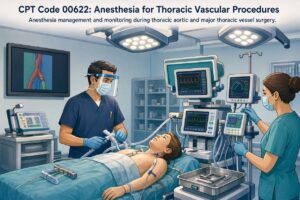
CPT Code 00622
The Anatomical Theater of CPT 00622
To apply CPT 00622 correctly, you must first define its precise anatomical boundaries. The code is officially described as “Anesthesia for procedures on the thoracic blood vessels.” This refers to the major arteries and veins located within the chest cavity, bounded by the thoracic inlet at the top and the diaphragm at the bottom. This region is the central hub of the circulatory system, and the vessels here are large, high-pressure, and unforgiving.
The primary structures covered by this code include the ascending aorta, the aortic arch, the descending thoracic aorta, the pulmonary artery and its branches, the superior vena cava, the innominate (brachiocephalic) artery, and the proximal portions of the subclavian and carotid arteries as they emerge from the arch. When a surgeon operates directly on these vessels, the anesthesia provider must be prepared to manage several unique challenges. These include the need for one-lung ventilation to provide a still surgical field, the use of partial or full cardiopulmonary bypass to circulate blood around a clamped aorta, and the profound hemodynamic swings that occur when a major vessel is cross-clamped and then unclamped.
It is essential to distinguish this code from CPT 00560, which covers anesthesia for cardiac surgery. If the surgeon is operating on the heart muscle itself or the coronary arteries, the cardiac codes apply. CPT 00622 is specifically for the blood vessels, not the heart chambers or valves. However, many thoracic aortic procedures involve the aortic root and the aortic valve. If the surgeon performs an aortic root replacement with a composite graft and reimplantation of the coronary arteries, the case is often considered a cardiac procedure because of the valve and coronary involvement. The coder must carefully read the operative note. If the primary purpose is to replace a diseased ascending aorta, and the valve is replaced simply because it is part of the root, 00622 may still be appropriate if the surgeon and the documentation emphasize the aortic pathology. This is often a gray area that requires close communication with the anesthesia provider.
The thoracic blood vessels also include the pulmonary vasculature. A pulmonary thromboendarterectomy for chronic thromboembolic disease is a massive operation on the pulmonary arteries. This procedure requires deep hypothermic circulatory arrest and maps directly to 00622. The diagnosis code for chronic pulmonary embolism (I27.82) supports the medical necessity of the surgery and the extended anesthesia time required for cooling and rewarming the patient.
The Surgical Landscape: Procedures Mapped to 00622
The types of surgical procedures that require CPT 00622 are among the most resource-intensive in any operating room. They are typically performed in major tertiary care centers with dedicated vascular and cardiothoracic anesthesia teams. Knowing these procedures helps the coder anticipate the typical length of the case and the necessary monitoring lines.
-
Thoracic Aortic Aneurysm Repair (Open): The classic 00622 procedure. The surgeon replaces a dilated segment of the descending thoracic aorta with a Dacron graft. This requires a left thoracotomy, one-lung ventilation, and often a left heart bypass circuit. The risk of paraplegia from spinal cord ischemia is significant. The anesthesia provider must manage the proximal hypertension and distal hypotension during the aortic cross-clamp.
-
Thoracoabdominal Aneurysm Repair: These aneurysms extend from the chest into the abdomen. The surgical exposure is massive, involving a thoracoabdominal incision and division of the diaphragm. The anesthesia team manages the cardiac, pulmonary, and renal systems under extreme stress. This code remains 00622 if the primary vascular target is the thoracic aorta.
-
Aortic Transection Repair: High-speed deceleration injuries, like those from car crashes, can tear the thoracic aorta just beyond the left subclavian artery. This is a surgical emergency. The patient arrives in the OR in shock. The anesthesiologist must simultaneously resuscitate the patient and provide a stable field for the surgeon to clamp the aorta.
-
Subclavian Artery Bypass or Transposition: When a blockage in the subclavian artery causes subclavian steal syndrome, a bypass may be performed. The approach may be supraclavicular or via a thoracotomy. If the surgery requires entering the chest to access the proximal subclavian or innominate artery, it falls under 00622.
-
Pulmonary Thromboendarterectomy (PTE): This delicate procedure removes chronic blood clots from the pulmonary arteries. It requires a median sternotomy, cardiopulmonary bypass, and periods of deep hypothermic circulatory arrest. The anesthesia management is intensely complex, involving strict temperature control and cerebral protection.
-
Superior Vena Cava (SVC) Syndrome Repair: A tumor or clot compressing the SVC may require surgical bypass or reconstruction. This is a high-risk procedure due to the venous hypertension in the head and neck, which can make airway management difficult.
Each of these operations demands continuous, high-level anesthesia care. The CPT code 00622 provides the billing framework, but the time units and the physical status modifiers are what capture the full clinical story.
CPT Code 00622: Base Units and Reimbursement
The base unit value for an anesthesia code reflects the inherent risk and skill required before the first minute of the procedure is even logged. For CPT 00622, the American Society of Anesthesiologists (ASA) Relative Value Guide typically assigns a base value of 6 base units. This places it among the higher base unit codes in the anesthesia section, on par with major cardiac and extensive neuro-surgery codes.
Why 6 base units? The rationale is clear. Thoracic vascular procedures require the routine placement of invasive monitoring lines, including a radial arterial line and often a femoral arterial line to monitor distal perfusion pressure. A central venous catheter is essential, and a pulmonary artery catheter (Swan-Ganz) is frequently placed. The provider must be an expert in one-lung ventilation techniques, using a double-lumen endotracheal tube or a bronchial blocker. The use of a transesophageal echocardiography (TEE) probe to assess the aorta and cardiac function is standard. All of this preparation occurs before the skin incision and is bundled into the base units. The base value also accounts for the expected rapid blood loss and the need for immediate transfusion.
The reimbursement formula is the standard: (Base Units + Time Units) x Conversion Factor. With a base of 6, a 5-hour (300-minute) thoracoabdominal aneurysm repair yields 20 time units plus 6 base units for 26 total units. At a conversion factor of $22.00, this claim is worth $572.00. The higher base unit means that even a relatively short emergency procedure, such as a 90-minute repair of a traumatic aortic injury, generates 6 time units plus 6 base units for 12 total units. Compare this to a code with a base of 3 units for the same 90 minutes, which would only yield 9 total units. The 6 base units ensure the provider is reimbursed for the mandatory complex preparation and the extreme vigilance required from the very first moment.
| Procedure Type | Base Units | Typical Duration | Total Units (approx) |
|---|---|---|---|
| Descending Thoracic Aortic Aneurysm (Open) | 6 | 300 min (5 hrs) | 26 (6 + 20) |
| Traumatic Aortic Transection | 6 | 120 min (2 hrs) | 14 (6 + 8) |
| Pulmonary Thromboendarterectomy | 6 | 480 min (8 hrs) | 38 (6 + 32) |
| Subclavian Bypass (Intrathoracic) | 6 | 180 min (3 hrs) | 18 (6 + 12) |
This table clearly shows that the base unit is constant, and the time is the primary variable that increases revenue. The long durations of these cases make accurate time tracking absolutely critical.
Physical Status Modifiers in a High-Risk Population
Patients requiring thoracic vascular surgery are, almost by definition, extremely ill. An otherwise healthy patient does not develop a thoracic aortic aneurysm or a saddle pulmonary embolism without significant underlying pathology. The P4 modifier (severe systemic disease that is a constant threat to life) is the rule rather than the exception for 00622 cases. A patient with a leaking thoracic aortic aneurysm who is hypotensive in the emergency department is a P4 or even a P5 (moribund).
The physical status modifier is informational for Medicare but can unlock additional base units with some commercial payers and workers’ compensation carriers. An extra unit for a P4 patient adds direct value to the claim. The documentation in the pre-anesthetic evaluation must justify this modifier in explicit terms. “Patient with acute Type B aortic dissection. Malperfusion syndrome with acute renal failure and lactic acidosis. Emergent intubation in the ED for respiratory failure. ASA 4E.” This note leaves no doubt about the patient’s status. It also explains why the induction of anesthesia might have taken longer than usual. The patient’s hemodynamic instability required careful titration of induction agents to avoid cardiovascular collapse. This extended induction time is part of the total anesthesia time and is supported by the P4 modifier.
The anesthesia record for a P4 patient must read like a continuous critical care narrative. The vital signs will show the labile blood pressure. The record will document the vasopressor infusions and their dose adjustments. It will show the serial blood gas results and the transfusion of blood products. This dense, detailed record is your best defense when the claim for a 10-hour PTE case is inevitably audited. The auditor will see the clinical reality of the 38 units billed. They will see the cooling and rewarming phases. They will see the circulatory arrest period and the meticulous documentation of cerebral perfusion management. The P4 modifier ties it all together.
Medical Direction and One-Lung Ventilation Management
Thoracic vascular surgery demands a high level of expertise in airway management. The standard of care for descending thoracic aortic surgery is one-lung ventilation using a double-lumen endotracheal tube. This allows the surgeon to work in a quiet, deflated lung field. The anesthesia provider must confirm the correct placement of the double-lumen tube with a fiberoptic bronchoscope. This entire process, from intubation to bronchoscopic confirmation, takes time. This time is billable and is included in the total anesthesia time.
When an anesthesiologist medically directs a CRNA for a thoracic vascular case, the anesthesiologist must be present for this critical airway management. The documentation must state: “Personally present for induction, double-lumen tube placement, and bronchoscopic verification of position.” This satisfies one of the key elements of medical direction. The anesthesiologist also should be present during the initiation of one-lung ventilation, as profound hypoxemia can occur and requires expert troubleshooting.
The QK modifier is used by the anesthesiologist, and the QX modifier by the CRNA. Because of the extreme acuity of a thoracoabdominal aneurysm repair, many anesthesiologists will direct only this single case or, at most, one other low-acuity case. Directing a full slate of four concurrent rooms while one of them is a 00622 case is clinically risky and would be a major red flag for auditors. The concept of “immediately available” means the anesthesiologist must be able to physically return to the thoracic vascular operating room within minutes. They cannot be tied up in a cardiac catheterization lab on the other side of the hospital. The medical direction documentation should ideally show that the anesthesiologist was physically in the vascular room for more than just the induction and emergence. Check-in notes during the aortic cross-clamp period, such as “Check-in at 11:00, cross-clamp time 45 min, urine output adequate, pressors stable,” demonstrate frequent monitoring.
The Aortic Cross-Clamp: A Critical Billing Event
The moment the aortic cross-clamp is applied in a descending thoracic aneurysm repair, the patient’s physiology is split in two. Above the clamp, the heart faces a sudden increase in afterload, causing severe proximal hypertension. Below the clamp, the spinal cord, kidneys, and viscera become ischemic. The anesthesia provider must manage the proximal hypertension with vasodilators like nitroprusside or clevidipine, while supporting the distal circulation with a shunt or partial bypass.
This entire period requires intense, minute-to-minute management. The anesthesia record must clearly note the clamp time and the unclamp time. The total cross-clamp time is a critical piece of data. It correlates directly with the risk of spinal cord injury and renal failure. A longer clamp time means a sicker patient postoperatively and a longer, more intense hospital course. For billing, the time during the cross-clamp is simply continuous anesthesia time. But the documentation of the events during the clamp—the titration of drips, the blood gas values, the volume of blood transfused—proves the high level of continuous care.
When the cross-clamp is removed, the ischemic distal tissues release a load of metabolic acids and vasodilatory substances, causing profound hypotension. The anesthesia provider must be ready with volume and vasopressors. This is the “declamping shock” phase. The documentation of this phase is equally important. “Aortic cross-clamp removed at 13:30. Declamp hypotension to 60/40 treated with fluid bolus and Neo drip. Pressure stabilized after 10 minutes.” This narrative detail supports the work performed and the time spent.
Distinguishing CPT 00622 from Related Codes
The high-risk nature of thoracic surgery means several codes live in close proximity. Confusing 00622 with a cardiac code or a chest wall code is a serious error.
CPT 00562 is for anesthesia for cardiac surgery with pump oxygenator. This is the code for coronary artery bypass grafting (CABG), valve replacement, and other open-heart procedures. If the surgeon uses cardiopulmonary bypass for a coronary artery bypass, you use 00562. If the surgeon uses partial left heart bypass for a descending thoracic aneurysm repair, you still use 00622 because the primary target is the aorta, not the heart. The diagnosis code for the aortic aneurysm (I71.2) is the key.
CPT 00620 is for anesthesia for the thoracic spine. A thoracic spinal fusion with instrumentation is a prone procedure with a different set of airway and monitoring requirements. It does not require one-lung ventilation. The surgical target is the vertebrae, not the blood vessels.
CPT 00604 is for anesthesia for cervical blood vessels. The neck is the anatomical boundary. A carotid endarterectomy uses 00604. If a subclavian bypass is done entirely through a supraclavicular incision and the chest is not entered, it might be argued to be 00604. However, the subclavian artery is a thoracic structure, and many subclavian bypasses are coded as 00622 if the surgical approach involves a median sternotomy or a thoracotomy. The operative note’s description of the incision and the retraction of the lung is the deciding factor.
CPT 00474 is for anesthesia for intrathoracic procedures on the upper abdomen, such as a Nissen fundoplication or a diaphragmatic hernia repair. These are laparoscopic or open abdominal surgeries that happen to go through the chest. The primary surgical target is not a thoracic blood vessel. The coder must identify the organ system being operated on.
| CPT Code | Primary Target | Approach | Anesthesia Technique |
|---|---|---|---|
| 00622 | Thoracic blood vessels (Aorta) | Thoracotomy/Sternotomy | One-lung ventilation, bypass possible |
| 00562 | Heart and coronary arteries | Sternotomy | Cardiopulmonary bypass |
| 00620 | Thoracic spine | Posterior (prone) | Prone positioning, neuromonitoring |
| 00604 | Cervical blood vessels (Carotid) | Neck incision | MAC or General, cerebral perfusion |
This comparative table is a powerful tool for coders. The surgical approach column is often the quickest way to identify the correct code. If the note describes entering the pleural cavity and deflating a lung to access a blood vessel, the code is 00622.
Documentation for Audit-Proof 00622 Claims
The documentation for a 00622 case must be a comprehensive medical record that tells the complete story of the physiological management. Because these claims are high-value, they are frequently targeted for prepayment review. The following elements are non-negotiable.
The pre-anesthetic evaluation must include a detailed cardiac, pulmonary, and neurological history. It must state the diagnosis, the planned procedure, and the anesthetic plan. The airway assessment is critical, especially for patients with SVC syndrome who may have facial and airway edema. “Patient has SVC syndrome with facial plethora and orthopnea. Plan for awake fiberoptic intubation.”
The intraoperative record must document the ventilation strategy. For one-lung ventilation, note the time the lung was isolated, the oxygen saturation, and any periods of desaturation. “Left lung isolation at 08:30, SpO2 dropped to 90%, CPAP 5cm H2O applied to non-dependent lung, SpO2 improved to 97%.” This shows active management of a known complication of thoracic anesthesia.
The record must document all invasive line placements. The arterial line site, the central line site, and the use of TEE are all standard. The doses and times of heparin administration are critical for vascular procedures. The activated clotting time (ACT) values should be recorded. The administration of protamine for reversal of heparin must be documented.
For procedures involving circulatory arrest, such as a PTE, the record must show the cooling process. The nasopharyngeal and bladder temperatures must be charted. The exact time of circulatory arrest must be noted: “Circulatory arrest at 11:00, temperature 18 degrees C.” The time of reperfusion and rewarming must also be noted. This period of the case requires the ultimate vigilance. The brain has no blood flow. The anesthesia provider is monitoring the clock, the temperature, and the surgeons. The entire circulatory arrest period is fully billable anesthesia time.
Coding for Circulatory Arrest and Bypass
When the patient is placed on cardiopulmonary bypass, the anesthesia time continues uninterrupted. The bypass perfusionist manages the pump, but the anesthesiologist remains responsible for the patient’s overall medical condition. They manage the medications, the ventilation (which is stopped during full bypass but managed before and after), and the monitoring. The time on bypass is billed exactly like any other anesthesia time.
If a separate provider, such as a cardiac anesthesiologist, provides the TEE monitoring, that service is billed separately by that provider using the TEE CPT codes. The general anesthesiologist billing 00622 does not bill for TEE interpretation unless they have the specific qualifications and submit a separate professional fee with the appropriate TEE code and modifier 26 (professional component). This is a common point of confusion. The 00622 claim is for the anesthesia service only. Diagnostic monitoring interpretations are separate.
If a major vascular catastrophe occurs, such as an aortic rupture during the dissection, the surgeon may call for massive transfusion protocol. The anesthesia record must reflect every unit of blood, plasma, and platelets given. The time spent managing the resuscitation is billable. The coder should be prepared to submit the full record with the claim because the time units and the blood product usage will be outliers that trigger an automatic medical necessity review. A claim note like “Intraoperative aortic rupture, massive transfusion protocol activated, 12 units PRBCs transfused, case extended by 3 hours” alerts the payer to the reason for the long time before they even open the record.
Postoperative Considerations and Separate Services
Patients after thoracic vascular surgery are not simply extubated and sent to the floor. They go to the intensive care unit intubated and sedated. The anesthesia provider’s care during the immediate postoperative transport and handoff is part of the global service and the total anesthesia time. The stop time is when the provider leaves the patient in the ICU, the report has been given, and the patient is stable.
If the anesthesia provider is called back to the ICU later that day to manage acute postoperative hemorrhage or to reintubate the patient, that is a separate service. The return to the operating room for “take back for bleeding” is a new anesthesia case with a new start and stop time. The diagnosis might be “postoperative hemorrhage, acute blood loss anemia.” This second surgery is billed with the same CPT code (00622) if the procedure is again on the thoracic blood vessels. The modifier 78 (unplanned return to the operating room by the same physician for a related procedure during the postoperative period) is appended to the surgical code, but for anesthesia, the claim is simply submitted as a new, separate service with its own time units.
The placement of a thoracic epidural for post-operative pain is a common practice for thoracotomy patients. If the epidural is placed at the end of the surgery, before emergence, it is often bundled as part of the global anesthesia service. Some practices successfully bill it separately with a 59 modifier, citing its distinct purpose for postoperative pain management. This requires a separate procedure note and must adhere to the NCCI edits. The safest path in many MAC jurisdictions is to not unbundle the epidural and instead focus on accurately capturing the total anesthesia time, which includes the few extra minutes it takes to place the catheter. The revenue from a few extra time units is often comparable to the professional fee for the epidural and carries zero audit risk.
Workers’ Compensation and Thoracic Vascular Trauma
Thoracic vascular injuries, while rare, are devastating and almost always work-related when they occur in heavy industry. A logger crushed by a falling tree may suffer a traumatic aortic transection. A welder involved in an explosion may have penetrating injuries to the great vessels.
Coding for workers’ compensation requires strict adherence to the state’s fee schedule. The base units for 00622 in a workers’ comp schedule might be the same as the ASA guide, or they might be completely different. Some states use a flat per-minute rate for all anesthesia services, regardless of the procedure’s complexity. In such cases, the code itself is less important for reimbursement, but it is still essential for data tracking and authorization. You must always obtain pre-authorization for the surgical procedure and the associated anesthesia.
The diagnosis coding must clearly link the vascular injury to the workplace accident. Use the appropriate S code for the specific vessel injury, along with the external cause code that describes the accident. For example, S25.0 (Injury of thoracic aorta) and V47.5 (Car occupant injured in collision with fixed or stationary object). The clinical documentation in the anesthesia record should briefly note the mechanism of injury and the patient’s condition on arrival to the operating room. “Patient intubated in the field, bilateral chest tubes placed, on norepinephrine drip, massive transfusion in progress.” This creates a clear picture of the emergency and justifies the high time units that will be billed.
Conclusion
CPT Code 00622 is the designated code for anesthesia during procedures on the thoracic blood vessels, covering high-mortality surgeries like aortic aneurysm repair and pulmonary thromboendarterectomy. Its 6 base units reflect the extreme risk and required preparatory work, while time units accurately capture the often-prolonged durations of these complex cases. Proper billing hinges on meticulous documentation of one-lung ventilation, aortic cross-clamping, circulatory arrest, and medical direction, ensuring these critical services are fully and defensibly reimbursed.
FAQ
What is the base unit value for CPT 00622?
The standard base unit for CPT 00622 is 6 units, reflecting the high risk, invasive monitoring, and potential for massive hemorrhage associated with thoracic vascular surgery.
Can I use CPT 00622 for coronary artery bypass surgery?
No, coronary artery bypass surgery on the heart is coded with 00562. CPT 00622 is for procedures on the thoracic blood vessels, such as the aorta and vena cava.
Does CPT 00622 cover subclavian artery surgery?
Yes, if the surgical approach requires a thoracotomy or median sternotomy. If the approach is limited to the neck and no chest entry is required, CPT 00604 might be more appropriate.
How do I bill the time during circulatory arrest for a pulmonary thromboendarterectomy?
The time during deep hypothermic circulatory arrest is continuous, billable anesthesia time. The record must clearly document the exact arrest and reperfusion times.
What modifier should I use for a patient with an acute aortic transection in shock?
You should use the P4 (life-threatening systemic disease) or P5 (moribund) physical status modifier, along with the appropriate provider modifier (AA, QK, QX, QZ).
Additional Resources
To stay current with base unit values and official coding guidelines, consult the American Society of Anesthesiologists website: https://www.asahq.org/