If you are an anesthesiologist, a certified registered nurse anesthetist (CRNA), or a medical coder, you know how important it is to get your billing right. One question that comes up often in pain management and regional anesthesia is: what is the correct CPT code for a transversus abdominis plane block?
You might see this procedure simply called a TAP block. It is a popular technique for providing postoperative pain relief after abdominal surgeries. But because it is a relatively “newer” block compared to epidurals or spinals, its coding can cause confusion.
In this guide, we will walk through everything you need to know. We will look at the specific code, when to use it, what not to do, and how to document your work to avoid claim denials.
Let us clear the air right away and make sure you get paid accurately for your skills.
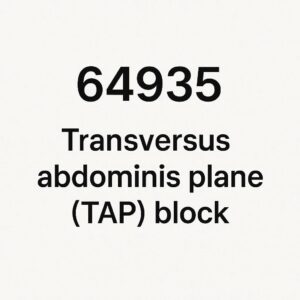
cpt code for transversus abdominis plane block
What Exactly Is a Transversus Abdominis Plane Block?
Before we talk numbers, let us briefly understand the procedure. This helps explain why a specific code exists.
A TAP block is a type of peripheral nerve block. The anesthesiologist injects local anesthetic into a specific plane in the abdominal wall. This plane sits between the internal oblique muscle and the transversus abdominis muscle.
By placing the anesthetic here, you block the sensory nerves that supply the skin, muscles, and parietal peritoneum of the anterior abdominal wall.
Common Uses for a TAP Block
Surgeons and anesthesiologists use this block for many abdominal operations. You will often see it used for:
-
Cesarean sections
-
Hysterectomies
-
Appendectomies
-
Cholecystectomies
-
Colon resections
-
Hernia repairs
The goal is simple: reduce opioid use, lower pain scores, and help patients move sooner after surgery.
Ultrasound Guidance Is the Standard
Today, almost all TAP blocks are performed using ultrasound guidance. This allows the doctor to see the needle in real time and watch the local anesthetic spread in the correct plane. Ultrasound makes the block safer and more effective.
This fact is very important for coding, as we will see in the next section.
The Primary CPT Code for TAP Block
Here is the answer you came for. The correct CPT code for a transversus abdominis plane block is 64486.
Let us break down exactly what CPT 64486 includes.
CPT 64486 Description
The official CPT language for 64486 states:
“Injection(s), anesthetic agent and/or steroid, transversus abdominis plane (TAP) block, with ultrasound guidance.”
This code includes three key components:
-
The injection of an anesthetic agent (like ropivacaine or bupivacaine).
-
The transversus abdominis plane as the target location.
-
Ultrasound guidance as an integral part of the procedure.
In plain English: when you perform a TAP block under ultrasound, you bill 64486 once per session, regardless of whether you inject on one side or both sides of the abdomen.
Unilateral vs. Bilateral: Does It Matter?
This is a common point of confusion. Many coders wonder if they can bill 64486 twice for a bilateral block (left and right side).
The answer is no. CPT 64486 is considered a unilateral or bilateral code. The descriptor uses the term “transversus abdominis plane block” without specifying side. The current coding guidelines and the American Society of Anesthesiologists (ASA) agree that you report one unit of 64486 for a bilateral TAP block.
Think of it like a lumbar epidural. You do not bill twice because you enter on the left and right. The code covers the entire service.
Important Note for Readers: Always check with your local payer (Medicare, Medicaid, private insurers) for specific billing rules. While the general standard is one unit for bilateral, some rare policies may differ. But for 99% of cases, 64486 x 1 is the correct submission.
Other Codes You Might See (But Should Not Use)
Sometimes, people try to use other codes for a TAP block. Let us look at why those are usually incorrect.
| CPT Code | Description | Why It Is Wrong for TAP Block |
|---|---|---|
| 64450 | Injection(s), anesthetic agent and/or steroid, other peripheral nerve or branch | This is a “miscellaneous” code for nerve blocks without a specific code. Since TAP block has its own code (64486), using 64450 is inappropriate. It will likely be denied. |
| 76942 | Ultrasonic guidance for needle placement | This code is for ultrasound guidance without the injection. Since 64486 already includes ultrasound, you cannot bill 76942 separately. Doing so is unbundling and considered fraud. |
| 0213T | Injection(s), anesthetic agent, TAP block (without ultrasound) | This is an old Category III code. It is no longer active. Do not use it. |
The Exception: When Ultrasound Is Not Used
In very rare cases, a provider might perform a TAP block using a landmark-based technique (without ultrasound). For example, during an open surgery, the surgeon might directly inject the plane under direct vision.
In this specific scenario, you cannot use 64486 because that code explicitly requires ultrasound guidance.
What should you use? You would fall back to 64450 (other peripheral nerve block). However, be prepared to provide strong documentation explaining why ultrasound was not used. Many payers will question this, and reimbursement is usually lower than 64486. For modern practice, always use ultrasound and bill 64486.
How to Document a TAP Block for Correct Coding
Good documentation is your best friend. If an auditor reviews your chart, your notes must support the CPT code you billed.
Here is a checklist of what your procedure note must include for a TAP block (CPT 64486):
-
Patient consent for the block.
-
Time out performed (per Universal Protocol).
-
Site marking or verbal confirmation of laterality (left, right, or bilateral).
-
Type of ultrasound probe used (e.g., high-frequency linear probe).
-
Visualization: “The external oblique, internal oblique, and transversus abdominis muscles were identified.”
-
Needle type and size.
-
Local anesthetic used: Name, concentration, volume, and total dose.
-
Confirmation of spread: “Injectate was seen spreading in the plane between the internal oblique and transversus abdominis muscles.”
-
Immediate complications: None, or describe if any occurred.
-
Signature and credentials of the person performing the block.
A Sample Documentation Snippet
“After obtaining informed consent, a time out was performed. Under aseptic technique, a high-frequency linear ultrasound probe was placed in the mid-axillary line. The external oblique, internal oblique, and transversus abdominis muscles were identified. A 22-gauge, 80-mm echogenic needle was advanced in-plane. After negative aspiration, 20 mL of 0.25% bupivacaine with epinephrine was injected on the right side, and 20 mL on the left side. Real-time ultrasound confirmed appropriate hydrodissection in the TAP plane bilaterally. No complications. Procedure tolerated well.”
This note clearly supports 64486 (bilateral TAP with ultrasound).
Modifiers for TAP Block (CPT 64486)
Modifiers can change the meaning of a code. Here are the common ones you might add to 64486.
Modifier 59 (Distinct Procedural Service)
You use modifier 59 when you perform a TAP block that is separate from another procedure on the same day, and they usually would not be done together.
Example: A patient has an open hernia repair under general anesthesia. The surgeon asks you to perform a TAP block for postoperative pain. You would bill the general anesthesia (e.g., 00830) and then 64486-59 for the TAP block. The -59 tells the payer, “Yes, this was a separate, distinct service.”
Modifier 50 (Bilateral Procedure)
Remember how we said you bill one unit of 64486 for bilateral? That is correct. But some payers still want to see Modifier 50 to indicate the procedure was performed on both sides.
Check your specific payer manual. Some want 64486-50. Others want 64486 with 1 unit and a note saying “bilateral.” When in doubt, many coders use 64486-50 for bilateral blocks to be safe. Do not bill two units.
Modifier G8 (Monitored Anesthesia Care for Deep Complex Case)
This is rare for TAP blocks. You would use G8 for deep, complex, monitored anesthesia care. Since most TAP blocks are done with general anesthesia or moderate sedation, you will likely not need this.
Billing Scenarios: Real-Life Examples
Let us put theory into practice. Here are three common clinical scenarios and exactly how to bill them.
Scenario 1: TAP Block for Cesarean Section
-
Procedure: A healthy patient has a scheduled C-section. The anesthesiologist performs spinal anesthesia. After delivery, the same anesthesiologist performs a bilateral ultrasound-guided TAP block for postoperative pain.
-
What to bill:
-
01961 (Anesthesia for cesarean delivery)
-
64486-59 (TAP block, distinct from the anesthesia service)
-
-
Explanation: The TAP block is a separate service from the spinal anesthetic. Modifier 59 is correct.
Scenario 2: TAP Block as the Primary Anesthetic
-
Procedure: A frail, elderly patient needs a small abdominal wall abscess drainage. The anesthesiologist performs only a unilateral ultrasound-guided TAP block with no sedation or general anesthesia.
-
What to bill:
-
64486 (TAP block only)
-
-
Explanation: No modifier is needed because there is no other anesthesia code to separate it from. The block is the anesthetic.
Scenario 3: TAP Block During General Anesthesia for Colectomy
-
Procedure: A patient has a laparoscopic colectomy under general anesthesia (00840). The anesthesia team performs a TAP block at the end of the case before emergence.
-
What to bill:
-
00840 (Anesthesia for large bowel surgery)
-
64486-59 (TAP block)
-
-
Explanation: Again, the TAP block is an add-on service. Modifier 59 separates it from the general anesthesia time.
Payment and Reimbursement Considerations
Let us be honest. You do this work to get paid. What can you expect for CPT 64486?
Reimbursement varies widely based on:
-
Your geographic location (Medicare locality)
-
The payer (Medicare, Medicaid, commercial)
-
The facility (hospital outpatient vs. ambulatory surgery center)
Medicare National Average (Rough Estimate)
For 2024 and 2025, the Medicare national average allowable for CPT 64486 is approximately $150 to $250 for the professional component (the doctor’s work). This does not include the facility fee.
Remember, this is the allowed amount. Your actual payment depends on your contract.
Commercial Payers
Private insurers like UnitedHealthcare, Aetna, and Cigna typically reimburse higher than Medicare. Many will pay between $250 and $450 for 64486. Some may even pay more if you negotiate well.
What About the Global Period?
CPT 64486 is a minor surgical procedure. It has a 10-day global period. This means the payment for the block includes all routine, uncomplicated follow-up care for the next 10 days. If the patient returns with a problem related to the block (like a persistent numb spot), you cannot bill separately for an office visit.
Common Denial Reasons and How to Avoid Them
No one likes denials. Here are the top reasons payers reject claims for TAP blocks.
1. Unbundling Ultrasound (76942)
As we said earlier, do not bill 76942 with 64486. The ultrasound is included. If you add it, the claim will deny as “mutually exclusive” or “bundled.”
2. Using the Wrong Code (64450)
If you use 64450 for a TAP block done under ultrasound, the payer will likely deny it. They will say, “This service has a more specific code (64486).” Always check for a specific code first.
3. Missing Modifier 59
If you bill 64486 without modifier 59 on the same day as a general anesthesia code, some payers may bundle the payment into the anesthesia fee. They will pay you less or nothing for the block. Always add -59 when the TAP block is done with another anesthesia service.
4. Incomplete Documentation
If your note does not mention “ultrasound guidance” or describe the muscle layers, an auditor can downcode your 64486 to 64450 (which pays less). They will argue you did not prove you used ultrasound. Write a complete note every time.
The Difference Between TAP Block, QL Block, and Rectus Sheath Block
It is easy to confuse these blocks. They are all abdominal wall blocks, but they target different nerves and have different CPT codes.
| Block Type | Target Area | Correct CPT Code | Key Difference |
|---|---|---|---|
| TAP Block | Anterior abdominal wall (T6-L1) | 64486 | Inject between internal oblique and transversus abdominis. |
| Quadratus Lumborum (QL) Block | Posterior abdominal wall | 64487 (Type 1) or 64488 (Type 2) | Inject near the quadratus lumborum muscle. Deeper block. |
| Rectus Sheath Block | Midline abdominal wall | 64486? No – Use 64450 | Inject into rectus sheath. No specific code exists (use 64450). |
Important: Do not confuse a rectus sheath block with a TAP block. They are different. Since there is no specific code for a rectus sheath block, you must use 64450. But for a true TAP block, use 64486.
Frequently Asked Questions (FAQ)
Let us answer some lingering questions you might have.
1. Can I bill a TAP block and an epidural on the same day for the same patient?
Yes, if medically necessary. For example, a patient with a thoracotomy and a laparotomy might need both. You would bill the epidural code (e.g., 62323) and the TAP block (64486-59). Be ready to justify the medical necessity in your notes.
2. Does 64486 include the cost of the local anesthetic?
No. The CPT code covers the professional work (the injection procedure). The cost of the medication (bupivacaine, ropivacaine, etc.) is billed separately by the hospital or facility under the drug’s HCPCS code (e.g., J0650 for bupivacaine). As a professional coder, you do not bill for the drug unless you are in a office setting with buy-and-bill.
3. How many units of 64486 can I bill for a single patient encounter?
Always one unit. Even if you do a left TAP, right TAP, and a subcostal TAP (a variation), you still bill 64486 x 1. The code is for the service “per session,” not per injection site.
4. What is the difference between 64486 and 64487?
CPT 64486 is for the initial TAP block (single injection plane). CPT 64487 is for each additional injection after the initial TAP block. For example, if you do a classic lateral TAP block and then a separate subcostal TAP block in the same patient, you would bill 64486 for the first and 64487 for the second. But this is rare. Most TAP blocks are a single injection.
5. Is the TAP block always billable separately from the surgical package?
No. Some global surgical packages include “incisional infiltration” by the surgeon. But a TAP block performed by an anesthesiologist is not incisional infiltration. It is a separate, distinct nerve block. You can and should bill it separately. However, if the surgeon performs the TAP block, it is usually considered part of the global surgical package. Only bill 64486 if an anesthesiologist or a separate provider (not the primary surgeon) performs it.
Pro Tips for Maximizing Reimbursement
Here are five final, practical tips to help you and your practice.
-
Educate your anesthesiologists. Make sure they document “ultrasound-guided TAP block” every single time. Do not let them write “TAP block” alone. The word “ultrasound” must be present.
-
Use a TAP block template in your electronic health record (EHR). This ensures no documentation elements are missed.
-
Appeal denials of modifier 59 with a copy of your operative note showing the block was performed after the surgical incision was closed or before the incision. Payers need to see the distinct timing.
-
Know your payer’s policy on bilateral. Call your top five commercial payers and ask: “Do you want modifier 50 on 64486 for a bilateral TAP block?” Write down the answer.
-
Stay updated. CPT codes change. The American Society of Anesthesiologists (ASA) and the American Academy of Professional Coders (AAPC) release updates every fall. Check for changes to 64486 annually.
Additional Resource
For the most current and official information on CPT coding for regional anesthesia, we recommend visiting the American Society of Anesthesiologists (ASA) Coding and Reimbursement page.
👉 Link: www.asahq.org/coding-and-reimbursement
This resource offers monthly coding Q&As, webinars, and the famous “ASA Relative Value Guide” which is essential for any anesthesia practice.
Conclusion
To summarize this guide in three lines:
-
The correct CPT code for an ultrasound-guided transversus abdominis plane (TAP) block is 64486, which includes both the injection and ultrasound guidance.
-
Bill one unit of 64486 for unilateral or bilateral blocks, always append modifier 59 when performed with another anesthesia service, and document the ultrasound visualization in detail.
-
Avoid common mistakes like unbundling ultrasound (76942) or using the outdated 64450 code, and always verify payer-specific rules for modifiers.
Disclaimer: This article is for educational purposes only and does not constitute legal or medical billing advice. CPT codes and payer policies change frequently. Always consult the latest CPT manual and your specific payer contracts before submitting claims.