The decision to straighten your teeth is a significant investment in your appearance and oral health. For many, the choice comes down to two primary contenders: traditional metal braces and clear aligners, most famously represented by Invisalign. The question of cost is often the first and most pressing one on a patient’s mind.
For years, the assumption was that Invisalign was the “luxury” option, always more expensive than standard metal braces. However, the orthodontic landscape has evolved. Today, the answer is more nuanced than a simple yes or no. The cost comparison between metal braces and Invisalign depends on a variety of factors, including the complexity of your case and the specific provider you choose. This guide will break down the costs of both options, compare them head-to-head, and help you understand which might be the more affordable choice for your unique situation.
Does The Cost Of Metal Braces Surpass That Of Invisalign?
The Classic Comparison: A General Overview
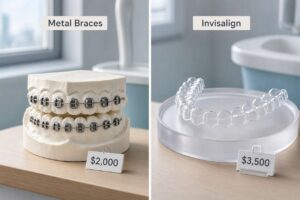
In the broadest sense, the cost of the two treatments overlaps significantly. Most comprehensive orthodontic treatment, regardless of the method, falls within a similar price range.
-
Traditional Metal Braces: The national average cost typically ranges from $3,000 to $7,500.
-
Invisalign (Clear Aligners): The national average cost typically ranges from $3,500 to $8,500.
Looking at these ranges, you can see that they are nearly identical. In many cases, Invisalign is not significantly more expensive than metal braces. In some cases, it can even be cheaper. The days of Invisalign being a massive financial upgrade are largely over.
When Metal Braces Are More Expensive
It might sound counterintuitive, but there are scenarios where traditional braces end up costing more than Invisalign. This typically happens in complex cases.
-
Complexity and Treatment Time: Metal braces are incredibly effective at handling severe misalignments, complex bite issues (like severe overbites, underbites, or crossbites), and impacted teeth. These complex cases require longer treatment times. Orthodontists often charge based on the estimated duration of treatment. Therefore, a complex case requiring 30 months of metal braces will cost more than a mild case requiring 12 months of Invisalign.
-
Frequent Adjustments and Appointments: Metal braces require monthly (or bi-monthly) visits for adjustments. While these visits are usually included in the total package price, a longer treatment plan involves more of the orthodontist’s time and overhead, which is reflected in the initial quote.
-
Emergency Repairs: While the cost of braces themselves is bundled, the lifestyle changes can have incidental costs. Broken brackets from eating hard or sticky foods require emergency repair visits, which may incur an extra fee. This is a cost factor unique to metal braces.
When Invisalign Is More Expensive
Conversely, Invisalign can be the pricier option in other scenarios, often related to the product itself and the demands of the patient.
-
The Aligner Lab Fee: Invisalign charges orthodontists a significant lab fee for producing the custom aligners. This fee is passed on to the patient. While the orthodontist’s chair time might be less than with braces, the cost of the physical product is high.
-
Complex Cases with Invisalign: While Invisalign technology has advanced, treating very complex cases with aligners can be challenging and often requires more aligners, attachments (tooth-colored bumps glued to teeth), and refinement phases. This can push the cost up. Some orthodontists may charge a premium for treating a complex case with Invisalign due to the increased planning and effort required.
-
The “Invis” Brand Premium: Invisalign is a brand name with a massive marketing budget. You are paying for the brand recognition, the guarantee, and the research and development behind the product. Other clear aligner brands (like ClearCorrect or SureSmile) often have lower lab fees, making them a cheaper alternative that functions similarly.
A Side-by-Side Cost and Value Comparison
To help you see the bigger picture, here is a detailed comparison of the factors that influence cost and value for both options.
| Feature | Traditional Metal Braces | Invisalign (Clear Aligners) |
|---|---|---|
| Average Cost Range | $3,000 – $7,500 | $3,500 – $8,500 |
| Cost Driver | Length of treatment time and complexity of adjustments. | The Invisalign lab fee and the number of aligners required. |
| Aesthetics | Highly visible. Metal brackets and wires. | Nearly invisible. Smooth, clear plastic trays. |
| Treatment Time | Often faster for complex cases. Average 18-24 months. | Often faster for mild-to-moderate cases. Average 12-18 months. |
| Comfort | Brackets can irritate cheeks and lips. Soreness after adjustments. | Smooth plastic is less irritating, but teeth can feel sore when switching trays. |
| Dietary Restrictions | Significant. No popcorn, nuts, gum, hard candy, etc. | None. Aligners are removed for eating and drinking. |
| Oral Hygiene | Difficult. Requires special floss threaders and brushes. | Easy. Aligners are removed to brush and floss normally. |
| Appointment Frequency | Monthly adjustments. | Every 6-12 weeks for progress checks. |
| Discipline Required | None. Braces are fixed. | High. Aligners must be worn 20-22 hours per day. |
| Best Suited For | Severe, complex cases, and patients who do not want to be responsible for compliance. | Mild-to-moderate cases, adults concerned with aesthetics, and highly disciplined patients. |
Understanding What Your Fee Includes
When you are quoted a price for either metal braces or Invisalign, it is essential to understand what that comprehensive fee covers. This is standard for both treatment types.
A typical treatment fee includes:
-
All Appliances: The brackets, wires, and bands for braces, or all the custom-made aligners for Invisalign.
-
All Office Visits: Every adjustment or progress check appointment.
-
Diagnostics: The initial exam, X-rays, and photographs.
-
Retainers: The set of retainers you receive at the end of treatment to maintain your new smile.
-
One Set of Refinements (Invisalign): Many Invisalign packages include a round of “refinement” aligners if your teeth need minor adjustments at the end of the initial series.
Important Note for Readers: Always ask your orthodontist for a written breakdown of what is included in the fee. Some offices may charge separately for records, retainers, or replacement aligners.
How Insurance Impacts the Cost
The cost equation changes significantly when you factor in dental insurance. The good news is that dental insurance typically treats both options the same way.
If your dental plan includes orthodontic coverage, it will usually provide a lifetime maximum benefit for orthodontics (e.g., $2,000). This benefit can be applied to either braces or Invisalign. The insurer does not care which method you choose; they will pay their percentage or up to their maximum limit regardless.
Therefore, if your insurance pays $2,000 toward orthodontics, that reduces your out-of-pocket cost for both a $5,000 braces treatment and a $5,000 Invisalign treatment to $3,000. The insurance factor neutralizes the cost difference.
The Hidden Value of Invisalign for Adults
When adults evaluate the cost, they often factor in “value” that goes beyond the price tag. This can make Invisalign a more valuable choice even if the upfront cost is slightly higher.
-
Professional Appearance: For working professionals, the aesthetic advantage of clear aligners can be priceless. Braces can feel like a hindrance in client-facing roles. The confidence of a nearly invisible treatment is a significant value-add.
-
Time Off Work: Invisalign requires fewer, shorter office visits. This means less time away from work, which for a busy professional, equates to real money saved.
-
Quality of Life: The ability to eat whatever you want and maintain your normal brushing and flossing routine is a major quality-of-life advantage. Avoiding the dietary restrictions and cleaning hassles of braces is a benefit many are willing to pay for.
The Reliability of Metal Braces
On the other hand, metal braces offer a different kind of value: reliability and no compliance requirement. The technology is proven, and the results are predictable for even the most difficult cases. You cannot lose them or forget to wear them. For a younger patient or someone who is not disciplined enough to wear aligners for 22 hours a day, braces will likely provide a faster, more predictable result, making them the better value.
How to Get an Accurate Cost Comparison
The best way to determine which option will cost more for you is to get a consultation. Most orthodontists offer free or low-cost initial consultations.
-
Find 2-3 Providers: Look for orthodontists in your area with good reviews. You can ask for recommendations from your dentist or friends.
-
Get Quotes for Both: During your consultation, ask the orthodontist to provide a written estimate for both metal braces and Invisalign.
-
Ask About Complexity: Have the orthodontist explain how complex your case is. Ask directly: “Will Invisalign be as effective as braces for my specific issue?”
-
Compare Apples to Apples: Ensure each quote includes the same things (records, retainers, all visits). If one quote is lower, understand why.
The Bottom Line
The idea that Invisalign always costs more than metal braces is a myth. In the modern orthodontic market, the costs are highly competitive. The final price for either option is determined by the complexity of your case, the fees of your specific provider, and the insurance benefits you have available. The choice should not be made on perceived cost alone. You should choose the treatment that is best suited to your clinical needs and your lifestyle.
Additional Resource: American Board of Orthodontics (ABO)
To find a board-certified orthodontist in your area who has demonstrated the highest level of skill and knowledge, you can visit the ABO website.
Link: https://www.americanboardortho.com/
Frequently Asked Questions
Q1: Can I get a discount if I pay for Invisalign or braces in full upfront?
A: Yes. Many orthodontic offices offer a “bookkeeping discount” or a “cash discount” of 5-10% if you pay the entire treatment fee upfront with cash or a check. This saves the office the time and cost of monthly billing. It is always worth asking about.
Q2: Does Invisalign work faster than braces?
A: For mild-to-moderate cases, Invisalign can sometimes be faster than braces. For complex cases, braces are often faster and more predictable. The speed of either treatment depends entirely on the complexity of your case and your compliance with the treatment plan.
Q3: What are the small bumps sometimes used with Invisalign?
A: These are called “attachments.” They are small, tooth-colored pieces of composite resin that are bonded to your teeth. They act as handles to help the aligners grip the teeth and apply the right amount of force to achieve certain movements. They are removed at the end of treatment.
Q4: Will my dental insurance cover Invisalign the same as braces?
A: In almost all cases, yes. Dental insurance policies that cover orthodontics do not typically differentiate between the method used. They will apply the same benefit and lifetime maximum to both braces and Invisalign.
Q5: Is it true that Invisalign requires a lot of self-discipline?
A: Yes. The success of Invisalign depends almost entirely on patient compliance. You must wear the aligners for 20-22 hours per day, removing them only to eat, drink (anything other than water), and brush your teeth. If you are not committed to this, braces are a much better option, as they work 24/7 without any effort from you.
Conclusion:
The cost of metal braces and Invisalign is now highly competitive, with both treatments falling within a similar price range and being influenced by case complexity and provider fees. Neither option is universally more expensive, as Invisalign can be cheaper for simple cases while braces may be more cost-effective for complex ones. The best way to determine the true cost for your smile is to obtain consultations and quotes for both treatments from a qualified orthodontist.