The prospect of losing all your teeth is a daunting one. It affects not only your ability to eat and speak but also your self-confidence and overall quality of life. For many people facing this reality, the question of cost is paramount. Replacing an entire mouth of teeth is one of the most significant investments you can make in your health, and the price range is vast.
The good news is that modern dentistry offers more solutions than ever before, from traditional, affordable dentures to cutting-edge, permanent implant-supported restorations. The path you choose will dramatically affect the cost, your comfort, and your long-term satisfaction. This guide will provide a comprehensive and realistic breakdown of the costs associated with each option, helping you understand what you are paying for and how to navigate this major decision.
How Much Does It Cost To Replace All Of Your Teeth?
Table of Contents
ToggleUnderstanding the Spectrum of Options
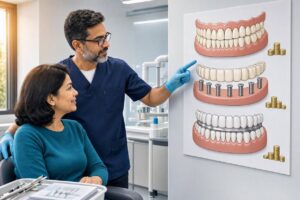
“Replacing all your teeth” is not a single procedure with a single price. It is a spectrum of treatments, ranging from a removable appliance to a fixed, permanent set of teeth that look and function like natural ones. The right choice for you will depend on your budget, the health of your jawbone, and your personal goals.
The three primary approaches are:
-
Traditional Dentures: A removable acrylic plate that sits on the gums.
-
Implant-Supported Overdentures (Snap-On Dentures): A removable denture that snaps onto dental implants for stability.
-
Full-Arch Fixed Implant Bridges (All-on-4 / All-on-X): A permanent set of teeth that is screwed into dental implants and can only be removed by a dentist.
Option 1: Traditional Complete Dentures
This is the most common and affordable method for replacing all teeth. A complete denture is a removable appliance made of acrylic resin that is molded to fit over your gums.
The Procedure and Timeline
The process typically takes several weeks and multiple appointments. Your dentist will take impressions of your mouth, help you choose the shape and color of your new teeth, and then have the denture fabricated in a dental laboratory. After your natural teeth are extracted, the denture is placed immediately or after a healing period.
The Cost Breakdown
The cost of dentures is highly variable and depends on the quality of the materials and the skill of the dentist or prosthodontist.
| Type of Denture | Description | Average Cost (per arch) |
|---|---|---|
| Economy/Basic | Standard acrylic, stock teeth, a one-size-fits-most approach. | $600 – $1,200 |
| Mid-Range/Conventional | Better materials, custom-selected teeth, more detailed fitting. | $1,200 – $3,000 |
| Premium/Custom | High-quality, lifelike teeth, custom gum shading, and multiple fittings for optimal comfort. | $3,000 – $8,000+ |
To replace all your teeth, you will need two arches (upper and lower). Therefore, the total cost for a full set of traditional dentures ranges from $1,200 to $16,000+.
Important Note for Readers: This cost usually covers the dentures themselves and the appointments for fitting. It does not include the cost of extracting any remaining teeth, which can add hundreds or thousands of dollars to your bill.
Pros and Cons
-
Pros: The most affordable option. Non-surgical. The process is faster than implant-based solutions.
-
Cons: Can be uncomfortable and unstable, especially the lower denture. They can slip and click when eating or speaking. They cause significant bone loss in the jaw over time. They require daily removal and cleaning. You will have significant dietary restrictions (avoiding sticky or hard foods).
Option 2: Implant-Supported Overdentures (Snap-On)
This is the bridge between traditional dentures and a fixed solution. It solves the biggest problem with dentures: stability. A small number of dental implants are surgically placed in your jaw. The denture is then fitted with special attachments that “snap” onto these implants.
The Procedure and Cost Components
This option involves surgery and a healing period, making it more expensive than traditional dentures. The total cost is broken down into three parts:
-
Implant Surgery: The cost to place the implants into the bone.
-
The Implants: The titanium posts themselves.
-
The Denture: A high-quality denture with the necessary attachments.
The Cost Breakdown
The number of implants needed varies. For a “snap-on” denture, you typically need 2-4 implants per arch.
| Cost Component | Description | Average Cost |
|---|---|---|
| Dental Implants | The titanium posts. You will need 2-4 per arch. | $1,500 – $3,000 per implant |
| Surgical Placement | The fee for the oral surgeon to place the implants. | $1,000 – $2,500 per implant |
| The Overdenture | A high-quality removable denture with attachments. | $2,000 – $5,000 per arch |
Total Estimated Cost for a Full Mouth (Both Arches): $15,000 to $45,000+
Pros and Cons
-
Pros: Massive improvement in stability compared to traditional dentures. They will not slip or click. You can eat a wider variety of foods. The implants help to slow down bone loss in the jaw. Less expensive than a fixed bridge.
-
Cons: They are still removable. You must take them out at night to clean them. The denture itself will still need to be relined or replaced over time. The cost is significantly higher than traditional dentures.
Option 3: Full-Arch Fixed Implant Bridges (All-on-4)
This is the gold standard for full-mouth tooth replacement. It is a permanent, non-removable set of teeth. Instead of replacing each tooth with an individual implant, this technique uses a full arch of prosthetic teeth (a bridge) that is fixed to a small number of strategically placed implants.
The “All-on-4” Concept
The name “All-on-4” is a trademarked treatment concept, but many dentists offer similar procedures (often called “Teeth in a Day”). The basic principle is that four implants are placed in the jaw, often at angles to maximize contact with the bone. This often allows for the placement of a temporary set of teeth on the same day as the surgery. After a healing period, a final, high-strength permanent bridge (usually made of zirconia or acrylic with titanium framework) is screwed into place.
The Cost Breakdown
This is the most expensive option, but it provides the closest experience to having natural teeth. The fees reflect the high level of surgical skill, the cost of the implants, and the complex laboratory work involved in creating the final bridge.
| Cost Component | Description | Average Cost |
|---|---|---|
| Dental Implants | 4-6 implants per arch. | $1,500 – $3,000 per implant |
| Surgical Placement & Anesthesia | Complex surgery, often with IV sedation. | $3,000 – $8,000 per arch |
| Temporary Bridge | A fixed, acrylic bridge you wear during the healing phase. | $2,000 – $4,000 per arch |
| Final Zirconia Bridge | The permanent, high-strength prosthetic arch. | $8,000 – $15,000 per arch |
Total Estimated Cost for a Full Mouth (Both Arches): $40,000 to $80,000+
Pros and Cons
-
Pros: The closest thing to natural teeth. They are completely fixed and stable. No dietary restrictions. They feel, look, and function like real teeth. The implants preserve your jawbone, preventing the “sunken” facial look associated with long-term denture wear.
-
Cons: The highest cost. Involves significant oral surgery and a longer healing period. Requires a very skilled and experienced surgical and restorative team.
The True Cost of Traditional Dentures: A Look Beyond the Price Tag
While traditional dentures are the cheapest option upfront, their long-term value needs careful consideration. Wearing dentures leads to a process called bone resorption. When your teeth are gone, the jawbone no longer receives the stimulation it needs, and it begins to shrink and melt away. Over years, this leads to:
-
Loose-Fitting Dentures: As the bone shrinks, the denture that once fit well becomes loose. It requires constant use of messy adhesives.
-
Frequent Relines and Replacements: A denture will need to be relined (its base reshaped to fit the new jaw) every 1-2 years, costing a few hundred dollars each time. The entire denture will need to be replaced every 5-7 years on average.
-
Facial Collapse: The loss of bone support leads to a sunken-in appearance around the mouth, making you look older.
-
Poor Nutrition: The difficulty of eating with loose dentures can lead to a diet of soft foods, which has significant health consequences.
When you calculate the cost of relines, replacements, and adhesives over 20-30 years, the “cheap” denture is not as inexpensive as it appears.
A Comparative Cost Table
Here is a summary table to help you compare the options at a glance.
| Feature | Traditional Dentures | Snap-On Overdentures | All-on-4 Fixed Bridge |
|---|---|---|---|
| Average Total Cost (Full Mouth) | $1,500 – $10,000 | $15,000 – $45,000 | $40,000 – $80,000+ |
| Stability | Low (can slip, needs adhesive) | High (snaps in place) | Excellent (permanently fixed) |
| Removable? | Yes | Yes | No |
| Bone Preservation | Poor (causes bone loss) | Good (implants stimulate bone) | Excellent (implants stimulate bone) |
| Dietary Restrictions | Significant | Moderate | None |
| Longevity of Prosthesis | 5-7 years (then replace) | 5-10 years (then replace/relign) | 15-20+ years (with good care) |
| Surgery Required? | No (unless extractions) | Yes | Yes |
How to Plan for the Cost
Replacing all your teeth is a significant financial undertaking. Here are some practical steps to plan for it.
-
Get Multiple Consultations: Do not go with the first dentist you see. Get opinions and quotes from at least two or three different providers, including a prosthodontist (a specialist in tooth replacement). Prices can vary dramatically.
-
Ask About a “Clear Choice” Style Consultation: Many practices that specialize in All-on-4 offer a free or low-cost initial consultation with a 3D CT scan. This will give you a very accurate picture of your surgical needs and costs.
-
Check Your Dental Insurance: While dental insurance rarely covers the full cost of these procedures, it may contribute. Many plans have a $1,500 annual maximum. It might help offset the cost of extractions or the denture component.
-
Use Your HSA or FSA: If you have a Health Savings Account or Flexible Spending Account, you can use pre-tax dollars to pay for any of these treatments, effectively giving you a 20-30% discount.
-
Consider Financing: Most major dental offices offer financing through companies like CareCredit, LendingClub, or Proceed Finance. These companies specialize in healthcare loans and offer terms of up to 7-10 years for large procedures like full-mouth restorations. This allows you to break the cost into a predictable monthly payment.
-
The Dental Tourism Option: A growing number of Americans travel to countries like Mexico, Costa Rica, or Hungary for major dental work. The cost of an All-on-4 procedure in these countries can be 50-70% less than in the U.S. While the savings are significant, this option requires thorough research, as you will not have the same legal protections or ease of follow-up care.
A Final Word on Investing in Your Health
When considering the cost of replacing all your teeth, it is helpful to reframe your thinking. This is not an “expense” like buying a car. It is an investment in your health, your nutrition, your social life, and your psychological well-being for the rest of your life. A high-quality, stable set of teeth can transform your quality of life in ways that are difficult to put a price on.
Additional Resource: The American College of Prosthodontists (ACP)
To learn more about tooth replacement options and find a board-certified prosthodontist (the specialist in this field) in your area, visit the ACP’s official website.
Link: https://www.prosthodontics.org/
Frequently Asked Questions
Q1: What is the cheapest way to replace all my teeth?
A: The cheapest option is a set of traditional, removable dentures. A full set can be obtained for as little as $1,500 to $3,000. However, this option has significant drawbacks in terms of comfort, stability, and long-term bone health.
Q2: How long do dental implants last?
A: With proper care and good oral hygiene, dental implants themselves can last a lifetime. The prosthetic teeth they support (the denture or bridge) will have a shorter lifespan and will eventually need to be replaced or repaired due to normal wear and tear.
Q3: Can I get All-on-4 on just my upper or lower teeth?
A: Yes, absolutely. While it is commonly done for the full mouth, you can have a full-arch restoration on just the top or just the bottom. The cost would be roughly half of the full-mouth price.
Q4: Does medical insurance ever cover tooth replacement?
A: In rare cases, yes. If the loss of your teeth was caused by a medical condition or an accident, your medical insurance might contribute to the cost of restoration. In the vast majority of cases, however, tooth replacement is considered a dental procedure and is not covered by medical insurance.
Q5: Is the surgery for dental implants painful?
A: The surgery itself is performed under anesthesia (local or IV sedation), so you should not feel pain during the procedure. After the anesthesia wears off, you can expect some soreness, swelling, and discomfort for a few days. Most patients manage this with over-the-counter or prescribed pain medication. The recovery is often compared to having a tooth extracted.
Conclusion:
The cost to replace all your teeth spans a wide spectrum, from under two thousand dollars for basic dentures to over eighty thousand for a permanent, implant-supported fixed bridge. Your choice will hinge on your budget, your need for stability, and your long-term health goals, as cheaper options come with significant lifestyle and health trade-offs. By understanding the true value of each solution and exploring financing, you can make a decision that restores not just your smile, but your quality of life.