If you have ever tried to sort out the billing side of a simple walking boot, you know it can feel surprisingly complex. You are not alone. Many patients, medical assistants, and even new billers find themselves searching for the correct “CPT code for a CAM boot” only to end up more confused than when they started.
Let us clear that up right now.
The short answer is that there is no single, universal CPT code labeled “CAM boot.” Instead, the correct code depends on three things: whether the boot is prefabricated or custom-fitted, whether it is off-the-shelf, and who is applying the device.
In this guide, we will walk through everything you need to know. We will cover the specific codes, the differences between them, documentation requirements, and common pitfalls to avoid. By the end, you will feel confident selecting the right code for every situation.
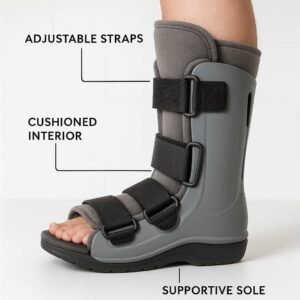
CPT Code for a CAM Boot
What Exactly Is a CAM Boot?
Before we dive into the numbers, let us make sure we are talking about the same device. A CAM boot stands for Controlled Ankle Movement boot. You might also hear it called a walking boot, a moon boot, or a fracture boot.
These devices are used to immobilize and protect the ankle and foot after injuries like fractures, severe sprains, or tendon repairs. They allow the patient to walk while keeping the injured area stable. The boot typically consists of a rigid plastic shell, internal padding, and adjustable straps.
CAM boots come in two main categories:
-
Low-top boots: These end below the calf. They are used for less severe injuries or for patients who need minimal immobilization.
-
High-top boots: These extend up the calf. They provide more stability and are used for fractures or significant ligament injuries.
Some boots also include an air pump system that allows the patient to adjust the compression around the swollen area. These are often called air cast boots or pneumatic walkers.
Understanding these basic differences matters because the coding world cares less about the brand name and more about how the device is provided to the patient.
The Correct CPT Codes for CAM Boots
Let us get straight to the numbers you came here for. The most relevant CPT codes for a CAM boot fall under the Lower Extremity Orthotics section. Specifically, you will work with codes L4360 and L4361, along with a few related codes for completeness.
Here is the breakdown.
L4360: Walking boot, non-pneumatic
This code describes a rigid walking boot that does not use air bladders for compression. It relies on foam padding and straps to hold the foot and ankle in place. Most standard, non-adjustable fracture boots fall into this category.
Use L4360 when:
-
The boot is prefabricated and rigid.
-
There are no air chambers for dynamic compression.
-
The boot is fitted to the patient by a qualified practitioner.
L4361: Walking boot, pneumatic
This code is for the fancier version. Pneumatic walking boots have built-in air cells that the patient or clinician can inflate to adjust the pressure around the injured area. The air system helps reduce swelling and provides a more customized fit.
Use L4361 when:
-
The boot includes an air pump or air bladders.
-
The patient receives instructions on how to adjust the air pressure.
-
The device is used for conditions where swelling is a major concern, such as acute fractures or post-surgical recovery.
Other Related Codes You Should Know
Sometimes a CAM boot is not the only device in play. Here are a few other codes that might appear on the same claim or be confused with the CAM boot codes.
| CPT/HCPCS Code | Description | When to Use |
|---|---|---|
| L4386 | Walking boot, non-pneumatic, with joints | For boots that include articulated ankle joints for controlled range of motion. |
| L4392 | Replacement heel pad for a walking boot | When only the heel pad wears out and needs replacement. Not for the whole boot. |
| L4396 | Walking boot, pediatric, prefabricated | Specifically designed for children. Often smaller and lighter. |
| A9285 | Off-the-shelf (OTS) walking boot, patient directly purchases | This is a supply code, not an orthotic code. Used when no professional fitting occurs. |
The last one, A9285, is where a lot of confusion happens. We will talk more about that in a moment.
Prefabricated vs. Custom-Fitted: Why It Matters
Here is one of the most important distinctions you will make. Payers, including Medicare, draw a hard line between prefabricated and custom-fitted orthotics. The difference directly affects which code you use and how much reimbursement you receive.
-
Prefabricated: The device is manufactured in standard sizes. The practitioner selects the size, applies it to the patient, and may make minor adjustments like trimming the liner or bending a metal strut. No custom molding or casting is involved.
-
Custom-fitted (or custom-molded): The device is created specifically for that patient using a cast, scan, or tracing of their foot or limb. This is rare for CAM boots but does happen for complex cases.
Most CAM boots are prefabricated. Even when a clinician chooses a size and straps it on, that is still considered prefabricated fitting. The codes L4360 and L4361 are both for prefabricated devices. If you ever have a truly custom-fabricated walking boot (very uncommon), you would look at code L4398, but that is outside the scope of this guide.
The Off-the-Shelf (OTS) Confusion
Now let us address the elephant in the room. Many people search for “CPT code for a CAM boot” because they bought one at a drugstore or online and want to submit it to insurance. That situation is different.
When a patient buys a CAM boot directly from a pharmacy, sporting goods store, or e-commerce site without any involvement from a healthcare provider, you do not use L4360 or L4361. Those codes are for devices that are fitted by a practitioner as part of a treatment plan.
Instead, the correct HCPCS code for a patient-purchased, off-the-shelf walking boot is A9285.
Here is the key difference in plain language:
“L codes are for orthotics that require a professional fitting. A codes are for DME (Durable Medical Equipment) supplies that the patient can buy and use without a clinician’s hands-on fitting.”
If your doctor prescribes a boot but you pick it up at a retail store and put it on yourself, you are still in the A9285 world. Only when a qualified provider (physician, podiatrist, orthotist, or physical therapist) performs a fitting does the L code become appropriate.
When to Use the CAM Boot CPT Codes
Let us put these codes into real-world scenarios. This will help you see the logic in action.
Scenario 1: The Emergency Room Visit
A patient arrives at the ER with a nondisplaced lateral malleolus fracture. The ER physician applies a high-top pneumatic walking boot, adjusts the straps, and shows the patient how to use the air pump. The patient leaves wearing the boot.
Correct code: L4361 (pneumatic walking boot, prefabricated, fitted by a provider)
Why not A9285? Because the ER physician performed a fitting as part of the treatment.
Scenario 2: The Orthopedic Clinic Follow-Up
A patient is six weeks post-ankle fracture. The cast is removed. The orthopedist prescribes a non-pneumatic walking boot for the next four weeks. The clinic has the boot in stock. A medical assistant sizes the patient, applies the boot, and checks the fit.
Correct code: L4360 (non-pneumatic walking boot, prefabricated, fitted by a provider)
Scenario 3: The Pharmacy Purchase
A patient has mild Achilles tendonitis. They read online that a walking boot might help. They go to a local pharmacy, buy a basic CAM boot for $79, and put it on at home. No healthcare provider is involved.
Correct code: A9285 (OTS walking boot, patient self-purchased, no professional fitting)
Important note: Many insurance plans do not cover A9285 without a prescription and proof of medical necessity. The patient in this scenario will likely pay out of pocket.
Scenario 4: The Replacement Boot
A patient lost their original CAM boot during a move. They call their doctor, who writes a new prescription. The patient takes the prescription to a DME supplier. The supplier fits them with the same type of boot (pneumatic) they had before.
Correct code: L4361 again. A replacement boot still requires a fitting unless the patient insists on picking the size themselves without help. If no fitting occurs, it is back to A9285.
Medical Necessity: Your Ticket to Reimbursement
You can use the exact right CPT code every single time, but if you cannot prove medical necessity, the claim will still get denied. Medical necessity is the reason the patient needs the device. It must be clearly documented in the medical record.
For a CAM boot, payers expect to see:
-
A specific diagnosis that justifies immobilization. Examples include:
-
Ankle fracture (ICD-10: S82.8xx for various types)
-
Severe ankle sprain (S93.40)
-
Achilles tendon rupture or tendinopathy (S86.01 or M76.6)
-
Post-operative status following foot or ankle surgery (Z47.89)
-
Diabetic foot ulcer with offloading needs (E11.621 with L97 code)
-
-
Documentation of the fitting. The note should state that a qualified provider sized the device, applied it, adjusted it, and instructed the patient on use and wear schedule.
-
Failure of conservative treatment (if applicable). For chronic conditions, payers may want to see that the patient tried rest, bracing, or physical therapy before moving to a CAM boot.
-
Expected duration of use. A CAM boot for a simple sprain might be two to four weeks. For a fracture, six to eight weeks is common. Payers want to see a plan.
Here is a sample documentation snippet that would support medical necessity for L4361:
*”Patient presents with acute right ankle fracture, nondisplaced, confirmed on X-ray. Due to pain and swelling, a pneumatic walking boot (L4361) was selected and fitted by this provider. The patient was instructed on inflation and deflation of air cells to manage edema. Patient will wear the boot for all weight-bearing activities for six weeks, with follow-up in three weeks for repeat imaging.”*
Without that level of detail, the claim is at risk.
Documentation Checklist for Providers
If you are the one fitting the boot, use this checklist before the patient leaves your office. Good documentation now saves hours of appeals later.
-
Patient name and date of service
-
Specific diagnosis (ICD-10 code to the highest specificity)
-
Description of the injury or condition
-
Rationale for immobilization (e.g., “to prevent motion at ankle joint during ligament healing”)
-
Type of boot used (pneumatic or non-pneumatic, high or low top, brand if relevant)
-
Confirmation that the boot is prefabricated (standard sizing)
-
Notation that the provider performed the fitting (not handed to patient without instruction)
-
Details of any modifications (trimming, padding adjustments, etc.)
-
Patient education provided (wear schedule, skin checks, air pressure adjustments)
-
Expected duration of use
-
Follow-up plan
Medicare and CAM Boot Coverage
Medicare has its own set of rules that often trickle down to private insurers. If you bill to Medicare or a Medicare Advantage plan, pay special attention here.
Medicare covers walking boots under the Durable Medical Equipment (DME) benefit, but only when specific conditions are met.
-
L4360 and L4361 are covered for fractures, dislocations, severe sprains, and post-surgical immobilization.
-
Medicare does not cover a CAM boot for plantar fasciitis, mild sprains, or general foot pain unless other conservative measures have failed.
-
A9285 (OTS) is generally not covered by Medicare for a CAM boot because it falls under the “convenience item” category for most diagnoses.
Medicare also requires a face-to-face encounter within six months prior to the order. The prescribing provider must document that they evaluated the patient and determined the boot is medically necessary.
One more Medicare nuance: For L4360 and L4361, the patient may be responsible for a 20% coinsurance after the Part B deductible is met. Always verify the patient’s secondary coverage if they have it.
Common Billing Mistakes to Avoid
Even experienced billers make errors with CAM boot codes. Here are the most frequent problems we see, along with how to avoid them.
Mistake #1: Using L4360 for a Pneumatic Boot
It is easy to grab the wrong code if you are in a hurry. But payers have sharp eyes. A pneumatic boot billed under the non-pneumatic code is a mismatch. The device description on your invoice or purchase order will not match the code. That is a quick denial.
Fix: Always confirm whether the boot has air bladders before selecting L4360 or L4361.
Mistake #2: Billing an L Code Without Fitting Documentation
If the medical record does not explicitly state that a provider fitted the boot, the payer will assume it was handed over like a box of bandages. That triggers a downcode to A9285 or a denial for lack of medical necessity.
Fix: Add a one-line note in every chart where a boot is applied. “Provider fitted patient with [size] boot, straps adjusted, fit checked.” That is enough.
Mistake #3: Billing Both a Boot and a Cast for the Same Injury
Sometimes a patient receives a cast first, then transitions to a CAM boot. That is fine. But billing a boot and a cast for the same date of service for the same injury is not allowed. You cannot immobilize the same limb in two different rigid devices on the same day.
Fix: If you remove a cast and apply a boot on the same visit, bill only the boot. The cast removal is part of the E/M service.
Mistake #4: Using a CAM Boot Code for a Diabetic Shoe Insert
This happens more than you would think. A patient with diabetes needs offloading for a foot ulcer. Someone orders a CAM boot, thinking it will provide the same pressure relief as a custom insert. The boot is approved, but the claim denies because the diagnosis does not match the device’s intended use.
Fix: Diabetic foot ulcers with offloading needs often require a total contact cast (TCC) or a specific diabetic walking boot like L4386 with extra rocker soles. Check your local coverage determination (LCD).
Private Payer Variations
Not every insurance company follows Medicare’s rules exactly. Some are more generous. Some are stricter. Here is what you need to know about the major categories of private payers.
Commercial PPOs (UnitedHealthcare, Cigna, Aetna, etc.)
Most commercial plans cover L4360 and L4361 when medically necessary. Some do not require a face-to-face fitting as strictly as Medicare, but they still expect the device to be prescribed. Prior authorization is rarely needed for a standard CAM boot, but check the plan’s policy if the boot is pneumatic (more expensive).
Workers’ Compensation
Workers’ comp claims for a CAM boot are usually straightforward. If the injury happened on the job, the boot is almost always covered. However, workers’ comp often requires using a specific DME supplier from their network. Billing an out-of-network boot can lead to a denial even if the code and diagnosis are perfect.
Medicaid
Medicaid coverage for CAM boots varies dramatically by state. Some states cover both L4360 and L4361 with minimal documentation. Others require prior authorization for any walking boot that costs over a certain dollar amount (often $150). Check your state’s DME fee schedule before billing.
Tricare
Tricare covers CAM boots for active duty members and retirees when prescribed by a Tricare-authorized provider. They follow Medicare’s lead on medical necessity but have their own DME supplier network. Use code L4360 or L4361 as appropriate.
How to Appeal a Denial
Even when you do everything right, denials happen. Do not panic. Most CAM boot denials fall into one of three categories, and each has a clear fix.
Denial Reason: “Coding Mismatch”
The payer says the code does not match the device or diagnosis.
Appeal strategy: Send a copy of the device invoice or manufacturer description showing that the boot is indeed pneumatic (or non-pneumatic). Also send the medical record with the diagnosis. Write a brief letter explaining the match.
Denial Reason: “No Medical Necessity”
The payer does not believe the boot was needed.
Appeal strategy: This is a documentation problem. Go back to the medical record. Pull the progress note from the date of fitting. Highlight the diagnosis, the rationale for immobilization, and the expected duration. Send these pages with a signed letter of medical necessity from the prescribing provider.
Denial Reason: “Not a Covered Benefit”
The payer says CAM boots are excluded from the patient’s plan.
Appeal strategy: Check the patient’s Evidence of Coverage (EOC) document. Some very lean plans (short-term limited duration plans, some health sharing plans) do not cover DME at all. If the plan does cover DME but the denial says the boot is excluded, ask for the specific policy section. You may need to file an external appeal.
A Note on Modifiers
Modifiers are two-digit codes added to a CPT or HCPCS code to provide extra information. For CAM boots, you will rarely need a modifier. But there are two exceptions.
-
Modifier LT or RT: Use these to indicate left or right side. While not always required, some payers want to know which ankle or foot received the boot. Adding LT or RT can prevent questions.
-
Modifier KX: This modifier is used for Medicare claims when specific policy requirements have been met. For a CAM boot, you would add KX if you have documented the face-to-face encounter and the fitting. Without KX when required, Medicare will deny.
Do not add modifiers unless you are certain the payer expects them. When in doubt, leave them off. You can always add them on a corrected claim later.
Patient Frequently Asked Questions (From the Front Desk)
Patients often have questions before they agree to accept a CAM boot. Here is how to answer the most common ones. These responses are written for a non-clinical audience, so you can share them directly.
“Do I really need a prescription for a CAM boot?”
Technically, no. You can buy one at any pharmacy or online without a prescription. But without a prescription, your insurance will not cover it. If you want your insurance to pay, you need a doctor to prescribe it and fit it.
“Why is my boot so expensive even with insurance?”
Walking boots cost between $75 and $400 depending on the brand and features. Your insurance likely has a deductible and coinsurance. If you have not met your deductible, you pay the full contracted rate. After the deductible, you typically pay 20% to 50% of the allowed amount. Ask your DME supplier for the cash price. Sometimes it is lower than your insurance copay.
“Can I buy a used boot from a friend?”
You can, but insurance will not pay for it. Used boots also lose their padding and support over time. For a simple sprain, a gently used boot might be fine. For a fracture, buy new or get one covered by insurance. Your healing is worth the investment.
“What if the boot breaks?”
Most manufacturers warranty their boots for 90 days to one year. If the boot breaks during normal use, call the supplier. They will often replace it at no charge. If the boot breaks after a year, you may need a new prescription and a new fitting for insurance to cover a replacement.
CAM Boots vs. Other Ankle Supports: A Quick Comparison
Patients and providers sometimes wonder if a CAM boot is the right choice or if something simpler would work. Use this table to guide the decision.
| Device | Immobilization Level | Typical Use Case | CPT/HCPCS Code |
|---|---|---|---|
| CAM boot (pneumatic) | High | Fractures, severe sprains, post-op | L4361 |
| CAM boot (non-pneumatic) | Moderate to high | Stable fractures, moderate sprains | L4360 |
| Ankle brace with straps | Low to moderate | Mild sprains, chronic instability | L1902 (prefabricated) |
| Elastic ankle sleeve | Very low | Minor swelling, proprioception | A9270 (often not covered) |
| Cast boot (post-cast) | Very high (but removable) | Transitioning from cast to walking | Same as L4360/L4361 |
| Rigid walking cast | Complete immobilization | Unstable fractures, non-healing wounds | Q4039 (cast supplies) |
The CAM boot sits in the sweet spot between a simple brace and a full cast. It offers good immobilization but allows removal for hygiene and skin checks.
Reimbursement Rates for CAM Boots (Estimates)
Let us talk about money. Reimbursement varies wildly by payer, region, and contracted rates. But these estimates give you a ballpark.
| Code | Medicare Allowance (Approx.) | Private Payer Range | Cash Price (Retail) |
|---|---|---|---|
| L4360 (non-pneumatic) | $85 – $120 | $100 – $180 | $75 – $150 |
| L4361 (pneumatic) | $150 – $210 | $180 – $300 | $125 – $400 |
| A9285 (OTS, no fitting) | Not covered for CAM boot | $40 – $90 | $50 – $100 |
These numbers change every year. Always check the current fee schedule for your specific payer. Also remember that the patient’s deductible and coinsurance apply. The allowed amount is not what you or the patient pays. It is the maximum the payer will consider before splitting the cost.
Future Trends in CAM Boot Coding
The world of DME coding is not static. Several changes are on the horizon that could affect how we code for CAM boots.
Telehealth fittings: Some payers now allow remote fitting of prefabricated orthotics via video visit. The provider watches the patient apply the boot, gives instructions, and documents the encounter. This may eventually require new codes or modifiers. For now, check your payer’s telehealth policy.
Bundled payments: In some orthopedic bundled payment models (like BPCI Advanced), the cost of the CAM boot is included in the episode payment. You do not bill separately for the boot. The hospital or practice absorbs the cost. If you work in a bundled payment environment, confirm whether you should bill L4360/L4361 at all.
Value-based coding: As payers move toward value-based care, they may require outcomes data to justify the use of a CAM boot over a cheaper brace. Documenting patient-reported outcomes (pain scores, functional status) now will prepare you for these future requirements.
Real-Life Case Studies
Let us walk through three patient cases from start to finish. These examples show how the coding and documentation work in practice.
Case Study 1: Acute Ankle Fracture in a Healthy Adult
Patient: 34-year-old male, rolled ankle playing basketball. X-ray shows nondisplaced lateral malleolus fracture.
Encounter: Orthopedic clinic visit. Provider orders a pneumatic walking boot to allow early weight-bearing while limiting motion. The boot is fitted by a medical assistant under provider supervision. Patient receives written and verbal instructions.
Documentation note: *”Nondisplaced fracture left lateral malleolus (S82.62XA). Due to pain and need for protected weight-bearing, a prefabricated pneumatic walking boot (L4361) was fitted by clinic staff. Air cells inflated to patient comfort. Patient instructed to wear boot for all weight-bearing activities for six weeks. Follow-up in three weeks for repeat X-ray.”*
Billing: L4361 (left side, modifier LT added per payer preference). Diagnosis S82.62XA.
Outcome: Claim paid at $195 allowed amount. Patient responsible for 20% coinsurance ($39) after deductible.
Case Study 2: Chronic Ankle Instability
Patient: 58-year-old female with history of multiple ankle sprains. Current episode is a grade 2 sprain. No fracture on X-ray.
Encounter: Podiatry office. Provider recommends a non-pneumatic walking boot for two weeks to allow ligament healing, followed by physical therapy.
Documentation note: *”Grade 2 inversion sprain right ankle (S93.401A). Patient has failed conservative treatment including rest, ice, and compression. A prefabricated non-pneumatic walking boot (L4360) was fitted today. Boot will be worn for all walking for 14 days. Patient instructed on home exercises and RICE protocol.”*
Billing: L4360 (right side). Diagnosis S93.401A.
Outcome: Payer denied initially, citing “not medically necessary for sprain without fracture.” Appeal with documentation of failed conservative treatment was successful. Claim paid at $110 allowed amount.
Case Study 3: Patient Self-Purchased Boot
Patient: 45-year-old male with plantar fasciitis. Buys a CAM boot at a pharmacy for $89. Uses it for three weeks. Submits receipt to insurance for reimbursement.
Encounter: No provider visit for the boot. No fitting. No prescription.
Billing: Patient submits claim using code A9285 (without a provider’s NPI or signature).
Outcome: Denied. Reason: No medical necessity documentation. Patient appeals and loses. Out-of-pocket expense remains $89.
Lesson: Insurance rarely reimburses patient-purchased DME without a prescription and professional fitting.
How to Verify Coverage Before Fitting a CAM Boot
You can save everyone a lot of frustration by checking coverage before the boot goes on the patient’s foot. Here is a simple three-step process.
Step 1: Call the payer’s DME verification line. Do not use the general member services line. Ask for the DME or Durable Medical Equipment department. Have the patient’s ID number and the specific code (L4360 or L4361) ready.
Step 2: Ask these four questions:
-
Is this code covered under the patient’s plan?
-
Does this code require prior authorization?
-
Is the patient’s deductible met for DME?
-
What is the patient’s coinsurance percentage for DME?
Step 3: Document the call. Write down the date, time, representative’s name, and the answers you received. If the claim denies later, this documentation helps with an appeal.
If the payer requires prior authorization, start that process immediately. Some payers take five business days. Others take four weeks. Do not fit the boot until you have an authorization number in hand unless the patient is willing to pay cash.
Cash-Pay Options for Patients
Sometimes insurance is not the answer. For patients with high deductibles or plans that exclude DME, paying cash can be faster and cheaper. Here is what to tell them.
Option 1: Buy from the clinic. Many clinics keep CAM boots in stock and sell them at cost plus a small markup. The patient leaves with the boot today. No insurance paperwork. No denials.
Option 2: Buy from an online DME supplier. Websites like braceability.com or donjoy.com sell CAM boots for $80 to $200. Delivery takes two to five days. These are new, unused devices with warranties.
Option 3: Rent a boot. Some medical supply companies rent CAM boots for $20 to $40 per week. This is a good option for short-term use (two to four weeks). The patient returns the boot when done.
Option 4: Buy used locally. Facebook Marketplace, Craigslist, and thrift stores often have used CAM boots for $20 to $50. Check the padding and straps carefully. Do not buy a boot that smells musty or has cracked plastic.
For cash-pay patients, you do not need to bill any code. The patient simply pays and leaves. However, you should still document the fitting in the medical record for liability purposes.
State-Specific Rules and Nuances
While most coding rules are national, a few states have their own quirks regarding CAM boots.
California: Workers’ comp claims in California require a specific DME form (DWC-106) for any device costing over $500. CAM boots rarely hit that threshold, but a high-end pneumatic boot with custom modifications might. Check before billing.
New York: Medicaid in New York requires prior authorization for any DME costing over $150. Most pneumatic CAM boots exceed that amount. Get the PA number before fitting.
Texas: Texas Medicaid does not cover any walking boot for a diagnosis of plantar fasciitis, regardless of medical necessity. This is written explicitly in their DME manual. Do not bother appealing.
Florida: Florida Blue (Blue Cross Blue Shield) requires a specific DME network for CAM boots. If your clinic is not in that network, the claim will deny even if the patient has a valid prescription. Always check network status.
If you practice in a state not listed here, check your state Medicaid DME manual. The rules are often different from Medicare’s.
The Role of Physical Therapists in CAM Boot Fitting
Physical therapists (PTs) can fit and bill for CAM boots under certain conditions. The rules vary by state scope of practice and payer policy.
Medicare: PTs can fit prefabricated orthotics, including CAM boots, as long as they are licensed and the fitting is within their scope. The PT must bill under their own NPI. The referring physician does not need to be present.
Private payers: Most commercial plans allow PTs to fit CAM boots. However, some require a physician’s order before the PT can proceed. Check the patient’s plan.
State laws: A few states restrict orthotic fitting to physicians, podiatrists, or certified orthotists. PTs in those states cannot bill L4360 or L4361. They can only recommend the boot and have the patient purchase it themselves.
If you are a PT, always check your state practice act before fitting a CAM boot. You do not want to run afoul of scope-of-practice laws.
Frequently Asked Questions (FAQ)
1. What is the exact CPT code for a CAM boot?
There is no single code. For a prefabricated non-pneumatic boot fitted by a provider, use L4360. For a pneumatic (air) boot fitted by a provider, use L4361. For a patient-purchased boot without a fitting, use A9285.
2. Does Medicare cover CAM boots?
Yes, for medically necessary indications like fractures, severe sprains, and post-surgical recovery. Medicare does not cover CAM boots for plantar fasciitis or mild sprains without failed conservative treatment.
3. Can I bill a CAM boot and an office visit on the same day?
Yes, as long as the office visit is a separately identifiable service. Append modifier -25 to the E/M code. For example, if the patient comes for fracture follow-up and you also fit a new boot, bill the E/M with -25 and the L code without a modifier.
4. How many units of L4360 or L4361 can I bill?
Typically one unit per device per date of service. If the patient needs bilateral boots (both ankles), you would bill two units with modifiers LT and RT. This is rare for CAM boots but possible for certain neuromuscular conditions.
5. What diagnosis codes support medical necessity for a CAM boot?
Common diagnoses include ankle fractures (S82 codes), severe sprains (S93.4 codes), Achilles tendon rupture (S86.01), post-operative states (Z47.89), and diabetic foot ulcers with offloading needs (E11.621 with L97 codes). Always check your payer’s medical policy for their specific list.
6. Can a CAM boot be billed as a rental?
Sometimes. Medicare and some private payers allow rentals for DME that the patient will use for less than 13 months. However, walking boots are almost always purchased, not rented, because the cost is low and the duration is short. Check your payer’s rental policy.
7. What is the difference between L4360 and L4386?
L4360 is a standard walking boot without joints. L4386 is a walking boot with articulated ankle joints that allow controlled motion. L4386 is used for patients who need some range of motion, not full immobilization. Most CAM boots fall under L4360 or L4361, not L4386.
8. Do I need to keep the boot’s packaging for billing?
No, but you should keep an invoice or purchase order that shows the device type (pneumatic vs. non-pneumatic), the brand, and the size. That documentation supports your code choice during an audit.
9. Can a patient have two CAM boots for the same injury?
No. One boot per limb. If the patient wants a spare for convenience, they must pay cash. Insurance will not pay for two boots for the same injury on the same date.
10. What happens if I use the wrong code?
The claim will likely deny. You can submit a corrected claim with the correct code within the payer’s timely filing limit (usually 90 to 365 days). Do not wait. Submit the correction as soon as you realize the error.
Additional Resource
For the most up-to-date information on DME coding, including local coverage determinations for CAM boots in your region, visit the Noridian Medicare DME Documentation Center (for jurisdictions JJ and D) or the Palmetto GBA DME website (for Jurisdictions C and A). These sites publish the official LCDs (Local Coverage Determinations) that Medicare contractors use to approve or deny claims.
🔗 Resource link: https://www.cms.gov/medicare/coverage/determination-process – Search for “walking boot” or “L4360” to find your state’s specific policy.
Conclusion
Finding the correct code for a CAM boot does not have to be a headache. Remember the simple rule: L4360 for non-pneumatic, L4361 for pneumatic, and A9285 for patient purchases without a fitting. Always document the fitting, justify medical necessity with a clear diagnosis, and verify coverage before the patient walks out the door. With this guide in hand, you are ready to bill with confidence and help your patients get the care they need without billing surprises.