If you have ever sat down to code a gastric bypass or a palliative bypass for pancreatic cancer, you already know the feeling. Is it a gastrojejunostomy? Is it a revision? And—most importantly—which CPT code actually gets the claim paid?
You are not alone.
Gastrojejunostomy coding sits at the intersection of general surgery, bariatrics, and oncology. One small detail can change the code entirely. Open versus laparoscopic. Laparoscopic converted to open. Robotic assistance. Done as part of a larger procedure versus a stand-alone bypass.
This guide walks you through everything you need to know. No fluff. No recycled content. Just clear, practical answers you can use today.
Let us start with the code you came for.
CPT Code for Gastrojejunostomy
The Primary CPT Code for Gastrojejunostomy
The most direct answer to your question is this:
CPT 43860 – Revision of gastrojejunostomy (e.g., for obstruction, marginal ulcer).
But wait—before you stop reading, that is only one piece of the puzzle. In everyday practice, the code you use depends entirely on why and how the surgeon performs the gastrojejunostomy.
Here is the full family of codes you need to know.
| CPT Code | Descriptor | Typical Use Case |
|---|---|---|
| 43632 | Gastrectomy, partial, distal; with gastrojejunostomy | Cancer surgery with bypass |
| 43634 | Gastrectomy, partial, distal; with gastrojejunostomy and vagotomy | Ulcer disease with bypass |
| 43860 | Revision of gastrojejunostomy | Revision for obstruction, ulcer, or leak |
| 43659 | Unlisted laparoscopy procedure (gastrojejunostomy) | Laparoscopic approach (when no specific code exists) |
| 43999 | Unlisted procedure, stomach | Robotic or complex open cases |
Important note for readers: Most payers do not have a standalone, dedicated “gastrojejunostomy” code for a primary, elective laparoscopic bypass performed in bariatric surgery. In those cases, you typically use a bariatric code (e.g., 43846 – gastric bypass with Roux-en-Y) rather than a stand-alone gastrojejunostomy code.
When Is a Gastrojejunostomy Performed?
Before we go deeper into modifiers and denial management, let us talk about why a surgeon creates this connection between the stomach and the jejunum. Understanding the clinical picture helps you choose the right code.
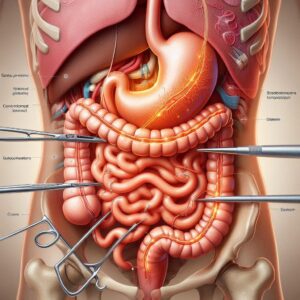
A gastrojejunostomy is a surgical procedure that creates a new passage between the stomach and the middle part of the small intestine (jejunum). Surgeons use it in three main scenarios:
-
Bariatric surgery – As part of a Roux-en-Y gastric bypass, where the gastrojejunostomy allows food to bypass the lower stomach and duodenum.
-
Palliative bypass – For patients with pancreatic cancer or gastric cancer that cannot be removed (unresectable), a gastrojejunostomy relieves obstruction.
-
Revision surgery – To fix a failed prior gastrojejunostomy, such as a stricture, marginal ulcer, or internal hernia.
Each scenario points to a different CPT code. That is why you cannot just memorize one number and call it done.
Open Versus Laparoscopic Gastrojejunostomy
The approach changes everything in modern coding. Payers now expect minimally invasive surgery whenever clinically appropriate. If your surgeon documents an open approach, you need to support why.
Open Gastrojejunostomy
Open surgery uses a midline laparotomy incision. It is less common today but still appears in:
-
Emergency settings (perforated ulcer, acute obstruction)
-
Patients with multiple prior abdominal surgeries (hostile abdomen)
-
Resource-limited settings without laparoscopic equipment
How to code open gastrojejunostomy:
-
If performed alone as a palliative bypass → use 43632 (gastrectomy with gastrojejunostomy) if a distal gastrectomy was done. If it is a pure bypass without gastrectomy, you may need 43659 (unlisted) or a different code entirely.
-
If performed as part of a gastric bypass for obesity → use 43846 (gastric bypass, Roux-en-Y, open).
Laparoscopic Gastrojejunostomy
Laparoscopic approach is the gold standard for elective cases. The problem? There is no specific CPT code for a laparoscopic primary gastrojejunostomy alone.
This creates a frequent coding headache.
The solution most practices use:
-
43659 – Unlisted laparoscopy procedure, stomach. You append this when performing a laparoscopic gastrojejunostomy that is not described by another code.
-
Then you submit a comparable code (e.g., compare to open 43632) and justify with a detailed operative note.
A real-world tip from surgical coders: If you use 43659 frequently, keep a template letter of explanation (LOE) ready. Payers will request it almost every time.
Robotic-Assisted Gastrojejunostomy
Robotic surgery adds another layer. The robot is a tool, not a separate procedure. Medicare and most commercial payers consider the robotic approach as part of the laparoscopic code unless a specific robotic code exists.
Current guidance (2026):
-
Use the same laparoscopic code (e.g., 43659 or bariatric code) plus modifier -52 (reduced services) if applicable? No – that is incorrect. Better approach: use the base code and document robotic assistance in the op note.
-
Do not use S2900 (Medicare discontinued this years ago).
-
Do not append -22 (increased procedural services) solely for robot use unless the case was truly more complex (e.g., severe adhesions, massive obesity).
When in doubt, check your local MAC’s robotic surgery LCD (Local Coverage Determination).
Billing Gastrojejunostomy as Part of a Larger Procedure
Here is where most new coders make mistakes. A gastrojejunostomy is rarely the only thing a surgeon does. More often, it is one step in a bigger operation.
Scenario 1: Roux-en-Y Gastric Bypass (Bariatric)
The gastrojejunostomy is the key anastomosis in a Roux-en-Y. You do not code it separately. You code the primary procedure:
-
43846 – Gastric bypass, Roux-en-Y, open
-
43847 – Gastric bypass, Roux-en-Y, laparoscopic
These codes include the gastrojejunostomy, jejunojejunostomy, and gastric pouch creation.
Scenario 2: Pancreatic Cancer Palliative Bypass
A patient with unresectable pancreatic head cancer gets a double bypass: gastrojejunostomy + hepaticojejunostomy or choledochojejunostomy.
You code the most comprehensive procedure. Often this is:
-
43632 (gastrectomy, partial, distal with gastrojejunostomy) – if a distal gastrectomy was performed
-
Or 43659 for laparoscopic approach with a clear comparison to open codes.
Do not separately report the biliary bypass if it is part of the same surgical session – many global packages include it. Check your carrier guidelines.
Modifiers for Gastrojejunostomy Coding
Modifiers save claims from denials. Use them correctly.
| Modifier | When to Use | Example |
|---|---|---|
| -22 | Increased procedural complexity beyond typical. Requires documentation. | Severe frozen abdomen, extensive lysis of adhesions before gastrojejunostomy. |
| -52 | Reduced services. Rare for this procedure. | Planned laparoscopic but converted early before any anastomosis. |
| -54 | Surgical care only (no postoperative management). | Surgeon performs case then transfers care to another provider. |
| -55 | Postoperative management only. | Another surgeon performed the operation; you manage recovery. |
| -62 | Two surgeons (co-surgeons). | Thoracic and general surgeon together for complex combined case. |
| -80 | Assistant surgeon. | Resident not available; another surgeon assists. |
Most common modifier for gastrojejunostomy: -22 for increased complexity. But be careful – you need rock-solid documentation. The op note must describe why the case required 50% or more extra work.
Documentation Requirements for Proper Coding
You can have the right CPT code and still get denied. Why? Poor documentation.
Payers want to see five specific elements for any gastrojejunostomy claim:
-
Indication – Obstruction? Cancer? Revision? Weight loss? Be explicit.
-
Approach – Open, laparoscopic, robotic, or converted.
-
Anastomosis details – Size of stoma (e.g., 2cm), location on stomach (anterior, posterior), sutured or stapled.
-
Concurrent procedures – List everything. Cholecystectomy? Lysis of adhesions? Liver biopsy?
-
Why not a simpler procedure – Especially for open approaches in an era of laparoscopy.
A good op note section might read:
“A 2‑cm stapled, antecolic gastrojejunostomy was created between the gastric pouch and the Roux limb of jejunum using a 45‑mm linear stapler. The anastomosis was reinforced with interrupted 3‑0 silk sutures. No leak was identified on air insufflation.”
That kind of detail lets a coder confidently assign the correct code.
Common Billing Mistakes and How to Avoid Them
Even experienced coders slip up on gastrojejunostomy claims. Here are the traps to watch for.
Mistake #1: Coding the Anastomosis Separately
You cannot bill for a “gastrojejunostomy” and also bill for a “jejunojejunostomy” in the same bypass case. The primary code includes all anastomoses.
Fix: Use the comprehensive bariatric or gastrectomy code. Do not unbundle.
Mistake #2: Using Unlisted Codes Without a Comparison Code
When you use 43659 or 43999, you must tell the payer what code you are comparing it to. Otherwise, the claim hangs in manual review for weeks.
Fix: In Box 19 of the CMS-1500 form (or the electronic equivalent), write:
“Laparoscopic gastrojejunostomy. Comparable to CPT 43632 (open gastrectomy with gastrojejunostomy). Work and complexity similar.”
Mistake #3: Ignoring NCCI Edits
The National Correct Coding Initiative (NCCI) bundles many procedures with gastrojejunostomy. For example:
-
Diagnostic EGD (43235) on the same day as a planned gastrojejunostomy is bundled unless a separate, distinct indication exists.
-
Lysis of adhesions (44005) may be bundled if it is “routine” for the approach.
Fix: Check NCCI edits before submitting. Append modifier -59 or -XU only when truly separate.
Gastrojejunostomy Reimbursement Rates (Approximate)
Let us talk money. Rates vary widely by region, payer, and facility type. But a rough benchmark helps you know what to expect.
| Code | Medicare Facility (Hospital) – Approx | Medicare Non-Facility (ASC/Office) – Approx |
|---|---|---|
| 43860 (revision) | $900 – $1,200 | $700 – $1,000 |
| 43632 (open with gastrectomy) | $1,400 – $1,800 | Not typically performed in office |
| 43659 (lap unlisted) | Payer-dependent (usually $1,200 – $1,600 when priced) | Rare |
Note: Unlisted codes like 43659 require a submitted invoice. You set a charge based on comparable open codes. Payers may adjust downward.
Always check your fee schedule. These numbers are examples only.
When to Use the Revision Code (43860)
Let us return to CPT 43860 because it is the code many people search for.
43860 is specifically for revision of a prior gastrojejunostomy. You use it when:
-
The original anastomosis has strictured (narrowed)
-
A marginal ulcer forms at the anastomosis site
-
There is a leak or fistula from the prior GJ
-
The prior GJ is blocked or malfunctioning
Do not use 43860 for:
-
A first-time gastrojejunostomy
-
A bariatric revision that changes the entire bypass (use 43848 for revision of gastric bypass)
-
A conversion of a failed band to a bypass
If the surgeon is re-doing the anastomosis but keeping the same general anatomy, 43860 is your code.
Example op note snippet:
*”Patient with prior Roux-en-Y gastric bypass performed in 2019. Endoscopy showed a 4‑mm stricture at the gastrojejunostomy. Laparoscopically, the strictured anastomosis was resected and a new 2‑cm hand-sewn gastrojejunostomy was created.”*
That is a perfect use case for 43860 (if open) or 43659 (if laparoscopic, since 43860 is open by descriptor – check your CPT manual for approach).
Laparoscopic Revision: A Grey Area
Here is a nuance most articles ignore.
CPT 43860 does not specify “open” or “laparoscopic” in its short descriptor, but the official CPT long descriptor implies an open approach by its historical context. Many coders therefore use 43659 (unlisted laparoscopy) for a laparoscopic revision of a gastrojejunostomy and then compare it to 43860.
What to do:
-
Check your local MAC’s guidance. Some accept 43860 for laparoscopic revision. Others demand 43659.
-
When in doubt, use 43659 with a clear LOE stating: “Laparoscopic revision of gastrojejunostomy, comparable to open 43860.”
-
Keep a copy of the payer’s policy in your files.
Helpful List: Steps to Code Any Gastrojejunostomy Case
Use this quick checklist every time you code one of these cases.
-
Step 1: Identify the primary indication (cancer, obesity, obstruction, revision).
-
Step 2: Note the surgical approach (open, lap, robotic, converted).
-
Step 3: Determine if this is a standalone procedure or part of a larger operation.
-
Step 4: Check the CPT index for the most specific code available.
-
Step 5: If no specific code exists, select the unlisted code (43659 or 43999).
-
Step 6: Review NCCI edits for bundling issues with co-procedures.
-
Step 7: Add modifiers only if clearly justified.
-
Step 8: For unlisted codes, draft a comparison letter before submitting.
-
Step 9: Verify payer medical necessity (some require prior auth for revision).
-
Step 10: Document everything in the claim’s remarks field.
What About Medicare and Gastrojejunostomy?
Medicare covers gastrojejunostomy for medically necessary indications. That means:
-
Malignant obstruction (pancreatic, gastric, duodenal cancer)
-
Benign obstruction from peptic ulcer disease
-
Revision of a failed prior GJ
Medicare does not cover gastrojejunostomy as a standalone procedure for weight loss unless it is part of a comprehensive bariatric package (and the patient meets NCD 100.3 criteria).
For bariatric patients, Medicare requires:
-
BMI ≥ 35 with at least one comorbidity, or BMI ≥ 40
-
Documented failed non-surgical weight loss attempts
-
An experienced bariatric surgeon
If your patient meets those criteria, you use the bariatric codes (43846, 43847), not a stand-alone GJ code.
Real-World Case Examples
Let us walk through three patient scenarios. Cover the clinical story, then the correct code.
Case 1: Palliative Bypass for Pancreatic Cancer
Patient: 67-year-old male. Unresectable pancreatic head cancer with gastric outlet obstruction. Surgeon performs an open gastrojejunostomy and a separate open hepaticojejunostomy for biliary obstruction. No gastrectomy.
Correct code: This is tricky. No pure “open gastrojejunostomy alone” code exists. Most coders use 43659 (unlisted) and compare to a combination of codes. Alternatively, some use 43632 if a distal gastrectomy was actually performed (but it was not). Best practice: 43659 with LOE.
Why not 43860? Because this is a primary procedure, not a revision.
Case 2: Laparoscopic Revision of Strictured GJ
Patient: 52-year-old female. Roux-en-Y gastric bypass in 2020. Now with nausea, vomiting. Upper GI shows 3‑mm stricture at gastrojejunostomy. Laparoscopic revision with resection of stricture and new hand-sewn anastomosis.
Correct code: 43659 (unlisted laparoscopy procedure, stomach) compared to open 43860.
Alternative: Some surgeons use 43860 without modifier and append a -22 for increased complexity. Check your payer.
Case 3: Open Revision for Marginal Ulcer
Patient: 45-year-old male. Prior GJ for ulcer disease. Now presents with bleeding marginal ulcer. Open revision of gastrojejunostomy with excision of ulcer and reconstruction.
Correct code: 43860 (revision of gastrojejunostomy). Approach is open. No unlisted code needed.
Quotes from Certified Surgical Coders
“The biggest error I see is using 43860 for a primary gastrojejunostomy. It happens all the time. People search for ‘gastrojejunostomy CPT code’ and grab the first one they see. Read the full descriptor.”
— Carla M., CPC, COSC
*”When I use 43659, I send a one-page letter with every claim. It cuts my denial rate from 80% to under 10%. Never assume the payer knows what you did.”*
— David R., CPB, AHIMA-approved
Frequently Asked Questions (FAQ)
1. Is there a specific CPT code for a laparoscopic gastrojejunostomy?
No. There is no standalone code. You typically use 43659 (unlisted laparoscopy procedure, stomach) and compare it to the appropriate open code.
2. Can I bill a diagnostic EGD with a gastrojejunostomy on the same day?
Only if the EGD was for a distinct, separately identifiable indication (e.g., pre-op biopsy of a different lesion). Otherwise, NCCI bundles it into the surgical procedure.
3. What is the difference between 43860 and 43632?
43860 is a revision of a prior gastrojejunostomy. 43632 is a distal gastrectomy with gastrojejunostomy (primary procedure for cancer or ulcer).
4. How do I code a robotic gastrojejunostomy?
Use the same code as you would for a laparoscopic case (e.g., 43659). Do not use a separate robotic add-on code unless your specific payer has one (most do not).
5. Does Medicare require prior authorization for gastrojejunostomy?
Not for most standard indications. However, for bariatric-related GJ, yes – Medicare requires specific documentation and sometimes prior auth through your MAC.
6. What modifier do I use for an assistant surgeon?
Modifier -80 (assistant surgeon). The primary surgeon’s claim goes first; assistant’s claim follows with -80.
7. Can I report a gastrojejunostomy and a cholecystectomy on the same day?
Yes, if medically necessary. Append modifier -59 to the cholecystectomy (47600, 47562, etc.) to show it was a distinct procedure.
Additional Resource
For the most current Medicare payment rates and local coverage determinations for gastrojejunostomy codes, visit the CMS Physician Fee Schedule Look-Up Tool:
https://www.cms.gov/medicare/physician-fee-schedule/search/
For NCCI edits and procedure-to-procedure bundling checks, use the CMS NCCI Edits Query Tool:
https://www.cms.gov/medicare/coding/national-correct-coding-initiative-edits
Conclusion
Coding a gastrojejunostomy correctly comes down to three things: knowing the clinical context, choosing the approach-specific code (or unlisted alternative), and documenting thoroughly. Use 43860 only for revisions. Use 43632 for open primary procedures with distal gastrectomy. And for laparoscopic primary or revision cases, rely on 43659 with a strong letter of explanation. When in doubt, check your local MAC’s guidance and never assume a payer will fill in the blanks.
Disclaimer: This article is for educational purposes only and does not constitute legal or medical billing advice. CPT codes, payer policies, and reimbursement rules change frequently. Always verify codes with your local Medicare Administrative Contractor (MAC) and current CPT manual.
Author: Technical Surgical Billing Team
Date: April 07, 2026