If you are a medical coder, a billing specialist, or a gynecologist trying to make sense of the paperwork following a procedure, you have likely landed here looking for one specific piece of information: the correct CPT code for hysteroscopic MyoSure myomectomy.
You are not alone. This is one of the most common—and sometimes confusing—coding scenarios in modern gynecology. The MyoSure system is a fantastic, minimally invasive tool that has changed how we treat symptomatic uterine fibroids. But because it is a mechanical tissue removal system (a morcellator) rather than a traditional electrosurgical resection, the coding logic shifts.
In this guide, we will strip away the complexity. We will look at the exact codes used, why specific codes apply, how to avoid the most common denial traps, and what documentation payers want to see. Whether you are dealing with a single submucosal fibroid or multiple lesions, by the end of this article, you will have a clear roadmap.
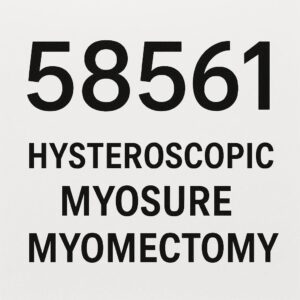
CPT Code for Hysteroscopic MyoSure Myomectomy
Understanding the Procedure: What Is Hysteroscopic MyoSure Myomectomy?
Before we assign a number to a procedure, we must understand what actually happened in the operating room. The MyoSure system is a hysteroscopic tissue removal device. Unlike a traditional resectoscope that uses electrical energy to cut and coagulate, the MyoSure uses a rotating blade housed within a sheath to shave and evacuate fibroid tissue.
It is important to distinguish this from other types of hysteroscopic procedures.
How MyoSure Differs from Traditional Resection
The difference matters because the CPT code set distinguishes between procedures based on the method and extent of tissue removal.
-
Traditional Resectoscopy (TCR): Uses a resectoscope with an electrocautery loop. The physician cuts the fibroid into strips and removes them. The codes for this are often 58561 (hysteroscopy with removal of leiomyomata) or 58563 (hysteroscopy with endometrial ablation).
-
MyoSure (Mechanical Morcellation): Uses a mechanical cutter to shave the fibroid. No electrical energy is used to remove the fibroid (though it may be used for hemostasis).
-
Key Concept: The coding community and the American Medical Association (AMA) generally categorize MyoSure myomectomy under Hysteroscopy with removal of leiomyomata, which is CPT 58561.
The Primary CPT Code: 58561
Let’s start with the headline. For the vast majority of hysteroscopic MyoSure myomectomy procedures, the correct primary CPT code is 58561.
CPT 58561: Hysteroscopy, surgical; with removal of leiomyomata.
What Does 58561 Include?
This code is inclusive of the entire service. When you report 58561, you are telling the payer that the surgeon performed a diagnostic hysteroscopy (looking inside the uterus) and then proceeded to remove one or more fibroids (leiomyomata) during the same session.
Because it is a comprehensive code, you generally cannot bill for a separate diagnostic hysteroscopy (58558) on the same day. The “surgical” part of the code includes the diagnostic evaluation.
When Is 58561 the Wrong Choice?
While 58561 is the primary code for a myomectomy, there are specific instances where it is not the correct choice. This usually happens if the provider does not remove the fibroid tissue using the hysteroscope alone.
For example, if the surgeon uses the MyoSure device to shave down the fibroid but then must convert to a different approach, or if the procedure is primarily for polyps, the coding changes. We will discuss these nuances later in the “Bundling and Modifiers” section.
Alternative and Adjacent Codes
While 58561 is the star of the show, it doesn’t work alone. Sometimes, additional codes are necessary to describe the full picture of the surgery, or a different code is used if the primary intention was not myomectomy.
58558 vs. 58561: A Critical Distinction
One of the biggest points of confusion in hysteroscopic coding is the difference between 58558 and 58561.
-
58558: Hysteroscopy, surgical; with sampling (biopsy) of endometrium and/or polypectomy.
-
58561: Hysteroscopy, surgical; with removal of leiomyomata.
If the surgeon removes a polyp, you use 58558. If the surgeon removes a fibroid (leiomyoma), you use 58561. However, what happens if the surgeon removes both a polyp and a fibroid during the same surgery?
| Scenario | CPT Code | Rationale |
|---|---|---|
| Polyp Only | 58558 | The primary procedure was polypectomy. |
| Fibroid Only | 58561 | The primary procedure was myomectomy. |
| Polyp + Fibroid | 58561 | CPT guidelines generally consider the myomectomy (58561) the more extensive procedure. It is not appropriate to bill both 58561 and 58558 together. You report only the myomectomy code. |
CPT 58563: Endometrial Ablation
Sometimes, a patient may have a MyoSure myomectomy to remove a fibroid that is causing heavy bleeding, and the surgeon may also perform an endometrial ablation (e.g., NovaSure, ThermaChoice) to treat the bleeding.
In this case, you have two distinct surgical procedures performed through the hysteroscope. You can bill 58561 and 58563 together.
However, when billing these two codes together, you must append a modifier to the secondary procedure.
CPT 58559: Hysteroscopy with Lysis of Intrauterine Adhesions
This code is relevant if the fibroid is causing scarring (Asherman’s syndrome) and the surgeon must cut adhesions before they can access the fibroid. If this is a separate, identifiable service, it may be billed with modifier -59 or -XS. However, if the lysis is incidental to gaining access to the fibroid, it is often considered bundled into 58561.
Modifiers: Getting Paid for the Full Story
Modifiers are two-character add-ons to CPT codes that tell the payer, “This was a little different” or “There was more to this story.” When performing a MyoSure myomectomy, specific modifiers are critical.
Modifier -22 (Increased Procedural Services)
This is a crucial modifier for MyoSure procedures, though it is often underutilized. Hysteroscopic myomectomy has a standard work value based on an “average” fibroid—typically one that is small (under 3 cm) and easy to remove.
If the surgeon removes a massive fibroid (e.g., >5 cm), multiple fibroids (e.g., 5-10 fibroids), or a fibroid that is deeply embedded in the myometrium (Type 1 or Type 2), the procedure is significantly more complex.
Important Note: Modifier -22 does not guarantee extra payment, but it alerts the payer to review the documentation. You must provide strong operative notes that justify the increased complexity. Include the size, number, location, and total operative time.
Modifier -51 (Multiple Procedures)
If the surgeon performs a MyoSure myomectomy (58561) and an ablation (58563) on the same day, you will list the primary procedure first (usually the most resource-intensive or RVU-heavy) and then list the secondary procedure with modifier -51 attached.
Example:
-
58561 (Myomectomy)
-
58563-51 (Ablation)
Modifier -59 or -XS (Distinct Procedural Service)
If the surgeon performs a myomectomy via hysteroscopy and also performs a separate procedure via a different approach (e.g., a laparoscopic salpingectomy), you would use modifier -59 or the more specific -XS (separate structure) to indicate that the services were distinct and not bundled.
Documentation: The Key to Clean Claims
You can use the correct code, but if the documentation doesn’t support it, the claim will be denied. Payers are increasingly scrutinizing hysteroscopic procedures to ensure that the medical necessity is clear.
What the Operative Note Must Include
To support the use of CPT 58561, the operative note should include:
-
A Clear Diagnosis: Document the symptoms (menorrhagia, bulk symptoms, pain) and the findings (submucosal fibroid).
-
Specific Location: Was it a Type 0 (pedunculated, entirely in the cavity), Type 1 (less than 50% intramural), or Type 2 (more than 50% intramural)?
-
Size and Number: “A 3 cm fibroid” is different from “multiple fibroids ranging from 2 cm to 5 cm.”
-
Method of Removal: Note the use of the MyoSure tissue removal system. Do not simply say “resected.”
-
Complexity: If the case was challenging, note why. Was the visualization poor? Was there significant bleeding? Was the fibroid calcified?
Medical Necessity: The Diagnosis Codes
The diagnosis codes (ICD-10-CM) must support the need for the surgery. Common diagnoses that support a myomectomy include:
-
D25.0 – Submucous leiomyoma of uterus
-
D25.1 – Intramural leiomyoma of uterus
-
D25.2 – Subserosal leiomyoma of uterus (if causing symptoms)
-
N92.0 – Excessive and frequent menstruation with regular cycle
Avoid using a vague diagnosis like “N93.9 – Abnormal uterine bleeding” without linking it to the specific fibroid found.
Common Denials and How to Fix Them
Even with perfect coding, denials happen. Let’s look at the most common reasons a MyoSure claim is rejected and how to handle them.
Denial 1: Bundling of 58558 and 58561
Scenario: The biller submits both 58558 (polypectomy) and 58561 (myomectomy) because the operative note mentions a small polyp and a large fibroid.
The Problem: CPT guidelines consider 58558 a component of 58561 when performed in the same session.
The Fix: Resubmit the claim with only 58561. If the fibroid was the primary reason for surgery, this is correct. If the polyp was the primary reason, you may only bill 58558, but if a fibroid was also removed, the myomectomy code typically takes precedence.
Denial 2: “This Procedure Is Not Medically Necessary”
Scenario: The denial states that the procedure was not medically necessary.
The Problem: This often happens when the ICD-10 diagnosis code does not match the severity or location of the fibroid. For example, using D25.2 (subserosal) for a procedure that is hysteroscopic may raise a red flag because subserosal fibroids are usually removed laparoscopically, not hysteroscopically.
The Fix: Ensure the primary diagnosis is D25.0 (Submucous). If the fibroid is intramural but protruding into the cavity, ensure the documentation clearly describes it as a “submucosal component” to support the hysteroscopic approach.
Denial 3: Modifier -22 Rejection
Scenario: You appended modifier -22 for a large fibroid, and the claim was denied or paid at the base rate.
The Problem: Payer policies for modifier -22 are strict. They require supporting documentation. If the operative note did not include the total time, the size of the fibroid, and the specific difficulties, the payer will deny the extra payment.
The Fix: When appealing, submit the operative note with the relevant sections highlighted. Write a cover letter stating, “This procedure required significantly greater work due to [size/number/location], as documented in the operative note.”
Payer-Specific Policies: A Reality Check
One of the most important things to remember is that not all payers follow the same rules. While Medicare (and many commercial plans that follow Medicare guidelines) generally accept 58561 for MyoSure, some private insurers have specific policies regarding “mechanical morcellation.”
The “New Technology” Trap
Some payers classify MyoSure as “new technology” and may require the use of an unlisted code, such as CPT 58578 (Unlisted hysteroscopy procedure), if they do not have a specific policy for it.
Should you use 58578?
This is a last resort. Using an unlisted code invites a manual review and almost always delays payment. The general consensus among coding experts is that 58561 is the correct code for a hysteroscopic myomectomy, regardless of the device used (resectoscope, MyoSure, or another morcellator).
However, you should always check the specific payer’s medical policy. If a policy explicitly states, “We do not consider 58561 for mechanical morcellation,” you may have no choice but to use 58578 with a detailed description.
Medicare and 58561
Medicare does not have a national non-coverage policy for MyoSure myomectomy. Coverage is determined by local contractors (MACs). Generally, as long as medical necessity is documented (submucosal fibroids causing symptoms), 58561 is a covered service.
The Financial Picture: RVUs and Reimbursement
While we don’t discuss specific dollar amounts (as they vary wildly by region and payer), understanding Relative Value Units (RVUs) helps to understand the value of the procedure.
| CPT Code | Description | Work RVU (Approx.) |
|---|---|---|
| 58561 | Hysteroscopy with removal of leiomyomata | 6.53 |
| 58558 | Hysteroscopy with polypectomy/biopsy | 4.53 |
| 58563 | Hysteroscopy with endometrial ablation | 5.12 |
As you can see, 58561 has a higher work RVU than a polypectomy or ablation alone, reflecting the increased complexity of removing fibroids, which are often larger and more vascular than polyps.
When billing 58561 and 58563 together with modifier -51, payers typically apply a multiple procedure reduction. The primary code is paid at 100%, and the secondary code is paid at a reduced percentage (often 50%).
Frequently Asked Questions (FAQ)
Q1: Can I bill for the MyoSure handpiece or device separately?
A: No. The cost of the MyoSure device, the hysteroscope, and the disposable components are considered supplies. They are not separately reimbursed under the physician fee schedule. These costs are factored into the practice expense RVU of the CPT code. In an outpatient hospital setting (facility), the hospital bills for supplies separately, but the physician does not.
Q2: What is the difference between a myomectomy and a polypectomy in coding terms?
A: The distinction is histological. A leiomyoma (fibroid) is a smooth muscle tumor. A polyp is an overgrowth of endometrial tissue. CPT 58561 is specifically for leiomyomata. If the pathology report confirms a fibroid, you use 58561. If it confirms a polyp, you use 58558.
Q3: What if the MyoSure procedure is abandoned?
A: If the procedure is started but cannot be completed due to a complication (e.g., uterine perforation, inability to visualize, equipment failure), you should bill the procedure with modifier -53 (Discontinued procedure). For example, 58561-53. You do not bill for a diagnostic hysteroscopy separately. You will also need to append a diagnosis code to explain the reason for discontinuation.
Q4: Is a separate code billed for the hysteroscopy itself?
A: No. The hysteroscopy is inherent to the procedure. The surgical code (58561) includes the cost of performing the diagnostic hysteroscopy to guide the myomectomy. This is known as a “comprehensive code.”
Q5: Can a MyoSure myomectomy be performed in an office setting?
A: Yes. Many MyoSure procedures are performed in ambulatory surgery centers (ASCs) or office-based operating rooms. The CPT code (58561) is the same regardless of the place of service. However, the place of service modifier (e.g., 11 for office, 24 for ASC) will affect the reimbursement calculation.
Additional Resources
Navigating the world of gynecologic surgery coding requires staying current. Here is a curated list of resources to help you maintain accuracy.
-
The American College of Obstetricians and Gynecologists (ACOG) Coding Department: ACOG offers regular coding workshops, webinars, and a coding manual specifically for ob-gyn practices. Their guidance is often considered the gold standard for specialty-specific questions.
-
American Medical Association (AMA) CPT Network: For the official language of the CPT codes, the AMA website provides the most up-to-date information on code descriptors and guideline changes. It is the source of truth.
-
Hologic (MyoSure Manufacturer) Reimbursement Hotline: The manufacturer often provides coding and reimbursement support. While they cannot guarantee payment, they can provide local coverage determination (LCD) links and coding sheets that are helpful for navigating payer-specific rules.
Link: AMA CPT Code Lookup Tool (External resource for official code descriptors)
Conclusion
Finding the correct CPT code for a hysteroscopic MyoSure myomectomy comes down to understanding the primary action: removal of a fibroid. The code is 58561. This code covers the diagnostic scope and the removal of the fibroid tissue, regardless of the specific device used.
However, success in coding is not just about picking the right number. It requires precise documentation of the fibroid’s size and location, the appropriate use of modifiers for multiple procedures or increased complexity, and a thorough understanding of payer-specific policies to avoid denials. By combining accurate coding with robust operative notes, you ensure that the clinical picture is clear and the reimbursement process runs smoothly.
Disclaimer: This article is intended for informational and educational purposes only. It does not constitute legal, medical, or billing advice. CPT codes, payer policies, and reimbursement rules are subject to change. Always verify coding requirements with your local payer and current CPT manual.
Author: Medical Coding Specialist Team
Date: March 30, 2026