If you have ever stared at a procedure report for a renal angiogram and felt unsure which CPT code fits best, you are not alone. Renal artery imaging can be tricky. The difference between a diagnostic study and one that includes an intervention changes everything.
This guide walks you through the most common CPT codes for renal angiography. You will learn how to distinguish between unilateral and bilateral procedures, when to add selective catheterization codes, and how to avoid common claim denials. No fluff. No made‑up rules. Just realistic, useful information.
Let us start with the short answer, then dig into the details.
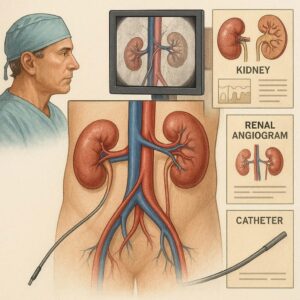
CPT Code for Renal Angiogram
Table of Contents
ToggleWhat Is the Main CPT Code for a Renal Angiogram?
The most direct CPT code for a diagnostic renal angiogram is CPT 36245.
This code describes Selective catheterization of the renal artery, unilateral. In simple terms: the doctor guides a catheter into one renal artery and injects contrast to see blood flow.
If both kidneys are studied, you need CPT 36246 — bilateral selective catheterization of the renal arteries.
But that is only the beginning. Many renal angiograms are performed together with other procedures. Sometimes the angiogram is done during a larger intervention like stenting or angioplasty. In those cases, the coding changes significantly.
Important note for readers: Never code solely from the procedure name. Always read the full operative or interventional radiology report. The documentation determines the correct code.
Understanding Renal Angiography in Simple Terms
A renal angiogram is an X‑ray exam of the blood vessels leading to your kidneys. A radiologist or interventional cardiologist inserts a thin tube (catheter) into a large artery — usually the femoral artery in the groin — and guides it to the renal arteries. Contrast dye is injected, and images are captured.
Doctors order this test for several reasons:
-
Suspected renal artery stenosis (narrowing)
-
Uncontrollable high blood pressure
-
Kidney failure of unknown cause
-
Before or after a kidney transplant
-
Pre‑operative mapping for kidney surgery
From a coding perspective, the key details are:
-
How many arteries are studied (one kidney or both)
-
Is it only diagnostic, or is something done (angioplasty, stent, embolization)
-
Was the catheter already in place from another procedure
Let us break down the codes.
Complete List of CPT Codes for Renal Angiography
Below is a practical table of the most relevant CPT codes. These are the ones you will use 95% of the time.
| CPT Code | Description | When to Use |
|---|---|---|
| 36245 | Selective catheterization, renal artery, unilateral | Diagnostic study of one kidney |
| 36246 | Selective catheterization, renal artery, bilateral | Diagnostic study of both kidneys |
| 36247 | Selective catheterization, each additional second-order or higher branch (add‑on) | When a branch beyond the main renal artery is studied |
| 75722 | Renal angiography, unilateral, radiological supervision and interpretation | Professional component (imaging read) |
| 75724 | Renal angiography, bilateral, radiological supervision and interpretation | Professional component (imaging read) |
| 37246 | Transluminal balloon angioplasty, renal artery | When angioplasty is performed |
| 37236 | Transcatheter placement of a stent, renal artery | When a stent is placed |
Notice that 36245 and 75722 are often billed together for a complete unilateral diagnostic study. The first code covers the catheter work; the second covers the image interpretation.
Diagnostic vs. Interventional Renal Angiogram – Key Difference
This is where many billing errors happen. A diagnostic angiogram only looks. An interventional angiogram treats.
Diagnostic scenario:
The patient has hypertension. The doctor performs a selective renal angiogram to check for stenosis. No balloon, no stent, no embolization.
➜ Code: 36245 (unilateral) or 36246 (bilateral) + 75722 / 75724.
Interventional scenario:
The same patient has a 75% stenosis found during the angiogram. The doctor decides to place a stent immediately.
➜ You do not code the diagnostic angiogram separately. Instead, code the stent placement (37236) which includes the diagnostic angiogram necessary to guide the intervention.
This rule comes from the National Correct Coding Initiative (NCCI). Diagnostic imaging before an intervention in the same vessel is bundled.
“Do not report diagnostic angiography separately when it is performed to plan an intervention on the same vessel.” – NCCI Manual
Unilateral vs. Bilateral – Why It Matters
Let us compare two examples.
Example A (Unilateral):
The doctor selectively catheterizes the left renal artery only. Contrast is injected. Images show normal flow. The procedure ends.
Code: 36245 + 75722.
Example B (Bilateral):
The doctor selectively catheterizes the left renal artery, then the right renal artery. Contrast is injected into each side. Images are taken of both kidneys.
Code: 36246 + 75724.
If the doctor attempts bilateral but fails to engage one side due to difficult anatomy, you still report unilateral. Documentation must clearly state why both sides were not studied.
When to Use Add‑On Code 36247
Sometimes the doctor goes beyond the main renal artery into a branch (for example, an accessory renal artery or a segmental branch). This requires extra work and skill.
-
36247 is an add‑on code. It cannot be used alone.
-
It is used in addition to 36245 or 36246.
-
It is reported per additional branch vessel studied.
Example:
The doctor selectively catheterizes the right main renal artery (36245). Then, he selectively catheterizes an upper pole branch of the same right renal artery (36247).
Codes: 36245, 36247, and 75722.
Renal Angiogram with Angioplasty or Stent – Coding Rules
When an intervention is performed, the coding changes completely.
Angioplasty Only (no stent)
Use 37246 – Transluminal balloon angioplasty, open or percutaneous, renal artery.
This code includes:
-
Catheterization of the renal artery
-
Diagnostic angiography of that vessel
-
Balloon dilation
Do not add 36245 or 75722 separately.
Stent Placement
Use 37236 – Transcatheter placement of an intravascular stent, renal artery.
This includes all the same components as angioplasty, plus stent deployment.
Multiple Vessels with Intervention
If angioplasty or stenting is performed on both renal arteries, you may report the intervention code twice with modifier 59 or XU. However, check payer guidelines – some require separate sessions or separate access.
Renal Angiogram During Another Procedure – What to Avoid
A common scenario: the patient has a diagnostic cerebral angiogram. The catheter is already in the aorta. The doctor advances it into the renal artery and performs a renal angiogram.
Is this separately billable?
Yes, if:
-
The renal study is planned and documented separately
-
It requires additional work beyond the primary procedure
-
It is not routinely performed with the primary procedure
Use modifier 59 (Distinct Procedural Service) on the renal codes to show it was a separate and distinct service.
But be careful: If the renal angiogram is performed solely because the catheter was already there and no additional time or risk was involved, some payers will deny it.
Honest advice: Document why the renal angiogram was medically necessary. “Because we could” is not a valid reason.
Common Coding Mistakes (And How to Avoid Them)
Let us look at real mistakes I have seen in radiology billing.
| Mistake | Why It Is Wrong | Correct Action |
|---|---|---|
| Billing 36245 for a flush aortogram | Flush aortogram (36140) is non‑selective. 36245 requires selective catheterization. | Use 36140 or 75625 for abdominal aortogram. |
| Adding 75722 to every renal angiogram | 75722 is the professional component. In a facility setting, technical and professional may be separate. | Know your billing role (facility vs. provider). |
| Bypassing modifier 59 for same‑session renal study | Without modifier, NCCI bundles renal angiography with many primary codes. | Append modifier 59 if truly distinct. |
| Using 36246 when only one side is documented | Bilateral requires documented selective engagement of both arteries. | Review the report carefully. |
Real‑World Case Examples
Case 1: Diagnostic Unilateral Renal Angiogram
History: 58‑year‑old with difficult‑to‑control hypertension.
Procedure: Left renal artery selectively catheterized. Contrast injection shows 30% stenosis – no intervention.
Codes: 36245, 75722.
Case 2: Bilateral Diagnostic Study
History: Living kidney donor evaluation.
Procedure: Right and left renal arteries selectively catheterized and imaged.
Codes: 36246, 75724.
Case 3: Angiogram with Stent Placement
History: 72‑year‑old with flash pulmonary edema. Renal artery stenosis found.
Procedure: Left renal artery catheterized. Diagnostic images show 85% stenosis. Stent placed.
Codes: 37236 (stent placement includes everything). Do not add 36245 or 75722.
Case 4: Failed Bilateral Attempt
History: Right renal artery engaged without difficulty. Left renal artery ostium could not be selectively catheterized due to severe angle.
Documentation: Report states “attempted bilateral, successful unilateral.”
Codes: 36245, 75722. Append modifier 52 (reduced services) if payer requires.
How to Document a Renal Angiogram for Correct Coding
As a coder, you depend on the doctor’s report. Encourage your providers to include:
-
Which artery was accessed (e.g., right common femoral artery)
-
Whether selective catheterization was achieved for each renal artery
-
Number of arteries studied (left, right, both, accessory branches)
-
Findings (normal, stenosis, aneurysm, occlusion)
-
Any intervention performed (angioplasty, stent, embolization)
-
If bilateral was attempted but failed – why
Without these details, you are guessing. And payers deny guesses.
Medicare and Payer‑Specific Rules
Medicare does not have a single “renal angiogram only” code for outpatient hospital payment. Instead, payments are bundled into ambulatory payment classifications (APCs).
However, for physician billing under Medicare Part B:
-
36245 has a global period of 000 (endoscopic or minor procedure)
-
37236 (stent) has a global period of 010 (minor procedure with postoperative period)
Commercial payers often follow NCCI edits but may have unique medical necessity policies. Always check:
-
Coverage for renal angiography (some require prior authorization)
-
Whether diagnostic angiography is payable the same day as intervention
-
Documentation requirements for modifier 59
Tips to Reduce Renal Angiogram Claim Denials
-
Match codes to documentation – Never assume bilateral.
-
Do not overbill intervention codes – One stent = one 37236, even if multiple stents in same vessel.
-
Use modifiers correctly – Modifier 59 is not a magic wand. It requires a real reason.
-
Append the correct imaging code – 75722 for unilateral, 75724 for bilateral. Do not mix them.
-
Check NCCI edits quarterly – Bundling rules change.
A good rule of thumb: If the procedure report does not clearly say “selective,” do not code selective.
Frequently Asked Questions (FAQ)
1. Is CPT 36245 the only code for a renal angiogram?
No. 36245 is for selective catheterization of one renal artery. You also need 75722 for the imaging supervision and interpretation, unless you are billing technical-only in a facility.
2. Can I bill 36245 and 75722 together?
Yes, for a complete diagnostic unilateral renal angiogram by the same physician.
3. What is the CPT code for a renal angiogram with angioplasty?
Use 37246. Do not also bill 36245 or 75722.
4. What code is used for a bilateral renal angiogram?
36246 (catheterization) + 75724 (imaging interpretation).
5. How do I code a renal angiogram that is done through an existing catheter?
Use the same codes (36245, 75722) with modifier 59 if the renal study was not part of the primary procedure.
6. Does a renal angiogram require medical necessity documentation?
Yes. Hypertension, renal insufficiency, suspected stenosis, or pre‑transplant evaluation are common valid reasons.
7. What is the difference between 36245 and 36140?
36140 is non‑selective (catheter not in the renal artery). 36245 is selective (catheter intentionally placed into the renal artery).
8. Can a renal angiogram be billed with an abdominal aortogram?
Sometimes. If the aortogram is performed for a different reason (e.g., aneurysm evaluation) and the renal angiogram is separate, use modifier 59. But check NCCI – they often bundle.
Additional Resource for Coders and Billers
For the most current and official CPT coding guidelines, always refer directly to the American Medical Association (AMA) CPT® Professional Edition and the NCCI Policy Manual for Medicare Services.
🔗 Link to NCCI resources:
Centers for Medicare & Medicaid Services – NCCI Coding Policy Manual
This is a free, authoritative source. Bookmark it.
Summary – What You Need to Remember
-
For a diagnostic unilateral renal angiogram, use 36245 + 75722.
-
For bilateral, use 36246 + 75724.
-
If angioplasty or stenting is performed, use 37246 or 37236 and do not add diagnostic codes.
-
Always read the full procedure note. Never code from the order or summary alone.
-
Use modifier 59 only when the renal study is truly distinct from another same‑session procedure.
Conclusion (Three Lines)
Renal angiogram coding depends entirely on whether the study is diagnostic or interventional, and whether one or both kidneys are examined. Use 36245/36246 for diagnostic catheterization with their corresponding imaging codes, but switch to 37246 or 37236 when an angioplasty or stent is performed. Always document medical necessity and selective catheterization to avoid costly denials.
Disclaimer:
This article is for educational purposes only. Coding rules change frequently. Always verify with current CPT, CMS guidelines, and your specific payer policies. The author and publisher are not liable for claim denials or reimbursement decisions made based on this information.
Author:
Rachel M. Westbrook, CPC, CRC – Certified Professional Coder with 14 years of experience in interventional radiology and cardiovascular coding.
Date:
APRIL 06, 2026