If you have ever sat in a dentist’s chair and heard the phrase “We need to extract a few teeth,” your mind probably goes straight to the procedure itself. Will it hurt? How long will recovery take? But for many people, the anxiety starts a little later, when they receive the treatment plan or the insurance statement.
Suddenly, you are looking at a page filled with numbers, abbreviations, and a column labeled “Amount Due.” One of the most common sources of confusion is the CPT code (or more accurately in dentistry, the CDT code) listed next to the procedure.
If you are facing the removal of multiple teeth, understanding these codes is your superpower. It allows you to verify what work was done, ensure your insurance is billed correctly, and avoid unexpected out-of-pocket costs.
In this guide, we are going to break down everything you need to know about the codes used for multiple tooth extractions. We will cover the difference between simple and surgical codes, how dentists bill for several teeth at once, and what the numbers actually mean for your wallet.
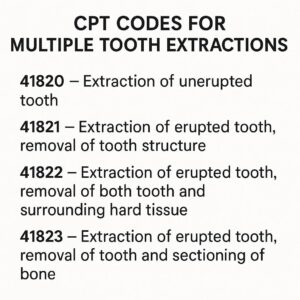
CPT Codes for Multiple Tooth Extractions
Table of Contents
ToggleUnderstanding the Difference: CPT vs. CDT Codes
Before we dive into the specifics of extraction codes, it is important to clear up a common point of confusion.
In the medical world, providers use Current Procedural Terminology (CPT) codes. However, dentists operate under a different system. They use the Current Dental Terminology (CDT) code set, which is published by the American Dental Association (ADA).
When patients search for “cpt code for teeth extraction multiple,” they are usually looking for the dental equivalent. In dentistry, we use CDT codes.
So, why does this distinction matter? Because if you try to look up a CPT code for a tooth extraction in a medical billing manual, you might not find what you are looking for. Dental procedures have their own specific language.
Throughout this article, we will be focusing on the CDT codes that your dentist uses when submitting a claim to your dental insurance for the removal of multiple teeth.
The Core Codes: Simple vs. Surgical Extractions
When it comes to pulling teeth, not all extractions are created equal. The code used depends entirely on the complexity of the procedure. Generally, extractions fall into two main categories: simple and surgical.
Simple Extractions (D7140)
A simple extraction is performed on a tooth that is visible in the mouth. The dentist uses an instrument called an elevator to loosen the tooth and forceps to remove it. This is a straightforward procedure that usually requires only local anesthesia.
-
The Code: D7140 – Extraction, erupted tooth or exposed root (elevation and/or forceps removal).
-
Typical Use: Removing a tooth that is fully erupted (visible above the gum line) and not broken off at the gum level.
Surgical Extractions (D7210)
A surgical extraction is more complex. This code is used when the tooth is not easily accessible. This includes teeth that are broken off at the gum line, teeth that have not fully erupted (impacted wisdom teeth), or teeth that require the dentist to make an incision in the gum tissue and possibly remove bone to access the tooth.
-
The Code: D7210 – Surgical extraction of erupted tooth requiring elevation of mucoperiosteal flap and removal of bone and/or section of tooth.
-
Typical Use: Removing a tooth that is broken, impacted, or requires cutting through gum tissue and bone.
Why This Distinction Matters for Multiple Teeth
When you are having multiple teeth extracted, the dentist will assign a specific code to each tooth based on the complexity of its removal.
For example, if you are having three teeth removed—two that are simple and one that is broken and requires surgery—your treatment plan will likely show:
-
D7140 (Simple extraction) x 2
-
D7210 (Surgical extraction) x 1
Understanding this helps you see why the price isn’t simply “three times the price of one tooth.” The surgical one is more expensive because it requires more skill, time, and materials.
How Multiple Extractions Are Coded
One of the biggest misconceptions is that there is a single, magical “cpt code for teeth extraction multiple.” In reality, there is no single code that covers “multiple teeth” in one blanket fee.
Instead, dentists and oral surgeons code each tooth individually. However, they use a modifier to tell the insurance company that multiple procedures were performed in the same visit.
The Role of the “Multiple Procedure” Modifier
When a dentist performs several extractions in one appointment, they will list each extraction on the claim form. To ensure fair reimbursement, they often append a modifier to the additional teeth.
The most common modifier used is -51 (Multiple Procedures).
Here is how it looks in practice:
-
First Tooth: D7140 (Full fee)
-
Second Tooth: D7140-51 (Reduced fee)
-
Third Tooth: D7140-51 (Reduced fee)
Insurance companies often apply a “multiple procedure reduction.” They reason that the overhead costs (like anesthesia, sterilization, and setup) are covered in the first procedure. Therefore, they pay less for the subsequent procedures. This is standard practice, though the exact reduction percentage varies by insurance carrier.
When Multiple Codes Are Different
As mentioned earlier, if the extractions are a mix of simple and surgical, the “primary” procedure is usually the most complex one.
If you have a surgical extraction (D7210) and two simple extractions (D7140), the surgical one will likely be paid at the full fee, and the simple ones will be subject to the multiple procedure reduction.
Deep Dive: Codes for Complex Multiple Extractions
Sometimes, “multiple teeth” refers to the removal of teeth that are adjacent to each other, or the removal of impacted teeth. In these cases, there are specific codes that actually bundle multiple teeth into one code.
D7240 and D7250: Impacted Teeth
When dealing with wisdom teeth (third molars), the coding becomes more specific. If you are having all four wisdom teeth removed, you will likely see one of these codes, depending on the complexity.
-
D7240: Removal of impacted tooth – completely bony. This means the tooth is completely covered by bone. This is the most complex wisdom tooth extraction.
-
D7230: Removal of impacted tooth – partially bony. The tooth is partially covered by bone and partially visible.
-
D7220: Removal of impacted tooth – soft tissue. The tooth is covered by gum tissue but not bone.
For multiple impacted teeth, the dentist will list these codes per quadrant (section of the mouth). You might see:
-
D7240 (Upper right wisdom)
-
D7240 (Upper left wisdom)
-
D7240 (Lower right wisdom)
-
D7240 (Lower left wisdom)
Again, the -51 modifier is often applied to the second, third, and fourth teeth.
D7260 and D7270: Orbits and Re-implantation
In rare cases involving trauma, you might see codes for removing teeth from unusual locations or re-implanting them. However, for standard multiple extractions, these are less common.
Full Mouth Extractions
When a patient requires the removal of all their teeth (often in preparation for dentures), the billing can be extensive. It is rare to see a single code for “all teeth.” Instead, the dentist will bill for each quadrant or each individual tooth, depending on the insurance plan’s requirements.
A Comparative Table: Extraction Codes at a Glance
To help you visualize the differences, here is a breakdown of the most common codes you will see on a treatment plan for multiple extractions.
| CDT Code | Procedure Description | Typical Scenario for Multiple Extractions | Relative Complexity |
|---|---|---|---|
| D7140 | Extraction, erupted tooth | Removing several loose teeth that are fully visible in the mouth. | Low |
| D7210 | Surgical extraction, erupted tooth | Removing a tooth that is broken off at the gum line among a set of other teeth. | Medium |
| D7220 | Removal of impacted tooth – soft tissue | Removing a wisdom tooth that is covered only by gum, not bone. | Medium-High |
| D7230 | Removal of impacted tooth – partially bony | Removing a wisdom tooth that is partially stuck in the jawbone. | High |
| D7240 | Removal of impacted tooth – completely bony | Removing a wisdom tooth that is fully encased in the jawbone. This often requires more complex surgical techniques. | Very High |
| D7250 | Removal of residual roots | Removing the leftover root fragments of a tooth that has already broken down or decayed away. | Medium |
Anesthesia and Sedation: The Additional Codes
When you are having multiple teeth extracted, the procedure itself is only half the story. Anesthesia is a critical component, and it is billed separately using different codes.
If you are having a simple extraction of two teeth, you might only need local anesthesia (numbing shots), which is typically included in the extraction code. However, for multiple or complex extractions, you might opt for sedation or general anesthesia.
Here are the codes you might see alongside your extraction codes:
-
D9230: Inhalation of nitrous oxide (laughing gas). This is often used for mild anxiety.
-
D9241: Intravenous conscious sedation (twilight sleep). This is common for wisdom tooth removal. It is billed per 15-minute increments or per visit depending on the insurance.
-
D9222/D9223: Deep sedation or general anesthesia. This is typically administered by an anesthesiologist or a specialized oral surgeon for extensive procedures.
Important Note on Bundling
Some insurance plans have a policy where the anesthesia code is “bundled” into the surgical extraction code if only a few teeth are removed. However, for extensive multiple extractions (like full-mouth or all four wisdom teeth), the anesthesia is almost always a separate, billable line item.
Common Scenarios and How They Are Billed
Let’s look at a few real-world examples to see how these codes come together on a dental claim.
Scenario 1: The Denture Prep
Patient: An elderly patient needing eight front teeth removed to prepare for an immediate denture. All teeth are loose and visible.
Treatment Plan:
-
D7140 (Extraction, erupted tooth) x 8
-
*Modifier -51 applied to teeth 2 through 8.*
Outcome: The insurance pays 100% of the first extraction (if the patient has met their deductible) and a reduced percentage for the remaining seven.
Scenario 2: The Wisdom Teeth
Patient: A young adult having all four wisdom teeth removed. Two are partially bony, and two are soft tissue impactions.
Treatment Plan:
-
D7230 (Impacted – partially bony) – Upper right
-
D7230-51 – Upper left
-
D7220-51 (Impacted – soft tissue) – Lower right
-
D7220-51 – Lower left
-
D9241 (IV Sedation)
Outcome: The most complex tooth (first on the list) is paid at the highest rate. The others are reduced. Sedation is paid separately, often subject to its own deductible or co-insurance.
Scenario 3: Mixed Complexity
Patient: A patient requiring removal of three teeth: one molar that is broken at the gum line, and two premolars that are fully erupted.
Treatment Plan:
-
D7210 (Surgical extraction – broken molar)
-
D7140-51 (Simple extraction – premolar)
-
D7140-51 (Simple extraction – second premolar)
Outcome: The surgical extraction is the primary code. The simple extractions are considered secondary and paid at a reduced rate.
Insurance Limitations and Frequency Rules
One of the most frustrating aspects of multiple extractions is discovering that your insurance has limitations.
Most dental insurance plans have a frequency limitation. For example, a plan might state that a D7140 (simple extraction) is only covered once per tooth per lifetime.
What does this mean for multiple extractions?
If you are having 10 teeth extracted, and your insurance has a lifetime limit of one extraction per tooth, you are covered. However, if you had a tooth extracted five years ago, and now that same tooth (same location) needs to be extracted again (which is rare, usually due to a retained root), insurance might deny the claim.
Additionally, many plans have an annual maximum (usually between $1,000 and $2,000). If you are having multiple surgical extractions, the total cost can easily exceed this annual maximum. In this case, the insurance will pay up to the limit, and you will be responsible for the remaining balance.
The “Missing Tooth Clause”
Some older or more restrictive dental plans have a “Missing Tooth Clause.” This clause states that the plan will not cover a bridge or implant to replace a tooth that was missing before the patient was enrolled in the plan.
While this doesn’t affect the extraction codes themselves, it is crucial context if you are having teeth extracted as the first step toward replacement (like implants or dentures). Always ask your insurance provider about this clause before scheduling the extractions.
Tips for Reading Your Treatment Plan
When your dentist presents you with a treatment plan for multiple extractions, it can look like a spreadsheet full of numbers. Here is how to read it like a pro.
-
Locate the Code: Look for the column labeled “Code,” “CDT,” or “Proc Code.” This is the number we have been discussing (D7140, D7210, etc.).
-
Check the Tooth Number: Ensure the code corresponds to the correct tooth. The Universal Numbering System is used in the US. Adults have teeth numbered 1-32.
-
Look for Modifiers: See if there is a “-51” or “51” in the modifier column. This indicates a multiple procedure discount.
-
Identify the “Estimated Patient Responsibility”: This is the amount you will likely owe after insurance. If this number seems high, ask the office manager to explain how they arrived at it based on the multiple extraction codes.
Why Accuracy in Coding Matters
You might be wondering, “Does it really matter if they use D7140 or D7210 for my tooth?”
The short answer is yes. It matters a lot.
For your insurance: Using the wrong code can result in a denial. If a dentist submits a simple extraction code (D7140) but the insurance company’s reviewer notes that the X-ray shows the tooth was impacted, they may deny the claim for “incorrect coding.” Conversely, if a dentist uses a surgical code for a simple extraction, the insurance may overpay now, but they will audit the file later and request the money back.
For you: The difference between a simple and surgical code can mean a difference of hundreds of dollars in your out-of-pocket cost. Surgical codes typically have higher fees because they reflect the increased complexity and skill required.
For your future treatment: If you are planning to get dental implants after extractions, having the correct extraction codes on file is important. Some implant warranties require proof that the extraction was performed with minimal trauma to the bone. A surgical extraction (D7210) that preserves the bone is different from a traumatic simple extraction.
Questions to Ask Your Dentist Before Treatment
To avoid surprises, here is a list of questions you should ask your dentist or oral surgeon before they begin the procedure. Do not be shy. A good dental team expects these questions and appreciates an informed patient.
-
“Which specific codes will you be using for each tooth?”
This opens the conversation. Ask them to point to the code on the treatment plan. -
“Are any of these considered surgical extractions (D7210) rather than simple (D7140)?”
This clarifies the complexity and the cost. -
“How will the multiple procedure discount affect my total cost?”
This shows the billing team that you understand how modifiers work. -
“Is sedation included in the extraction fees, or is it separate?”
Anesthesia costs can add a significant amount to the final bill. -
“Have you verified my insurance coverage for multiple extractions in a single visit?”
Some insurance plans limit the number of procedures allowed in one day. It is best to know this beforehand.
The Cost Factor: What to Expect
While we cannot provide specific prices (as they vary wildly by geographic location and provider), understanding the code structure helps you understand the cost breakdown.
Generally, the hierarchy of cost for extraction codes is as follows:
-
Lowest: D7140 (Simple erupted tooth)
-
Medium: D7210 (Surgical erupted tooth) and D7220 (Soft tissue impaction)
-
High: D7230 (Partial bony impaction)
-
Highest: D7240 (Complete bony impaction)
When you multiply these by multiple teeth, you can see how the total adds up quickly.
“Many patients are shocked when they see a bill for four wisdom teeth because they assume the price is the same as four simple extractions. In reality, they are paying for four complex surgical procedures, often with general anesthesia. It is a completely different level of care.”
— Dr. Sarah Jenkins, Oral Surgeon
Navigating Insurance Denials for Multiple Extractions
Sometimes, despite best efforts, an insurance claim is denied. If you receive an Explanation of Benefits (EOB) stating that your multiple extraction claim was denied, here are a few common reasons and how to address them.
Denial Reason: “Procedure code is inconsistent with the modifier used.”
This often happens when the -51 modifier is used incorrectly. For example, if the dentist bills a D7240 (complex impaction) with a -51 modifier as the first procedure. The first procedure should rarely have a -51 modifier.
What to do: Ask your dentist’s billing coordinator to review the claim and resubmit it with the correct order of procedures.
Denial Reason: “This service is not covered under your plan.”
Some discount plans or basic plans do not cover surgical extractions (D7210 or D7240) at all. They may only cover D7140.
What to do: Review your insurance booklet. If surgical extractions are excluded, you will be responsible for the full fee. You can ask the dentist if they offer a cash discount for the surgical portion of the treatment.
Denial Reason: “Frequency limitation has been exceeded.”
If you had a tooth extracted in the past and now the dentist is billing for the same tooth number again, the insurance may deny it, thinking it is a duplicate.
What to do: This often requires a narrative report from the dentist explaining that the previous extraction was incomplete (residual root) or that this is a different tooth. Usually, a corrected claim with a detailed explanation solves the problem.
The Importance of Pre-Authorization
If you are facing a complex case involving multiple extractions, especially surgical ones or full-mouth extractions, always request a pre-authorization (or pre-determination) from your insurance company.
This is not a guarantee of payment, but it is an estimate. The dentist sends the treatment plan (with all the CDT codes for the multiple extractions and sedation) to the insurance company. The insurance company sends back a document stating what they will cover and what your estimated responsibility is.
This document is invaluable. It allows you to:
-
Verify that the codes are correct.
-
See exactly how the multiple procedure reduction will be applied.
-
Know your out-of-pocket maximum before you sit in the chair.
If the pre-authorization comes back with denials or unexpected costs, you have the chance to appeal or discuss alternative treatment plans with your dentist before the work is done.
Final Checklist: Preparing for Your Multiple Extraction Appointment
To wrap up, here is a helpful checklist to ensure you are fully prepared, both clinically and financially.
-
Confirm the codes: Review the treatment plan and ensure you understand which codes (D7140, D7210, D7240, etc.) are being used for each tooth.
-
Ask about modifiers: Confirm if the -51 modifier will be applied to the second and subsequent extractions.
-
Verify anesthesia billing: Know whether sedation is included or billed separately (D9230, D9241, D9222).
-
Check your annual maximum: Calculate how much of your annual insurance limit this procedure will consume.
-
Obtain a pre-authorization: If possible, have the dental office submit a pre-authorization to avoid surprises.
-
Discuss payment options: If the out-of-pocket cost is high, ask about payment plans or third-party financing.
Conclusion
Navigating the world of dental codes does not have to be a headache. While there is no single “cpt code for teeth extraction multiple,” understanding the system of CDT codes—specifically D7140 for simple extractions and D7210 for surgical—gives you the power to understand your treatment.
By recognizing that each tooth is billed individually, often with a multiple procedure modifier, you can accurately estimate costs and communicate effectively with your dental insurance provider. Whether you are preparing for wisdom tooth removal or full-mouth extractions, being an informed patient is the best way to ensure a smooth process from the treatment plan to the final bill.
Frequently Asked Questions (FAQ)
Q1: Is there a specific code for extracting two teeth next to each other?
No, there is no specific code for adjacent teeth. Each tooth is coded individually. However, if the teeth are surgical and involve a flap that covers multiple teeth, the dentist may use a surgical code (D7210) for the primary tooth and simple or surgical codes for the adjacent ones.
Q2: Will my insurance cover all four wisdom teeth extractions at once?
Most dental insurance plans cover wisdom tooth extractions, but they often have age limits (usually up to age 20-25 for impacted teeth). Additionally, your annual maximum may limit how much the insurance pays. Pre-authorization is highly recommended.
Q3: What is the difference between D7210 and D7240?
D7210 is used for a surgical extraction of a tooth that is already visible (erupted) but requires cutting gum and bone to remove it. D7240 is used specifically for impacted wisdom teeth that are completely covered by bone and have not erupted at all.
Q4: Can a dentist bill a simple extraction (D7140) if the tooth breaks during the procedure?
This is a common scenario. If the dentist starts a simple extraction and the tooth breaks, requiring surgical intervention, they may need to “upcode” to D7210. Ethically and contractually, they must bill for the actual procedure performed. However, you should be notified if this change occurs, as it will affect your bill.
Q5: Why does my treatment plan have a “D9999” code?
D9999 is an unspecified code. It is sometimes used for additional time or complexity not covered by other codes. Be cautious with this code. If you see it on your plan, ask for a clear explanation of what it represents.
Q6: Does Medicare cover multiple tooth extractions?
Original Medicare (Part A and B) does not cover routine dental care, including extractions. However, if the extraction is performed in a hospital setting as part of a covered medical procedure (like jaw surgery), it may be covered. Some Medicare Advantage (Part C) plans offer dental benefits, but coverage varies widely.
Additional Resource
For the most up-to-date and official information on dental coding, you can refer to the American Dental Association (ADA). They publish the Current Dental Terminology (CDT) guide, which is the definitive source for all dental codes.
-
Resource Link: American Dental Association – CDT Codes (Open in a new tab)
-
Tip: You can often find older editions of the CDT codebook at your local public library if you want to do deeper research without purchasing the book.
Disclaimer: This article is for informational purposes only and does not constitute medical, legal, or billing advice. CPT codes and insurance policies are subject to change. Patients should always consult their dental provider and insurance carrier for specific coverage details.
Author: Dental Billing Specialists Team
Date: March 30, 2026