If you have ever stared at a billing sheet wondering whether to use 76700, 76706, or 76775 for an abdominal aortic ultrasound, you are not alone. Medical coding for vascular studies can feel like walking through a maze with a blindfold on. But here is the good news: once you understand a few simple rules, choosing the correct code becomes second nature.
In this guide, we will walk through every relevant CPT code for ultrasound of the abdominal aorta. We will look at complete versus limited studies, screening exams for aneurysms, and how to avoid costly claim denials. No confusing jargon. No fluff. Just clear, practical advice you can use today.
Let us start with the most important question.
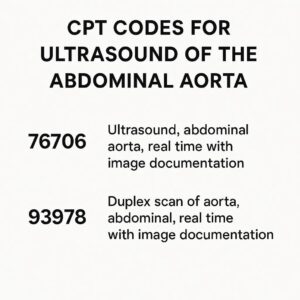
CPT Codes for Ultrasound of the Abdominal Aorta
What Exactly Is an Abdominal Aorta Ultrasound?
Before we talk about codes, let us make sure we are on the same page about the exam itself. An abdominal aorta ultrasound is a non-invasive imaging test that uses sound waves to create pictures of the main blood vessel that carries blood from your heart to your lower body. This vessel runs right through your abdomen, just in front of your spine.
Doctors order this exam for several reasons. The most common one is to check for an abdominal aortic aneurysm (AAA). An AAA is a bulging, weak spot in the artery wall that can grow over time. If it gets too large, it can rupture. A rupture is a life-threatening emergency.
Other reasons include:
-
Following up on a known small aneurysm.
-
Evaluating abdominal pain that might be related to the aorta.
-
Checking blood flow before or after surgery.
Now that we know what the exam does, let us talk about the numbers that matter for billing.
The Primary CPT Code for a Complete Ultrasound of the Abdominal Aorta
The main code you will use most often is 76700. This code represents a complete ultrasound examination of the abdominal aorta. But what does “complete” actually mean in this context?
According to the AMA guidelines, a complete study (76700) must include all of the following components:
-
Real-time scanning of the entire abdominal aorta from the diaphragm to the iliac bifurcation (where the aorta splits into the two iliac arteries).
-
Visualization of the proximal, mid, and distal segments.
-
Measurement of the maximum anteroposterior (AP) and transverse diameters.
-
Documentation of the presence or absence of an aneurysm.
-
Evaluation of the vessel wall and any associated thrombus (blood clot) or plaque.
When do you use 76700? You use this code when the ordering physician wants a full, detailed look at the entire abdominal aorta. This is typical for initial evaluations of a patient with a pulsatile abdominal mass, unexplained abdominal pain that could be vascular in nature, or a family history of AAA.
Important Note: 76700 is a complete exam. If you do not visualize all segments of the aorta due to bowel gas or patient body habitus, you must document why. However, you still report 76700 if you attempted a complete exam. Do not automatically downgrade to a limited code just because the image quality was poor. The intent matters.
The Limited Exam: When to Use CPT 76775
Sometimes a full, complete exam is not necessary. Maybe the patient already has a known small aneurysm, and the doctor just wants to check the size. Or perhaps the patient is post-surgical, and the physician only needs to see the graft. In these cases, you use 76775.
CPT 76775 is a limited ultrasound of the abdominal aorta. The key difference is the scope of the exam. A limited study does not require visualization of the entire aorta from diaphragm to bifurcation. Instead, it focuses on a specific area or a specific question.
Typical scenarios for 76775 include:
-
A follow-up exam on a known AAA (for example, measuring a 3.5 cm aneurysm every six months).
-
Checking only the proximal aorta for dissection.
-
Evaluating a specific area where the patient reports pain.
-
Looking at a known endoleak after endovascular aneurysm repair (EVAR).
How do you choose between 76700 and 76775? The rule is simple: if the order asks for a complete evaluation of the entire aorta, use 76700. If the order asks for a targeted evaluation of a specific segment or a known finding, use 76775.
Let us look at a quick comparison.
| Feature | CPT 76700 | CPT 76775 |
|---|---|---|
| Type of Exam | Complete | Limited |
| Required Anatomy | Entire aorta (diaphragm to bifurcation) | Specific segment only |
| Typical Use | Initial diagnosis, unexplained symptoms | Follow-up, known aneurysm, post-op check |
| Documentation | Measurements of all three segments | Targeted measurements only |
| Relative Value | Higher work RVU | Lower work RVU |
Screening for Abdominal Aortic Aneurysm: The Unique Case of CPT 76706
Here is where many people get tripped up. There is a third code that involves the abdominal aorta but works very differently. That code is 76706.
CPT 76706 is specifically for ultrasound screening for an abdominal aortic aneurysm. This is not a diagnostic exam. It is a preventive service. The goal is not to diagnose a problem in a symptomatic patient. The goal is to find an aneurysm in someone who has no symptoms but has risk factors.
Who qualifies for a screening ultrasound (76706)? In general, payers follow Medicare guidelines. Medicare covers a one-time AAA screening ultrasound for eligible beneficiaries. To qualify, the patient must have a family history of AAA or be a man aged 65 to 75 who has smoked at least 100 cigarettes in their lifetime.
What makes 76706 different?
-
It is a limited study focused only on measuring the maximal aortic diameter.
-
You do not need to visualize the entire aorta in detail.
-
It is typically a preventive service with no patient out-of-pocket cost (subject to payer rules).
-
You cannot use 76706 if the patient has symptoms. If the patient has abdominal pain, use 76700 or 76775.
Here is a critical point: 76706 is not interchangeable with 76775. If a patient comes in for a follow-up of a known 4 cm AAA, you cannot use 76706. You must use 76775. The screening code is only for the first-time screening in an asymptomatic, at-risk individual.
A Simple Decision Flow
-
Asymptomatic patient, first-time screening, meets risk criteria? → CPT 76706
-
Symptomatic patient (pain, pulsatile mass, etc.)? → CPT 76700 (complete) or 76775 (limited, if only one area is relevant)
-
Known AAA, routine follow-up? → CPT 76775
-
Post-EVAR or post-surgical surveillance? → CPT 76775 (unless complete exam is specifically ordered)
Complete vs. Limited: Real-World Examples
Let us put these codes into practice with some patient stories.
Example 1: A 72-year-old man with a 40-year smoking history comes to his primary care physician for a routine physical. He has no abdominal pain. The physician orders a one-time screening ultrasound for AAA. You perform a limited study to measure the maximal aortic diameter. The aorta is normal at 1.8 cm.
You bill: CPT 76706.
Example 2: A 68-year-old woman arrives at the emergency department with sudden-onset, severe lower back pain and a feeling of “pulsations” in her belly. The emergency physician orders a complete abdominal aorta ultrasound to rule out a ruptured or expanding aneurysm. You scan from the diaphragm to the iliac bifurcation and take measurements of all segments.
You bill: CPT 76700.
Example 3: A 65-year-old man has a known 3.2 cm AAA. His vascular surgeon orders a follow-up ultrasound in six months to check the size. The order specifically says “limited follow-up of known AAA – measure maximal diameter only.” You visualize the known aneurysm, take AP and transverse measurements, and do not scan the entire aorta.
You bill: CPT 76775.
Example 4: A 55-year-old patient with Marfan syndrome (a connective tissue disorder) has had a previous aortic root replacement. The cardiologist orders a “complete ultrasound of the abdominal aorta to evaluate for dilation.” The patient has no current symptoms. You perform a full exam from diaphragm to bifurcation.
You bill: CPT 76700. (Note: This is diagnostic surveillance, not a screening under 76706, because the patient has a known connective tissue disorder that predisposes to aortic disease.)
Documentation Requirements for Each Code
Good documentation is your best friend when it comes to avoiding denials. Payers want to see that you performed the level of service you billed. Here is what you need for each code.
For CPT 76700 (Complete Exam)
Your report must include:
-
A statement that you evaluated the entire abdominal aorta from the diaphragmatic hiatus to the aortic bifurcation.
-
Visualization of the proximal, mid, and distal segments. You can name them as such or describe the landmarks (celiac axis, superior mesenteric artery, renal arteries).
-
Maximum AP diameter measurement and maximum transverse diameter measurement. If no aneurysm is present, document the normal size (usually less than 3 cm).
-
Assessment of the aortic wall and presence or absence of thrombus, plaque, or dissection.
-
Representative images of each segment.
For CPT 76775 (Limited Exam)
Your report must include:
-
The specific clinical question you are answering (e.g., “Follow-up measurement of known 3.5 cm infrarenal AAA”).
-
The specific segment of the aorta you evaluated.
-
The maximum diameter measurement(s).
-
A clear statement that this was a limited exam focused on a specific finding.
-
Representative images of the targeted area.
For CPT 76706 (Screening Exam)
Your report must include:
-
Documentation that the patient is asymptomatic.
-
Documentation of risk factors (family history of AAA, smoking history, age 65-75 for men, etc.).
-
Measurement of the maximal aortic diameter.
-
A statement that the exam was a screening study.
-
Representative images showing the measurement.
Critical warning: Do not use the words “complete” or “limited” loosely. If your documentation for a 76775 says “complete evaluation of the aorta,” you have created a contradiction. That will lead to a denial or a downcode by the payer.
Common Billing Mistakes and How to Avoid Them
Even experienced coders make errors. Here are the most frequent mistakes we see with abdominal aorta ultrasound coding.
Mistake #1: Using 76706 for Follow-Up
This is the most common error. A patient has a known 3.2 cm AAA. He comes back in one year for a repeat ultrasound. Someone bills 76706. This is incorrect. The patient is no longer being screened. He is being monitored. The correct code is 76775.
Mistake #2: Billing 76700 When Only a Limited Study Was Performed
If the order says “measure known AAA,” and you only measure that one area, do not bill 76700. The documentation will not support a complete exam. You will either get a denial or, worse, an audit finding for upcoding.
Mistake #3: Not Documenting Why a Complete Exam Was Incomplete
Sometimes you attempt a complete exam (76700), but you cannot see the entire aorta. Maybe the patient has excessive bowel gas. Or the patient cannot lie flat. In these cases, you can still bill 76700, but your report must clearly state what you attempted and why you could not visualize every segment. Say: “Attempted complete evaluation of the abdominal aorta. The distal aorta was not well visualized due to overlying bowel gas. The proximal and mid aorta were normal.” Then you get paid for the work you attempted.
Mistake #4: Forgetting Modifiers
If you perform a bilateral lower extremity arterial duplex study and an abdominal aorta ultrasound on the same patient on the same day, you need a modifier. The aorta is part of the arterial system. Some payers consider this bundled. In many cases, you will append modifier -59 (Distinct Procedural Service) or -XU (Unusual non-overlapping service) to the second procedure to show they are separate and distinct.
How Payers View These Codes: Medicare and Commercial Insurance
Medicare and private insurers do not always see eye to eye. Here is a high-level overview.
Medicare follows National Coverage Determinations (NCDs) and Local Coverage Determinations (LCDs) for AAA screening. For 76706, the patient must meet the specific criteria mentioned earlier. For diagnostic codes 76700 and 76775, Medicare expects medical necessity. That means the patient must have a sign, symptom, or known condition that justifies the exam. Abdominal pain, pulsatile mass, known AAA, and connective tissue disorders all qualify. Routine screening in a symptomatic patient does not.
Commercial payers vary widely. Some follow Medicare’s lead. Others have their own rules. Always check the specific payer’s medical policy before billing 76706. Some commercial plans do not cover AAA screening at all. Others cover it with different age or risk criteria.
A note on medical necessity: Even if you use the correct CPT code, the payer may deny the claim if the diagnosis code does not support the exam. For example, billing 76700 with a diagnosis of “routine physical exam” (Z00.00) will almost certainly be denied. Use specific, relevant diagnosis codes like:
-
R10.9 (Unspecified abdominal pain)
-
R10.2 (Pelvic and perineal pain) – if the pain is lower.
-
Z86.79 (Personal history of other diseases of the circulatory system) – for known AAA history.
-
Z82.49 (Family history of other cardiovascular diseases) – for family history of AAA.
Adding Other Ultrasound Codes: What Can You Bill Together?
Sometimes the aorta is not the only structure you need to look at. A patient may need an abdominal aorta ultrasound and a renal artery duplex. Or an aorta ultrasound and a liver ultrasound. Can you bill both?
The general rule is: you can bill multiple ultrasound codes on the same day if they evaluate different, unrelated anatomical structures and you perform separate, complete exams. However, you cannot bill for overlapping work.
Examples of appropriate bundling:
-
76700 (abdominal aorta complete) + 76770 (ultrasound, retroperitoneal, complete) – These overlap significantly. Most payers will not pay for both. You will need modifier -59 and strong documentation that each exam answered a distinct clinical question.
-
76700 + 93978 (duplex scan of aorta, inferior vena cava, or iliac vessels, complete) – This is even more overlapping. Avoid billing these together. Choose the one that best describes the primary purpose of the exam.
-
76775 (limited aorta) + 76775 (limited retroperitoneal) – This is usually not separately payable. You are essentially doing one limited exam covering two adjacent areas.
Safer combinations:
-
76700 (aorta) + 76536 (thyroid ultrasound) – These are completely different body parts. No overlap. No modifier needed.
-
76775 (aorta follow-up) + 93970 (complete bilateral lower extremity venous duplex) – Different systems (arterial vs. venous, but the aorta is central). Check payer policies. Some want modifier -59.
When in doubt, check the National Correct Coding Initiative (NCCI) edits. These are available for free on the CMS website.
The Role of Contrast and Other Modifiers
Most abdominal aorta ultrasounds are done without contrast. However, there are contrast agents approved for ultrasound use (like Lumason or Definity). If you use an ultrasound contrast agent to better visualize the aortic lumen or to evaluate an endoleak after EVAR, you may add a contrast modifier.
There is no specific CPT code for contrast injection in ultrasound. Instead, you report the contrast material separately (Q9950 or Q9951 for Lumason) and append modifier -26 (Professional component) or -TC (Technical component) as appropriate. You do not change the primary ultrasound code (76700 or 76775). The contrast simply enhances the same procedure.
Modifiers you should know for aorta ultrasound:
-
-26 (Professional component): Used when you only read the study but did not perform it (e.g., teleradiology).
-
-TC (Technical component): Used when you only performed the study but did not interpret it (rare in most outpatient settings).
-
-59 (Distinct procedural service): Used when you perform two separate procedures on the same day that are normally bundled.
-
-XS (Separate structure), -XE (Separate encounter), -XP (Separate practitioner), -XU (Unusual non-overlapping service): These are more specific alternatives to -59. Payers increasingly prefer these.
Global Period and Post-Op Scans
Here is a topic that surprises many people. The abdominal aorta ultrasound codes (76700, 76706, 76775) have no global period. They are purely diagnostic procedures. However, if you perform a post-operative ultrasound on a patient who just had aortic surgery, you must consider whether the service is included in the surgical global package.
Medicare’s global surgery rules say that diagnostic imaging performed during the post-operative period for a related condition is not separately payable if it is part of normal post-op care. But if the patient develops a new, unrelated problem, or if the surgeon specifically needs imaging to manage a complication, you may bill it with modifier -24 (Unrelated evaluation and management service during post-op period) or -78 (Return to operating room for related procedure). For ultrasound, you are usually safe billing the study if the order is for a specific, unexpected finding.
Example: A patient had an open AAA repair 10 days ago. She now has new-onset abdominal pain. The surgeon orders a 76700 to rule out an endoleak or graft complication. You can bill this. It is not routine follow-up. It is a diagnostic study for a suspected complication.
Medicare Advantage and Private Payer Variations
Medicare Advantage plans (Part C) do not always follow traditional Medicare rules. Some require prior authorization for 76706. Others have different coverage criteria. Always verify benefits before performing a screening AAA ultrasound.
Private payers may have their own specific codes. A few very old plans still use unlisted codes for vascular ultrasound, but that is extremely rare today. Stick with 76700, 76706, and 76775. Those are the industry standards.
One more variation: Some payers consider 76706 a “screening” code that applies to the patient’s deductible. Others cover it at 100% with no cost-sharing, just like Medicare. Check the patient’s Summary of Benefits or call the payer’s provider line.
Frequently Asked Questions (FAQ)
Q1: Can I use CPT 76700 if the patient has a known AAA and I only want to measure it?
A: No. If the order specifically asks only for measurement of a known aneurysm, use 76775 (limited). 76700 is for a complete, initial, or comprehensive evaluation.
Q2: Is there a separate CPT code for a screening abdominal aortic ultrasound?
A: Yes. That is CPT 76706. Do not confuse it with 76700 or 76775. It has specific patient eligibility criteria.
Q3: What diagnosis code should I use for a routine follow-up of a known AAA?
A: Use I71.4 (Abdominal aortic aneurysm, without rupture) for an infrarenal AAA. If the aneurysm is thoracoabdominal, use I71.6. If it is a history of a repaired AAA, use Z95.828 (Presence of other vascular grafts) or Z98.89 (Other specified postprocedural states).
Q4: Can I bill both 76775 and 93970 on the same day?
A: Possibly. But you will likely need modifier -59 on one of them. The aorta is part of the arterial system, and some payers consider this a duplicate service. Check your specific payer’s policy.
Q5: What happens if I cannot visualize the entire aorta for a 76700?
A: Document the reason (bowel gas, patient habitus, patient unable to tolerate positioning). Then bill 76700 as attempted. Do not downgrade to 76775 unless you did not attempt a complete exam.
Q6: Does 76706 require a referral from a primary care physician?
A: For Medicare, yes. The screening must be ordered by the patient’s primary care provider as part of the initial preventive physical exam (IPPE) or the annual wellness visit (AWV). For commercial plans, follow their referral rules.
Q7: How often can I bill 76706 for the same patient?
A: Medicare allows one lifetime screening. Do not repeat it. After the initial screening, use 76775 for follow-ups if an aneurysm is found.
Q8: Is there a code for an abdominal aorta ultrasound with duplex/Doppler?
A: Yes and no. Standard 76700 and 76775 include real-time B-mode and M-mode. If you add color or spectral Doppler to evaluate blood flow velocities, you are moving into a different family of codes: duplex scans (93978 for complete aorta duplex, 93979 for limited). You cannot bill both 76700 and 93978 for the same exam. Choose the one that best reflects the primary purpose. If you need flow velocities, use the duplex code.
Practical Tips for Reducing Denials
No one likes to resubmit claims. Here are five simple strategies to keep your claims clean.
1. Match your documentation to the code. If you bill 76700, your report must say “complete” and list all three segments. If it does not, you will get a denial.
2. Use the right diagnosis. Do not use a screening diagnosis (Z13.6 – Encounter for screening for cardiovascular disorders) with 76700. That makes no sense. Screening codes pair only with 76706.
3. Know your local coverage determinations. Every Medicare Administrative Contractor (MAC) issues LCDs for abdominal ultrasound. Some require specific measurements. Some want to see the outer wall to outer wall measurement. Others want inner wall to inner wall. Read your MAC’s policy.
4. Obtain a clear order. The physician’s order should state the type of exam (complete vs. limited) and the indication. An order that just says “abdominal aorta ultrasound” is vague. Ask for clarification before you scan.
5. Train your sonographers to document properly. Sonographers are the ones who see what is on the screen. They should take measurements in real time and record all required elements. A missing measurement is the fastest way to a denial.
What the Future Holds for Aorta Ultrasound Coding
Coding rules evolve. The AMA updates CPT every year. However, the codes for abdominal aorta ultrasound have been stable for many years. That is good news. You are not likely to see a major overhaul soon.
What you will see is increased scrutiny on medical necessity. Payers are cracking down on unnecessary imaging. They are using prior authorization programs and artificial intelligence to flag claims that do not match guidelines. The best defense is good documentation and appropriate code selection.
Also watch for changes in screening guidelines. The U.S. Preventive Services Task Force (USPSTF) currently recommends one-time screening for AAA in men aged 65 to 75 who have ever smoked. They do not recommend routine screening in women who have never smoked. If these guidelines change, payer policies for 76706 may change too.
Additional Resources
For more detailed guidance, refer to the following authoritative sources:
-
American Medical Association (AMA) CPT® Professional Edition – The official source for code descriptors and guidelines.
-
CMS Medicare Learning Network (MLN) – Ultrasound Coding – Free educational resources from Medicare.
-
Society for Vascular Surgery (SVS) – Clinical Practice Guidelines for AAA – Evidence-based recommendations for screening and surveillance.
Link to additional resource: CMS – Abdominal Aortic Aneurysm Screening Coverage (opens CMS official page)
Conclusion
In summary, there are three main CPT codes for ultrasound of the abdominal aorta: 76700 for a complete diagnostic exam, 76775 for a limited or follow-up exam, and 76706 specifically for a one-time screening in asymptomatic, at-risk patients. Choosing the correct code depends entirely on the clinical indication, the scope of the exam performed, and the patient’s history. Always document thoroughly, match your code to your documentation, and verify payer-specific rules to avoid denials and ensure proper reimbursement.
Disclaimer: The information in this article is for educational purposes only and does not constitute legal, coding, or billing advice. CPT codes, descriptions, and guidelines are copyright 2023 American Medical Association (AMA). Payers may have specific local coverage determinations (LCDs) that override general guidelines. Always verify with your specific payer.
Author: Technical Medical Writing Team
Date: APRIL 11, 2026
=