If you have just scheduled a vascular ultrasound, or if you are a medical coder trying to sort through paperwork, you have likely run into a small but critical question: What is the exact CPT code for an ultrasound of the carotid arteries?
It sounds simple, but the answer is rarely just one number.
In the world of medical billing and diagnostics, getting this code right matters. It matters for insurance approval. It matters for your medical record. And it matters for understanding exactly what your doctor is looking for.
In this guide, we will walk through everything you need to know. We will look at the two primary codes, explain the difference between them, discuss why your doctor chooses one over the other, and even cover what happens during the actual test.
Let us start with the simple answer, then build from there.
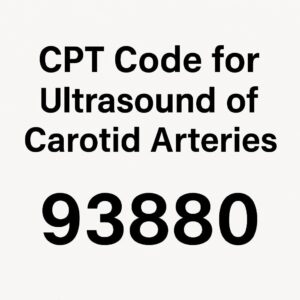
CPT Code for Ultrasound of Carotid Arteries
The Short Answer: Two Main Codes for Carotid Ultrasound
If you need a direct answer, here it is. There is not one single code. There are two, depending on how much of the artery system the doctor needs to examine.
-
CPT 93880: This is the complete bilateral (both sides) study of the extracranial (outside the skull) cerebrovascular arteries. This includes the common carotid, internal carotid, external carotid, and vertebral arteries.
-
CPT 93882: This is a limited or unilateral (one side) study. It is also used when the doctor repeats a study to check a known problem rather than diagnose a new one.
In everyday clinical practice, 93880 is the code you will see most often. It is the standard, complete look at the blood flow from your heart up into your brain.
But let us be very clear: using the wrong code can lead to denied claims or unnecessary patient payments. So, let us dive deeper.
Breaking Down CPT 93880: The Complete Bilateral Study
Think of CPT 93880 as the “gold standard” screening and diagnostic tool for your neck arteries.
What Does “Extracranial” Mean?
The code specifically covers extracranial arteries. This is a fancy way of saying “the parts of the arteries that live outside your skull, inside your neck.” Once the arteries enter the bone of your skull, they become intracranial, and that requires a different test entirely.
What Arteries Are Included in 93880?
When a doctor orders code 93880, the ultrasound technician is required to image the following vessels on both the right and left side of your neck:
-
Common Carotid Artery (CCA): The main pipe running up each side of your neck.
-
Internal Carotid Artery (ICA): The branch that takes blood directly to your brain.
-
External Carotid Artery (ECA): The branch that takes blood to your face and scalp.
-
Vertebral Arteries: These run inside the bones of your spine and supply the back part of your brain (the posterior circulation).
When Is This Code Used?
Your doctor will likely use CPT 93880 in the following scenarios:
-
You have symptoms of a possible stroke or transient ischemic attack (TIA). These include sudden weakness on one side, slurred speech, or vision loss.
-
You have a bruit (an unusual whooshing sound) that the doctor hears through a stethoscope placed on your neck.
-
You have significant risk factors for vascular disease, such as diabetes, high cholesterol, or a history of smoking.
-
You need a baseline study before a major heart surgery, like coronary artery bypass grafting (CABG).
-
You have a known blockage (stenosis) and the doctor needs a detailed follow-up.
Important Note for Readers: If your doctor orders code 93880, expect to be on the exam table for approximately 30 to 45 minutes. The technician will need to take many images and Doppler measurements.
Breaking Down CPT 93882: The Limited or Unilateral Study
Now, let us look at the other code. CPT 93882 is not simply “half the work.” It serves very specific clinical situations.
What Does “Limited” Really Mean?
In medical coding, “limited” does not mean “bad.” It means the scope of the exam is narrower. The technician will not image every single artery mentioned above.
When Is This Code Used?
You will typically see CPT 93882 used in three specific situations:
-
Unilateral Study (One Side Only): Perhaps the patient has a surgical wound on the left side of the neck, or a cast, or a severe burn. The doctor cannot examine the right side. Therefore, they only order a study of the left side. That is 93882.
-
Follow-up to a Known Problem: Let us say a patient has a known 70% blockage in the right internal carotid artery. The doctor does not need to re-examine the healthy left side every time. They just want a quick “limited” look at the known problem side. That is 93882.
-
Technical Restriction: Sometimes, a patient cannot lie flat, or they have a very short neck, or they have a tracheostomy tube blocking the view on one side. The technician can only get images from one side.
A Real-World Example
Imagine a patient, Mary, who had a carotid endarterectomy (surgery to clean out a blocked artery) on her right side six months ago. Her surgeon orders a routine follow-up to ensure the artery has not re-blocked. The surgeon does not need to scan Mary’s left side because it was healthy before and remains asymptomatic. The surgeon orders 93882. This is faster, cheaper, and perfectly appropriate.
Side-by-Side Comparison: 93880 vs. 93882
To make this crystal clear, here is a simple comparison table. Use this as a quick reference.
| Feature | CPT 93880 (Complete Bilateral) | CPT 93882 (Limited/Unilateral) |
|---|---|---|
| Number of Sides | Both sides (right and left) | One side only (or both sides with limited views) |
| Arteries Examined | CCA, ICA, ECA, and Vertebral arteries | Usually 1-2 specific arteries (e.g., just the ICA) |
| Typical Time | 30 to 45 minutes | 15 to 20 minutes |
| Common Reason | Initial diagnosis of stroke symptoms or bruit | Follow-up on a known blockage or post-surgery check |
| Doctor’s Order | “Complete carotid duplex” | “Limited carotid ultrasound, right side only” |
| Relative Value (RVU) | Higher (more work/time) | Lower (less work/time) |
The Critical Role of “Duplex” Scanning
You will often hear doctors say, “I am ordering a carotid duplex.” This is not a separate CPT code. It is a description of the technology used within the codes above.
A “duplex” ultrasound combines two elements:
-
B-mode (Brightness mode): This is the standard black-and-white image that shows the actual structure of the artery wall. It allows the technician to see plaque (fatty deposits) and measure how thick the artery wall has become.
-
Doppler (Color and Spectral): This is the magic part. Doppler uses sound waves to measure the speed and direction of blood flow.
Why Does Doppler Matter for Coding?
The CPT guidelines explicitly require that the study be “duplex.” If the technician only takes black-and-white pictures of the artery without measuring the blood flow speed, it does not qualify as a complete carotid ultrasound (93880). It would be considered a different, lower-level code.
So, when you see cpt code for ultrasound of carotid arteries, know that the “ultrasound” in this context almost always implies duplex technology.
When Other Codes Come Into Play
While 93880 and 93882 are the stars of this article, they do not live alone. You need to be aware of neighboring codes to avoid confusion.
The Transcranial Doppler (93886, 93888, 93890)
These codes are for the intracranial arteries (the ones inside the skull). This is a completely different test.
-
93886: Complete transcranial Doppler study.
-
93888: Limited transcranial Doppler study.
You cannot use 93880 for a transcranial study. The probe is different. The window into the body is different (they have to use the temple, the eye, or the back of the neck). If your doctor is worried about a blood clot inside the brain itself, they will order a transcranial Doppler, not a carotid ultrasound.
The Non-Doppler Carotid Study (93875)
This is an old, rarely used code today. It is for a carotid artery study without Doppler. This is essentially just a B-mode picture. Because it provides no information about blood flow velocity, it is rarely sufficient for diagnosing blockages. Most modern payers will not reimburse for 93875 because it is considered incomplete.
The Aorta and Iliac Arteries (93978)
If the doctor extends the study down into your belly to look at the main abdominal artery (aorta) and the arteries that go to your legs (iliac arteries), that requires a different code (93978). That is an entirely different exam.
How Medical Necessity Determines the Correct Code
Here is a truth that many online guides skip: You cannot simply pick a CPT code. The patient’s symptoms (or lack thereof) determine the code.
Insurance companies use coverage determinations based on medical necessity. If you try to bill a complete 93880 for a patient with no symptoms and no risk factors, the claim will likely be denied.
Medically Necessary Reasons for 93880
| Category | Specific Examples |
|---|---|
| Neurological Symptoms | Dizziness, vertigo, ataxia, transient monocular blindness (amaurosis fugax), hemiparesis, aphasia. |
| Physical Exam Findings | Carotid bruit (audible sound over the neck), asymmetric blood pressure in the arms. |
| High-Risk Conditions | Prior stroke or TIA, known carotid stenosis, bruits, or vascular bruits. |
| Pre-surgical Screening | Prior to coronary artery bypass graft (CABG) or major aortic surgery. |
When an Insurance Company Will Likely Deny a Carotid Ultrasound
-
The patient is completely asymptomatic (no symptoms) and has zero risk factors.
-
The patient had a normal carotid ultrasound 11 months ago, and there has been no change in symptoms. (Insurers often require 12 months between routine scans).
-
The ordering doctor is a general practitioner performing a “routine physical” with no specific indication.
Quote from a billing specialist: “The number one reason we see denied claims for carotid ultrasounds is a lack of specific symptoms in the doctor’s notes. ‘Dizziness’ is not specific enough. ‘Vertigo with left-sided weakness’ is specific.”
Step-by-Step: What Happens During the Exam (CPT 93880)
If you are a patient reading this, you might be nervous. Let us walk through exactly what happens during a complete bilateral carotid ultrasound. This will help you understand why the code takes 45 minutes.
Step 1: Preparation
There is almost no preparation. You can eat normally. You can take your regular medications. However, you should wear a comfortable shirt with an open collar. A turtleneck is a bad idea. You will lie on your back on an exam table.
Step 2: Positioning
The technician will turn your head slightly to one side. They will apply a warm, water-based gel to your neck. This gel helps the sound waves travel from the probe (called a transducer) into your skin.
Step 3: The Right Side Scan
The technician will start on the right side of your neck. They will glide the transducer up and down your neck. You may feel a slight pressure, but it should not be painful.
-
B-mode images: You will see black-and-white images of your artery on a screen. The technician will freeze the image and measure the thickness of the artery wall.
-
Doppler audio: You will hear a “whoosh, whoosh, whoosh” sound. That is the sound of your blood moving. A high-pitched, whistling sound indicates turbulent flow, which suggests a narrowing (stenosis).
Step 4: The Left Side Scan
The technician will then move to the left side of your neck and repeat the entire process.
Step 5: The Vertebral Arteries
The technician will then angle the probe differently to capture the vertebral arteries. These are deeper and smaller, so this takes patience.
Step 6: The Report
The technician does not diagnose. A vascular surgeon or a radiologist will review the images and velocities. They will then write a final report that includes a percentage of stenosis (blockage) if any is found.
-
Normal: 0% to 49% stenosis (often described as “minimal” or “mild” plaque).
-
Moderate: 50% to 69% stenosis.
-
Severe: 70% to 99% stenosis.
-
Occluded: 100% blocked (no blood flow).
Billing and Reimbursement Realities
Let us talk money. This section is for medical billers and curious patients.
The price of a carotid ultrasound varies wildly based on your location, the facility (hospital vs. private clinic), and your insurance contract.
Global Period and Modifiers
Unlike a surgical procedure, the carotid ultrasound codes (93880 and 93882) do not have a global surgical period. They are purely diagnostic. However, you may see modifiers attached.
-
Modifier -26 (Professional Component): This is used when a radiologist reads the images, but the hospital or clinic owns the equipment. The doctor bills for their interpretation.
-
Modifier -TC (Technical Component): This is used when the facility bills only for the use of the machine and the technician’s time.
-
Modifier -59 (Distinct Procedural Service): This is used if the doctor performs a carotid ultrasound and another completely different ultrasound (like a thyroid ultrasound) in the same session. It tells the insurance company, “These are separate, distinct exams.”
Average Reimbursement (Estimate for 2026)
Please note: These are rough estimates for outpatient settings. Actual rates vary by payer (Medicare, Blue Cross, Aetna, etc.).
| Code | Medicare National Average (Facility) | Private Payer Range |
|---|---|---|
| 93880 | $90 – $120 | $150 – $350 |
| 93882 | $60 – $80 | $90 – $200 |
Important: The patient’s responsibility (copay, deductible) depends entirely on their specific insurance plan.
Common Mistakes and How to Avoid Them
Whether you are a coder, a biller, or a doctor, these mistakes happen all the time. Avoid them.
Mistake #1: Billing 93880 for a Unilateral Follow-up
This is the most frequent error. The doctor’s note says, “Follow-up right ICA stent.” The coder bills 93880. The payer denies, saying, “Medical necessity not met for bilateral study.”
Fix: Always bill 93882 for unilateral follow-ups unless the doctor explicitly notes symptoms on the contralateral (other) side.
Mistake #2: Forgetting the Doppler
If the technician only took still images and did not perform spectral Doppler velocity measurements, you cannot bill 93880. You should bill the lesser code 93875 (which will likely not be paid) or not bill at all. Always ensure the report includes peak systolic velocities (PSV) and end-diastolic velocities (EDV).
Mistake #3: Using the Wrong Code for a Post-Endarterectomy Patient
A patient who had surgery to clean out a carotid artery needs a different code than 93880 for follow-up? Actually, no. For the contralateral side (the side not operated on), you can use 93880 if it is a complete study. But for the operated side, many payers prefer a specific code for a postoperative evaluation, though often 93882 is used. Check your local coverage determination (LCD).
A Complete List of Related CPT Codes for Cerebrovascular Imaging
To help you navigate the entire landscape, here is a helpful list of codes that are often discussed alongside the carotid ultrasound.
-
93880: Duplex scan of extracranial arteries; complete bilateral study.
-
93882: Duplex scan of extracranial arteries; limited or unilateral study.
-
93886: Transcranial Doppler; complete study.
-
93888: Transcranial Doppler; limited study.
-
93890: Transcranial Doppler with vasodilator (e.g., acetazolamide) for cerebrovascular reactivity.
-
93892: Transcranial Doppler with emboli detection.
-
93893: Transcranial Doppler with bubble study (for right-to-left shunt detection).
-
93975: Duplex scan of arterial inflow/outflow of extremity or visceral vessels (complete).
-
93976: Duplex scan of arterial inflow/outflow (limited).
-
93978: Duplex scan of abdominal aorta, iliac, or mesenteric arteries (complete).
-
G0389: (Obsolete for most) Ultrasound B-scan and real-time for abdominal aortic aneurysm screening (a Medicare benefit).
How to Document a Carotid Ultrasound Report for Proper Coding
If you are a physician or a mid-level provider writing the order or the report, your documentation determines the code. Here is a checklist.
For a complete bilateral study (93880), your report must state:
-
“Complete bilateral duplex ultrasound of the extracranial cerebrovascular arteries was performed.”
-
“Images were obtained of the bilateral common, internal, external, and vertebral arteries.”
-
“Spectral Doppler analysis was performed, including peak systolic and end-diastolic velocities.”
-
“Findings: Right internal carotid PSV 85 cm/s. Left internal carotid PSV 92 cm/s… etc.”
For a limited/unilateral study (93882), your report must state:
-
“Limited duplex ultrasound of the [Right/Left] extracranial cerebrovascular arteries was performed.”
-
“Due to [patient’s cast / known history / surgical site], only the [specific artery] was evaluated.”
-
“Comparison is made to the prior study from [date].”
Pro Tip: Never use the word “complete” in your report if you are billing 93882. That is a guaranteed denial.
Frequently Asked Questions (FAQ)
Let us answer the most common questions people type into search engines about the CPT code for ultrasound of carotid arteries.
Q1: Is CPT 93880 the same as a “carotid duplex”?
A: Yes. In almost all clinical contexts, when a doctor orders a “carotid duplex,” they are ordering CPT 93880. The word “duplex” simply confirms that both imaging and Doppler flow analysis will be used.
Q2: Can I bill 93880 and 93882 on the same day for the same patient?
A: Generally, no. The 93882 is a subset of 93880. You cannot bill for a limited study and a complete study on the same patient on the same day for the same artery system. If you attempt this, the payer will deny the 93882 as a duplicate.
Q3: What is the difference between 93880 and 93978?
A: 93880 looks at the arteries in your neck (carotids and vertebrals). 93978 looks at the arteries in your abdomen (aorta and iliac). They are completely different anatomical areas and require different patient preparation.
Q4: How often can Medicare pay for a carotid ultrasound (93880)?
A: Medicare typically covers a carotid duplex once every 12 months for asymptomatic patients with known stenosis. For symptomatic patients, there is no strict time limit, but the doctor must document new or worsening symptoms each time.
Q5: What does “bilaterally” mean in coding?
A: “Bilaterally” means both sides of the body. In the case of CPT 93880, it means the right side of the neck and the left side of the neck are both examined. If only one side is examined, you must use 93882.
Q6: Do I need a prior authorization for CPT 93880?
A: Many private insurers do not require prior authorization for a standard carotid duplex. However, Medicare and some HMO plans do require it, especially for non-symptomatic screening. Always check with the specific payer before performing the test.
Q7: Is there a specific CPT code for a carotid artery screening (no symptoms)?
A: There is no specific CPT code for “screening” of carotid arteries. Screening is defined by the reason for the test, not a separate code. You would still use 93880 or 93882, but the diagnosis code (ICD-10) would be for screening (Z13.6). Be warned: Many payers do not cover screening carotid ultrasounds.
Q8: What happens if the doctor only images the common and internal carotid but not the external or vertebral?
A: If the doctor specifically excludes the external and vertebral arteries, it is not a complete study (93880). However, if the technician tries to image them but cannot due to patient anatomy (e.g., deep vertebral arteries), it is still considered a complete study because a good faith effort was made. The report should note the limitation.
Additional Resource for Readers and Professionals
If you need to look up the official, yearly updates to CPT codes, including potential changes to 93880 or 93882, you should always consult the primary source.
Link: American Medical Association (AMA) CPT Code Set
(Note: The AMA is the official owner and publisher of the CPT code set. Always use their resources for definitive answers.)
Practical Advice for Patients: Questions to Ask Your Doctor
Before you leave the office with an order for a carotid ultrasound, ask these three questions. They will save you time and money.
-
“Is this a complete study of both sides of my neck, or just one side?”
-
Why ask: This tells you if you are getting 93880 (longer) or 93882 (shorter).
-
-
“What specific symptoms are you documenting to justify this test?”
-
Why ask: If they say “just routine,” call your insurance company. Many will not pay for “routine.”
-
-
“Do I need a prior authorization?”
-
Why ask: You do not want a surprise bill for $400.
-
The Future of Carotid Ultrasound Coding
As of April 2026, codes 93880 and 93882 remain stable. However, the world of vascular imaging is evolving.
-
Artificial Intelligence (AI): Some new ultrasound machines use AI to automatically measure artery walls. The CPT code does not change, but the documentation might get more precise.
-
Contrast-Enhanced Ultrasound (CEUS): Some patients have difficult-to-scan arteries. A special contrast agent (microbubbles) can be injected into the bloodstream. Currently, this is reported with an add-on code (often 8599 if unlisted, or specific codes like +93881 for contrast in some payers). Always check your local coverage.
-
Value-Based Care: Insurance companies are moving toward paying for outcomes, not just tests. This means they will scrutinize the medical necessity for every 93880 even more closely in the coming years.
Conclusion: Choosing the Right Code for the Right Reason
We have covered a lot of ground. Let us summarize the essential takeaways in three lines.
First, the correct code depends entirely on the scope of the exam: use 93880 for a complete, bilateral look at all the major neck arteries, and 93882 for a limited study or a look at just one side. Second, medical necessity is the true gatekeeper—insurance companies require clear symptoms or high-risk conditions to pay for either code. Third, always pair the technical procedure with accurate documentation and the correct ICD-10 diagnosis code to avoid claim denials and ensure the patient gets the proper vascular assessment.
Final Checklist for Coders and Billers
Before you submit a claim for a carotid ultrasound, run through this checklist.
-
Is the code 93880 or 93882?
-
Does the doctor’s order explicitly state “complete bilateral” or “limited/unilateral”?
-
Does the report include both B-mode images and spectral Doppler velocities?
-
Is there an appropriate ICD-10 code (e.g., I65.21 for occlusion of right carotid artery, R42 for dizziness)?
-
Did you check the payer’s Local Coverage Determination (LCD) for frequency limits?
-
Did you apply Modifier -26 or -TC correctly if billing for professional and technical components separately?
-
Is the patient’s symptom clearly documented in the medical record?
If you answered “yes” to all of these, you are ready to submit your claim with confidence.
Disclaimer: The information in this article is for educational purposes only and does not constitute medical or billing advice. CPT codes are copyright of the American Medical Association. Always consult a certified medical coder or your specific payer guidelines for accurate billing.
Author: Technical Writing Team, Medical Resources Division
Date: APRIL 11, 2026