Medical coding feels like a moving target, especially in the fast-evolving world of orthopedic sports medicine. If you are a surgeon, a coder, a biller, or a practice administrator, you know the anxiety that comes with a new calendar year. The rules shift, the codes get tweaked, and the guidance from payers changes.
For years, coding a Medial Patellofemoral Ligament (MPFL) reconstruction has been a puzzle. You were often forced to use an unlisted code, which almost guaranteed a fight with the insurance company. The good news is that the landscape has matured significantly.
In 2026, we have a much clearer path than we did five years ago. However, “clearer” does not mean “simple.”
This guide serves as your definitive resource. We will explore the specific CPT code you should use in 2026 for a primary MPFL reconstruction. We will dissect the nuanced guidelines, address tricky bundling scenarios, and look at common concomitant procedures like tibial tubercle osteotomy. You will learn how to document correctly to maximize legitimate reimbursement and avoid denials.
Grab a coffee, settle in, and let’s get into the details. This is a long read, but by the end, you will have absolute clarity on the current state of MPFL reconstruction coding.
The Evolution of the MPFL Reconstruction Code: A Brief History
To understand where we are in 2026, you have to appreciate where we came from. The history of this procedure’s coding is a classic American Medical Association (AMA) story of innovation outpacing categorization.
The Dark Ages of the Unlisted Code
For the longest time, no specific CPT code existed for MPFL reconstruction. Surgeons performed the procedure, patients benefited immensely, but the back office suffered. You were forced to report the surgery using CPT 27599 – Unlisted procedure, femur or knee.
Using an unlisted code is the billing equivalent of raising a white flag. You knew the claim would be suspended. You knew you would have to send a mountain of documentation—operative reports, clinical notes, and often a desperate letter comparing your work to a Bankart repair in the shoulder or an ACL reconstruction.
The reviewers often didn’t grasp the procedure. They saw “unlisted,” and their first instinct was denial. Payment, when it came, was arbitrary and often failed to cover the cost of the heavy suture anchors, the allografts, and the extended operative time. This period was frustrating and unsustainable for practices specializing in patellar instability.
The Turning Point: Category I Code 27427
The game changed on January 1, 2020. The AMA, recognizing the widespread adoption of MPFL reconstruction as a standard of care, granted it a dedicated Category I code. This was a massive victory for the orthopedic community.
The new code was CPT 27427: Ligamentous reconstruction (augmentation), knee; extra-articular.
Finally, there was a spot on the fee schedule. You had a Relative Value Unit (RVU) assignment. You had a target for payment. The work RVU, reflecting the intense surgical effort and intraoperative decision-making, was set at a level that finally began to justify the procedure’s complexity.
However, the introduction of 27427 immediately created a new set of coding quandaries. It wasn’t a perfect, airtight solution. The central debate became: Is 27427 a “catch-all” extra-articular knee ligament code, or is it specifically the MPFL code? The answer in 2026 is “yes, with rules.”
The Definitive 2026 Code: CPT 27427
Let’s cut to the chase. In 2026, the primary code you will report for a medial patellofemoral ligament reconstruction is CPT 27427.
This code represents a reconstruction of a static stabilizer outside the joint capsule. For a primary, isolated MPFL reconstruction using an autograft (like a gracilis tendon) or an allograft, your coding line is clear. You list it on your claim form and move on.
But your work doesn’t stop at plugging in five digits. 2026 brings refined National Correct Coding Initiative (NCCI) edits and more specific local coverage determinations (LCDs) from Medicare Administrative Contractors (MACs). These rules dictate what you can and cannot bill alongside 27427.
A Critical Modifier Update for 2026
One of the most impactful shifts in the 2026 regulatory environment is the tightened guidance on the -LT (Left side) and -RT (Right side) modifiers.
While always required by most payers for anatomical identification, the 2026 claims processing system leverages these modifiers to track the “global period” more aggressively. If you perform a staged bilateral reconstruction—say, the left knee in January and the right knee in March—you must ensure the payer does not mistakenly link the second surgery to the first knee’s global period.
2026 Coding Tip: Always append the anatomical modifier immediately after CPT 27427. Do not bury it at the end of a long claim. A clean entry looks like 27427-RT. If your billing system appends the modifier automatically at the line-item level, verify it is mapping to the correct procedure. A modifier placed on a bundled X-ray code will not protect your surgical claim from a global period denial.
Understanding the 2026 NCCI Edits for CPT 27427
The National Correct Coding Initiative (NCCI) edits are your rulebook. In 2026, the Procedure-to-Procedure (PTP) edits for 27427 remain robust. Payers use these edits to prevent “unbundling,” which is the practice of billing separately for components that are considered part of the total package of a larger surgery.
You cannot simply list every single surgical step on the claim form. Here is what the NCCI bundles into CPT 27427 in 2026.
1. Diagnostic Arthroscopy (CPT 29870)
This is the most frequent source of coding errors and denials in MPFL cases. The surgeon almost always starts with a diagnostic scope.
The 2026 Rule: A diagnostic arthroscopy, CPT 29870, is a component of a Column 2 code for CPT 27427. An NCCI edit with a modifier indicator of “1” exists.
What this means for you: You can override this edit with a suitable modifier if the scope is diagnostically necessary and distinct. The modifier you need is -59 (Distinct Procedural Service) or the more specific anatomical modifier -XU (Unusual Non-Overlapping Service).
However, do not misuse this. You cannot append the modifier just because you “looked around.” The documentation must clearly state why the diagnostic scope was more than a standard portal placement and inspection. Was there a loose body removed from the opposite compartment? Was there a meniscal tear identified that was previously unknown? The medical necessity for a distinct examination drives the modifier.
A frequently asked question is: “The surgeon scopes the knee, sees the cartilage, confirms the instability, and then performs the MPFL. Can we bill the scope?” The strict 2026 answer is no. A confirmation of the pre-op diagnosis is part of the global surgical package. The -59 modifier is for a different diagnosis, a different location, or a different patient encounter. Merely staging the cartilage damage before deciding to proceed with the reconstruction does not constitute a distinct service.
2. Open Synovectomy (CPT 27333, 27334, 27335)
Patellar instability often leads to synovial hypertrophy and inflammation. Surgeons may perform a limited synovectomy during the open approach for the MPFL reconstruction.
The 2026 Rule: A synovectomy, major or minor, of the anterior knee performed through the same incision is considered inherent to the ligament reconstruction exposure. The NCCI bundles these codes. A modifier override is generally not supported by MAC guidance this year unless the synovectomy is for a separate disease process (like Pigmented Villonodular Synovitis) and involves a separate compartment or a significantly extended dissection.
3. Lateral Retinacular Release (CPT 27425)
This is a controversial procedure in patellofemoral surgery, and its popularity has waxed and waned. However, some surgeons still perform it in cases of severe lateral tightness.
The 2026 Rule: The NCCI bundles a lateral retinacular release (open, CPT 27425) into the MPFL reconstruction. Because lateral tightness is directly related to the medial deficiency, the payer views the release as an integral part of addressing the patellar tracking disorder. You cannot report it separately. Do not append a modifier.
4. Vastus Medialis Obliquus (VMO) Advancement
Sometimes, the surgeon will advance the VMO muscle as part of the medial reefing or to cover the graft.
The 2026 Rule: This is a crucial coding boundary. A simple VMO advancement or imbrication is bundled into the MPFL reconstruction code. The surgical exposure and medial soft tissue work encompass this service. It is not separately billable.
CPT 27427 Bundling Matrix for 2026
To help you visualize the coding relationships at a glance, refer to the table below. This is your quick reference guide for the clean claim build.
| Concomitant Procedure | CPT Code | 2026 NCCI Status | Modifier Allowed? | Coding Advice |
|---|---|---|---|---|
| Diagnostic Arthroscopy | 29870 | Column 2 (Bundled) | Yes, -59 or -XU | Only if performed for a truly distinct diagnostic need in a separate compartment. High audit risk. |
| Open Lateral Retinacular Release | 27425 | Column 2 (Bundled) | No | Considered a component of the comprehensive patellar realignment. Unbillable. |
| Open Synovectomy (Limited) | 27334 | Column 2 (Bundled) | No | Exposure-related. No separate payment. |
| VMO Advancement/Imbrication | 27420 (Historical) | Inherent Component | No | Included in the work of 27427. Do not report separately. |
| Loose Body Removal (Arthroscopic) | 29874 | Column 2 (Bundled) | Yes, -59 | Only if the loose body is in a different compartment and causes specific symptoms separate from instability. |
| Meniscal Repair (Arthroscopic) | 29882/29883 | Separate Procedure | Yes | Fully distinct procedure. Append appropriate -RT/-LT modifiers. |
The Tibial Tubercle Osteotomy Conundrum
Patellar instability rarely exists in isolation that involves only the ligament. The bony anatomy plays a pivotal role. A high-riding patella (alta) or a significantly lateralized tibial tubercle (TT-TG distance > 20mm) requires a bony procedure. The standard of care for this is a tibial tubercle osteotomy (TTO).
The combination of an MPFL reconstruction and a TTO creates a coding scenario that demands precise documentation and an intimate knowledge of the 2026 NCCI manual.
The Primary Code for TTO
The correct code for an osteotomy of the tibial tubercle with anteromedialization (the most common type for instability, such as the Fulkerson procedure) is CPT 27418 – Anterior tibial tubercleplasty (eg, Maquet type procedure).
Wait, you might think. “Tubercleplasty” sounds cosmetic. It is not. In orthopedic coding, 27418 describes the elevation and medial transfer of the tibial tubercle. The CPT descriptor “anterior” encompasses the anteromedialization concept, as the true Maquet operation is rarely performed in isolation anymore.
The 2026 NCCI Relationship: 27427 and 27418
Here is the critical question: When you perform both 27427 and 27418, do you get paid for both?
The Answer: Yes. In the 2026 code edits, CPT 27427 and CPT 27418 are not bundled together. They remain distinct, separately billable procedures because they address different anatomical structures (soft tissue stabilizer vs. bony alignment) and involve distinct surgical incisions and work.
However, the payer’s logic will scrutinize the medical necessity. You must document:
- The TT-TG distance on advanced imaging (CT or MRI).
- The presence of patella alta (Caton-Deschamps index > 1.3).
- The staged surgical plan: “The soft tissue reconstruction alone is biomechanically insufficient. A TTO is required to correct the vector pull.”
Modifier Application for the Combo
When billing 27427 and 27418 together, you must break the NCCI edit for separate procedures on the same anatomical site. The edit likely carries a modifier indicator of “1,” meaning you can override it with a modifier, but only if the documentation supports it.
The most appropriate modifier to append to the secondary code (usually 27418) is -59 (Distinct Procedural Service) or -XU.
A common 2026 billing line for an MPFL + TTO looks like this:
- Line 1: 27427-RT (Medial Patellofemoral Ligament Reconstruction)
- Line 2: 27418-59-RT (Anterior Tibial Tubercleplasty)
The documentation must reflect that the work of the TTO did not overlap the graft harvest or tunnel drilling for the MPFL in a way that would constitute double-dipping on the exposure.
2026 RVU and Reimbursement Snapshot
Understanding the work value helps you prioritize your documentation efforts. The following table provides a realistic, estimated compensation landscape for 2026. These values reflect Medicare Physician Fee Schedule trends, adjusted for site of service.
| Service | CPT Code | Work RVU (Est. 2026) | Global Period | Site of Service Differential |
|---|---|---|---|---|
| MPFL Reconstruction | 27427 | 16.85 | 90 Days | Hospital Outpatient payments lower than ASC due to site-neutral policies expanding. |
| Tibial Tubercleplasty (TTO) | 27418 | 14.20 | 90 Days | Inpatient-only list removal remains intact for uncomplicated cases; check local MAC. |
| Diagnostic Arthroscopy | 29870 | 5.30 | 0 Days | Bundled; billable only with bulletproof distinct-diagnosis documentation. |
| Chondroplasty (Abrasion) | 29879 | 8.15 | 0 Days | Only separate if a distinct focal lesion in a non-patellofemoral compartment was treated. |
Special Scenario: CPT 27427 vs. CPT 27422
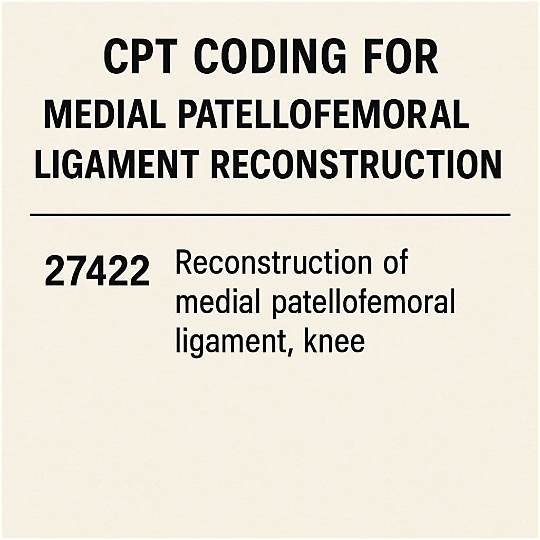
One of the most confusing coding intersections involves proximal realignment procedures. We have 27427 (extra-articular ligament reconstruction), but we also have CPT 27422: Reconstruction of recurrent dislocation of the patella, with extensor realignment.
When do you use 27422 instead of 27427 in 2026? This is a vital distinction that many providers get wrong.
The Nature of the Procedure
CPT 27422 is the code for a proximal “soft tissue” realignment without a formal graft passing through the anatomical MPFL footprint. Think of procedures like the classic Insall proximal realignment, a Roux-Goldthwait procedure, or a vastus medialis advancement performed as the definitive repair for instability. It represents a reefing and imbrication of the medial retinaculum and VMO, altering the pull of the extensor mechanism.
By contrast, CPT 27427 mandates the use of a graft (autograft or allograft) that is fixed to the femur and patella via tunnels or sockets to reconstruct the ligament.
The Surgeon’s Intent
If the operative note says, “The medial tissues were reefed in a pants-over-vest fashion,” you are in 27422 territory. If the note says, “A 4.5mm gracilis graft was passed through a patellar bone tunnel and fixed with an interference screw in a femoral socket,” you are squarely in 27427 territory.
2026 Coding Alert: Some payers are now rejecting 27427 when the op note describes a suture-only technique without tissue augmentation. A primary repair of a torn MPFL, without a graft, is not CPT 27427. A primary repair is coded as 27422 if it involves extensor realignment, or potentially a soft tissue repair code if it is a mid-substance tear repair without imbrication. This scrutiny has intensified in 2026, with several MACs publishing articles differentiating “repair” from “reconstruction.” You must look for the words “tunnel,” “socket,” “interference screw,” “tendon graft,” or “allograft” to solidify the 27427 choice.
Pediatric and Congenital Considerations
Patellar instability often begins in the adolescent skeleton. Coding for this population presents a unique challenge, especially when the surgeon opts for techniques that respect the open distal femoral physis.
The Physeal-Sparing MPFL
There is no unique 2026 CPT code for a physeal-sparing MPFL reconstruction. Whether the surgeon uses a “docking” technique or an adductor sling transfer, the work is still reported with CPT 27427.
The confusion often arises because some surgeons borrow techniques from congenital dislocation repairs. Code 27418 (TTO) is almost never appropriate in a truly skeletally immature patient, as the surgeon is not performing a Fulkerson osteotomy through an open physis. Instead, they may perform a soft tissue realignment, falling back to 27422.
Congenital Dislocation vs. Recurrent Dislocation
If the patient has a congenital, fixed dislocation of the patella, not a recurrent episodic instability, the coding path changes. You would look to CPT 27420 (Reconstruction for dislocation of the patella) which is reserved for the complex congenital or neuromuscular cases requiring extensive quadricepsplasty. This is rare, but using 27427 for a fixed congenital dislocation is incorrect and will likely be downcoded upon review.
Mastering Modifier -59 and -XS
We have touched on the need for a distinct service modifier. Let’s formalize the 2026 standards. The -59 modifier is the most scrutinized modifier in surgical coding. The Office of Inspector General (OIG) investigates its misuse annually. The AMA created the “X{EPSU}” subset to bring more specificity.
For MPFL reconstruction, you will primarily focus on two modifiers.
-XS: Separate Structure
This is your most powerful tool. In an MPFL reconstruction, the medial patellofemoral ligament is the structure. If you scope the knee and perform a partial medial meniscectomy, that is a distinct anatomical structure (meniscus vs. ligament). The supporting documentation naturally separates them. The service was performed on a separate organ or structure.
-XU: Unusual Non-Overlapping Service
This is less common in this context but applicable if you do an extensive posterolateral corner exploration that is not a routine part of the MPFL diagnostic scope. It signals that the work performed was unusual and did not overlap with the typical components of the primary procedure.
Documentation for Success:
The op note body often fails the modifier -59 test. The coders in 2026 are being trained to look for the “separately identifiable” paragraph. You should structure your operative note to include a distinct section titled “Separate Procedure” or “Findings Requiring Additional Intervention.” For example: “Attention was turned to the lateral compartment, which is distinct from the planned medial reconstruction. A distinct, unstable flap tear of the lateral meniscus was identified that is unresponsive to non-operative care. It was resected with a 4.0mm shaver.” This paragraph gives the coder and the auditor the explicit language they need.
The Medial Reefing and Plication Confusion
Language is the coder’s currency, and surgeons often use terms imprecisely. A “medial reefing” or “plication” at the conclusion of an MPFL reconstruction is a prime example of a documentation pitfall.
When you perform a reconstruction with a graft, the stability relies on the graft. The surgeon may tighten the native remnant tissue over the graft to provide a vascularized bed. This additional tightening of the native tissue is a component of the closure and graft security. It is not a separate procedure.
If your operative note states, “Following graft fixation, a pants-over-vest plication of the remaining medial retinaculum was performed,” you have not performed a CPT 27422. You have performed a standard step of a CPT 27427. Do not try to code both. The payer’s automated “unbundling” edits will flag it immediately, and the denial reason will state that 27422 is an integral part of a more comprehensive procedure.
The only time you can potentially bill for both is in the extremely rare case of a failed MPFL reconstruction where you are performing a complete revision reconstruction with a new graft (27427) AND a separate proximal realignment (27422) to address a previously unaddressed rotational abnormality. This would require an exceptionally detailed pre-op plan and distinct operative steps. In 99% of cases, pick the code that describes the main event: the ligament reconstruction.
Graft Harvest: When Is It Separate?
The MPFL graft is often an autograft hamstring tendon. Can you code the harvesting separately? This is a classic coding question that the 2026 NCCI manual answers definitively.
The General Rule: Bundled
The harvesting of a graft is generally considered an inherent part of the reconstruction procedure. You cannot use CPT 20924 (Tendon graft, from a distance) when the harvest is from the ipsilateral knee through a separate incision that is in the same anatomical area. The exposure for a hamstring harvest is contiguous with the knee surgical field.
The Exception: Autograft from a Truly Distant Site
If you perform a revision MPFL and harvest a contralateral hamstring tendon, you have a distinct case. The contralateral leg is a different anatomical site. In this scenario, you may report the graft harvest with CPT 20924 and append the -59 modifier and the appropriate side anatomical modifier (e.g., -LT for the left knee harvest for a right knee reconstruction). The op note must be crystal clear that a separate skin prep and drape of the contralateral knee was performed, and the graft was harvested from this distinct site due to a lack of ipsilateral tissue.
The MAC Landscape: Navigating Regional Differences in 2026
The AMA publishes CPT, but Medicare Administrative Contractors (MACs) interpret the rules. What works in Florida (First Coast) might fail in California (Noridian). In 2026, staying on top of your local MAC’s Local Coverage Article (LCA) is non-negotiable.
Hot-Button Issues by Region
- Noridian: Aggressive on the medical necessity of TTO with MPFL. They have been known to request the raw CT scan measurements for the TT-TG distance. A radiology report simply stating “increased TT-TG distance” is insufficient. The exact millimeter measurement must be part of the surgical decision-making note.
- Novitas: Scrutinizing the use of 29877 (Chondroplasty) at the time of 27427. They are tracking the frequency of “Grade II chondromalacia” debridements and suspect upcoding. If you bill a chondroplasty with an MPFL, the op note must describe a discrete, unstable cartilage flap treated with a mechanical shaver, not just a radiofrequency wand smoothing.
- WPS: Issued a clarification in late 2025 regarding physical therapy services during the global period. Any therapeutic procedure not directly related to the surgical rehabilitation protocol requires the -GY modifier to indicate it’s statutorily excluded, ensuring the beneficiary is liable.
Action Plan for 2026
Assign a team member to review your primary MAC’s website quarterly. The “Latest Updates” section often hides policy retirements or draft LCDs open for comment. Attending the comment period hearings, even virtually, gives your practice a voice before restrictive policies become law.
Anatomy of a Bulletproof 2026 Operative Note
You cannot code what you do not document. In 2026, the complexity of the procedure must be evident not just to a surgeon, but to a lay-auditor using keyword-search software. A dictated note that simply says, “Standard MPFL reconstruction, done,” is a liability.
Here is a structural template for your operative note to maximize specificity and defend the 27427 code.
1. Preoperative Diagnosis Section
- Specify: “Recurrent atraumatic right patellofemoral instability, failed 6 months of guided physiotherapy.”
- Include the advanced imaging findings: “MRI demonstrates a torn, attenuated MPFL at the femoral insertion. TT-TG distance measures 14mm.”
- This immediately establishes medical necessity for a ligament reconstruction, not just a scope.
2. Diagnostic Arthroscopy Findings
- Be explicit about the compartments. “Lateral compartment: Intact meniscus, pristine articular cartilage. No loose bodies.”
- If you plan to bill a separate chondroplasty, this is where the “separate structure” documentation must be vivid. “Medial compartment: An isolated, discrete, grade 3 unstable chondral flap measuring 1.5 x 1.5 cm on the medial femoral condyle. This is unrelated to the patellofemoral pathology.”
3. The Graft Harvest and Preparation
- State the graft type. “A 4.5mm ipsilateral gracilis autograft was harvested through a 3cm incision over the pes anserinus.”
- Measure and report the graft diameter and length. A graft diameter of less than 3mm for an adult female might prompt a peer reviewer to question if this was just a strip of retinaculum.
4. The Reconstruction Specifics
- List the implant manufacturer, size, and lot number in the implant log, but also narrate the technique. “A femoral socket was reamed to 25mm depth with a 6mm reamer. The graft was docked and fixed with a 7mm x 23mm PEEK interference screw.”
- Describe the patellar fixation. “The patella was prepared with two 3.2mm drill holes in the medial half, not violating the anterior cortex. The graft limbs were passed and tied over a bony bridge.”
- State the isometry or tensioning: “The graft was tensioned at 30 degrees of flexion with arthroscopic confirmation of centralized tracking without medial overload.”
The 2026 Role of Imaging in Medical Necessity
Insurance carriers are increasingly leaning on radiologic criteria. The 2026 precertification process for “knee instability surgery” can be a Kafkaesque experience. To get an authorization number for 27427, you must become familiar with the specific parameters that nurses and medical directors at the insurance company are checking off on their screens.
The Must-Have Metrics
- TT-TG Distance: The tibial tubercle to trochlear groove distance. A measurement over 20mm often triggers a requirement for a TTO (27418) for the authorization of the MPFL (27427) to stand. Without the TTO, they may deem the MPFL reconstruction “biomechanically doomed to failure.”
- Caton-Deschamps Index: Patella alta. An index over 1.3 indicates a high-riding patella. If you have this and a normal TT-TG, the payers want to see you address the patellar height. MPFL reconstruction alone does not correct alta.
- Trochlear Dysplasia: The Dejour classification. High-grade dysplasia (Type C or D) is a bony convexity. The insurance medical director may request a peer-to-peer to discuss why you are not performing a trochleoplasty. You must articulate that trochleoplasty has a high complication rate and you plan to offload the trochlea with the TTO and MPFL.
Denial Management and Appeals Strategy
Even with perfect coding, denials happen. The 2026 strategy is not to panic, but to have a tiered fight-back protocol.
The Initial Denial
You claim CPT 27427 and 27418-59. The payer processes and denies 27418 as bundled. The remittance advice remark code is NCCI PTP edit.
Level 1 Appeal: The Redetermination
You write a concise letter. Do not send a novel. The first-level reviewer processes 100 claims an hour. Your letter states:
- “Review of the operative note demonstrates the osteotomy was performed through a separate lateral incision along the anterior tibial crest.”
- “The graft tunnels for 27427 were entirely medial.”
- “The procedure of 27418 addressed the bony malalignment, a distinct anatomical structure from the soft tissue ligament.”
- Attach the key op note page with the distinct anatomical paths highlighted.
Level 2 Appeal: Reconsideration
When the redetermination upholds the denial, you move to the reconsideration. Here, you involve the physician. The surgeon writes a short letter citing the specific 2026 NCCI manual chapter (Orthopaedics: Musculoskeletal System, Chapter 4). Quote the definition of “separate structure.” Quote the 2026 AAOS Global Service Data Guide entry for CPT 27427, which does not list tibial tubercle osteotomy as a component of the code.
Level 3: Administrative Law Judge
For high-dollar claims (a bilateral MPFL/TTO case can exceed $4,000 in physician fees alone), an ALJ hearing is statistically highly likely to win if your documentation is sound. The government’s own data shows a high overturn rate when providers present clear, evidence-based arguments. The key is to have this designated as a separate “line of business” mindset in your practice.
Frequently Mistaken Code Choices: A Guide
The table below summarizes common coding mistakes and provides the corrected action path for 2026, saving you from the most frequent claim rejections.
| Incorrect Code / Combo | Why It’s Wrong | The Correct 2026 Action |
|---|---|---|
| 27427 and 27422 | Reporting the reconstruction AND the reefing. The reefing is inherent to the 27427 closure. | Drop 27422. Report only 27427. |
| 29877 with 27427 (No Modifier) | Chondroplasty of the patella during MPFL surgery is considered part of the patellar work. | If performed on a separate femoral condyle lesion, add -XS modifier. If on the patella, it is bundled; write off the technical component. |
| 27427 for a Primary Repair | Using the reconstruction code for suturing a torn native ligament without a graft. | Use 27422 for a proximal repair or an unlisted code for a mid-substance repair. The AMA has clarified this gap remains. |
| 29874 (Loose Body) without -59 | Simple removal of a loose body found during the routine patellofemoral inspection. | Ensure the loose body was in the posterior medial or lateral compartment and symptomatic. Add -59 with a strong note. |
| 20924 for Ipsilateral Hamstring | Routine graft harvest through a contiguous knee incision. | Deleted from the claim. Do not report. This is the number one source of overpayment demands on audit. |
Navigating Telehealth and Post-Operative Global Care in 2026
The COVID-era telehealth expansions have permanently altered the post-operative care landscape. The MPFL reconstruction carries a 90-day global period. What is billable beyond the bundled post-op visits?
The E-Visit as a Separate Service
In 2026, if a patient sends a portal message that requires your clinical decision-making and it is not a routine post-op follow-up, you may bill an E-visit. However, the key phrase is “not routine.” A message asking, “Is it okay that I bent my knee to 90 degrees today?” is a routine global period question. A message stating, “I fell on my operative knee, it’s now hot and I can’t lift my leg off the bed” initiates a separate, distinct problem. The documentation for a billable E-visit must state, “Provider initiated management of a new, acute complaint distinct from the routine surgical recovery path.”
Staged Bilateral Procedures and Global Periods
If you stage the procedures 8 weeks apart, the second procedure (e.g., Left Knee MPFL) falls within the global period of the first (Right Knee MPFL). The claim for the left knee must be appended with modifier -79 (Unrelated Procedure or Service by the Same Physician During the Postoperative Period). The diagnosis code for the left knee should support that this is a staged procedure addressing a distinct anatomical site, not a complication of the first surgery. Using Z47.1 (Aftercare following joint surgery) on the second claim might lead a claims processor to think it’s a staged revision rather than a primary contralateral case. Use the active diagnosis code M22.0- (Recurrent dislocation of patella) for the second side.
The Role of the Advanced Practice Provider (APP)
More and more MPFL cases are managed surgically by teams where the APP is integral. The coding for APP services remains nuanced.
Shared Visits in the Facility
In 2026, the “substantive portion” rule for shared E/M visits is fully embedded. For a pre-op H&P in the hospital, either the surgeon or the APP can perform the substantive portion and bill under the physician’s NPI if requirements are met. The definition of substantive portion is tied to total time or key components. Your practice must have a clear policy on this to prevent audit clawbacks.
Incident-To Services in the Office
In the office setting, for follow-up care, “incident-to” billing requires direct physician supervision. The surgeon must be in the office suite, immediately available. With the surgical schedule of an orthopedic surgeon, this is often a logistical nightmare. If the surgeon is in the OR and the APP sees a post-op patient for a routine 14-day wound check, this does not satisfy the “incident to” supervision requirement. The service must be billed under the APP’s own NPI at the lower reimbursement rate. Billing this under the surgeon’s NPI when the surgeon is in a different building is a false claim.
Direct Supervision Rules for Physical Therapy and Rehab
The post-op protocol is a make-or-break component for a successful outcome. Clarifying the coding of these services prevents patient frustration over surprise bills.
The “Incident-To” Trap Revisited
Physical therapists in the surgeon’s office must also adhere to the direct supervision requirements for Medicare patients. If the therapist renders a therapeutic activity (CPT 97530), and the surgeon is not in the office, the service cannot be billed as “incident to.” It must be billed on the rehab revenue cycle. This often leads to a higher patient co-pay because the outpatient physical therapy cap and separate deductible rules apply.
The Global Period Kit
You have likely dispensed a “global period kit” which includes the continuous passive motion (CPM) machine, the cold therapy unit, and the hinged knee brace. Since 2016-2017, CPT 27427 is categorized as a code that includes a post-op brace in many MAC jurisdictions. Do not bill for a brace separately using L1832 unless you have a clear, written waiver stating the patient requested a specific upgraded custom brace beyond the standard functional hinged knee brace that is part of the global package. An Advanced Beneficiary Notice (ABN) is mandatory here.
A Practical Table of Key Modifiers for 2026
Using the right modifier is a strategic art. Here is a quick-reference table for the modifiers you will use most frequently with 27427.
| Modifier | Definition | MPFL Application Scenario |
|---|---|---|
| -59 | Distinct Procedural Service | Unbundling the diagnostic scope for an unequivocal separate diagnosis (e.g., lateral meniscus tear). |
| -XS | Separate Structure | A separate structure modifier for a chondroplasty of the medial femoral condyle during an MPFL. |
| -XU | Unusual Non-Overlapping Service | Extensive posterolateral corner dissection for a loose body not reachable via standard portals. |
| -RT / -LT | Right Side / Left Side | Anatomical identification; required on essentially every 27427 claim. |
| -79 | Unrelated Procedure (Global Period) | Staged bilateral primary MPFL reconstruction. The second procedure is staged and distinct. |
| -KX | Medical Necessity Met | An emerging requirement for TTO procedures. Append to 27418 to signal you have the quantitative TT-TG distance on file. |
Combining MPFL with Cartilage Restoration: A Growing Trend
In 2026, the overlap between instability surgery and cartilage restoration has grown substantially. Patients with recurrent dislocations often have traumatic chondral injuries.
Matrix-Induced Autologous Chondrocyte Implantation (MACI)
MACI (CPT 27412) is a staged procedure. However, you often perform a biopsy at the time of the MPFL if you anticipate a future need. The biopsy code 29870 is bundled as we know. The MACI implantation is separate.
- If you perform MPFL and MACI implantation in the same setting, they are not bundled by NCCI.
- You must document the lesions as discrete. The patellar lesion (for MACI) vs. the MPFL graft (for stability).
- Both typically require approval from the insurance carrier’s musculoskeletal program, and 2026 has seen stricter requirements for pre-authorization overlap.
Osteochondral Allograft (OCA) Transplantation
Transplanting a bulk osteochondral allograft (CPT 27415) at the time of an MPFL reconstruction is a massive surgical undertaking. The 2026 coding principle is identical to the TTO scenario: are they distinct structures? Yes. The bone is separate from the ligament. You report 27427 and 27415 with modifier -59. The op note must clearly delineate the exposure. If you are already doing a large lateral arthrotomy for the OCA, the medial soft tissue work for the MPFL might be difficult to see as a separate exposure. You must detail that the OCA required a lateral parapatellar arthrotomy, while the MPFL was reconstructed through a distinct, standard medial approach.
The “Trochleoplasty” Factor
Trochlear dysplasia is the final frontier. A sulcus-deepening trochleoplasty addresses the root cause of instability for severe Dejour Type D morphology. The procedure is technically demanding and has a significant complication profile.
In 2026, there remains no specific CPT code for trochleoplasty. This is a critical void. You must still use the unlisted code CPT 27599.
How to Value an Unlisted Trochleoplasty
When you perform a trochleoplasty with an MPFL, you report 27427 for the ligament, and 27599 for the trochleoplasty. The claim is guaranteed to be manually reviewed. Your cover letter for the 27599 code must be a masterpiece of comparative analysis.
Do not just say, “This is like an osteotomy.” Compare it specifically to the work of an ACL reconstruction (29888) combined with a TTO (27418). The work of detaching the trochlear cartilage, burring the subchondral bone, and fixing the cartilage shell is far beyond a simple knee scope. Include the op note and an estimate of the work RVU based on internal practice cost accounting. Ask for a value equivalent to 20.0 RVUs for the unlisted code. The key in 2026 is providing comparative codes that the medical director understands. Do not compare it to a hip impingement surgery; compare it to a complex knee reconstruction.
ICD-10-CM Diagnostic Coding for 2026
Your CPT code may be perfect, but the claim will die without a precise, linked ICD-10-CM code. The 2026 code set still uses the M22 series for patellofemoral disorders.
The Gold Standard Codes
- M22.01 – Recurrent dislocation of patella, right knee
- M22.02 – Recurrent dislocation of patella, left knee
- M22.11 – Recurrent subluxation of patella, right knee
- M22.12 – Recurrent subluxation of patella, left knee
Distinguishing between “dislocation” and “subluxation” is a clinical distinction. Dislocation implies a complete loss of contact between the patella and trochlea. Subluxation is a partial lateral translation with spontaneous reduction. Use the specific term. For an MPFL reconstruction, the diagnosis of “recurrent dislocation” (M22.01/M22.02) is the strongest support for medical necessity.
Secondary Codes
Do not forget the secondary diagnoses that justify the concomitant procedures.
- M22.2X – Patellofemoral disorders (Use for chondral damage, documented as patellofemoral chondrosis).
- M23.2 – Derangement of meniscus due to old tear or injury (Use for the bucket-handle tear you fix).
- S83. – Sprain and strain of knee and leg (Acute injury codes, rarely appropriate for a truly recurrent chronic MPFL case, but useful for an acute traumatic rupture).
The 2026 Audit Landscape: What the Watchdogs Are Watching
The Office of Inspector General (OIG) and the Recovery Audit Contractors (RACs) have refined their algorithms. They are not doing random audits; they are doing data-driven sweeps.
The High-Risk Audit Triggers for MPFL in 2026
- Clustering: A surgeon whose every MPFL reconstruction is billed with a -59 modifier for a scope, a TTO, and a chondroplasty. The RAC flags this as an “outlier utilization pattern.”
- The Absent TTO: A surgeon repeatedly billing 27427 but never billing 27418. The RAC might not deny the claim, but they might ask for the charts to ensure the surgeon is not incorrectly using 27427 for a simple medial imbrication (which should be 27422).
- Facility vs. Professional Fee Discrepancy: The hospital bills for an implant used only in an arthroscopic procedure, but the surgeon bills for an open reconstruction. The data mismatch triggers an automatic query to both the facility and the professional claim databases.
Advanced Coding: Conversion from a Failed Repair
You are seeing more of this: a young patient had a primary MPFL repair (coded 27422) a few years ago. It failed. Now they need a revision reconstruction.
The 2026 coding for a revision MPFL reconstruction is still CPT 27427. There is no specific “revision” CPT add-on code for this ligament. This creates a significant undervaluation risk, as a revision is profoundly more difficult. The tunnels are malpositioned. There might be broken hardware. The graft options are scarce.
The Case for Modifier -22
Modifier -22 (Increased Procedural Services) is your sole mechanism to capture the extra work of a revision in 2026. The criteria are strict. The work must be substantially greater than typically required.
You must state this explicitly: “Due to the extensive scarring from the prior failed surgery, the identification and mobilization of the native tissue required an additional 45 minutes of surgical time.” You need to quantitate the increased work. “Removal of a malpositioned prior femoral interference screw required an extensive bone graft of the femoral socket.” When you submit a claim with -22, you send the op note and a cover letter requesting a specific additional percentage of payment (e.g., “We are requesting a 30% increase in the allowable for the substantial additional work documented”).
Telemedicine and Virtual Pre-Op Clearance
The pre-operative visit is part of the global package, but many surgeons struggle with when a distinct E/M service is billable.
The 2026 Medicare rule clarifies that if a patient is sent to you for a knee that “gives out,” and you order an MRI and diagnose the MPFL tear, that initial visit is a billable E/M (New Patient, 99204 typically). The decision for surgery happens during that visit.
However, if you do a virtual check-in a few days before the scheduled surgery to “re-answer questions,” this is a bundled global period service. Do not bill a telehealth visit. The only exception is a significant change in the patient’s condition requiring a separate medical decision-making process, such as a new skin infection at the planned surgical site requiring antibiotics and a potential delay.
DME and Bracing Updates for 2026
The Durable Medical Equipment Medicare Administrative Contractors (DME MACs) have updated the Standard Written Order (SWO) rules again.
When prescribing the post-op ROM brace, the SWO must include the beneficiary’s name, the item of DME ordered (L1832), the ordering practitioner’s National Provider Identifier (NPI), the signature of the ordering practitioner, and the date of the order. The date of the order must be on or before the delivery date. A major audit risk in 2026 is a SWO signed by the surgeon 3 days after the surgery date because the hospital staff “found the form late.” The supplier will deny the claim, and the patient will receive a large bill. Your office must have a protocol that the brace order is part of the surgery booking packet, not the post-op floor orders.
A Deeper Look at the Data: MPFL in the ASC vs. Hospital
The migration of MPFL reconstruction to the Ambulatory Surgery Center (ASC) is accelerating. The 2026 CMS reimbursement tables favor the shift.
The Financial Coding Implication
The ASC payment is based on a percentage of the Hospital Outpatient Prospective Payment System (OPPS). For 2026, CPT 27427 remains on the ASC Covered Procedures List (CPL). However, adding a TTO (27418) can complicate the ASC claim. Some commercial payers still consider an osteotomy an “inpatient-only” procedure. You must verify your state’s ASC-approved list before scheduling a combo MPFL/TTO in an outpatient center. If the payer denies the place of service for 27418, the entire claim, including 27427, can be caught in a lengthy appeal process.
Integrating the Clinical Note with the Coding Query
You are implementing a new electronic health record (EHR) template in 2026. Why not build the coding logic into the template?
Create a coding companion checklist:
- Does the op note mention a “graft” and “tunnel”? (Validates 27427 vs. 27422)
- If a TTO was done, is the quantitative TT-TG distance in the indication section? (Validates 27418)
- If a -59 modifier is needed, does the op note have a dedicated “Separate Procedure” paragraph? (Validates separate services)
- If a graft was harvested from the contralateral leg, is the contralateral prep specifically mentioned? (Validates 20924)
By embedding these checks, you transform coding from a reactive clerical function into a prospective, physician-driven accuracy initiative. You create a culture of documentation integrity.
The Convergence of Robotics and Navigation in 2026
While still in its infancy for soft tissue knee surgery, robotic-assisted navigation is entering the MPFL arena for tunnel placement. If you use a robotic system that provides a 3D model and haptic guidance for femoral socket placement, what code do you use?
In 2026, there is no distinct CPT code for robotic-assisted MPFL reconstruction. The primary procedure remains 27427. The use of the robot is considered a surgical tool, similar to an arthroscopic shaver or a radiofrequency wand. You cannot bill separately for the robotic disposable or the navigation software.
Some practices have tried using an unlisted code (27599) with a -52 modifier to capture the additional cost. This is a high-risk billing practice. Most payers have specific policies stating that robotic guidance is inherent to the procedure and not separately billable unless a specific Category III code exists. For the knee, outside of partial and total knee arthroplasty, no such soft tissue tracking code exists. Your reimbursement for the technology must come from your institutional negotiation with the payers via a higher direct cost reimbursement for the case, not a phantom code.
The Psychology of the Auditor: How to Win an Appeal
An appeal letter is not a clinical journal article. It is a persuasive business document aimed at a medical reviewer who may be a retired family physician. Your letter must educate quickly.
The Three-Paragraph Appeal Structure
- Paragraph 1 – The Summary: “This is an appeal for the denial of CPT 27418, billed with CPT 27427. The denial was based on a PTP edit, but the services addressed separate anatomical structures.”
- Paragraph 2 – The Anatomical Separation: Speak in plain English. “The MPFL procedure (27427) is a soft tissue reconstruction on the medial side of the knee. The Fulkerson osteotomy (27418) is a bony realignment procedure performed through a separate incision on the front of the shin bone. The surgeon did not correct the bony alignment through the MPFL incision.”
- Paragraph 3 – The Resolution Demand: “We have enclosed the fee schedule support and the redacted operative note. The distinct pathology justifies separate payment. We respectfully request a reopening and reprocessing with payment for line 2.”
Keep your tone professional, not antagonistic. A well-reasoned, concise appeal has a high probability of success because the reviewer needs clear, concise justification to overturn the denial and move to the next file.
Looking to the Future: A Potential Category I MPFL-Specific Code
The coding community is vocal about the limitations of 27427. It is an “extra-articular” code, but it doesn’t describe the specific patellar tunnels, the unique graft choices, or the complications of a revision.
The AMA’s Relative Value Scale Update Committee (RUC) often surveys specialty societies to gauge the need for new codes. The American Academy of Orthopaedic Surgeons (AAOS) is aware of the revision MPFL undervaluation and the trochleoplasty gap. A new code set that might drop in the late 2020s could be:
- 274X1 – Medial patellofemoral ligament reconstruction, primary
- 274X2 – Medial patellofemoral ligament reconstruction, revision
- 275X1 – Trochleoplasty, sulcus deepening
Until then, we master the tools we have: 27427 with precise modifier application and impeccable documentation.
Summary and Conclusion
The 2026 coding landscape for medial patellofemoral ligament reconstruction is built around CPT 27427, a powerful but nuanced code. Success hinges on understanding the strict NCCI edits that bundle diagnostic arthroscopy and lateral release, and knowing exactly when to use the -59 or -XS modifier to unlock legitimate reimbursement for distinct procedures. For the complex case involving bony malalignment, the correct pairing of 27427 with a tibial tubercle osteotomy (27418) remains separately billable, provided your documentation clearly proves the medical necessity of both and the distinct anatomical dissection planes. As the regulatory environment tightens, a bulletproof operative note and a thorough understanding of your specific MAC’s 2026 policies are your best defense against denials and audit risk.
Frequently Asked Questions (FAQ)
What is the primary CPT code for MPFL reconstruction in 2026?
The primary code is CPT 27427. This represents an extra-articular ligamentous reconstruction of the knee and is the industry standard for this procedure.
Can I bill CPT 27427 for a primary repair of the MPFL without a graft?
No. CPT 27427 describes a reconstruction using a tissue graft. A primary repair of the native ligament is more accurately coded as CPT 27422 (if it involves extensor realignment) or a separate soft tissue repair code. Using 27427 for a simple repair is a common coding error that will lead to a denial or a downcode.
Does the diagnostic arthroscopy get paid separately with the MPFL?
Usually, no. The diagnostic scope (29870) is a bundled component of 27427. You can only bill it separately if you perform a truly distinct procedure, such as a meniscus repair in a separate compartment for a distinct traumatic tear. You must append a -59 or -XS modifier and have extensive documentation to support this.
Is a tibial tubercle osteotomy (TTO) bundled into the MPFL reconstruction code?
No. The TTO (CPT 27418) is not bundled with 27427 in the 2026 NCCI edits. However, you must append a -59 modifier to 27418 and provide clear documentation that the TTO was a distinct procedure addressing bony malalignment through a separate surgical exposure.
How do I code a physeal-sparing MPFL in a child?
You still use CPT 27427. There is currently no specific code for a physeal-sparing technique. The code describes the reconstruction work regardless of the maturity of the bone, provided a graft is used.
What if I perform a lateral release at the same time? Is that billable?
No. An open lateral retinacular release (CPT 27425) is considered an integral part of the comprehensive patellofemoral realignment. The NCCI edits bundle it into 27427, and a modifier override is not supported in the current 2026 guidance.
What is the correct modifier for a staged bilateral MPFL reconstruction?
For the second procedure, which falls within the 90-day global period of the first, you must append modifier -79 (Unrelated Procedure or Service) to the CPT 27427 claim for the second side. You must also use the correct anatomical modifiers (-LT and -RT) and link the active dislocation diagnosis code, not an aftercare code.
Additional Resources: Official 2026 Coding Guidelines
Staying current requires direct access to the source documents. Use the link below to access the official CMS physician fee schedule and NCCI edit look-up tool. You can enter the CPT code 27427 to view the exact Procedure-to-Procedure edits active for the current quarter.
Resource Link:
Centers for Medicare & Medicaid Services – NCCI PTP Edits Lookup