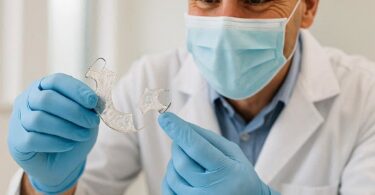
If you have ever needed to replace a few missing teeth right after extraction, you might have heard the term “immediate partial denture.” But when you look at a dental insurance claim form, finding the right code can feel like solving a puzzle.
You are not alone.
Many patients and even dental office staff get confused about the difference between a standard partial denture and an immediate one. The good news is that the American Dental Association (ADA) has specific Current Dental Terminology (CDT) codes for exactly this situation.
In this guide, we will walk you through everything you need to know about the dental code for immediate partial dentures. We will keep things simple, clear, and practical.

What Is an Immediate Partial Denture?
Before we talk about codes, let us make sure we understand what this device actually is.
An immediate partial denture is a removable dental appliance that is placed right after your natural teeth are extracted. Unlike a traditional partial denture, which requires you to wait weeks for your gums to heal, an immediate denture is prepared in advance.
Think of it this way: Your dentist takes impressions of your mouth while your natural teeth are still in place. The lab then builds the partial denture around models of those teeth. On the day of your extraction, the dentist removes the problematic teeth and seats the partial denture immediately.
Why Do Patients Choose This Option?
- No time without teeth: You never have to leave the dental office without teeth in that area.
- Protects healing gums: The denture acts like a bandage to control bleeding and protect the extraction sites.
- Maintains jaw alignment: It prevents your remaining teeth from shifting into the empty spaces.
- Supports facial muscles: This helps maintain your natural smile contour during healing.
A Note on Realistic Expectations
Immediate partial dentures are temporary by nature. Your gums and bone will shrink as they heal. Within six to twelve months, you will likely need a permanent partial denture or a reline of the immediate one. This is completely normal.
The Main Dental Codes for Immediate Partial Dentures
Now, let us answer the core question.
There is no single “one-size-fits-all” code. The ADA CDT manual provides two primary codes for immediate removable partial dentures.
They are:
| CDT Code | Official Description | What It Covers |
|---|---|---|
| D5820 | Interim partial denture (maxillary) – upper jaw | A temporary partial denture for the upper arch, often used immediately after extractions. |
| D5821 | Interim partial denture (mandibular) – lower jaw | A temporary partial denture for the lower arch, used immediately after extractions. |
Wait – why do these codes say “interim” instead of “immediate”?
That is an excellent question. The ADA officially uses the term interim partial denture for any temporary prosthetic that serves a short-term purpose. In everyday clinical practice, when a partial denture is placed on the same day as extractions, it falls under these interim codes.
The Difference Between D5820 and D5821
The distinction is simple: it is based on the jaw.
- D5820 is for the upper (maxillary) partial denture.
- D5821 is for the lower (mandibular) partial denture.
If a patient needs an immediate partial on both the top and bottom arches, you would bill both codes on separate claim lines.
What About Code D5225 or D5226?
You might see codes like D5225 (partial denture – flexible base) or D5211 (maxillary partial denture – resin base). These are permanent codes.
Do not use them for an immediate denture placed on the day of extractions. Using a permanent code for a temporary case is a fast track to a denied claim. Insurance companies expect the interim codes (D5820 or D5821) for immediate placement following extractions.
When to Bill an Immediate Partial Denture Code
Timing is everything in dental billing. The code you choose depends on when the denture is inserted relative to the extractions.
Scenario A: Same-Day Placement
Your dentist extracts teeth in the morning and places the partial denture in the afternoon. This is the classic “immediate partial denture.”
Correct code: D5820 or D5821
Scenario B: Placement After Healing (Standard)
Your dentist extracts teeth. You wait four to six weeks for complete healing. Then, your dentist takes new impressions and makes a partial denture.
Correct code: D5211 (upper) or D5212 (lower) – permanent partial denture
Scenario C: Extraction and Delayed Immediate Placement
Sometimes, a dentist extracts teeth but places the partial denture one to two weeks later. This is less common, but it still qualifies as interim. The healing is not complete, and the denture remains temporary.
Correct code: D5820 or D5821
Important Note for Readers: If your dentist tells you they are billing an immediate partial denture under a permanent code, ask why. This can lead to higher out-of-pocket costs for you if your insurance expects the interim code.
Breaking Down the Components of the Billing Process
Let us look at what actually happens when your dental office submits a claim for an immediate partial denture.
1. The Treatment Plan
Your dentist will create a written treatment plan that includes:
- The teeth to be extracted
- The fact that the partial will be placed immediately after extraction
- The expected duration of use (usually up to 12 months)
2. The Laboratory Fee
The lab creates the immediate partial denture before extraction day. Your dentist pays this fee upfront. Most offices pass this cost to the patient, either partially or fully, depending on insurance coverage.
3. The Procedure Codes on the Claim Form
A complete claim for an immediate partial denture often includes multiple codes on the same day. For example:
| Code | Description | Notes |
|---|---|---|
| D7140 | Extraction, single tooth | Repeat for each tooth extracted |
| D5820 | Interim partial denture – upper | Placed same day |
| D9910 | Application of desensitizing agent | Optional |
4. The Narrative (Written Explanation)
Many insurance companies require a brief narrative. A simple sentence like “Immediate interim partial denture placed following extraction of teeth #7, #8, #9, #10” can prevent denials.
How Insurance Handles Immediate Partial Dentures
Let us be honest: insurance coverage for interim dentures varies widely.
Some plans cover immediate partial dentures exactly like permanent ones. Others treat them as temporary appliances with limited benefits. A few plans exclude them entirely.
Typical Coverage Patterns
- PPO Plans: Often cover 50% to 80% of the cost for D5820/D5821 after the deductible.
- HMO/DHMO Plans: May require a small copay, often between $50 and $200 per arch.
- Medicaid (by state): Some states cover interim partials for adults, but many do not. Children’s Medicaid often covers them if medically necessary.
- Dental Discount Plans: You pay a negotiated fee, usually 20% to 40% less than the office’s regular fee.
What Affects Your Coverage?
- The “Missing Tooth Clause” – Some plans do not cover any denture to replace a tooth that was missing before the policy started.
- Frequency Limits – Most plans cover a partial denture (interim or permanent) only once every five to ten years.
- Extraction Necessity – The plan may require proof that the extracted teeth could not be saved.
Reader Tip: Call your insurance company before treatment. Ask specifically: “Do you cover CDT codes D5820 and D5821 for immediate partial dentures placed on the same day as extractions?” Write down the representative’s name and the date.
Average Costs for Immediate Partial Dentures (Without Insurance)
If you are paying out of pocket, knowing the price range helps you plan.
| Type of Immediate Partial | Average Cost (per arch) |
|---|---|
| Acrylic (standard, temporary) | $300 – $800 |
| Flexible acrylic (more comfortable) | $600 – $1,200 |
| Cast metal framework (rare for immediate) | $900 – $1,800 |
These prices usually include:
- Initial impressions
- Jaw relation records
- Laboratory fabrication
- Placement appointment
- One post-insertion adjustment (usually within one week)
These prices usually do not include:
- Extractions (D7140, D7210) – typically $75 to $300 per tooth
- Relines or rebases (D5750, D5751) – typically $200 to $500
- Permanent partial denture after healing
Common Billing Mistakes to Avoid
Even experienced dental offices make errors with immediate partial denture codes. Here are the most frequent problems.
Mistake #1: Using D5211 Instead of D5820
This is the most common error. D5211 is for a definitive (permanent) partial denture. If you use it for an immediate partial, the insurance company may:
- Deny the claim as “not a covered benefit”
- Pay a lower amount than expected
- Ask for pre-treatment x-rays showing healed ridges (which you do not have yet)
Mistake #2: Billing Extraction and Denture on Different Dates
If you bill extractions on Monday and the denture on Tuesday, you lose the “immediate” status. The denture is no longer immediate. It becomes a delayed interim denture. Some payers will downgrade the code to a permanent code, which may have different coverage rules.
Mistake #3: Forgetting the “Same Day” Modifier
While the CDT manual does not have a specific “immediate” modifier, many insurance companies expect a note in box 35 of the ADA claim form. Write: “Placed immediately following extraction – interim code appropriate.”
Mistake #4: Not Including Tooth Numbers
Always list the teeth that were extracted and replaced by the partial. If you extracted teeth #20, #21, and #22, state that clearly. Without tooth numbers, the insurer does not know if the denture is actually necessary.
Step-by-Step: What to Expect as a Patient
If your dentist has recommended an immediate partial denture, here is how the process usually goes.
Step 1: Consultation and Impressions (Appointment 1)
Your dentist examines your mouth, takes x-rays, and decides which teeth must come out. They take an impression (mold) of your upper and lower teeth. This impression goes to a dental lab.
Step 2: Lab Fabrication (1 to 3 weeks)
The lab creates your immediate partial denture using the impression. They do not have your extracted teeth yet, so they work from models that show your current teeth. The lab technician removes the “problem teeth” from the stone model and builds the partial around the remaining teeth.
Step 3: Extraction and Placement (Appointment 2 – The Big Day)
Your dentist numbs your mouth. They extract the agreed-upon teeth. Then, without you leaving the chair, they seat the immediate partial denture. They will check your bite and make minor adjustments. You leave the office with your new partial in place.
Step 4: First Follow-Up (24 to 48 hours later)
You return so your dentist can check for sore spots. The gums will be swollen at first, but as swelling goes down, the denture may feel loose. This is normal. Your dentist may add a soft liner (tissue conditioner) to improve the fit.
Step 5: Healing and Reline (3 to 6 months later)
Your gums and bone shrink significantly during healing. At this point, your immediate partial will likely be very loose. Your dentist will either:
- Perform a hard reline (D5750 or D5751) to refit the same denture, or
- Recommend a new permanent partial denture (D5211/D5212)
Comparison Table: Immediate vs. Traditional Partial Denture
This table helps you see the differences at a glance.
| Feature | Immediate Partial (D5820/D5821) | Traditional Partial (D5211/D5212) |
|---|---|---|
| When placed | Same day as extraction | 4-12 weeks after healing |
| Duration of use | Temporary (6-12 months) | Permanent (5+ years) |
| Need for impressions | Before extractions | After healing |
| Healing period without teeth | None | Yes (weeks with a gap) |
| Typical material | Acrylic | Metal framework or flexible resin |
| Adjustments needed | Frequent (due to bone shrinkage) | Minimal after initial fitting |
| Insurance frequency limit | Often counts toward permanent benefit | Once every 5-10 years |
| Average cost (no insurance) | $300 – $1,200 | $800 – $2,500 |
Frequently Asked Questions (FAQ)
1. Can I eat normally with an immediate partial denture?
Not right away. Stick to soft foods for the first week. Avoid sticky, hard, or crunchy foods for at least one month. Your gums need time to heal. As healing progresses, you can slowly add more foods back into your diet.
2. How long does an immediate partial denture last?
As a temporary device, expect six to twelve months of use. After that, your jawbone will have changed so much that the denture will no longer fit well. At that point, you need either a reline or a new permanent partial denture.
3. Will my insurance cover the reline of my immediate partial?
Many plans cover a hard reline (D5750 for upper, D5751 for lower) once per denture. However, some plans consider relines as part of the original denture benefit. Check your specific policy.
4. What happens if I lose my immediate partial denture?
Call your dentist immediately. Do not wait. If you lose it within the first few weeks of healing, your gums may shift, and a replacement may not fit. Most offices will make a replacement at your expense since insurance rarely covers lost appliances.
5. Is an immediate partial denture painful?
You will feel soreness from the extractions, not necessarily from the denture itself. The denture actually helps reduce pain by protecting the extraction sites. Most patients describe the experience as “uncomfortable but manageable” with over-the-counter pain relievers.
6. Can I sleep with my immediate partial denture in?
Your dentist will likely tell you to wear it for the first 24 to 48 hours continuously, even while sleeping. This helps control swelling and bleeding. After the first two days, you should remove it at night to let your gums rest.
7. Do I need a separate code for each tooth replaced?
No. The code D5820 or D5821 covers the entire partial denture for one arch, regardless of how many teeth it replaces. You do not bill per tooth.
8. What is the difference between an immediate partial and a flipper?
They are essentially the same thing. “Flipper” is a slang term for a very simple, small acrylic immediate partial that replaces one to three front teeth. In coding terms, a flipper still uses D5820 or D5821.
Tips for Dental Office Staff (Billing and Coding)
If you work at the front desk or in billing, these tips will save you time and headaches.
Always Pre-Authorize
For immediate partials, always send a pretreatment estimate (pre-authorization) to the insurance company. Write clearly on the form: “Interim partial placed immediately post-extraction – no healed ridge.” This prevents nasty surprises.
Keep Excellent Photographs
Take photos of the patient’s mouth before extractions, immediately after extractions (with the denture in place), and at follow-up visits. Insurance auditors love to deny claims without visual evidence.
Document the Medical Necessity
In your narrative, include:
- Why the natural teeth could not be saved (e.g., “severe decay,” “fracture below gumline”)
- Why an immediate replacement is necessary (e.g., “patient work requires public interaction,” “prevention of adjacent tooth drift”)
- That the patient understands this is a temporary appliance
Use the Correct Tooth Numbering System
In the US, use the Universal numbering system (1-32). For international claims, use FDI (two-digit) system. Never mix systems on the same claim.
Additional Resources
For the most up-to-date and official information on dental coding, always refer to the ADA CDT Code Book. You can purchase the current version directly from the American Dental Association.
👉 Link: ADA CDT Code Book Official Page (Open in a new tab)
This resource provides the exact wording, guidelines, and official decisions for every dental procedure code, including interim partial dentures.
Conclusion
Let us wrap this up in three simple lines.
First: The correct dental codes for an immediate partial denture are D5820 (upper jaw) and D5821 (lower jaw), officially called “interim partial dentures.”
Second: These codes are specifically for temporary appliances placed on the same day as tooth extractions, not for permanent partials made after healing.
Third: Always verify coverage with your insurance provider before treatment, and make sure your dentist documents the “immediate” nature of the procedure to avoid claim denials.
Understanding these codes saves you money, time, and frustration. Now you are ready to talk confidently with your dentist and your insurance company.
Author: Dental Billing Specialist Team
Date: APRIL 21, 2026
Disclaimer: This article is for informational purposes only and does not constitute legal or medical advice. Dental coding varies by payer and region. Always verify codes with your specific insurance provider.