If you have been told you need to have bony growths in your mouth removed, you are likely navigating a world of unfamiliar terms, surgical procedures, and confusing paperwork. One of the first hurdles people face is understanding the billing side of things. What exactly is the right dental code for mandibular tori removal? And why does it seem like there is more than one?
The truth is, that dental surgery billing can feel like a maze. You might be sitting in the consultation chair, hearing words like “alveoloplasty” and “exostosis,” while trying to figure out how your insurance fits into the picture. You are not alone. Most patients find this part just as stressful as the surgery itself.
The goal of this guide is to demystify everything. We will walk you through the specific codes used by oral surgeons and dentists, explain why choosing the correct code matters for your wallet, and help you understand exactly what you are paying for. By the end of this article, you will feel confident walking into your appointment, armed with the knowledge to ask the right questions and verify your billing.
Let’s start by understanding what mandibular tori actually are.
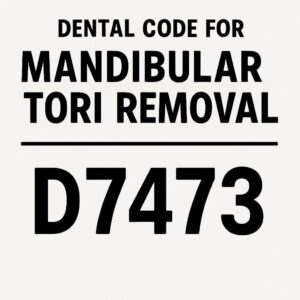
Dental Code for Mandibular Tori Removal
What Are Mandibular Tori?
Before we dive into the numbers and codes, it helps to understand the “what” and the “why.” Mandibular tori (the singular is “torus”) are bony growths that form on the lower jaw, typically on the tongue-side of your teeth, just above the mylohyoid muscle. They are usually symmetrical, meaning if you have one on the left side, you likely have a matching one on the right.
These growths are not cancerous. In fact, they are completely benign. They grow very slowly, often over many years. For many people, they are small and cause no issues at all. However, for others, they can grow large enough to interfere with daily life.
Why Do They Form?
Dentists and researchers are not 100% certain why tori form, but there are a few leading theories. Genetics play a huge role. If your parents had tori, there is a high chance you will develop them too. Bruxism, or teeth grinding, is another major factor. The constant pressure and stress on the jawbone can stimulate bone growth over time.
Diet and environmental factors can also contribute. Some studies suggest that a diet rich in calcium or certain ocean fish might correlate with higher rates of tori, though this is still being studied.
When Do They Need to Be Removed?
Here is the most important takeaway: not everyone needs to have their tori removed. If they are small and asymptomatic, most dentists will recommend leaving them alone. Surgery is only necessary when they start causing problems.
The most common reason for removal is the need for dentures. If you are transitioning to full or partial dentures, the tori will prevent the denture from seating properly. A denture that rocks back and forth over a bony growth is painful and functionally useless.
Other reasons for removal include:
-
Interference with speech: Large tori can make it hard to pronounce certain sounds.
-
Chronic ulceration: The thin gum tissue over the tori can easily tear or ulcerate when eating hard foods.
-
Difficulty eating: If the growths are so large that they touch each other in the middle of the mouth, they can trap food and make chewing difficult.
-
Interference with orthodontics: Sometimes, braces or aligners require the removal of tori to allow for proper tooth movement.
If you are facing surgery for any of these reasons, the next step is figuring out how the procedure will be billed.
Understanding Dental CDT Codes
In the world of dentistry, billing is standardized by the Current Dental Terminology (CDT) codes. These are published by the American Dental Association (ADA) and updated annually. Think of them as the language that dentists, oral surgeons, and insurance companies use to communicate exactly what procedure was performed.
If you have ever looked at a dental claim form (like the ADA 2012 form), you have seen these five-character alphanumeric codes. They start with the letter “D” followed by four numbers. For surgical procedures involving the jawbone, there are specific codes that differentiate between simple and complex cases.
When we talk about the dental code for mandibular tori removal, we are actually looking at a family of codes. There isn’t just one single code. The code your surgeon uses depends entirely on the complexity of the surgery, whether it involves one side or both sides, and whether it is part of a larger procedure like denture preparation.
The Primary Dental Code for Mandibular Tori Removal
Let’s get straight to the point. The two most common codes you will see for this procedure are D7310 and D7311.
These codes fall under the category of “Alveoloplasty.” Alveoloplasty is the surgical procedure used to recontour or smooth the jawbone. While mandibular tori are technically exostoses (bony protuberances), their removal is almost always classified as an alveoloplasty because you are reshaping the ridge of the jaw to create a smooth surface.
Here is the breakdown of the two primary codes:
D7310 – Alveoloplasty in Conjunction with Extractions – Per Quadrant
This code is used when the bone smoothing (including tori removal) is done in the same area where teeth are being extracted. If you are having teeth pulled and the surgeon needs to smooth the bone in that quadrant (section) of the mouth to prepare for a denture or implant, this is the code they use.
D7311 – Alveoloplasty Not in Conjunction with Extractions – Per Quadrant
This is the most common code for mandibular tori removal when no teeth are being extracted in that area. If you are having the tori removed simply because they are causing discomfort or to prepare for dentures at a later date (after the gums have healed), the surgeon will likely bill D7311 per quadrant.
Why “Per Quadrant” Matters
Notice that both codes specify “per quadrant.” The mouth is divided into four quadrants: upper right, upper left, lower right, and lower left. If you have tori on both sides of your lower jaw, that involves two quadrants (lower right and lower left). Therefore, you will likely see the code billed twice—once for the left side and once for the right side.
It is crucial to understand this because if you are reviewing an estimate and you see D7311 listed twice, it does not mean you are being double-charged. It means you are being billed for two surgical areas.
D7310 vs. D7311: A Comparative Overview
To help visualize the difference, here is a simple comparison. This table outlines the key distinctions between the two primary codes used for mandibular tori removal.
| Procedure | Estimated Cost (Per Quadrant) | Estimated Total (Bilateral) |
|---|---|---|
| D7311 – Simple Alveoloplasty (Small Tori) | $400 – $800 | $800 – $1,600 |
| D7311 – Complex Alveoloplasty (Large Tori) | $800 – $1,500 | $1,600 – $3,000 |
| D7472 – Exostosis Removal (Medical Billing) | $500 – $1,200 | $1,000 – $2,400 |
It is important to note that if you are having tori removed from the lower jaw and you are also having teeth extracted from the upper jaw, those are different quadrants and different procedures. The billing will reflect the specific work done in each location.
Alternative and Supporting Codes
While D7311 is the mainstay for mandibular tori removal, there are other codes that may appear on your bill depending on the specific surgical approach and the location of the growths. Sometimes, tori are located in the upper jaw (maxillary tori), which uses different codes, or the surgery may be extensive enough to warrant a different classification.
Here are a few other codes you might encounter:
D7472 – Removal of Exostosis (Maxilla or Mandible)
This code is specifically for the removal of an exostosis, which is a benign bony growth. While D7311 focuses on reshaping the ridge for a prosthesis (like dentures), D7472 is more focused on the removal of the growth itself, regardless of prosthetic needs. Some surgeons prefer this code if the tori are being removed purely for comfort or to alleviate pain, rather than in preparation for dentures.
However, there is a catch. Many insurance companies view D7472 as a “major surgical” code that falls under medical insurance rather than dental insurance. If your surgeon uses this code, they may recommend billing your medical insurance first, as it might be considered a medically necessary procedure to remove a benign tumor (exostosis).
D7312 – Alveoloplasty (Per Quadrant) – Not in Conjunction with Extractions – but with Bone Graft
This is a newer or less common variation, but it appears in some fee schedules. If the removal of the tori leaves a significant depression or defect in the jawbone, and the surgeon places a bone graft to build the area back up for future implants, this code (or a combination of D7311 and D7953 for the graft) might be used.
Maxillary Tori Codes (D7310/D7311 for Upper Jaw)
If you have tori on the roof of your mouth (maxillary tori), the same D7310 and D7311 codes apply. The difference is the location. The surgeon will specify in the narrative report (a written explanation sent to insurance) that the procedure was performed on the maxilla (upper jaw) rather than the mandible (lower jaw).
Insurance Coverage: What You Need to Know
One of the biggest frustrations patients face is discovering that their dental insurance may not cover the removal of mandibular tori, or that coverage is limited. It is essential to manage expectations here. No two insurance plans are the same, but there are general trends in how these procedures are viewed.
Dental Insurance vs. Medical Insurance
This is the single most important distinction to understand. Mandibular tori removal sits in a gray area between dentistry and medicine.
-
Dental Insurance: Most dental plans cover procedures that are “restorative” or necessary to maintain oral health. If you are getting dentures (a dental prosthetic), dental insurance often covers D7311 as part of the “pre-prosthetic surgery” benefit. However, many plans have a waiting period or a low annual maximum (e.g., $1,500) which might not cover the full cost of surgery.
-
Medical Insurance: If the tori are causing a medical issue—such as difficulty swallowing, chronic pain, or recurring ulcers—your medical insurance may cover the procedure. In this case, the surgeon would likely use a medical code (like CPT codes 21040 or 21041) rather than dental CDT codes.
Common Insurance Limitations
Before you schedule your surgery, call your insurance company and ask these three specific questions:
-
Is D7311 (alveoloplasty) covered under my plan?
-
Is there a waiting period for pre-prosthetic surgery?
-
What is my deductible and remaining annual maximum?
A note from the writer: Do not rely solely on the dentist’s office to verify coverage. While most offices do a pre-authorization (a request sent to insurance asking if they will pay), the final decision rests with your insurer. A pre-authorization is not a guarantee of payment, but it is a good indicator.
The Surgical Procedure: What to Expect
Understanding the code is easier when you understand the work involved. Let’s walk through what actually happens during mandibular tori removal. This will help you appreciate why the procedure is categorized as a surgical alveoloplasty.
Consultation and Imaging
Your journey begins with a consultation. The surgeon will examine the size and location of the tori. They will likely take a panoramic X-ray (OPG) or a CBCT (3D scan) to see how deep the bone growth goes and to locate the mandibular nerve. This nerve runs through the lower jaw, and the surgeon must be careful to avoid damaging it during the removal.
Anesthesia
The procedure is typically done under local anesthesia (numbing shots). However, because the lower jaw is dense bone and the surgery can be uncomfortable, many surgeons offer sedation options. This can range from nitrous oxide (laughing gas) to oral sedation (a pill) or IV sedation (twilight sleep). If you opt for sedation, there will be additional charges on your bill for the anesthesia (often coded as D9241, D9242, etc.).
The Removal Process
Once the area is numb, the surgeon makes an incision along the gumline to create a flap, exposing the bone. Using specialized surgical drills and hand instruments, the surgeon carefully separates the tori from the jawbone. Because tori are dense, cortical bone, this takes precision and time. The goal is to smooth the jaw ridge down to a level where the gums can lay flat against it.
Suturing and Healing
After the bone is smoothed, the surgeon places sutures (stitches) to close the gum flap. These are often dissolvable stitches that go away on their own in 7 to 14 days. You will be sent home with gauze to control bleeding and instructions on how to manage swelling.
The Role of Quadrants in Billing
Since we established that D7310 and D7311 are billed “per quadrant,” it is worth exploring what this means in terms of surgery logistics. Surgeons often have a strategy when it comes to quadrants, which impacts both the cost and the recovery.
Unilateral Removal (One Quadrant)
If your tori are only on one side, or if they are small and only on one side, the surgeon will only bill for one unit of D7311. This is the simplest and least expensive scenario.
Bilateral Removal (Two Quadrants)
If you have tori on both sides, the surgeon must decide whether to do them in one appointment or two. Doing both sides at once (bilateral removal) is more convenient for the patient because it is one recovery period. However, it can be more taxing on the body. The billing will show D7311 x 2 (two units) for the lower jaw.
Staged Surgery
Sometimes, a surgeon will recommend doing one side, waiting 4 to 6 weeks for it to heal, and then doing the other side. This is often recommended if the tori are massive, if the patient has medical concerns, or if the patient wants to be able to eat on one side while the other side heals. In this case, you will have two separate bills, each with one unit of D7311.
Cost Considerations: How Much Will It Cost?
Let’s talk numbers. The cost of mandibular tori removal varies wildly based on geography, the surgeon’s experience, the complexity of the case, and whether you have insurance. While we cannot give exact prices because they change, we can give you a realistic range to expect.
If you are paying out of pocket (without insurance), you are typically looking at a fee schedule that includes:
-
Surgeon’s fee: This is the cost of the D7311 code.
-
Anesthesia fee: Separate charge for sedation if used.
-
Facility fee: If the surgery is done in a hospital or surgical center rather than the dentist’s office, there is an additional facility charge.
Here is a realistic breakdown of estimated costs for mandibular tori removal in the United States (2026 estimates). These are averages for private pay (no insurance) and do not include anesthesia.
| rocedure | Estimated Cost (Per Quadrant) | Estimated Total (Bilateral) |
|---|---|---|
| D7311 – Simple Alveoloplasty (Small Tori) | $400 – $800 | $800 – $1,600 |
| D7311 – Complex Alveoloplasty (Large Tori) | $800 – $1,500 | $1,600 – $3,000 |
| D7472 – Exostosis Removal (Medical Billing) | $500 – $1,200 | $1,000 – $2,400 |
Note: These fees are for the surgical procedure only. If you require IV sedation, expect an additional $300 to $800. If you are having the procedure done in a hospital, facility fees can add $1,000 to $3,000 to the total cost.
How to Prepare for Your Billing Appointment
Walking into a surgical consultation can be intimidating. However, you can take control of the financial aspect by preparing ahead of time. Here is a checklist of what to bring and what to ask.
Questions to Ask Your Surgeon
-
“Based on my X-rays, will you be using D7311 or a different code?”
-
“Are we doing one quadrant or two quadrants?”
-
“Do you anticipate this being a simple or complex case?”
-
“Will you be submitting a pre-authorization to my insurance?”
-
“What is the total estimated cost, including the surgery, anesthesia, and any facility fees?”
Questions to Ask Your Insurance
-
“Is D7311 a covered benefit under my plan?”
-
“Is there a waiting period for pre-prosthetic surgery?”
-
“Do I need a referral from my general dentist?”
-
“Does my annual maximum apply to this procedure?”
Recovery and Aftercare
The billing doesn’t end when you walk out of the office. Understanding the recovery process helps you understand why the surgeon charges what they do. Aftercare is crucial to prevent complications like dry socket (if extractions were involved) or infection.
The First 24 Hours
Immediately after surgery, you will be managing bleeding with gauze. Swelling is your body’s natural response. Ice packs applied to the outside of the jaw are essential. You will be on a liquid or soft food diet. Most surgeons prescribe an antibiotic and a pain reliever.
The First Week
Swelling peaks around day 2 or 3. You will need to rinse with warm salt water (but not vigorously) to keep the area clean. Avoid drinking through a straw, as the suction can dislodge the blood clot that is helping the area heal. Stitches will either dissolve or be removed at a follow-up appointment.
Long-Term Healing
While the gum tissue heals in a few weeks, the underlying bone continues to remodel for several months. The goal of the surgery is to create a smooth, healthy ridge. If you are having the surgery for dentures, you typically need to wait 4 to 6 months for the bone to stabilize before the final denture is made.
Potential Complications and Why Codes Change
Sometimes, a procedure that starts as a simple removal becomes complex. If this happens, the billing code may change. This is not a bait-and-switch; it is an ethical requirement for surgeons to bill for the work actually performed.
If the surgeon discovers during surgery that the tori are much larger than the X-ray suggested, or if they are fused to the nerve, the surgery takes significantly more time and skill. In this case, they might append the code with a modifier or use a different code that reflects the complexity.
If you are concerned about this, ask the surgeon about their policy on “unforeseen circumstances.” Reputable surgeons will discuss the possibility of complexity during the consultation.
Frequently Asked Questions (FAQ)
To wrap things up, let’s address some of the most common questions patients have about the dental code for mandibular tori removal.
Q: Is the dental code for mandibular tori removal always D7311?
A: Not always. D7311 is the most common code used when no teeth are extracted. However, if the removal happens alongside extractions, D7310 is used. Some surgeons also use D7472 (exostosis removal) depending on the situation and the insurance they plan to bill.
Q: Will my dental insurance cover the removal?
A: It depends on your plan. If the removal is deemed “pre-prosthetic” (necessary to place a denture), many dental plans cover it, often at 50% after the deductible. If the removal is for comfort or pain, coverage is less likely, but you may be able to bill your medical insurance.
Q: Why does my estimate show two codes for the lower jaw?
A: Because the codes are billed “per quadrant.” If you have tori on both the left and right side of your lower jaw, the surgeon must perform the surgery in two separate areas (quadrants), resulting in two charges.
Q: Can I have the tori removed under my medical insurance?
A: Possibly. If the tori are causing a medical issue such as chronic pain, difficulty eating, or recurring ulcers, the removal may be considered a medical necessity. Your surgeon would then use a CPT code (like 21040) instead of a dental CDT code. You should discuss this with your surgeon and your medical insurance provider.
Q: Is it painful to have mandibular tori removed?
A: The procedure itself is not painful because of anesthesia. The recovery involves swelling and soreness for about a week, similar to having wisdom teeth removed. Pain is manageable with prescribed or over-the-counter medication.
Q: How long does it take to heal?
A: Most patients return to normal activities within 3 to 5 days. The gums heal in about 2 weeks, but the bone continues to heal for several months. A soft food diet is usually recommended for the first week.
Additional Resource
For further reading on dental billing codes and to verify the most current CDT code updates, the American Dental Association (ADA) maintains the official guide. You can visit the ADA’s official CDT Code page for the latest information and code books.
Conclusion
Navigating the world of dental surgery billing doesn’t have to be a mystery. The dental code for mandibular tori removal—most commonly D7311 for standalone procedures—is a critical piece of information that determines how your surgery is billed and what your insurance might cover. By understanding the difference between D7310 and D7311, the importance of quadrants, and the distinction between dental and medical insurance, you empower yourself to ask the right questions and avoid unexpected bills. Remember, preparation and clear communication with both your surgeon and your insurance provider are your best tools for a smooth surgical experience.
Disclaimer: This article is for informational purposes only and does not constitute medical or billing advice. Dental insurance policies and CDT codes vary by provider and region. Always consult with your dental surgeon and insurance carrier to confirm coverage and treatment plans specific to your situation.