If you have ever been told you need a crown, you might have heard the term “post and core” mentioned by your dentist. It sounds a bit like construction work, and in a way, it is. When a tooth is severely damaged, a simple crown isn’t enough. You need a foundation.
Navigating dental insurance and treatment plans can feel like trying to read a map in a foreign language. You look at the treatment plan, see a confusing code like D2952, and wonder what you are actually paying for.
In the world of restorative dentistry, accuracy is everything. Using the correct dental code for a post and core isn’t just about billing; it’s about defining the complexity of the procedure you are about to undergo.
In this guide, we will strip away the jargon. We will explore the specific codes used for posts and cores, why they are billed separately from crowns, how insurance typically views them, and what you, as a patient, need to know to make informed decisions.
Dental Code for Post and Core
Table of Contents
ToggleUnderstanding the Foundation: What is a Post and Core?
Before we dive into the numbers, let’s talk about the “why.” Imagine a house that has been damaged by a fire. The walls are gone, but the foundation is still there. To rebuild, you need to anchor the new structure to that existing foundation.
Your tooth is similar. A tooth that has had a root canal (endodontic treatment) is essentially hollow. The nerve and pulp have been removed, leaving a shell. If there isn’t enough solid tooth structure left above the gum line to hold a crown, the crown will snap off under pressure.
This is where the post and core come in.
-
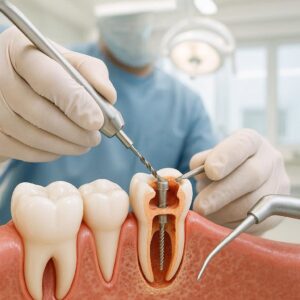
The Post: This is a small, rod-like structure. It fits down into the hollow canal of the root (where the nerve used to be). It provides stability and retention. Posts can be made of metal (stainless steel, titanium, or gold) or non-metal materials like fiber-reinforced resin (fiber posts).
-
The Core: This is the foundation built around and on top of the post. It builds up the missing tooth structure so that there is a solid, stable base to cement the final crown onto.
Together, the post and core transform a compromised, root-canaled tooth into a sturdy pillar capable of supporting a crown for years to come.
The Main Codes: D2952 and D2954
When you look at a dental insurance breakdown, you will likely see one of two primary codes for this service. The choice between them usually depends on the type of post used and the timing of the procedure.
Here are the two main dental codes you need to know.
D2952: Post and Core in Conjunction with Crown
This is the most common code you will encounter. D2952 is defined as “Core buildup, including any pins when required.”
Let’s clarify the naming. Historically, this code is used for a post and core, even though the descriptor says “core buildup.” In practice, D2952 is used when a prefabricated post (like a metal or fiber post) is cemented into the tooth to help retain the core.
When is D2952 used?
-
When the tooth has already undergone root canal therapy.
-
When a prefabricated post (ready-made from a manufacturer) is used.
-
When the core is built up around that post to prepare the tooth for a crown.
D2954: Prefabricated Post and Core
This code, D2954, is defined as “Prefabricated post and core in conjunction with crown.”
At first glance, it looks very similar to D2952. In fact, many insurance companies have overlapping guidelines. However, historically and in many current coding scenarios, D2954 specifically indicates that the post and core are being placed immediately following root canal therapy, or it is used to specifically bill for the post itself when the core is billed separately (though this is becoming less common).
The key distinction:
-
D2952 often includes the core buildup with any pins or posts.
-
D2954 is specifically for the prefabricated post and the core as a combined service.
Note to Readers: There is significant regional variation and insurance-specific interpretation regarding these two codes. Some insurance companies prefer D2952 for all prefabricated post and core cases, while others strictly require D2954. The most important thing is that the treatment is documented correctly by your dentist to support the medical necessity of the procedure.
D2953: A Separate Code for the Core Only
Sometimes, the post and the core are billed separately. This usually happens when a custom cast post and core is fabricated, or when a prefabricated post is used, but the dentist bills the core buildup separately.
D2953 is defined as “Each additional prefabricated post (same tooth).” However, in modern practice, D2950 (Core buildup, including any pins when required) is often used alongside a separate code for the post.
To simplify the confusion, here is a quick comparison:
| Code | Description | Typical Use Case |
|---|---|---|
| D2950 | Core buildup (no post) | Tooth has enough structure for a crown but needs a “filling” foundation. No root canal required, or root canal present but no post needed. |
| D2952 | Post and core (prefabricated) | Root canal treated tooth. Prefabricated metal or fiber post is cemented, and core built around it for crown retention. |
| D2953 | Additional prefabricated post | Rarely used alone. Used if a tooth requires more than one post (usually in multi-rooted teeth like molars). |
| D2954 | Prefabricated post and core | Similar to D2952. Often used interchangeably, but sometimes required when the post is placed immediately after root canal therapy. |
| D2957 | Cast post and core | A custom-made post and core fabricated in a dental lab (usually gold or metal). Used for complex cases where prefabricated posts won’t work. |
The Cast Post and Core: D2957
While prefabricated posts (D2952/D2954) are common, there is a more specialized version: the cast post and core.
D2957 is defined as “Cast post and core in conjunction with crown.”
This procedure is more involved. Instead of using a ready-made post and building the core with filling material in the mouth, the dentist takes an impression of the root canal space. A dental laboratory then casts a single, solid piece of metal (usually a noble metal like gold) that is both the post and the core. This custom-fabricated piece is then cemented into the tooth as one unit.
Why choose D2957 over D2952?
-
Strength: It is often stronger and less likely to fracture than a prefabricated post with a resin core.
-
Angulation: If a tooth is severely angled or the root canal is unusually shaped, a custom cast post allows for better alignment for the future crown.
-
Space: In situations where there is very little tooth structure left above the gum, a cast post and core can provide a more predictable foundation.
The downside is cost and time. D2957 is usually more expensive because it involves lab fees, and it requires an additional appointment.
Insurance Coverage: What You Need to Know
One of the most confusing aspects of dental treatment is understanding why your insurance check doesn’t match what you expected. When it comes to the dental code for post and core, there are a few hard truths.
1. The “Missing Tooth” Clause
This is the biggest “gotcha” in dental insurance. Many dental insurance plans have a clause that they will not cover a post and core (or a crown) on a tooth that was missing a filling or was “missing tooth structure” before the insurance policy was active.
If you had a large filling or a root canal years before joining your current insurance plan, the insurance company may deem the post and core “pre-existing” and deny coverage. This isn’t because the procedure isn’t necessary; it’s a contractual limitation of your specific plan.
2. Frequency Limitations
Most insurance plans consider a post and core a “once per tooth per lifetime” procedure. If a post fails and needs to be replaced years later, insurance may not pay for the replacement.
3. Bundling
Some insurance companies consider the post and core “bundled” with the crown. This means they will pay for the crown, but consider the post and core as part of the crown preparation and refuse to pay extra for it. This is an outdated concept, as the post and core is a distinct procedure requiring additional skill and time, but it still exists in some plans.
4. Medical Necessity
To get coverage, the dentist must justify why the post and core is needed. This usually involves X-rays showing that the existing tooth structure is insufficient to support a crown without it.
Pro Tip: Before undergoing treatment, ask your dentist’s office to submit a pre-treatment estimate (predetermination) to your insurance. This is not a guarantee of payment, but it gives you a written estimate of what the insurance plans to pay, allowing you to budget for your out-of-pocket costs.
The Clinical Procedure: What to Expect
Understanding the procedure can help you feel more comfortable with the codes on your bill. Here is a step-by-step look at what happens when a dentist uses D2952 (prefabricated post and core).
Step 1: Evaluation and X-Rays
Your dentist will take a radiograph (X-ray) to evaluate the root canal. They need to ensure the root canal was successful, there are no fractures in the root, and the root is long enough to support a post.
Step 2: Removing the Old Filling
The dentist removes the temporary filling or old restoration to access the root canal opening.
Step 3: Preparing the Canal
Special instruments (like Peeso reamers or Gates-Glidden drills) are used to gently shape the canal to accept the post. The goal is to remove just enough gutta-percha (the root canal filling material) to make space for the post, leaving the tip of the root sealed.
Step 4: Selecting and Cementing the Post
The dentist selects the appropriate size post (either metal or fiber). The post is tried in to ensure it fits passively. Once the fit is confirmed, the post is cemented into the canal using a strong resin cement.
Step 5: Building the Core
With the post in place, the dentist applies a composite resin (tooth-colored filling material) around the post and onto the remaining tooth. This material is shaped to create a solid, uniform foundation. The core must be shaped to have adequate “ferrule”—a band of sound tooth structure or core material that wraps around the tooth like a metal ring on a barrel. This ferrule is critical for long-term success.
Step 6: Crown Preparation
Once the core is set, the tooth is now ready to be prepared for the crown. The dentist shaves down the core and remaining tooth to accept the crown, takes an impression, and places a temporary crown.
Materials Matter: Metal vs. Fiber
The dental code (D2952 or D2954) often doesn’t specify which material is used, but the material choice can influence the longevity and aesthetics of the restoration.
Fiber Posts
-
Material: Glass or quartz fibers embedded in an epoxy resin matrix.
-
Pros: They are tooth-colored, flexible (flex similar to dentin), and bond chemically to the resin cement and core. If they fail, they often do so in a way that spares the tooth root from fracturing.
-
Cons: Not as rigid as metal.
Metal Posts (Stainless Steel or Titanium)
-
Material: Non-precious or precious metals.
-
Pros: Extremely strong and rigid.
-
Cons: Opaque and grey, which can sometimes show through all-ceramic crowns. The rigidity, while strong, can sometimes transmit forces to the root that cause a vertical root fracture—which is usually an untreatable condition requiring extraction.
Cast Posts (D2957)
-
Material: Gold or high-noble metal alloys.
-
Pros: The “gold standard” for strength and fit. They are custom-made, ensuring a precise fit to the unique anatomy of the root canal.
| Material Type | Strength | Aesthetics | Risk of Root Fracture | Cost |
|---|---|---|---|---|
| Fiber Post | Moderate | Excellent | Low | Moderate |
| Prefabricated Metal | High | Poor | Moderate | Moderate |
| Cast Post (Gold) | Very High | Poor (metal) | Moderate | High |
Common Questions About Billing and Codes
Even with the codes laid out, confusion remains. Let’s address some of the most frequent scenarios.
Why is there a separate charge for the post and core if I already paid for a crown?
Think of the crown as the roof of a house. The post and core is the framing and foundation. If the framing isn’t there, the roof has nothing to attach to. It is a distinct clinical procedure that requires a different skill set, materials, and time than simply taking an impression for a crown.
My dentist says I need a “buildup” but no post. What code is that?
If your tooth has had a root canal, but there is still enough solid tooth structure above the gum to hold a crown without a post, your dentist will perform a core buildup only. This is coded as D2950. This code is often used for teeth that have large cavities but don’t need a post to retain the core.
Can I get a post and core without a crown?
Technically, yes, but it is not recommended. The post and core is a foundation designed to hold a crown. Placing a post and core and then leaving it exposed (without a crown) leaves the tooth vulnerable to fracture. Insurance typically will not cover a post and core unless it is billed “in conjunction with crown” because the two procedures are dependent on one another.
What if my tooth fractures under the crown? Do I pay again?
This is a difficult situation. If a tooth fractures below the gum line, it often cannot be saved. If the post breaks but the tooth is still intact, the dentist may attempt to remove the old post and place a new one. This would require a new post and core code (D2952 or D2954) as it is a redo of the original service. Unfortunately, most insurance plans will not pay for a redo of a procedure, citing the “once per tooth per lifetime” rule.
The Importance of the “Ferrule”
If you want to understand why your dentist insists on a post and core, you need to understand the concept of the “ferrule.” This is not a dental code, but it is the clinical reason the code exists.
A ferrule is a 360-degree band of solid tooth structure (or core material) that extends at least 1.5 to 2 mm above the gum line. It acts like a metal band around a barrel, preventing the tooth from splitting under pressure.
If a tooth lacks a ferrule, a crown placed directly on the tooth will likely fail. The post and core is often necessary to create this ferrule artificially, providing the stability needed for the crown to survive the biting forces of everyday life.
Studies in dental literature consistently show that the presence of a ferrule is the single most important factor in the long-term survival of a crown on a root-canal-treated tooth.
Decoding Your Treatment Plan
When you sit in the dentist’s chair, you might receive a treatment plan that looks something like this. Here is how to read it:
-
D2950 (or D2952): Core Buildup / Post & Core – This is the foundation.
-
D2740: Crown – Porcelain/Ceramic – This is the final restoration.
-
D3330: Root Canal Therapy (if not already done) – This is the internal treatment.
Sometimes, you might see D2954 listed alongside D2750 (Crown – Porcelain Fused to High Noble Metal).
Understanding that these are separate line items helps you understand the total cost. If you only budget for the crown, you might be surprised by the additional expense of the post and core. However, skipping the post and core to save money today almost always leads to a fractured tooth and a more expensive extraction and implant tomorrow.
Future Trends in Post and Core Coding
The world of dental coding is not static. The American Dental Association (ADA) updates the Current Dental Terminology (CDT) codes every year, though major changes usually happen every few years.
Currently, there is a push within the dental community to simplify the confusion between D2952 and D2954. Many coding experts anticipate that future code revisions may merge these two codes or clarify the definitions to reduce insurance disputes.
Additionally, with the rise of digital dentistry, we may see new codes emerge for computer-aided design/computer-aided manufacturing (CAD/CAM) fabricated posts and cores, which are currently often billed under the existing cast post code (D2957) or prefabricated codes, depending on the lab process.
A Note on Quality and Ethics
As a patient, it’s crucial to understand that not all posts are created equal, and not all insurance codes reflect the quality of care.
A dentist might bill D2952 using a cheap, mass-produced metal post, or they might bill D2952 using a high-quality, translucent fiber post that offers superior aesthetics and fracture resistance. The code is the same; the material and skill vary.
A good dentist will not choose a post based on what the insurance pays. They will choose it based on the specific clinical needs of your tooth. If you have questions about the material being used, ask. A transparent dentist will be happy to explain why they are choosing a fiber post over a metal one, or vice versa.
Conclusion
Navigating the terminology of restorative dentistry doesn’t have to be a headache. By understanding the primary codes—D2952 for prefabricated post and core, D2954 for similar scenarios, and D2957 for custom cast posts—you empower yourself to ask the right questions.
A post and core is not an upsell; it is often the critical factor that determines whether a tooth can be saved or must be extracted. When reviewing your treatment plan, look for these codes as signs that your dentist is prioritizing the structural integrity of your tooth to ensure your crown lasts for decades.
Remember to always request a pre-treatment estimate from your insurance, ask your dentist about the materials being used, and view the post and core not as an extra expense, but as an investment in the longevity of your smile.
Frequently Asked Questions (FAQ)
Q1: Is a post and core always necessary after a root canal?
No. If the tooth has enough solid structure remaining above the gum line, a simple core buildup (D2950) without a post may be sufficient. The decision depends on how much healthy tooth remains.
Q2: Does insurance cover the dental code for post and core?
Often, yes, but it varies. Many plans cover 50% of the cost, considering it a major restorative service. However, check for “missing tooth clauses” or frequency limitations that might affect your specific coverage.
Q3: What is the difference between D2952 and D2950?
D2950 is a core buildup only (no post). D2952 is a post and core (a prefabricated post is used to help retain the core). D2950 is for teeth that need a foundation; D2952 is for teeth that need a foundation and a post for retention.
Q4: Can I get a crown without a post and core?
Yes, if your tooth has enough natural structure left. Your dentist will evaluate this based on X-rays and clinical examination. If there is insufficient structure, skipping the post and core greatly increases the risk of the crown falling off or the tooth fracturing.
Q5: How long does a post and core last?
With good oral hygiene and a properly fabricated crown, a post and core can last 10 years or more. However, they are susceptible to decay if the crown margin fails, and they can fracture if subjected to excessive forces (like grinding or clenching).
Additional Resources
For more information on dental coding standards and to stay updated on the latest CDT codes, visit the official source:
-
American Dental Association (ADA) – Current Dental Terminology (CDT): https://www.ada.org/en/publications/cdt
For patients looking to understand their insurance benefits better, the National Association of Dental Plans (NADP) offers consumer guides on understanding dental benefits.
Disclaimer: This information is for educational purposes only. Dental procedures and insurance coverage vary by location, provider, and individual policy. Always consult with your licensed dentist and insurance provider before undergoing any dental treatment.
Disclaimer: This article is for informational purposes only and does not constitute medical, financial, or legal advice. Dental coding standards (CDT codes) are updated by the American Dental Association (ADA). While every effort is made to ensure accuracy, codes and insurance policies change. Always consult with your dental insurance provider and dental professional for specific coverage details.
Author: [Your Name/Web Staff Writer]
Date: March 24, 2026