If you have ever looked at a dental treatment plan and felt like you were trying to decode a secret language, you are not alone. Dental terminology can be intimidating. One of the most common questions patients ask is, “What is the dental code for PRR?” and, more importantly, “What does that mean for my teeth and my wallet?”
PRR stands for Preventive Resin Restoration. In the simplest terms, it is a modern, tooth-conserving technique used by dentists to treat small cavities. It sits right in the middle of two other common procedures: a simple sealant and a full traditional filling.
Understanding this specific code—or rather, the set of codes associated with it—can help you make better decisions about your dental health. It can help you understand why your dentist might choose this option over a larger filling and how it affects your insurance coverage.
In this guide, we will walk you through everything you need to know about the dental codes for PRR. We will cover the definitions, the costs, the insurance nuances, and why this approach is often considered a superior way to manage early tooth decay.
Dental Code for PRR
What is a Preventive Resin Restoration (PRR)?
Before we dive into the codes themselves, let’s talk about the procedure. A Preventive Resin Restoration is a hybrid procedure. It combines a dental sealant with a small filling.
Traditionally, when a dentist found a cavity, the approach was straightforward: drill a hole to remove the decay and fill it with amalgam (silver) or composite (tooth-colored) material. However, dentistry has evolved. We now understand that cavities often start in the deep grooves (fissures) of the back teeth (molars and premolars).
A PRR is used when there is a small, localized cavity that extends just slightly into the dentin (the layer under the enamel), but the surrounding grooves are also at high risk for developing future cavities.
During a PRR procedure, the dentist:
-
Cleans the cavity: Removes the decayed area precisely.
-
Prepares the tooth: Smoothens the area.
-
Places the restoration: Uses a tooth-colored composite resin to fill the tiny hole.
-
Seals the grooves: Applies a flowable dental sealant over the remaining deep grooves to prevent future decay.
Essentially, a PRR fixes the existing problem (the small cavity) while simultaneously preventing future problems in the same tooth.
The Core Dental Codes for PRR
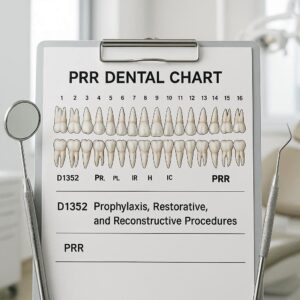
The American Dental Association (ADA) maintains the Current Dental Terminology (CDT) codes. For PRR, there is not just one code. There are four distinct codes, and the specific one used depends entirely on the surface of the tooth being treated.
These codes fall under the “Sealants” category in the CDT manual. This is an important distinction because insurance companies classify them differently than they do “fillings.”
Here are the four dental codes used for Preventive Resin Restorations:
| Code | Description | Tooth Surface |
|---|---|---|
| D2391 | Resin-based composite – one surface, posterior | Occlusal (biting surface) only |
| D2392 | Resin-based composite – two surfaces, posterior | Occlusal plus one other surface (e.g., cheek side or tongue side) |
| D2393 | Resin-based composite – three surfaces, posterior | Occlusal plus two other surfaces |
| D2394 | Resin-based composite – four or more surfaces, posterior | Occlusal plus three or more surfaces |
Code D2391: The Single Surface PRR
This is the most common code associated with a PRR. If your dentist says, “We are going to do a PRR on tooth number 30,” and the cavity is only on the biting surface (occlusal), they will almost certainly bill D2391.
This code represents a resin-based composite filling on one surface of a back tooth. When performed as a PRR, it usually involves a “mini-filling” and a sealant over the rest of the grooves.
Codes D2392, D2393, and D2394: When PRR Expands
Sometimes, the decay is not isolated to just the biting surface. It might extend down the side of the tooth (the buccal or lingual surface). In these cases, the dentist is still conserving tooth structure, but the procedure requires covering more surfaces.
If the decay involves the biting surface and the cheek side, the dentist will bill D2392.
If it involves the biting surface, the cheek side, and the tongue side, they will bill D2393.
If the decay is extensive (though usually if it is this large, it is often classified as a traditional filling rather than a true PRR), they will bill D2394.
It is crucial to note that while dentists may call all of these “PRR” in a conversational sense, the billing code determines how the insurance company views the procedure.
Why These Codes Matter for You
You might wonder why we are spending so much time on these four numbers. The reason is simple: cost and coverage.
In the world of dental insurance, there is a massive difference between a “sealant” and a “filling.” Technically, codes D2391 through D2394 are classified under “Restorative” services (fillings). However, because the PRR technique involves sealing the grooves, some insurance companies view them as sealants.
This gray area is where confusion happens.
The Sealant vs. Filling Dilemma
-
Dental Sealants (D1351): This is a preventive code. Insurance companies love sealants. They usually cover them at 100% or 80% with no deductible, especially for children and adolescents.
-
PRR (D2391 – D2394): This is technically a “restorative” code. Insurance companies often cover these at a lower percentage (usually 50% to 80%) after you meet your deductible.
If a dentist uses a PRR to treat a small cavity, they cannot bill it as a sealant (D1351) because the procedure involved removing decay, which makes it a restoration. Billing it as a sealant would be insurance fraud.
This is why it is essential to look at your treatment plan. If you see D2391, know that it is a small, conservative filling, and your insurance will likely treat it as such.
PRR vs. Traditional Fillings: A Comparative Look
To truly understand the value of the PRR and why dentists use these specific codes, it helps to compare them to traditional fillings. Traditionally, a small cavity would have been treated with an amalgam filling, which required the dentist to drill a specific “retentive” shape into the tooth to hold the metal in place. This often meant removing healthy tooth structure.
Here is a comparison of the PRR approach (using D2391) versus a traditional two-surface amalgam (D2160) or composite (D2392) filling.
| Feature | PRR (D2391) | Traditional Filling (D2160 / D2392) |
|---|---|---|
| Tooth Structure Removed | Minimal; only decay and a few deep grooves | Moderate to Extensive; includes “undercuts” to hold filling |
| Procedure | Mini-filling + Sealant | Standard filling preparation |
| Best For | Small, localized occlusal decay | Larger decay or decay involving multiple surfaces |
| Longevity | High; seals out bacteria effectively | High; but may require larger replacement over time |
| Cost (Avg) | Lower ($100 – $250) | Higher ($200 – $400+) |
Note for Readers: While PRR is excellent for stopping small cavities, it is not a solution for every cavity. If the decay is too large or involves the contact point between teeth, a traditional filling (or even an inlay/onlay) is the better choice.
Cost Considerations for PRR (D2391-D2394)
Let’s talk about money. No one likes surprises when they get to the front desk after a dental appointment. Understanding the cost structure of these codes can help you budget appropriately.
The cost of a PRR varies based on three factors:
-
Geographic Location: Dental fees in New York City will be higher than in rural Iowa.
-
Dentist’s Expertise: Highly specialized or experienced dentists may charge a premium.
-
Number of Surfaces: As you move from D2391 (one surface) to D2394 (four surfaces), the price increases.
Estimated Average Costs (Without Insurance)
If you are paying out-of-pocket, here is a general estimate of what you might expect to pay for these codes in the United States.
-
D2391 (One Surface PRR): $100 – $250
-
D2392 (Two Surfaces): $150 – $350
-
D2393 (Three Surfaces): $200 – $450
-
D2394 (Four Surfaces): $250 – $550
These prices typically include the local anesthetic and the materials used. If you have dental insurance, you will likely pay a percentage of these costs.
Insurance Coverage Breakdown
Most dental insurance plans follow the 100/80/50 structure:
-
Preventive (Cleanings, Exams, Sealants): 100% coverage (usually).
-
Basic Restorative (Fillings, PRR codes): 80% coverage.
-
Major Restorative (Crowns, Bridges): 50% coverage.
So, if your dentist performs a D2391 (PRR) and the fee is $200, and you have met your deductible, your insurance will likely pay 80% ($160), leaving you with a $40 copay.
Important Warning: Some insurance companies try to “downcode” PRR procedures. They might look at D2391 and say, “This looks like a sealant, so we are only going to pay the sealant rate.” This leaves the patient responsible for the difference (balance billing). Always check with your insurance provider before treatment to confirm how they classify these codes.
How to Read Your Dental Treatment Plan
When your dentist presents a treatment plan, it usually looks like a spreadsheet. Here is how to spot a PRR.
Look for the following:
-
Tooth Number: Usually a molar or premolar (teeth #1-5, #12-16, #17-21, #28-32).
-
Code: D2391, D2392, D2393, or D2394.
-
Description: It will likely say “Resin composite – [number] surface(s), posterior.”
If you see this, you are likely looking at a PRR or a small composite filling. If you are unsure, ask the treatment coordinator: “Is this a preventive resin restoration, or is it a traditional filling?” A good dental office will be happy to explain the difference.
The Clinical Benefits of PRR
Why do dentists love PRR? It is not about making more money—in fact, PRR often costs less than a traditional filling. It is about philosophy.
Minimally invasive dentistry is the gold standard today. The goal is to keep your teeth strong for life. Every time a dentist drills a tooth, they weaken it slightly. A PRR is designed to be as minimally invasive as possible.
Key Benefits:
-
Preserves Tooth Structure: Because the preparation is limited to the decay and the deep grooves, the healthy cusps (the raised points) of the tooth remain untouched. This keeps the tooth stronger.
-
Aesthetic: The composite resin matches the tooth color perfectly. No silver fillings.
-
Preventative: By sealing the grooves, it stops bacteria from getting into the deep fissures, effectively preventing future cavities on that tooth.
-
Bonding: Modern composites bond chemically to the tooth structure, creating a tight seal that prevents micro-leakage (where bacteria sneak in under the filling).
The Process: What to Expect During a PRR Appointment
If you are scheduled for a PRR (D2391), you might feel nervous, but the procedure is often quicker and less invasive than a traditional filling.
Step 1: Anesthesia
For a small PRR, the dentist may not even need to numb the tooth if the decay is shallow. However, most dentists will use a topical gel followed by a local anesthetic to ensure you are comfortable.
Step 2: Isolation
The dentist will isolate the tooth using a rubber dam or cotton rolls to keep it dry. Moisture is the enemy of composite bonding.
Step 3: Preparation
Using a high-speed handpiece (drill) or air abrasion, the dentist removes the decay. They create a very small, precise cavity preparation. They also use a fine bur to open up the deep grooves (fissurotomy) to clean out any bacteria.
Step 4: Etching and Bonding
The tooth surface is etched with a mild acid to create a rough surface. A bonding agent (adhesive) is then applied. This acts like a glue to hold the filling in place.
Step 5: Placement and Curing
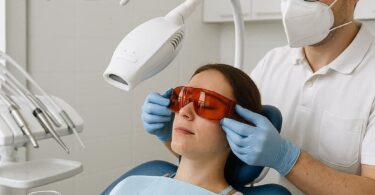
The dentist places the composite resin in layers. After each layer, they use a special blue curing light to harden (polymerize) the material.
Step 6: Shaping and Polishing
Once the resin is hard, the dentist uses burs and discs to shape the filling to match the natural anatomy of your tooth. They polish it so it feels smooth against your tongue and doesn’t irritate your cheek.
Step 7: Bite Check
The dentist will have you bite down on a piece of articulation paper to ensure the filling is not “high.” If it is too high, it can cause jaw pain, so they will adjust it until your bite feels perfect.
The entire process usually takes 15 to 30 minutes, depending on the size of the restoration.
Frequently Asked Questions (FAQ)
Q: Is a PRR the same as a sealant?
A: No, but it is related. A sealant (D1351) is placed on a tooth with no decay. A PRR (D2391-D2394) is placed on a tooth that already has a small cavity. The PRR fixes the cavity and then seals the rest of the grooves.
Q: Will my insurance cover D2391?
A: Most dental insurance plans cover D2391 (composite filling, one surface) as a basic restorative service. Typically, they cover it at 70-80% after your deductible. However, some plans have age limits or frequency limitations. Always verify with your provider.
Q: How long does a PRR last?
A: With good oral hygiene and regular dental check-ups, a PRR can last anywhere from 5 to 10 years or more. Because it seals the grooves so effectively, the tooth is less likely to develop new decay around the restoration.
Q: Is a PRR painful?
A: The procedure itself is not painful because of the local anesthetic. After the anesthetic wears off, you may feel mild sensitivity to cold or pressure for a few days, but this usually subsides quickly.
Q: Why is my dentist using D2392 instead of D2391?
A: If your dentist uses D2392, it means the decay was slightly larger than anticipated or involved a second surface of the tooth (like the side). They are still likely using the PRR philosophy, but the complexity of the restoration requires billing for two surfaces.
Q: Can adults get PRR?
A: Absolutely. While PRR is often associated with children (because children get a lot of sealants), adults with newly erupted wisdom teeth or deep grooves that develop small cavities are also excellent candidates for PRR.
Conclusion
Understanding the dental code for PRR—specifically codes D2391 through D2394—empowers you to take control of your dental health. You now know that these codes represent a modern, minimally invasive approach to treating small cavities. They bridge the gap between prevention (sealants) and restoration (fillings).
By opting for a PRR when appropriate, you are choosing a treatment that preserves more of your natural tooth structure, looks aesthetically pleasing, and helps prevent future decay on the same tooth. While insurance coverage for these codes can sometimes be a gray area, knowing what to look for on your treatment plan allows you to ask the right questions and avoid billing surprises.
Remember, your teeth are designed to last a lifetime. Treatments like the Preventive Resin Restoration are a testament to how far dentistry has come in helping you achieve that goal with less drilling, less discomfort, and better long-term results.
Additional Resources
For further reading on dental codes and minimally invasive dentistry, we recommend visiting the American Dental Association (ADA) Center for Professional Success. They maintain the official CDT code book and offer resources for patients to understand dental benefits.
Link to ADA Center for Professional Success
Disclaimer: This article is for informational purposes only and does not constitute medical advice. Dental procedures and insurance coverage vary widely. Always consult with a licensed dental professional for diagnosis and treatment options specific to your health needs. The author and publisher are not liable for any actions taken based on the contents of this article.