Let’s be honest for a second.
You probably clicked on this article because you saw a confusing insurance denial. Or maybe you are a dental hygienist who just spent fifteen minutes talking a patient out of their smokeless tobacco habit, and now you are wondering: Can I actually bill for this?
The answer is yes. But like many things in dental billing, the details matter.
The dental code for tobacco counseling is not just a random set of numbers. It is a powerful tool. When used correctly, it helps your practice get paid for the valuable time you spend improving a patient’s overall health. It also helps your patients finally break a habit that hurts their teeth, gums, and their entire body.
In this guide, we will walk through everything you need to know. No confusing jargon. No hidden secrets. Just a clear, honest, and friendly roadmap to using these codes the right way.
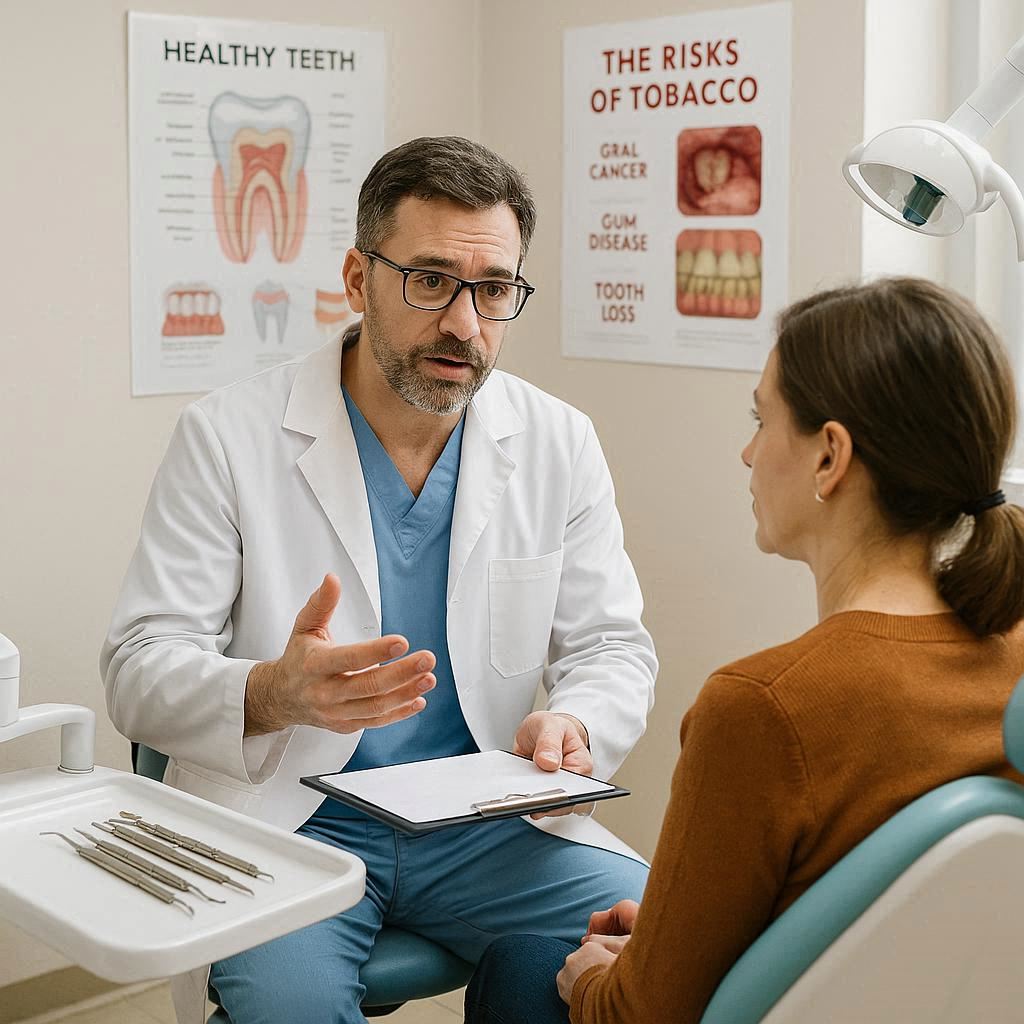
Why Tobacco Counseling Belongs in Your Dental Chair
Before we talk numbers, let us talk about why this matters.
Most people do not think of their dentist as a lung doctor. But your mouth is the front door to your body. Every time a patient lights a cigarette or places a dip, their oral tissues take the very first hit.
Tobacco causes gum disease to progress three times faster. It hides the signs of bleeding, which makes early diagnosis tricky. It leads to oral cancer, tooth loss, and delayed healing after extractions or implants.
Here is the good news: dental professionals are in a unique position to help. You see your patients twice a year. You see the white patches. You smell the smoke. You notice the receding gums.
That is why the American Dental Association (ADA) created specific codes for this service. They recognize that a conversation about quitting tobacco is not just “being nice.” It is a clinical intervention.
The Two Main Codes You Need to Know
When people search for the dental code for tobacco counseling, they usually find two answers. Both are correct, but they serve different situations.
Let us break them down in plain English.
| CDT Code | Official Name | Time Requirement | Best Used For |
|---|---|---|---|
| D1320 | Tobacco counseling for the control and prevention of oral disease | 3 to 10 minutes | Brief, chairside advice during a regular check-up or cleaning |
| D1321 | Counseling on tobacco use and dependence (greater than 10 minutes) | More than 10 minutes | In-depth sessions, motivational interviewing, or smoking cessation plans |
Think of D1320 as the “quick chat.” Think of D1321 as the “real conversation.”
Most dental practices will use D1320 most often. You are already talking to patients about flossing and diet. Adding a two-minute conversation about tobacco fits naturally into that flow.
Deep Dive into D1320: The Quick Intervention Code
Let us get specific.
D1320 is officially described as “tobacco counseling for the control and prevention of oral disease.” The key phrase here is “control and prevention.” You are not trying to solve their entire life. You are simply connecting their tobacco use to their oral health problems.
When to Use D1320
Imagine this scene.
A 45-year-old patient comes in for a routine prophylaxis (cleaning). You notice heavy stain on the lower anterior teeth and generalized bone loss on their X-rays. You ask, “Have your tobacco habits changed at all since your last visit?”
They say, “I still smoke about half a pack a day.”
You spend four minutes explaining how smoking reduces blood flow to their gums, which makes it harder to fight infection. You give them a simple brochure. You say, “Even cutting down by two cigarettes a day would help your gums heal faster.”
That is D1320.
You do not need to become a therapist. You do not need to prescribe patches. You just need to connect the dots between their habit and their mouth.
Documentation Requirements for D1320
Here is where many offices get denied. You cannot just write “tobacco counseling” in the chart and expect payment.
Insurance companies want proof. Good documentation should include three things:
- The patient’s self-reported tobacco use. (Example: “Pt reports smoking 10 cigarettes per day for 20 years.”)
- The clinical findings related to tobacco. (Example: “Generalized 4-6mm pockets, heavy calculus, and grade 2 mobility on #24.”)
- The specific advice given. (Example: “Discussed link between smoking and bone loss. Recommended quitting resources. Pt expressed willingness to cut back.”)
If you write those three sentences, you have a solid claim.
Reimbursement Reality for D1320
Let us be realistic. D1320 is not a money-maker. Most PPO plans reimburse between $15 and $35 for this code. Some medical plans pay more, but dental plans typically treat it as a small add-on service.
However, that is not the point. The point is to validate your time and to create a culture of prevention in your practice. Even if you only collect $15, that is $15 you were leaving on the table before.
Important Note: Many commercial dental plans limit D1320 to once per 12 months per patient. Check each patient’s benefits before billing.
Deep Dive into D1321: The Intensive Counseling Code
D1321 is the bigger brother of the two codes. It requires more time, better documentation, and a dedicated appointment structure.
When to Use D1321
You should reserve D1321 for patients who are actively ready to quit. This is not for the person who says “I know I should stop” and then changes the subject.
This code is for the patient who says:
- “I have tried to quit three times, but I keep failing.”
- “My doctor told me I have COPD, and I am scared.”
- “Can you actually help me make a plan?”
When you hear those words, you know you need more than four minutes.
What a D1321 Appointment Looks Like
A proper D1321 session lasts between 11 and 30 minutes (sometimes longer, but most plans cap at 30). During that time, you should:
- Perform a readiness assessment (are they truly ready to quit?)
- Discuss nicotine replacement options (patches, gum, lozenges)
- Create a specific quit date
- Identify triggers (coffee, driving, stress)
- Provide written materials or referral to a quitline
- Schedule a follow-up call or visit
You are essentially acting as a health coach. And that is valuable work.
Documentation for D1321
This requires a separate progress note. Do not bury it inside your cleaning note.
A strong D1321 note should include:
- Total time spent (e.g., “15 minutes of face-to-face counseling”)
- Readiness score (e.g., “Patient rates readiness to quit as 8/10”)
- Specific plan (e.g., “Quit date set for 5/1. Will use nicotine patch 21mg daily.”)
- Barriers identified (e.g., “Stress at work is primary trigger.”)
- Follow-up plan (e.g., “Return in 2 weeks for support visit.”)
Reimbursement for D1321
D1321 pays better, but it is also harder to get approved. Many dental plans reimburse between $40 and $75. Some medical plans (if you are credentialed) pay over $100.
But here is the catch: many plans require prior authorization for D1321. They also often limit it to 2 to 4 sessions per year.
Always verify before you deliver the service. There is nothing worse than spending 25 minutes helping a patient only to find out their plan does not cover it.
A Simple Comparison Table: D1320 vs. D1321
Let us make this even clearer.
| Feature | D1320 | D1321 |
|---|---|---|
| Typical time spent | 3-10 minutes | 11-30 minutes |
| Best for | Brief advice during hygiene visit | Dedicated quit plan session |
| Patient readiness | Low to moderate | High (ready to set a quit date) |
| Documentation difficulty | Easy (3 sentences) | Moderate (separate note) |
| Average dental insurance payment | $15-$35 | $40-$75 |
| Prior authorization needed | Rarely | Often |
| Frequency limit | Usually 1x per year | Usually 2-4x per year |
How to Bill These Codes Correctly (Without Getting Audited)
Now we get into the practical stuff. Billing errors are the number one reason these claims get rejected.
The “Same Day” Rule
You can bill D1320 or D1321 on the same day as a prophylaxis (D1110), periodic exam (D0120), or even a filling (D2391). There is no rule that says you cannot.
However, you must document that the counseling was distinct and separate from the other services. Do not just copy-paste your cleaning note.
A good trick: Write your tobacco counseling note in a separate paragraph or a separate section of the chart. Use a timestamp if your software allows it.
Medical vs. Dental Billing
Here is a pro tip.
Some medical insurance plans (like Medicare Advantage, Medicaid in certain states, and some commercial medical plans) cover tobacco counseling under medical codes (such as 99406 or 99407). These often pay significantly more than dental codes.
But you need to be credentialed as a medical provider with that plan. Most dentists are not. However, some large group practices are.
If you are a solo practitioner, stick with D1320 and D1321 for dental claims. If you are part of a medical-dental integration program, explore the medical codes.
Common Denial Reasons and How to Fix Them
Let us look at the real world.
Denial Code CO-97: “The benefit for this service is included in another procedure.”
- Why it happens: The insurance company thinks your counseling was “part of” the exam.
- Fix: Add a separate narrative report explaining that the counseling was extra and beyond routine education.
Denial Code CO-50: “These are non-covered services under the patient’s plan.”
- Why it happens: Some cheap plans simply exclude tobacco counseling.
- Fix: Verify benefits before the appointment. Write off the service or bill the patient if you forgot to check.
Denial Code CO-234: “This procedure code is not compatible with the primary procedure code.”
- Why it happens: You billed D1320 with a crown (D2740) on the same tooth. The insurer thinks you were just “chatting” during the crown prep.
- Fix: Bill D1320 only on prevention-focused visits (cleanings, exams, recalls).
Step-by-Step Workflow for Your Dental Team
Theory is nice. But you need a workflow that actually works in a busy Monday morning schedule.
Step 1: Identify the Patient
Your front desk or hygienist should flag tobacco users. Add a pop-up alert in your practice management software. Something simple like: “Smoker – ask about quit readiness.”
Step 2: Ask Permission
Do not lecture. Try this script instead:
“I see in your chart that you smoke. Would it be okay if I took two minutes to share how that affects your gums specifically?”
Most patients say yes. If they say no, respect it and move on.
Step 3: Deliver the Brief Intervention (For D1320)
Use the “Ask, Advise, Refer” model from the CDC.
- Ask: “How many cigarettes do you smoke per day?”
- Advise: “The bone loss we are seeing on your X-rays is happening three times faster because of smoking. Quitting would slow that down significantly.”
- Refer: “Here is a free number for the Quitline. They send free nicotine patches.”
That takes three minutes.
Step 4: Document Immediately
Do not wait until lunch. Write those three sentences we talked about earlier right in the chart.
Step 5: Bill and Track
Submit the claim with D1320. Track your approval rate. If you get denied more than 30% of the time, call the insurance company and ask why.
Real-Life Examples (So You Can See It in Action)
Examples help. Let us walk through two patient scenarios.
Example 1: The Long-Term Smoker
Patient: Tom, age 52. Smokes 1.5 packs per day for 35 years. Presents for routine cleaning. Has generalized moderate periodontitis. Has never tried to quit.
Visit flow:
- Hygienist probes and records 5mm pockets.
- Hygienist says, “Tom, your gum disease is more advanced than it should be for your age. Smoking is a big part of that.”
- Tom sighs. “I know. My wife nags me about it.”
- Hygienist spends 4 minutes explaining how smoking masks bleeding and reduces healing.
- Hygienist gives Tom a brochure and a Quitline card.
- Tom says he will “think about it.”
Billing: D1320
Documentation: “Pt reports smoking 1.5ppd x 35yrs. Generalized 5mm pockets with BOP. Discussed link between smoking and periodontitis progression. Provided written quit resources. Pt not ready to set quit date at this time.”
Expected payment: $22 (typical PPO rate)
Example 2: The Ready-to-Quit Patient
Patient: Maria, age 38. Uses smokeless tobacco (dip) daily for 12 years. Has a white lesion on her lower vestibule. She is scared. She says, “I want to stop, but I do not know how.”
Visit flow:
- Dentist examines lesion. Explains it is likely frictional keratosis but needs to be monitored.
- Dentist says, “The best treatment for this lesion is to stop using tobacco.”
- Maria says, “I am ready. Please help me.”
- Dentist schedules a dedicated 20-minute counseling appointment for next week.
- During that appointment, they set a quit date, discuss weaning strategies, and prescribe nicotine lozenges (medical referral).
- Dentist schedules a 2-week follow-up.
Billing: D1321 (20 minutes)
Documentation: Separate note. “20 minutes face-to-face counseling. Pt rates readiness 9/10. Quit date set for 4/22. Identified triggers: after meals and driving. Plan to switch to cinnamon sticks for oral fixation. Follow-up scheduled for 5/6.”
Expected payment: $62 (if covered)
Frequently Asked Questions (FAQ)
Let us answer the questions you probably still have.
Can a dental hygienist bill for tobacco counseling?
Yes, but only under the dentist’s supervision and NPI. The claim goes out under the dentist’s name. The hygienist can perform the service and document it, but the supervising dentist is the billing provider.
Does Medicaid cover the dental code for tobacco counseling?
It depends entirely on your state. Some states (like California, New York, and Minnesota) cover D1320 and D1321 under Medicaid dental benefits. Other states do not. Check your state’s dental Medicaid manual.
Can I bill both D1320 and D1321 for the same patient in one year?
Yes, but rarely. Most plans allow one D1320 per year and up to two or four D1321 sessions per year. However, you cannot bill both on the same day. Pick the one that matches the time and intensity.
What if the patient is a vaper or uses e-cigarettes?
Great question. The CDT codes do not specify “smoking” only. They say “tobacco counseling.” E-cigarettes that contain nicotine derived from tobacco count. However, some plans may deny if the patient only vapes zero-nicotine products. Use your clinical judgment.
Do I need a signed consent form for tobacco counseling?
No, not typically. This is considered a preventive service. However, if you are doing a 30-minute intensive session (D1321), some practices have patients sign a simple acknowledgment form. It is not required by law, but it is a good habit.
What happens if the patient lies about their tobacco use?
You can only document what they tell you and what you observe. If you smell smoke or see stain, you can write “Clinical findings suggestive of tobacco use” even if the patient denies it. Never accuse a patient of lying. Just document objectively.
Additional Resources for You and Your Patients
You do not have to do this alone. Here are free, reliable resources to support your tobacco counseling efforts.
For dental professionals:
- ADA Center for Professional Success (search “tobacco cessation”)
- CDC’s Tips from Former Smokers campaign materials (free posters and fact sheets)
For patients (give them this link):
- Smokefree.gov – Official U.S. government resource with text message programs, apps, and live chat.
Recommended external link:
Smokefree.gov Quit Guide – Share this directly with patients who are ready to make a plan. It is free, evidence-based, and easy to use.
A Friendly Note on Realistic Expectations
Let us close this section with some honesty.
Not every insurance plan will pay you for this work. Some will deny every single claim. Others will pay inconsistently. That is frustrating. I get it.
But here is what I have learned after years in this field: The dental code for tobacco counseling is not just about the money.
It is about building a reputation as a practice that truly cares about whole-body health. It is about giving your team permission to have meaningful conversations. And sometimes, it is about being the one person who finally says the right words that make a patient quit for good.
If you get paid for 50% of your claims, consider that a win. The other 50% is still valuable patient care.
Conclusion (Three Lines)
Tobacco counseling codes D1320 and D1321 let dental teams bill for brief or intensive quit conversations. Use D1320 for quick chairside advice during cleanings and D1321 for dedicated quit planning sessions. Document carefully, verify benefits first, and remember that even unpaid counseling improves patient health and loyalty.
Final Checklist Before You Bill
Before you submit that claim, run through this quick list.
- Did the patient self-report tobacco use (or show clear clinical signs)?
- Did you spend at least 3 minutes (for D1320) or 11 minutes (for D1321)?
- Did you document the specific advice you gave?
- Did you check the patient’s plan for tobacco counseling coverage?
- Did you avoid billing on the same day as major restorative work?
- Did you write a separate note (for D1321) or a distinct paragraph (for D1320)?
If you checked all six boxes, submit with confidence.
One Last Thought
You became a dental professional to help people. Tobacco counseling is one of the highest-impact things you can do. A five-minute conversation today could add years to a patient’s life.
That is not just good billing. That is good medicine.
Now go help someone quit. You have got this.
Disclaimer: This article is for informational purposes only and does not constitute medical, legal, or billing advice. Dental codes and insurance policies vary by region and payer. Always verify with the patient’s specific plan and consult official CDT code manuals.
Author: Dental Billing & Wellness Team
Date: APRIL 14, 2026