You have just finished a thorough exam. You have taken X-rays, reviewed medical history, and talked with your patient about their concerns. Now comes the most important step: creating a clear, organized treatment plan.
But how do you translate that plan into a code that insurance companies understand?
Many dental teams struggle with this exact question. The dental code for treatment planning is not as straightforward as a filling or a crown. Yet getting it right saves time, prevents denials, and ensures your practice gets paid for the work you put into organizing complex care.
Let us walk through everything you need to know.
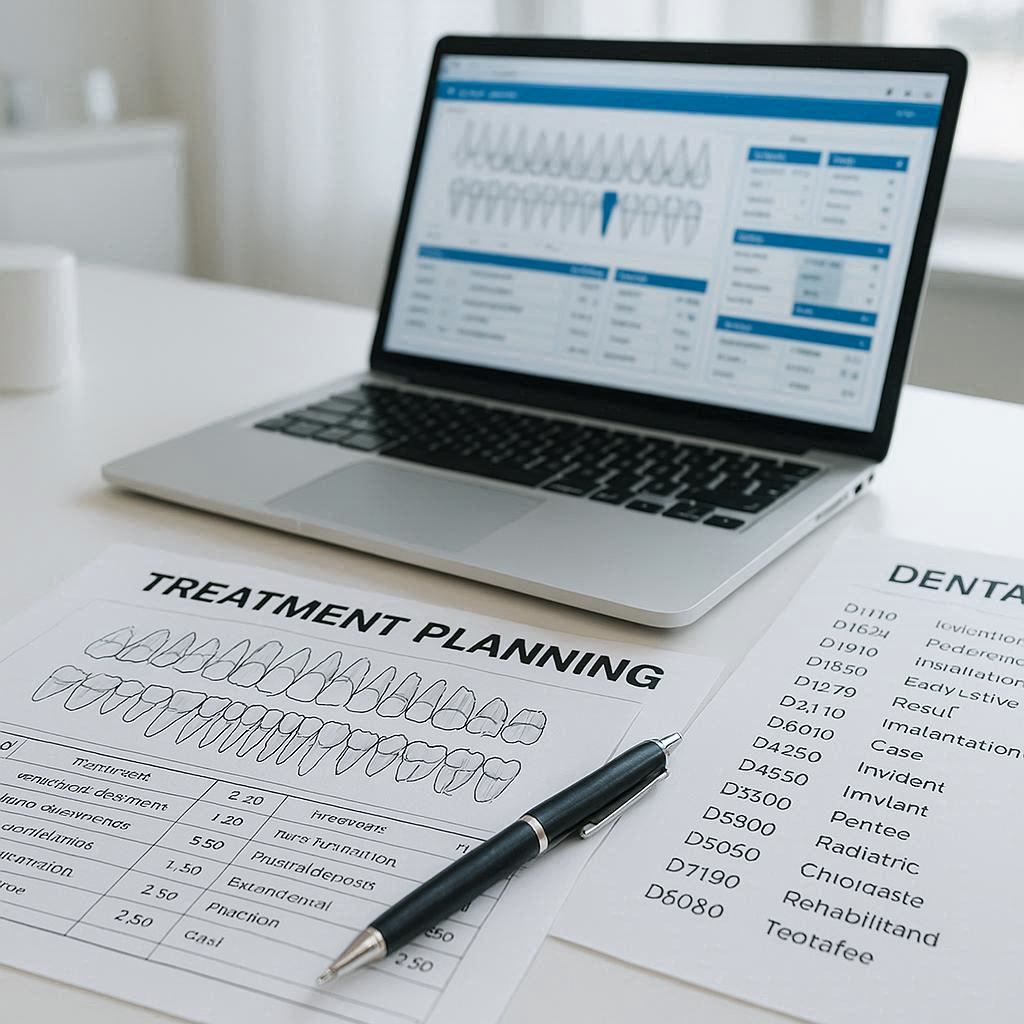
Why Treatment Planning Codes Matter More Than You Think
Treatment planning is the blueprint for patient care. Without a solid plan, procedures get done out of order, insurance benefits get wasted, and patients become confused.
But from a billing perspective, treatment planning codes serve a different purpose. They document the cognitive work your team performs. They justify the medical necessity for future procedures. And they help track the complexity of cases over time.
Here is a simple truth: many practices leave money on the table because they do not properly code for treatment planning activities. They assume these codes are not worth the effort. Or they worry about audits.
Neither fear is justified when you use the codes correctly.
What Counts as Treatment Planning in Dental Coding?
Treatment planning involves more than just listing procedures. The dental code for treatment planning typically covers:
- Reviewing diagnostic data (X-rays, photos, models)
- Evaluating multiple treatment options
- Coordinating care across specialties
- Presenting the plan to the patient
- Obtaining informed consent
- Modifying the plan based on medical conditions
Each of these activities may fall under a specific code depending on the situation.
The Main Dental Codes for Treatment Planning
Let us look at the most relevant codes from the Current Dental Terminology (CDT) code set. These are the ones you will use most often.
D0160 – Detailed and Extensive Oral Evaluation
This is often the closest thing to a dedicated treatment planning code. D0160 is used when a patient requires a comprehensive evaluation that goes beyond a routine checkup.
Typical uses include:
- New patients with complex medical histories
- Patients requiring full-mouth reconstruction
- Cases involving significant periodontal disease
- Pre-orthodontic evaluations with treatment planning
The key here is the word “detailed.” You are not just looking at teeth. You are analyzing how everything fits together and documenting a specific plan of action.
Note from the field: Many auditors look for detailed narrative notes when you bill D0160. Simply writing “treatment plan discussed” is not enough. Document the number of options reviewed, the risks and benefits discussed, and the final agreed-upon sequence.
D0191 – Assessment of a Patient
This code is newer and often misunderstood. D0191 covers a focused assessment that leads directly to a treatment plan. It is shorter than D0160 but more involved than a problem-focused exam.
Use D0191 when:
- A patient comes in with a specific chief complaint
- You need to create a treatment plan for that single issue
- The plan involves only one or two procedures
- You are not doing a full comprehensive exam
For example, a patient calls with severe tooth pain. You take a periapical X-ray, diagnose an irreversible pulpitis, and plan a root canal. D0191 fits this scenario perfectly.
D0999 – Unspecified Diagnostic Procedure
This is a catch-all code. Use it only when no other code accurately describes the diagnostic or treatment planning service you performed.
Because it is unspecified, many payers will deny it automatically. Reserve D0999 for rare situations, such as:
- Consulting with a specialist on a patient’s behalf (without an exam)
- Extensive care coordination across multiple providers
- Researching unusual medical-dental interactions for a treatment plan
Most practices will use this code less than five times per year. If you find yourself using it weekly, review your coding habits.
Comparative Table: Treatment Planning Codes at a Glance
| CDT Code | Description | Best For | Typical Reimbursement |
|---|---|---|---|
| D0160 | Detailed and extensive oral evaluation | Complex cases, full-mouth rehab, new patients with high needs | Varies by plan, often 2–3x a basic exam |
| D0191 | Assessment of a patient | Single chief complaint, focused treatment plan | Low to moderate, similar to a limited exam |
| D0999 | Unspecified diagnostic procedure | Rare, catch-all scenarios | Very low, often denied |
| D0150 | Comprehensive oral evaluation | Routine new patients, baseline treatment plans | Standard exam fee |
| D0145 | Oral evaluation for a patient under 3 years | Pediatric treatment planning | Low, but important for early intervention |
Important note: D0150 (comprehensive oral evaluation) is often used as a default treatment planning code. However, for truly complex cases requiring extensive documentation and multiple visits, D0160 may be more appropriate.
How to Document Treatment Planning Correctly
You can use the right code, but if your notes do not support it, you will face denials or audits. Good documentation is your best defense.
Essential Elements for Every Treatment Plan Note
Include these five items every time:
- Chief complaint or reason for the visit – Even if the patient is asymptomatic, state that clearly.
- Diagnostic data reviewed – List X-rays, photos, models, or previous records.
- Clinical findings – Describe what you saw, measured, or tested.
- Options presented – List at least two reasonable treatment options (even if one is no treatment or monitoring).
- Patient decision – Note which option the patient chose and why.
Here is a short example of a strong note:
*Patient presents for treatment planning following recent full periodontal charting. Reviewed FMX from 04/01/2026. Clinical findings show generalized 5–6mm pockets with bleeding on probing at sites #3, #14, #19, #30. Presented three options: (1) scaling and root planing with 3-month recall, (2) referral for periodontal surgery on deep sites, (3) continued monitoring with improved home care. Patient chooses option 1. Risks and benefits discussed. Treatment plan sequenced over four appointments starting 04/22/2026.*
That note supports either D0160 or D0191 depending on the complexity.
Common Documentation Mistakes
Avoid these errors that trigger denials:
- Vague language like “treatment plan reviewed” with no details
- Missing patient consent or decision documentation
- No mention of alternative options
- Failing to link the plan to diagnostic findings
- Using a treatment planning code with no corresponding diagnostic data
Billing and Reimbursement Realities
Let us be honest. Insurance companies do not always pay for treatment planning codes enthusiastically. Some plans bundle treatment planning into the cost of procedures. Others require specific medical necessity language.
When Will Insurance Pay for Treatment Planning?
You have the best chance of reimbursement when:
- The treatment plan leads to extensive, high-cost procedures (crowns, bridges, implants, full dentures)
- The patient has a medical condition that complicates dental care (diabetes, heart disease, bleeding disorders)
- You are coordinating with physicians or other specialists
- The plan involves multiple phases over more than six months
Some payers will reimburse D0160 at 60–80% of your standard fee. Others will deny it outright and say “included in comprehensive exam.”
Do not let denials frustrate you. Instead, see them as information. If a particular plan never pays for treatment planning codes, you may choose to:
- Bill a lower-level code (like D0150) instead
- Educate the patient that planning time is not covered
- Absorb the cost as patient education
How to Appeal a Denial
If you believe a treatment planning code should be paid, write a short appeal letter. Include:
- A copy of your detailed clinical note
- The relevant CDT code definition
- A one-paragraph explanation of why the case required extra planning time
Many appeals succeed because most denials are automatic, not reviewed by a human.
Treatment Planning for Specific Scenarios
Different clinical situations call for different coding approaches. Let us walk through common cases.
Full-Mouth Rehabilitation
This is the classic use case for D0160. The patient needs work on most or all teeth. The treatment plan may span 12–24 months.
Your coding strategy:
- Bill D0160 at the initial treatment planning appointment
- Document all diagnostic data (panoramic X-ray, photos, mounted models)
- Note the sequence of care (e.g., phase 1: periodontal therapy, phase 2: restorations, phase 3: prosthetics)
- If the plan changes later, document a new treatment planning code
Single-Tooth Implant
A patient needs one implant. The treatment plan is straightforward but involves multiple steps and specialists.
Consider using D0191 for the initial planning appointment. Then, if the case becomes more complex (bone grafting needed, sinus lift, coordination with oral surgeon), upgrade to D0160.
Pediatric Early Intervention
For a child under 6 with significant decay, you may need to plan treatment under sedation or general anesthesia.
Code D0145 (oral evaluation for a patient under 3 years) or D0150 for older children. Add a narrative explaining the complexity of sequencing treatment for a young, anxious patient.
Geriatric or Medically Complex Patient
Patients with dementia, Parkinson’s, or stroke history require extra planning. You may need to coordinate with caregivers, physicians, and social workers.
This justifies D0160 even if the dental treatment itself is simple. The planning time is what matters.
Frequently Asked Questions (FAQ)
1. Can I bill a treatment planning code at every visit?
No. Treatment planning codes are for initial planning or major plan revisions. Routine follow-ups do not qualify.
2. What is the difference between D0150 and D0160?
D0150 is a comprehensive exam for most new patients. D0160 is for detailed, extensive evaluations requiring significantly more time and documentation.
3. Does Medicare cover dental treatment planning?
Original Medicare does not cover routine dental care or treatment planning. Some Medicare Advantage plans with dental benefits may cover it under specific circumstances.
4. Can I use D0999 for treatment planning?
Only as a last resort when no other code fits. Most payers will deny it without a very strong narrative.
5. How do I code treatment planning that happens over the phone or via telehealth?
Check your local regulations. Some regions allow D9995 (telehealth synchronous) for treatment planning discussions. Document the time spent and the plan created.
6. What if the patient does not accept the treatment plan?
You can still bill for the treatment planning code. The code covers your work in creating the plan, not the patient’s acceptance.
7. Should I bill treatment planning and a comprehensive exam on the same day?
Usually not. The treatment planning is considered part of the exam. However, if the exam happens on one day and a separate, extensive planning session on another day, you may bill separately.
8. What is the average fee for D0160?
Fees vary widely by region and insurance. Typical private pay fees range from $150 to $350. Insurance allowed amounts may be lower.
9. Do I need a separate treatment planning code for orthodontics?
Orthodontic practices often use D0160 or D0150 for the initial records and planning appointment. Some orthodontic-specific codes exist for appliances, but treatment planning itself uses the same evaluation codes.
10. Can a dental hygienist document treatment planning?
In most regions, the diagnosing and treatment planning must be done by the dentist. Hygienists can collect data and document findings, but the final plan and code should be under the dentist’s supervision.
Additional Resources
For the most current CDT codes and official guidelines, refer to the American Dental Association’s CDT manual. You can access it here:
🔗 ADA CDT Code on Dental Coding (external link, opens in new tab)
Pro tip: Bookmark the ADA’s coding resource page. They update codes every year, and small changes can affect your reimbursement.
Practical Tips for Your Dental Team
Getting treatment planning codes right is a team effort. Here is how to build a smooth workflow.
For Front Desk Staff
- Ask patients if they have had a treatment plan before
- Verify insurance coverage for evaluation codes before the visit
- Schedule longer appointments for D0160 (45–60 minutes minimum)
- Collect copays or deductibles based on your standard fee, not the insurance prediction
For Dental Assistants
- Prepare all diagnostic data before the dentist enters the room
- Have treatment plan forms ready with common options listed
- Take photos or scans that show the current condition clearly
- Document the patient’s questions and concerns verbatim
For Dentists
- Dictate or write your treatment plan note immediately after the patient leaves
- Include the specific code you plan to bill in the note
- Review denied claims monthly to spot patterns
- Train regularly on new CDT codes
The Future of Dental Treatment Planning Codes
The CDT code set changes every year. Recent trends show a move toward valuing cognitive services more highly. That means treatment planning codes may become more recognized and better reimbursed over time.
Watch for these potential developments:
- New codes specifically for care coordination
- Separate codes for teledentistry treatment planning
- Higher relative value units for complex medical-dental planning
- Bundled payments that include planning with procedure packages
For now, use the existing codes with confidence. Document thoroughly. Appeal denials when justified. And always put the patient’s understanding and safety first.
Conclusion
The dental code for treatment planning is not one single number. It is a set of tools including D0160 for complex cases, D0191 for focused planning, and rarely D0999 as a catch-all. Choose the code based on the time, complexity, and documentation required. Document every plan with clear options, patient decisions, and clinical justification. Use the comparative table in this guide as a quick reference. Master these codes, and you will reduce denials, get paid fairly for your cognitive work, and create better treatment plans for your patients.
Final Checklist Before You Bill
✅ Did you document the chief complaint or reason for planning?
✅ Did you list the diagnostic data reviewed?
✅ Did you present at least two treatment options?
✅ Did you record the patient’s choice and consent?
✅ Did you choose the code that best fits the complexity (D0160, D0191, or D0150)?
✅ Did you avoid D0999 unless absolutely necessary?
✅ Did you check insurance coverage before the visit?