Walking out of a dentist’s office with a treatment plan in your hand can sometimes feel like you are trying to decipher a secret language. You see a list of teeth numbers, letters like “MOD,” and a string of numbers next to a price that makes your eyes widen. If you have been told you need a filling, you have likely encountered the term “dental code.”
Understanding these codes is not just about satisfying curiosity. It is about taking control of your dental health and your wallet. When you understand what your dentist is billing for, you can verify your insurance claims, avoid unexpected bills, and have a more informed conversation with your dental provider.
In this guide, we will strip away the confusion surrounding the dental code for fillings. We will look at why there isn’t just one code, how materials affect the price, and what those strange acronyms like “MO” and “DO” actually mean.
Dental Codes for Fillings
Table of Contents
ToggleWhy Dental Codes Matter
Dental codes, officially known as CDT (Current Dental Terminology) codes, are the universal language used by dentists and insurance companies. Every single procedure, from a routine cleaning to a complex root canal, has a specific code. These codes tell your insurance company exactly what work was done, where it was done, and what material was used.
For fillings, the codes are incredibly specific. You might wonder why a small filling in one tooth costs a different amount than a filling in another tooth. It all comes down to the location of the decay and the number of tooth surfaces that are involved.
The Anatomy of a Tooth Surface
To truly understand the dental code for fillings, you first need to understand the geography of your tooth. Dentists divide teeth into surfaces. When a filling code includes letters, it is describing which of these surfaces are being repaired.
-
Occlusal (O): This is the chewing surface of the back teeth (molars and premolars).
-
Mesial (M): This is the front surface of the tooth, facing towards the midline of your mouth.
-
Distal (D): This is the back surface of the tooth, facing away from the midline.
-
Buccal (B): This is the surface of the tooth facing the cheek (for back teeth).
-
Lingual (L): This is the surface of the tooth facing the tongue (for lower teeth).
-
Palatal (P): Similar to Lingual, but for upper teeth, facing the roof of the mouth.
-
Incisal (I): This is the biting edge of the front teeth (incisors and canines).
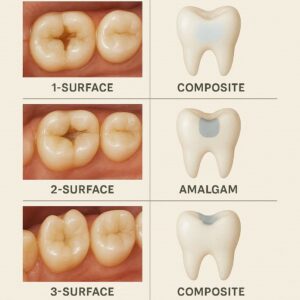
When you see a code like “D2391” followed by a description, it is often just the start. However, the complexity—and the cost—increases when a filling covers multiple surfaces. A “MO” filling covers the Mesial and Occlusal surfaces. A “MOD” filling covers the Mesial, Occlusal, and Distal surfaces. This is often referred to as a “three-surface filling” and is a much more involved procedure than a simple one-surface filling.
The Main Categories: Anterior vs. Posterior
Before we dive into the specific numbers, it is important to know that dental codes are split primarily by the location of the tooth. There are codes for anterior teeth (your front teeth—incisors and canines) and posterior teeth (your back teeth—premolars and molars).
Furthermore, codes are divided by the material used. Historically, the main distinction was between amalgam (silver fillings) and resin-based composite (tooth-colored fillings). While amalgam is still used in some practices, composite resins have become the standard for most direct restorations.
The Comprehensive List: Dental Codes for Fillings
Let us break down the specific codes you will most likely see on your treatment plan. These codes are standardized across North America. Keep in mind that the price associated with these codes varies depending on your geographic location and the specific dentist’s fee schedule.
Resin-Based Composite Fillings (Tooth-Colored)
These are the most common fillings today. They bond directly to the tooth structure, are aesthetically pleasing, and require less removal of healthy tooth structure compared to amalgam.
Anterior (Front Teeth) Codes
These codes apply to teeth #6 through #11 (upper front) and #22 through #27 (lower front).
-
D2330: Resin-based composite crown, anterior, one surface.
-
What it means: A small filling on a front tooth involving only one surface (usually the back side or the biting edge).
-
-
D2331: Resin-based composite crown, anterior, two surfaces.
-
What it means: A filling on a front tooth that covers two surfaces (e.g., Mesial and Incisal).
-
-
D2332: Resin-based composite crown, anterior, three surfaces.
-
What it means: A larger filling on a front tooth covering three surfaces.
-
-
D2335: Resin-based composite crown, anterior, four or more surfaces.
-
What it means: This is an extensive filling that covers most of the visible part of the front tooth. It is often used when a tooth has significant decay or damage, functioning almost like a crown but made of composite material.
-
Posterior (Back Teeth) Codes
These codes apply to premolars (bicuspids) and molars. This is where you will see the most variation based on size.
-
D2390: Resin-based composite crown, posterior, three-quarter.
-
What it means: This is a specific code for a large composite restoration that covers most of the back tooth, but not the entire biting surface. It is less common than the surface-specific codes below.
-
-
D2391: Resin-based composite, posterior, one surface.
-
What it means: A small filling on a back tooth, usually limited to the Occlusal (chewing) surface.
-
-
D2392: Resin-based composite, posterior, two surfaces.
-
What it means: A filling covering two surfaces, such as Mesial-Occlusal (MO) or Distal-Occlusal (DO).
-
-
D2393: Resin-based composite, posterior, three surfaces.
-
What it means: A filling covering three surfaces, such as Mesial-Occlusal-Distal (MOD). This is a significant restoration.
-
-
D2394: Resin-based composite, posterior, four or more surfaces.
-
What it means: The largest direct composite filling. This covers four or more surfaces of the tooth. If a tooth needs this much work, a dentist may also discuss the option of a full-coverage crown (D2740) as an alternative.
-
Amalgam Fillings (Silver)
While less common today due to aesthetic preferences and concerns about mercury content (though the ADA maintains they are safe), amalgam fillings are known for their durability and lower cost. They have their own set of codes.
Anterior (Front Teeth) Amalgam
-
D2140: Amalgam, one surface, anterior.
-
D2150: Amalgam, two surfaces, anterior.
-
D2160: Amalgam, three surfaces, anterior.
-
D2161: Amalgam, four or more surfaces, anterior.
Posterior (Back Teeth) Amalgam
-
D2140: Wait, careful. Actually, the anterior codes are D2140-2161. Posterior amalgam codes start at D2150? Let’s clarify properly.
The standard CDT codes for amalgam are distinct:
-
D2140: Amalgam, one surface, primary or permanent (anterior).
-
D2150: Amalgam, two surfaces, primary or permanent (anterior).
-
D2160: Amalgam, three surfaces, primary or permanent (anterior).
-
D2161: Amalgam, four or more surfaces, primary or permanent (anterior).
For posterior teeth (premolars and molars):
-
D2160: Wait—this creates confusion.
Let’s correct the standard sequence accurately:
Correct Standard CDT Codes for Amalgam Restorations:
For Anterior (Front) Teeth:
-
D2140: Amalgam, one surface, anterior.
-
D2150: Amalgam, two surfaces, anterior.
-
D2160: Amalgam, three surfaces, anterior.
-
D2161: Amalgam, four or more surfaces, anterior.
For Posterior (Back) Teeth:
-
D2162: Amalgam, one surface, posterior.
-
D2163: Amalgam, two surfaces, posterior.
-
D2164: Amalgam, three surfaces, posterior.
-
D2165: Amalgam, four or more surfaces, posterior.
This separation ensures that insurance companies know exactly whether the work was done on a visible front tooth or a durable back tooth.
Comparative Table: Resin vs. Amalgam Codes
To help you visualize the difference, here is a quick reference table comparing the most common composite and amalgam codes for posterior teeth.
| Number of Surfaces | Composite Code (Posterior) | Amalgam Code (Posterior) | Typical Complexity |
|---|---|---|---|
| 1 Surface | D2391 | D2162 | Small pit or fissure decay. |
| 2 Surfaces | D2392 | D2163 | Decay between teeth (MO or DO). |
| 3 Surfaces | D2393 | D2164 | Large decay crossing the tooth (MOD). |
| 4+ Surfaces | D2394 | D2165 | Extensive decay; often alternative to crown. |
The “Other” Codes: Beyond the Standard Filling
Sometimes, a standard filling code isn’t appropriate. There are situations where the tooth is so broken down that a simple filling won’t hold, or where the decay is so close to the nerve that the dentist must take extra steps. Here are a few additional codes you might encounter.
Sedative Fillings (D2940)
If you have a tooth that is deeply decayed and sensitive, your dentist might place a “sedative” or “temporary” filling. This is often used to calm the nerve and determine if the tooth will heal or if it requires a root canal.
-
D2940: Protective restoration.
-
What it means: This is a temporary or intermediate filling designed to sedate the nerve or protect the tooth until a definitive restoration (like a permanent filling or crown) can be placed. It is not a final solution.
-
Core Buildup (D2950)
This is a code that often confuses patients. If a tooth is severely broken down—perhaps it had a large old filling or a crack—the dentist may need to rebuild the foundation of the tooth before placing a crown.
-
D2950: Core buildup, including any pins.
-
What it means: This is not a filling. It is the reconstruction of the internal structure of the tooth to support a crown. If you see this code, it usually means you are getting a crown (cap) on that tooth. The “core” is the base that holds the crown on.
-
Inlays and Onlays (Indirect Restorations)
Sometimes, a tooth is too damaged for a regular filling but not damaged enough for a full crown. In this case, a dentist may use an inlay or onlay. Unlike direct fillings that are placed and hardened in your mouth in one visit, inlays and onlays are fabricated in a dental lab and cemented in during a second visit.
-
D2610 – D2660: These codes cover inlays and onlays made of gold, porcelain, or ceramic. They are considered a premium restoration and are usually more expensive than direct composite fillings.
How Insurance Interprets Filling Codes
Understanding the dental code for fillings is only half the battle. The other half is understanding how your dental insurance views these codes. Insurance companies do not always pay for the material you want. They often have a policy called the “least expensive alternative treatment” (LEAT).
The Composite vs. Amalgam Dilemma
Many insurance plans, especially older or lower-tier PPO plans, will only reimburse for the cost of an amalgam (silver) filling, even if you and your dentist opt for a composite (tooth-colored) filling.
Here is how it usually works:
-
Your dentist diagnoses a cavity on a back tooth.
-
You prefer a tooth-colored composite filling (D2392).
-
Your insurance plan says, “We will cover a silver filling (D2163) for this tooth.”
-
The insurance pays its portion based on the lower-cost silver code.
-
You are responsible for the difference in cost between the composite code and the amalgam code, plus your copay/deductible.
Important Note: This is often called a “downgrade.” Before scheduling a large filling procedure, it is wise to call your insurance company or ask your dentist’s front desk to provide a pre-treatment estimate. This estimate will tell you exactly how much the insurance will pay based on the specific dental code for fillings they plan to use.
Frequency Limitations
Insurance companies also have frequency limitations. Typically, they will only pay for a filling on the same surface of the same tooth once every two to five years. If a filling fails before that time frame, the dentist must usually submit a narrative (a written explanation) to the insurance company proving that the filling failed due to decay or fracture, not just normal wear, to get the claim paid.
Reading Your Dental Claim Form
When you receive your Explanation of Benefits (EOB) from your insurance company, it will list the codes used. Here is a quick guide to decoding what you see:
| Code on EOB | Procedure | What to Check |
|---|---|---|
| D2391 | Composite 1-surf post | Ensure it matches the tooth number listed. Did they do one surface or two? |
| D2392 | Composite 2-surf post | Check for “Downgrade” notes. Did insurance pay at amalgam rate? |
| D2950 | Core Buildup | Is this paired with a crown code (D2740)? If not, question it. |
| D2330 | Composite 1-surf ant | Usually fully covered if it’s a front tooth (cosmetic downgrades rarely apply to front teeth). |
A Note on New Patient Exams and X-Rays
Before a dentist places a filling, they must diagnose the cavity. This involves a comprehensive exam and X-rays. You will often see these codes on your treatment plan before you see the filling codes.
-
D0150: Comprehensive oral evaluation (new patient).
-
D0210: Full mouth X-rays (panoramic and periapical).
-
D0270: Bitewing X-rays (single image) – often used to detect cavities between teeth.
If these diagnostic codes are missing from your treatment plan, but fillings are present, it may indicate that the exam and X-rays were done in a previous visit. Always ensure the diagnostic phase is complete before proceeding with restorative work.
The Cost Factor: Why Prices Vary
One of the most common questions people ask is, “Why does my friend pay $150 for a filling, but my dentist quoted me $300 for the same code?”
The answer lies in three factors:
-
Geographic Location: Dental fees in New York City are generally higher than in rural Alabama. Overhead costs dictate the fee schedule.
-
Dentist’s Expertise: A dentist who uses advanced technology (like laser dentistry or CAD/CAM same-day crowns) may charge a premium for their time and equipment.
-
The Code Complexity: A D2392 (two surfaces) on a simple premolar is less expensive than a D2392 on a difficult-to-access third molar (wisdom tooth), even though the code is the same. Some offices have separate “location” fees, though most bundle it into the code price.
Estimated Price Ranges (Without Insurance)
While prices vary widely, here is a rough estimate for out-of-pocket costs in the United States for composite fillings:
-
D2330 / D2391 (1 surface): $150 – $250
-
D2331 / D2392 (2 surfaces): $200 – $350
-
D2332 / D2393 (3 surfaces): $300 – $450
-
D2335 / D2394 (4+ surfaces): $400 – $600
Note: These prices typically do not include the exam or X-rays needed to diagnose the cavity.
Tips for Managing Your Filling Treatment Plan
Navigating the world of dental codes and insurance can feel overwhelming, but a little preparation goes a long way. Here are some practical tips to help you manage your treatment plan effectively.
1. Ask for a Pre-Treatment Estimate
If your treatment plan involves multiple fillings or large restorations (like MOD fillings), ask your dentist’s office to submit a pre-treatment estimate (predetermination) to your insurance. This is not a guarantee of payment, but it provides a clear estimate of what the insurance will cover and what your out-of-pocket cost will be before the work is done.
2. Verify the Codes Before Treatment
Before you sit in the chair, take a moment to look at the treatment plan. Ask the billing coordinator:
-
“Are these codes for composite or amalgam?”
-
“Will my insurance downgrade the posterior composites?”
-
“Is there a core buildup (D2950) included, and if so, why?”
3. Understand Your “Yearly Maximum”
Most dental insurance plans have an annual maximum (usually between $1,000 and $2,000). If you need three three-surface fillings, you might hit that maximum quickly. Understanding the cost of the dental code for fillings can help you prioritize treatment. Sometimes it is wise to do the largest filling in one calendar year and the others in the next to maximize insurance benefits.
4. Don’t Ignore Small Codes
If a dentist recommends a D2391 (one surface) filling, do not postpone it hoping it will go away. Decay spreads. A one-surface filling is minimally invasive, preserves tooth structure, and is the least expensive option. If you wait, that one-surface code could easily turn into a three-surface code (D2393), which is more expensive and weakens the tooth further.
Frequently Asked Questions (FAQ)
Q: Why did my dentist use a composite code (D2392) but my insurance says I owe more?
A: As mentioned in the “downgrade” section, your insurance likely only covers the cost of an amalgam (silver) filling for back teeth. They paid what they would pay for D2163 (amalgam two surfaces), leaving you responsible for the difference in price for the composite material.
Q: What is the difference between a filling code (D2391) and a crown code (D2740)?
A: A filling (direct restoration) is placed directly into the tooth while it is still mostly intact. A crown (indirect restoration) covers the entire tooth like a cap. If a dentist uses a D2394 (four or more surfaces), the tooth is very broken down. Sometimes, a crown is actually a better long-term solution than a massive filling, as it protects the tooth from fracturing.
Q: Can a dentist charge me for a code that wasn’t on my original treatment plan?
A: Yes, sometimes. If the dentist removes the decay and finds it is much larger than the X-ray showed, they may need to use a different code (e.g., upgrading from a two-surface to a three-surface filling). Ethically, they should inform you of this change before proceeding, or at least note it on the invoice. If you are concerned about a surprise bill, discuss this possibility with your dentist beforehand.
Q: What is the dental code for a filling replacement?
A: There is no specific code for “replacement.” The code used is the same as for a new filling (e.g., D2392). However, the dentist must usually include a note in the claim indicating that the filling was replaced due to recurrent decay or fracture. If a filling is replaced simply because it is old and stained (for cosmetic reasons), insurance usually will not cover it.
Q: Are sealants (D1351) the same as fillings?
A: No. Sealants are preventive codes. They are placed on the deep grooves of healthy teeth (usually molars in children) to prevent cavities. A filling code is used to repair a tooth that already has decay. Sealants are much less expensive and often fully covered by insurance for children up to a certain age.
Additional Resources
For those looking to dive deeper into dental coding standards, the best resource is the official manual published by the American Dental Association (ADA).
-
Link: CDT Code Book
-
Note: This link directs to the official ADA store where you can purchase the Current Dental Terminology (CDT) manual. This is the definitive source for all dental codes and their official descriptions. It is updated annually.
-
Conclusion
Understanding the dental code for fillings is a powerful tool. It transforms a confusing bill into a transparent map of your oral health. By recognizing the differences between codes like D2391 and D2393, understanding the implications of amalgam versus composite, and knowing how to read your insurance claim, you place yourself in the driver’s seat of your dental care.
Remember, a code is more than just a number—it tells the story of your tooth’s health, the complexity of the procedure, and the materials used to restore your smile. Don’t be afraid to ask your dental provider to walk you through the codes on your treatment plan. A good dental team will appreciate your engagement and will be happy to clarify any questions you have, ensuring that you feel confident and informed every step of the way.
Disclaimer: This article is for informational purposes only and does not constitute medical or financial advice. Dental codes, insurance policies, and fee schedules vary by provider and location. Always consult with your dentist and insurance provider for specific information regarding your treatment plan and coverage.