If you have ever squinted at a dental bill, trying to figure out why a specific charge looks like a secret mathematical formula, you are not alone. Dental insurance and billing operate on a very specific language known as the Current Dental Terminology (CDT) code set. Among the most common questions patients ask is about the dental code for intraoral services.
Whether you are getting a routine check-up, a specific X-ray, or a high-tech 3D scan, there is a specific code attached to it. Understanding these codes isn’t just about satisfying curiosity; it is about taking control of your oral health budget and ensuring you are getting the care you paid for.
In this guide, we will walk through the most frequently used intraoral codes, explain what they mean, how they differ from one another, and why your dentist recommends them. We will keep things friendly, simple, and packed with real-world insights so you can walk into your next appointment feeling like an expert.
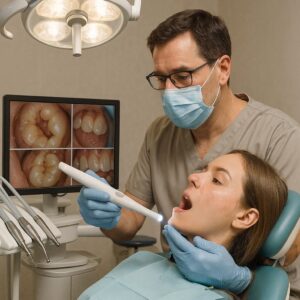
Dental Codes for Intraoral Procedures
What Does “Intraoral” Really Mean?
Before we dive into the numbers, let’s establish a baseline. In dentistry, “intraoral” simply means “inside the mouth.” When you hear your dentist or hygienist mention an intraoral procedure, they are referring to any examination, imaging, or treatment that takes place within the oral cavity.
This is a broad category. It covers everything from the basic visual examination your dentist performs with a small mirror to complex surgical procedures. However, in the context of billing and insurance codes, the term “intraoral” is most frequently associated with imaging and X-rays.
When insurance companies or dental offices talk about “intraoral codes,” they are usually referring to the specific codes that cover images taken from inside your mouth. These are the films or digital sensors you bite down on, or the small camera that captures a detailed picture of a single tooth.
Why Do Codes Matter to You?
You might think that codes are only for the person behind the front desk, but understanding them is a form of financial literacy. When you know what a code represents, you can:
-
Verify that your insurance claim matches the work done.
-
Compare treatment plans from different dentists fairly.
-
Understand why a specific X-ray is needed (and why it costs what it does).
-
Catch billing errors before they become big headaches.
Let’s look at the most common categories of intraoral codes you will encounter.
The Core Categories of Intraoral Imaging Codes
In the CDT manual, intraoral imaging codes fall under the “Diagnostic” section. These are typically categorized by the type of image and the number of images taken. Here are the primary groups you need to know.
Bitewing X-Rays (D0270 – D0277)
If you have ever had to bite down on a piece of plastic or paper tab while a machine hummed next to your cheek, you have experienced a bitewing X-ray. These are the backbone of preventive dentistry. They are designed to spot cavities between teeth (interproximal caries) and check the height of the bone supporting your teeth.
The codes here vary based on how many images are taken.
| Code | Description | When It’s Used |
|---|---|---|
| D0270 | Bitewing – Single Film | Used occasionally for a specific area if a patient is monitoring one specific spot. |
| D0272 | Bitewings – Two Films | Less common today, but used for patients with very few teeth or specific partial views. |
| D0273 | Bitewings – Three Films | A standard set for many adults, covering the back teeth on both sides. |
| D0274 | Bitewings – Four Films | The most common adult set. Four films capture the premolars and molars thoroughly. |
| D0277 | Vertical Bitewings – Seven to Eight Films | A specialized series used primarily by periodontists (gum specialists) to view bone levels in greater detail. |
Note: Most insurance plans cover a full set of bitewings (usually D0274) once or twice a year. If you see a charge for D0272, it might be because the dentist is only updating a specific section of your mouth.
Periapical X-Rays (D0220 & D0230)
While bitewings show the crowns of the teeth (the part you see), periapical X-rays show the entire tooth—from the crown all the way down to the root and the surrounding bone. “Periapical” literally means “around the apex” (the tip of the root).
These are the images your dentist takes when you have a toothache, a suspected abscess, or if they are monitoring a root canal.
-
D0220 – Intraoral – Periapical First Film: This code is used when the dentist takes a single X-ray of a specific tooth. For example, if you came in complaining that tooth number 19 hurts, the dentist might take one periapical film just of that tooth.
-
D0230 – Intraoral – Periapical Each Additional Film: This is the “add-on” code. If the dentist needs to take X-rays of two, three, or four specific teeth, they will bill D0220 for the first one, and then D0230 for each film after that.
A common scenario: If a dentist takes three periapical X-rays, the bill will read: D0220 (1x) and D0230 (2x). It is important to note that these are individual images, not a full-mouth series.
Full Mouth Series (FMX) – D0210
When a new patient joins a practice, or when a dentist needs a comprehensive baseline of a patient’s oral health, they often take a “Full Mouth Series” (FMX).
-
D0210 – Intraoral – Complete Series (including bitewings): This code covers a combination of periapical and bitewing images that capture every tooth in the mouth. Typically, this involves 14 to 20 images.
Insurance companies treat the FMX differently than individual X-rays. Because it is a comprehensive diagnostic tool, it is usually a covered benefit once every three to five years. If you see D0210 on your bill, you are essentially getting a full map of your dental landscape.
Panoramic X-Ray (D0330)
Technically, is a panoramic X-ray intraoral? No. The sensor or film is extraoral (outside the mouth), rotating around the head. However, it is frequently grouped with intraoral codes in treatment planning discussions because it serves a similar diagnostic purpose.
-
D0330 – Panoramic Radiographic Image: This is the “panorex” or “pan.” It gives a broad view of the entire jaw, sinuses, and teeth in one single image. It is excellent for seeing wisdom teeth, impacted teeth, and general bone structure. While it doesn’t show fine details like cavities between teeth (which bitewings do), it is invaluable for surgical planning.
The Rise of 3D Imaging: CBCT Codes
In recent years, dental technology has advanced rapidly. If your dentist has recommended an implant, a wisdom tooth extraction, or a root canal, you might hear them mention a “CBCT” scan.
CBCT stands for Cone Beam Computed Tomography. It is a 3D scan that provides a three-dimensional view of your teeth, nerves, bone, and soft tissues. This is a game-changer for complex procedures because it allows the dentist to see exactly where vital structures like nerves and sinuses are located before they make a single cut.
The codes for these scans are specific and are often referred to as “intraoral” codes because they image the oral and maxillofacial region, even though the machine does not go inside the mouth.
-
D0364 – Cone Beam CT – Craniofacial (with field of view less than one full jaw): This is used for focused areas, such as evaluating a single tooth for a root canal or a small area for an implant.
-
D0365 – Cone Beam CT – Craniofacial (with field of view covering one full jaw): As the name suggests, this captures an entire arch (upper or lower jaw) in 3D.
-
D0366 – Cone Beam CT – Craniofacial (with field of view covering both jaws with or without the cranium): This is the full monty—both jaws and often the sinuses and upper facial bones. This is commonly used for full-mouth reconstruction or complex orthodontic surgery planning.
-
D0367 – Cone Beam CT – Craniofacial (for evaluation of airway): This is a specialized scan used by sleep dentists and orthodontists to evaluate the airway for sleep apnea or breathing issues.
Why These Codes Are Different
Unlike standard X-rays, CBCT scans are not always covered by insurance, or they may have a very high deductible attached to them. Because they represent a significant investment in technology and safety (lower radiation than medical CTs, but higher than standard dental X-rays), dentists usually discuss these costs with you upfront.
Beyond X-Rays: Other Intraoral Diagnostic Codes
Imaging isn’t the only thing that falls under diagnostic intraoral codes. There are also codes for the physical examination itself.
The Comprehensive Oral Evaluation (D0150) vs. The Periodic Exam (D0120)
When you sit in the chair and the dentist looks in your mouth, that is an “evaluation.” However, the code changes based on the context.
-
D0120 – Periodic Oral Evaluation: This is your “check-up” code. It is used for an established patient of record. It involves a visual examination to check for cavities, gum disease, and existing restorations. This is typically done once every six months.
-
D0150 – Comprehensive Oral Evaluation: This is used for new patients, or for established patients who have had a significant change in their health status (like a major surgery or illness) or who haven’t been seen in over three years. It is a much more detailed assessment, often involving a full medical history review, periodontal charting, and a detailed head and neck exam.
-
D0140 – Limited Oral Evaluation: This is the “emergency” code. If you call up because a tooth is hurting, and the dentist sees you specifically for that problem (and not for a full check-up), they will likely bill D0140.
Intraoral Photography (D0350)
Have you ever had a dentist use a small camera to take a close-up picture of a cracked tooth or a suspicious lesion? That is intraoral photography.
-
D0350 – Oral/Facial Photographic Images: This code covers the use of a camera to document conditions inside the mouth. While not always covered by insurance, it is an excellent tool for patient education and for tracking changes in soft tissue over time.
How to Read Your Dental Bill Like a Pro
Now that we have covered the main codes, let’s talk about how they appear on a statement. A dental bill usually has a few columns:
-
Date of Service: When the work was done.
-
Code (CDT): The number we have been discussing.
-
Description: A short name for the code.
-
Fee: The total cost of the service.
-
Insurance Payment: What the insurance company paid.
-
Patient Responsibility: What you owe.
Why the “Description” Can Be Misleading
Sometimes, the description on your insurance explanation of benefits (EOB) might be very generic. For example, it might just say “Intraoral X-ray” without specifying if it was a periapical or a bitewing. If you ever see a generic description and you aren’t sure what you received, call the office. A good front office team will happily explain, “Yes, that was the X-ray of your wisdom tooth, code D0220.”
Common Billing Scenarios
Let’s walk through a few realistic scenarios to see how these codes come together.
Scenario 1: The Routine Cleaning
-
D0120: Periodic Oral Evaluation (The check-up)
-
D1110: Prophylaxis (Adult cleaning)
-
D0274: Four Bitewing X-rays (The standard set)
Scenario 2: The New Patient Appointment
-
D0150: Comprehensive Oral Evaluation (Detailed new patient exam)
-
D0210: Full Mouth Series (Complete set of X-rays)
-
D1110 or D4346: Prophylaxis or Scaling (Cleaning, depending on gum health)
Scenario 3: The Emergency Toothache
-
D0140: Limited Oral Evaluation (Focused only on the problem area)
-
D0220: Intraoral – Periapical First Film (X-ray of the hurting tooth)
-
D0230: Additional film if a second view was needed.
Insurance Coverage: What Is Usually Included?
Understanding the codes is one thing; understanding how insurance views them is another. Most dental insurance plans operate on a 100-80-50 structure:
-
100%: Preventive care (Cleanings, exams, bitewing X-rays).
-
80%: Basic procedures (Fillings, simple extractions, periapical X-rays in some cases).
-
50%: Major procedures (Crowns, bridges, implants, CBCT scans).
Frequency Limitations
Insurance companies love frequency limitations. They will usually pay for:
-
D0274 (Bitewings): Once every 6 to 12 months.
-
D0210 (FMX): Once every 3 to 5 years.
-
D0150 (Comprehensive Exam): Once every 3 years (or for new patients only).
-
D0120 (Periodic Exam): Once every 6 months.
If you try to get a set of bitewings after 5 months, the insurance will likely deny the claim, leaving the full fee up to you. This is why your dental office usually tracks these dates carefully to maximize your benefits.
A Closer Look at Advanced Intraoral Technology
While traditional film or digital sensors are still the standard, many modern offices are adopting newer technologies that fall under these same code families.
Intraoral Scanners (Not to be Confused with X-Rays)
You might hear about “intraoral scanners” like iTero or 3Shape. These are used to take digital impressions for crowns, aligners (like Invisalign), and retainers. Interestingly, these usually do not fall under the “diagnostic” codes like D0350. Instead, they are bundled into the treatment codes.
For example, if you are getting a crown, the digital scan is not billed separately; it is part of the crown code (D2740 – Crown – Porcelain/Ceramic). If you are getting a scan for orthodontics, it is usually bundled into the orthodontic case fee.
The Difference Between D0350 (Photo) and D0460 (Pulp Vitality)
Another code worth mentioning is D0460 – Pulp Vitality Test. This is not an X-ray, but a diagnostic procedure where the dentist uses cold or an electric pulp tester to see if a tooth nerve is alive or dead. If you have a toothache and the dentist is trying to figure out if you need a root canal, they may perform this test and bill it separately. It is an intraoral diagnostic procedure that does not involve imaging.
Protecting Yourself: Questions to Ask Your Dentist
If you are presented with a treatment plan that uses these codes, do not be shy about asking questions. A trustworthy dental team expects this and welcomes the conversation.
Here are three questions you should always ask:
-
“Is this X-ray necessary for my diagnosis, or is it a routine preventive measure?”
This helps you distinguish between a covered preventive code (like D0274) and a diagnostic code that might be subject to your deductible (like D0364). -
“Is there a different code that my insurance might prefer for this situation?”
Sometimes, if a dentist uses D0365 (one jaw CBCT), but only needs a smaller area, they might be able to use D0364, which could be priced differently or have a different insurance allowance. -
“Can you show me the images?”
This is a great way to verify that the work was done. If you are charged for a Full Mouth Series (D0210), you should expect to see a grid of 14 to 20 images. If you only see 4 bitewings, something doesn’t match.
Why Dentists Recommend Certain Codes
From a dentist’s perspective, choosing the correct code is a matter of ethics and legality. Upcoding (billing for a more expensive code than what was performed) is insurance fraud. Downcoding (using a cheaper code to get insurance to pay) can also be problematic, as it undervalues the service provided.
Dentists follow the “standard of care.” This is a legal term that means they must do what a reasonably prudent dentist would do in a similar situation.
-
For a new patient: The standard of care is often a comprehensive exam (D0150) and a full mouth series (D0210) or panoramic (D0330) to establish a baseline. Skipping this could mean missing pathology.
-
For a patient with gum disease: The standard of care involves vertical bitewings (D0277) or periapicals (D0220/D0230) to accurately assess bone loss, which a standard bitewing (D0274) might not show adequately.
The Future of Dental Coding
The CDT codes are updated annually by the American Dental Association (ADA). While the core intraoral codes have been stable for years, we are seeing a trend toward more specific codes for digital workflows and advanced imaging.
In recent years, we have seen the addition of codes specifically for:
-
D1354 – Caries Risk Assessment: This is a preventive code for patients who are high-risk for cavities.
-
D4346 – Scaling in presence of moderate or severe inflammation: This code bridges the gap between a simple cleaning (D1110) and a deep cleaning (D4341), acknowledging that many patients need more than a routine cleaning but less than full-blown periodontal therapy.
Staying Informed
For the most current list of codes, the ADA publishes the CDT manual each year. However, for the average patient, you do not need to buy the manual. You simply need to know that codes exist and that your dental office can explain them to you.
If you ever receive an EOB from your insurance that shows a denial for a code you thought was covered, your first step should be to call your dental office. Often, it is a simple coordination issue—the insurance might have processed the code under the wrong frequency limit, and the office can appeal it with a narrative or a copy of the X-ray.
Conclusion
Navigating the world of dental codes might seem intimidating at first glance, but it really comes down to understanding a few key numbers. Whether it is the routine four bitewings (D0274) you get at your cleaning, the single periapical (D0220) for a toothache, or the advanced 3D scan (D0364) for an implant, each code tells a story about your oral health journey.
By familiarizing yourself with these codes, you transform from a passive patient into an active participant in your dental care. You gain the ability to ask informed questions, verify your insurance claims, and truly understand the value of the technology and expertise that goes into keeping your smile healthy.
Remember, your dental team is your partner. If a code looks confusing on your bill, don’t hesitate to ask for a walkthrough. A great dental office knows that educated patients are happier, more compliant, and ultimately have better long-term outcomes.
Frequently Asked Questions (FAQ)
1. What is the most common dental code for intraoral X-rays?
The most common code for a routine set of X-rays is D0274, which covers four bitewing images. For a single X-ray of a specific tooth root, the most common code is D0220 (periapical first film).
2. Does insurance always cover intraoral X-rays?
Most insurance plans cover preventive intraoral X-rays like bitewings (D0274) at 100% once or twice a year. However, diagnostic codes like CBCT scans (D0364, D0365) often fall under “major” services and may only be covered at 50% or subject to a deductible.
3. What is the difference between D0210 and D0274?
D0274 is a set of four bitewings that only show the crowns of the back teeth. D0210 is a Full Mouth Series (FMX) that includes 14-20 images showing the entire structure (crown and root) of every tooth. D0210 is usually taken every 3-5 years, while D0274 is taken annually.
4. Why was I charged a code D0350 on my bill?
D0350 stands for intraoral photography. If your dentist took close-up photos of your teeth using a small camera—perhaps to document a crack, a lesion, or to show you a problem on a screen—they may bill this code. It is a documentation tool and may not always be covered by insurance.
5. Is a panoramic X-ray (D0330) considered intraoral?
Technically, no. The panoramic machine rotates around your head, so it is an extraoral image. However, it is often grouped with intraoral codes in conversations because it serves a diagnostic purpose for the teeth and jaws. It is frequently used instead of a full-mouth series.
6. Can I ask my dentist to use a different code to save money?
It is not appropriate to ask a dentist to use a different code than the one that accurately represents the service performed. Doing so is considered insurance fraud. However, you can ask if there is a different treatment option (for example, using a periapical instead of a CBCT) that would meet your diagnostic needs at a lower cost.
Additional Resources
For readers who want to dive deeper into dental coding and insurance, we recommend visiting the American Dental Association (ADA) – CDT Code Page. The ADA provides official resources and updates regarding the Current Dental Terminology.
Link: https://www.ada.org/en/publications/cdt (Note: This is the official source for code verification and updates.)
Disclaimer: This article is intended for educational and informational purposes only. It is not a substitute for professional medical advice, diagnosis, or treatment. Dental coding and insurance coverage vary significantly by plan and provider. Always consult with your dental insurance carrier and your licensed dentist regarding your specific treatment plan and financial responsibilities.