If you have ever stared at a patient’s medical record and wondered how a simple diagnosis turns into a risk score, you are not alone. The relationship between ICD-10 codes and Hierarchical Condition Categories (HCC) can feel confusing at first. But once you understand the logic behind the system, everything clicks into place.
In this guide, we will walk through what an HCC ICD-10 code actually is, why it matters for Medicare Advantage and other risk-adjusted payment models, and how to use this knowledge in your daily work.
We will keep things practical. No unnecessary jargon. Just clear explanations, real-world examples, and useful tips you can apply right away.
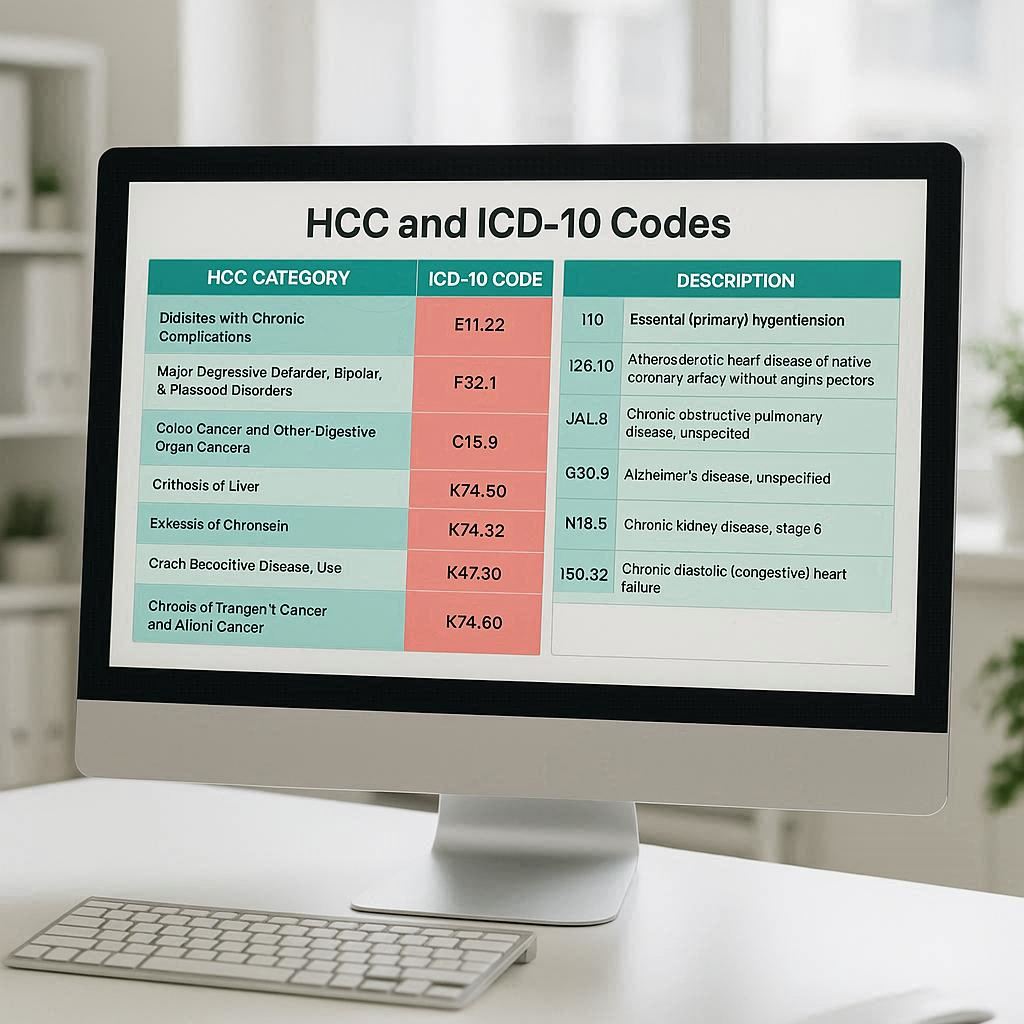
What Is an HCC ICD-10 Code? (A Simple Explanation)
An HCC ICD-10 code is simply a standard diagnosis code that maps to a specific Hierarchical Condition Category. In other words, not every ICD-10 code triggers an HCC. Only those codes that describe significant, chronic, or costly health conditions are part of the HCC model.
Think of it like this:
- ICD-10 codes are the raw data – the specific diagnosis a doctor writes in a patient’s chart.
- HCCs are the categories that group similar conditions together for risk adjustment.
- An HCC ICD-10 code is the bridge between the two.
When a coder or provider documents a diagnosis correctly, the ICD-10 code triggers an HCC. That HCC then contributes to a patient’s risk score, which affects how much a health plan gets paid to cover that person.
“Proper documentation and coding for HCCs is not just about reimbursement. It is about accurately reflecting a patient’s true health status.”
Why Does the HCC Model Exist?
The HCC risk adjustment model was developed to ensure that health plans receive fair payment based on the health status of their members. Without risk adjustment, plans might avoid sicker patients to protect their profits.
Medicare Advantage (Part C) plans use the CMS-HCC model to predict future healthcare costs. The thinking is simple: a patient with diabetes, heart failure, and COPD will likely need more medical services than a perfectly healthy person of the same age and gender.
By capturing the right HCC ICD-10 codes, plans get paid appropriately, and patients with complex needs get the attention they deserve.
How the CMS-HCC Model Works (Without the Overwhelming Details)
Every year, the Centers for Medicare & Medicaid Services (CMS) updates the HCC model. The model assigns each eligible ICD-10 code to one or more HCC categories.
Here are the basic steps:
- A provider documents a diagnosis during a face-to-face encounter.
- A medical coder assigns the correct ICD-10 code based on that documentation.
- The ICD-10 code is mapped to an HCC if the condition is part of the risk adjustment model.
- Each HCC has a numeric factor (a weight) that contributes to the patient’s risk score.
- The risk score determines risk-adjusted payments to the health plan.
Not all HCCs are equal. Some conditions have higher weights because they are more expensive to manage. For example, metastatic cancer will have a much higher weight than controlled hypertension.
Key Differences Between ICD-10 Codes and HCCs
To avoid confusion, let us compare the two concepts side by side.
| Feature | ICD-10 Code | HCC |
|---|---|---|
| Purpose | Records a specific diagnosis | Groups diagnoses by clinical similarity and cost |
| Number of entries | Over 70,000 codes | Around 100 categories (depending on model year) |
| Used for | Billing, statistics, and clinical records | Risk adjustment and payment calculation |
| Directly documented by | Providers and coders | Automatically assigned via mapping |
| Changes annually | Yes (additions, revisions, deletions) | Yes (CMS updates every year) |
This table makes one thing clear: HCCs are a higher-level grouping mechanism. You cannot document an HCC directly. You must document the underlying ICD-10 diagnosis.
Which ICD-10 Codes Trigger an HCC? (Examples by Body System)
Let us look at common clinical areas where HCC ICD-10 codes frequently appear. These examples are based on the CMS-HCC model and are relevant for most Medicare Advantage populations.
Cardiovascular Conditions
- HCC 85: Congestive Heart Failure
- Example ICD-10 code: I50.22 (Chronic systolic heart failure)
- Example ICD-10 code: I50.32 (Chronic diastolic heart failure)
- HCC 96: Ischemic or Unspecified Stroke
- Example ICD-10 code: I63.9 (Cerebral infarction, unspecified)
- HCC 108: Vascular Disease
- Example ICD-10 code: I70.0 (Atherosclerosis of the aorta)
Diabetes and Endocrine Disorders
- HCC 19: Diabetes with Acute Complications
- Example ICD-10 code: E10.10 (Type 1 diabetes with ketoacidosis without coma)
- HCC 18: Diabetes with Chronic Complications
- Example ICD-10 code: E11.22 (Type 2 diabetes with diabetic chronic kidney disease)
- HCC 17: Diabetes without Complication
- Example ICD-10 code: E11.9 (Type 2 diabetes without complications)
Important note: Uncomplicated diabetes still triggers an HCC, but it carries a lower weight than diabetes with complications.
Chronic Kidney Disease (CKD)
- HCC 137: CKD Stage 4
- Example ICD-10 code: N18.4
- HCC 138: CKD Stage 5
- Example ICD-10 code: N18.5
- HCC 139: End Stage Renal Disease (ESRD)
- Example ICD-10 code: N18.6
Respiratory Conditions
- HCC 111: COPD
- Example ICD-10 code: J44.9 (Chronic obstructive pulmonary disease, unspecified)
- HCC 114: Asthma
- Example ICD-10 code: J45.41 (Moderate persistent asthma with status asthmaticus)
Mental Health and Substance Use
- HCC 55: Major Depressive and Bipolar Disorders
- Example ICD-10 code: F32.2 (Major depressive disorder, single episode, severe)
- HCC 54: Drug Use Disorder
- Example ICD-10 code: F11.20 (Opioid dependence, uncomplicated)
These examples represent just a fraction of the possible HCC ICD-10 codes. Always check the official CMS mapping for the most current list.
A Realistic Look at HCC Coding Hierarchy
One unique feature of the CMS-HCC model is hierarchical logic. If a patient has two related conditions, the model only counts the more severe one.
For example:
- A patient with both Stage 3 CKD (HCC 139? No — Stage 3 does not map to an HCC in many model versions) and Stage 4 CKD (HCC 137) will only get credit for Stage 4.
- A patient with diabetes without complications (HCC 17) and diabetes with chronic complications (HCC 18) will only be counted under HCC 18.
This prevents double-counting for similar conditions. It also encourages providers to document the most specific and severe diagnosis possible.
Simple illustration of hierarchy
| Condition severity | HCC assigned |
|---|---|
| Diabetes without complications | HCC 17 |
| Diabetes with chronic complications | HCC 18 (overrides HCC 17) |
| Diabetes with acute complications | HCC 19 (overrides both HCC 17 and HCC 18) |
The rule is simple: when two HCCs belong to the same disease hierarchy, keep the highest severity code.
Documentation Requirements for Accurate HCC ICD-10 Coding
You cannot code what is not documented. This is the golden rule of medical coding. For an HCC ICD-10 code to be valid, the medical record must include specific details.
What good documentation looks like
- Specificity: The diagnosis should be as detailed as possible. “Diabetes” is not enough. “Type 2 diabetes with diabetic neuropathy” is much better.
- Chronic nature: HCCs are for chronic or significant conditions. The documentation should indicate that the condition requires ongoing management.
- Linkage: If two conditions are related, the record should show the connection. For example, “hypertensive CKD” links hypertension and kidney disease.
- Provider signature and date: All HCC-relevant diagnoses must be documented by a qualified provider during a face-to-face encounter.
Common documentation gaps
| Problem | Example | How to fix |
|---|---|---|
| Ambiguous wording | “Possible CHF” | Document as “CHF, confirmed by echocardiogram” |
| Missing linkage | “CKD and hypertension” | Document as “Hypertensive CKD” |
| Historical diagnosis | “History of COPD” | Document active COPD if patient still has symptoms |
| No provider link | Diagnosis listed in problem list only | Ensure provider references it in the assessment plan |
When documentation is poor, the HCC ICD-10 code may be rejected during audits, leading to lost revenue and compliance risks.
How to Find the Correct HCC ICD-10 Code (Step by Step)
Let us walk through a practical scenario. You have a clinical note that says:
“Patient with type 2 diabetes, long-standing. Also has stage 3 chronic kidney disease. No ketoacidosis. Currently stable.”
Step 1: Identify all documented diagnoses
- Type 2 diabetes
- Stage 3 chronic kidney disease
Step 2: Look up each ICD-10 code in an encoder tool or book
- Diabetes, type 2, without complications: E11.9
- CKD, stage 3: N18.3
Step 3: Map to the CMS-HCC model (use official CMS mapping files)
- E11.9 maps to HCC 17 (Diabetes without complication)
- N18.3 does not trigger an HCC because Stage 3 CKD is not a valid HCC condition in most CMS-HCC model years
Step 4: Confirm documentation supports the code
Yes — the diagnosis is clear and active.
Result
Only HCC 17 is triggered. The patient’s risk score increases slightly, but no credit is given for CKD stage 3.
This example shows why specificity matters. If the patient had stage 4 CKD, the coding would change completely.
Common Myths About HCC ICD-10 Codes (Debunked)
Myth 1: “All chronic conditions trigger an HCC.”
Reality: No. Many chronic conditions (e.g., stage 2 CKD, osteoporosis, GERD) do not map to any HCC in the standard CMS model. Always verify the mapping.
Myth 2: “You can code from a problem list without provider documentation.”
Reality: Absolutely not. Problem lists are helpful for tracking, but the HCC code must be supported by the most recent provider note.
Myth 3: “HCC codes are only for Medicare Advantage.”
Reality: While Medicare Advantage uses the CMS-HCC model, other payers (Medicaid, ACA plans) use their own risk adjustment models, which are often based on similar logic. So understanding HCCs helps across multiple scenarios.
Myth 4: “More HCC codes always mean higher payment.”
Reality: Not exactly. Hierarchy rules prevent double-counting. And if documentation is inaccurate, it can trigger audits and recoupments.
The Impact of Incorrect HCC Coding
Errors in HCC coding affect everyone: the patient, the provider, the health plan, and even the taxpayer.
Common types of errors
- Under-coding: Missing an HCC that should have been captured. This leads to lower risk scores and inadequate payments.
- Over-coding: Assigning an HCC that the documentation does not support. This can lead to audits, fines, and accusations of fraud.
- Mis-coding: Using the wrong ICD-10 code for a documented condition. This can trigger the wrong HCC or none at all.
Realistic consequences
| Error type | Consequence |
|---|---|
| Under-coding | Health plan loses revenue; patient risk not fully represented |
| Over-coding | CMS audit, repayment demands, potential FCA liability |
| Mis-coding | Risk score inaccurate; potential cascading errors in quality metrics |
“One incorrect HCC can affect thousands of dollars in payment and jeopardize compliance.”
How to Build an HCC Coding Improvement Plan
If you manage a practice, a health plan, or a coding team, consider these steps to improve accuracy for HCC ICD-10 codes.
1. Train providers on specific documentation requirements
Many physicians do not realize that “appears stable” or “history of” does not satisfy HCC documentation rules. Offer short, practical training sessions with real-world examples.
2. Use real-time coding support
Embed certified coders into clinical workflows. When a provider finishes a note, a coder can review it same-day and ask clarifying questions before the claim goes out.
3. Run regular internal audits
Audit a sample of charts every quarter. Look specifically for:
- Missed HCC opportunities
- Unsupported HCC codes
- Hierarchy rule violations
4. Close the feedback loop
After each audit, share anonymous examples with providers and coders. Celebrate good documentation. Gently correct common errors.
5. Stay current with CMS changes
The CMS-HCC model changes every year. Some ICD-10 codes are added, removed, or reassigned to different HCCs. Subscribe to CMS updates and adjust your internal tools accordingly.
HCC ICD-10 Coding for Different Healthcare Roles
Depending on your job, you interact with HCCs differently. Let us break it down.
For Physicians and Clinicians
- Focus on specific, accurate documentation.
- Avoid vague terms like “probable” or “rule out” for chronic conditions.
- Explicitly state the relationship between conditions (e.g., “diabetic CKD”).
For Medical Coders
- Use the most current CMS-HCC mapping file.
- Never add diagnoses that are not explicitly documented.
- When in doubt, query the provider.
For Practice Managers and Administrators
- Invest in coder and provider education.
- Track HCC capture rates as a key performance indicator.
- Prepare for risk adjustment data validation (RADV) audits.
For Compliance Officers
- Monitor for patterns of over-coding or under-coding.
- Establish a clear corrective action plan for identified issues.
- Ensure all HCC-related queries follow compliant wording.
The Future of HCC Coding: What to Expect
The HCC model is not static. CMS regularly updates it to reflect changes in medical knowledge, coding practices, and healthcare costs.
Major trends to watch
- Transition to ICD-11: While the U.S. remains on ICD-10 for now, ICD-11 includes different coding structures. When the transition happens, HCC mapping will change significantly.
- More precise clinical categories: Future HCC models may break down broad categories (like “diabetes”) into more granular groups based on specific complications.
- Integration with SDOH (Social Determinants of Health): Some pilot programs are testing whether adding SDOH data improves risk prediction. This could eventually become part of the official model.
- AI-assisted coding: Artificial intelligence tools are getting better at suggesting HCC ICD-10 codes from clinical text. However, human review remains essential.
No matter what changes come, one thing remains certain: accurate documentation and coding will always be the foundation.
Reference Table: Common Conditions and Their HCC Status
Use this table as a quick reference. Always verify with the latest official files.
| Condition | Common ICD-10 example | Triggers HCC? (typical CMS model) | HCC number |
|---|---|---|---|
| Type 2 diabetes without complications | E11.9 | Yes | HCC 17 |
| Type 2 diabetes with CKD | E11.22 | Yes | HCC 18 |
| Acute myocardial infarction (old) | I25.2 | No | — |
| Heart failure, unspecified | I50.9 | Yes | HCC 85 |
| COPD | J44.9 | Yes | HCC 111 |
| Asthma, mild intermittent | J45.20 | No | — |
| Rheumatoid arthritis | M05.79 | Yes | HCC 114 (varies) |
| Major depression, recurrent | F33.2 | Yes | HCC 55 |
| Hyperlipidemia | E78.5 | No | — |
| CKD stage 3 | N18.3 | No | — |
| CKD stage 4 | N18.4 | Yes | HCC 137 |
| Metastatic solid tumor | C80.0 | Yes | HCC 12 |
This table is a simplification. Always check the official CMS mapping for your specific contract year.
Important Notes for Readers: Do’s and Don’ts
Do:
- Document specific diagnoses even if they seem obvious.
- Use a structured assessment and plan section.
- Update problem lists at each visit and confirm active status.
- Query providers when documentation is unclear.
- Audit your HCC coding regularly.
Don’t:
- Copy and paste old diagnoses without verifying they are still active.
- Assume a diagnosis is HCC-relevant without checking the mapping.
- Code from a problem list without corresponding provider documentation.
- Ignore hierarchy rules.
- Use unsupported HCC codes just to increase risk scores.
How to Stay Updated on HCC Coding Changes
Keeping up with annual updates does not have to be overwhelming. Here is a simple routine you can follow.
Quarterly checklist
- Check the CMS website for any mid-year coding or model updates.
- Review internal audit findings for recurring HCC errors.
- Share one “HCC coding tip of the month” with your team.
- Test your team’s knowledge with a short quiz based on real charts.
Annual checklist
- Download the newest CMS-HCC model files when released (typically February for the following year).
- Update your encoder software or reference tools.
- Train providers and coders on material changes (added, dropped, or re-mapped codes).
- Revise internal policies and coding guides accordingly.
Trusted resources for updates
- CMS Risk Adjustment page (official announcements and model files)
- CMS ICD-10 Coordination and Maintenance Committee (meeting materials)
- AHIMA (American Health Information Management Association) – HCC coding webinars
- AAPC (American Academy of Professional Coders) – specialty guides and forums
Frequently Asked Questions (FAQ)
1. What is the difference between an ICD-10 code and an HCC code?
An ICD-10 code is a specific diagnosis code. An HCC is a risk adjustment category. An HCC ICD-10 code is simply an ICD-10 code that maps to a specific HCC.
2. Do all ICD-10 codes trigger an HCC?
No. Most ICD-10 codes do not map to any HCC. Only codes that represent significant, chronic, or costly conditions are included.
3. How do I know if an ICD-10 code is an HCC code?
You must check the official CMS-HCC mapping file for your specific model year. Encoder software typically includes this mapping.
4. Can one ICD-10 code trigger more than one HCC?
Yes, in rare cases. Some ICD-10 codes map to multiple HCCs. However, hierarchy rules often prevent double-counting.
5. Is it illegal to submit unsupported HCC codes?
Yes. Knowingly submitting inaccurate codes for higher payment can violate the False Claims Act. Always code based on documented, active conditions.
6. What is a “non-HCC” ICD-10 code?
Any ICD-10 code that does not map to an HCC in the current CMS model. These codes are still important for billing and clinical tracking, but they do not affect risk scores.
7. How often does the CMS-HCC model change?
Annually. New model files are typically released in February and take effect on January 1 of the following year. Mid-year changes are rare but possible.
8. Can a patient’s risk score decrease from one year to the next?
Yes. If a previously documented HCC condition resolves, is miscoded, or is dropped from the model, the risk score may decrease.
9. Do hospital coders need to learn HCC coding?
Yes. Many hospital outpatient and inpatient records are used for risk adjustment, especially if the health plan is a Medicare Advantage plan.
10. Are HCC codes used outside Medicare Advantage?
Yes. Many Medicaid managed care plans and ACA Marketplace plans use their own risk adjustment models, some of which are similar to CMS-HCC.
Additional Resource
For an official, up-to-date list of all ICD-10 codes mapped to HCCs, visit the CMS Risk Adjustment Models page:
🔗 CMS.gov – Risk Adjustment Models and Files (external link, opens in new tab)
Always refer to the most current annual model files for accurate coding.
Conclusion
HCC ICD-10 codes link specific diagnoses to risk adjustment categories that determine fair payment for health plans. Accurate documentation and coding require specificity, regular audits, and staying current with annual CMS updates. By mastering this system, providers and coders protect both revenue and compliance while reflecting patients’ true health needs.
Author: Professional Medical Coding Team
Date: APRIL 24, 2026
Disclaimer: This article is for educational purposes only. Always follow official coding guidelines and consult qualified professionals for specific medical or legal advice.