Accurate medical coding stands at the intersection of patient care and operational sustainability. In respiratory medicine, few drugs are as ubiquitous as albuterol sulfate. When administered in a nebulized form, the dosage of 2.5 mg per 3 mL represents a cornerstone of bronchodilator therapy. Yet, for all its clinical commonality, the billing process for this solution often creates a labyrinth of confusion for providers, billers, and durable medical equipment (DME) suppliers. This comprehensive guide tackles that complexity head-on, providing a definitive, human-centered walkthrough of the HCPCS code for albuterol sulfate 2.5 mg 3 mL. We will strip away the jargon to deliver clarity on code selection, modifier application, and payer-specific nuances that directly affect reimbursement.
Understanding the Landscape: Why Albuterol Coding Matters
Before dissecting the specific alphanumeric sequence, we must anchor our discussion in the “why.” Albuterol is a short-acting beta-agonist. Physicians prescribe it to treat or prevent bronchospasm in patients with reversible obstructive airway disease, such as asthma or chronic obstructive pulmonary disease (COPD). The unit dose vial containing 2.5 mg of albuterol sulfate in 3 mL of sterile saline solution simplifies administration. It eliminates the need for measuring and reduces contamination risk.
From a billing perspective, the delivery method dictates the code set. When a clinician administers the drug in a hospital outpatient department, physician office, or clinic, the cost of the drug itself often separates from the administration service. Medicare and most commercial payers rely on the Healthcare Common Procedure Coding System (HCPCS) Level II to identify these specific products and supplies. Using the correct code ensures that claims process without denials, that drug utilization data remains accurate, and that patients do not receive unexpected bills. Incorrect coding can trigger audits, fraud allegations, or revenue loss. Therefore, mastering this single code is not just a clerical task; it is a clinical-financial imperative.
Deconstructing the Drug: Albuterol Sulfate 2.5 mg/3 mL
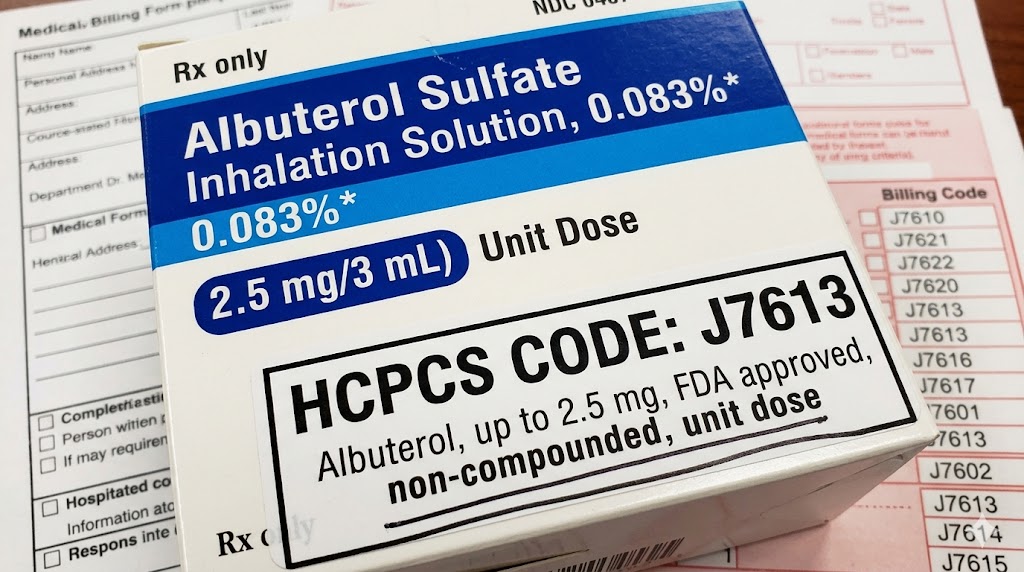
Let us first look at the product itself. The formulation is a sterile, clear, colorless solution. The standard unit of dispensing is a single-dose plastic vial, often sealed under a foil pouch. The concentration is 0.083%, which translates precisely to the 2.5 mg of active albuterol sulfate base delivered in a 3 mL volume of normal saline.
Commercially, this product appears under various trade names—Proventil HFA is a metered-dose inhaler, but for nebulization, common branded generics and authorized generics dominate. The vital billing distinction lies between the generic solution and a branded inhalation solution that may have a unique J-code. For the vast majority of scenarios involving the generic, preservative-free, single-dose vial, the coding pathway converges on a single HCPCS identifier.
The Primary HCPCS Code: A Deep Dive into J7613
For those seeking the immediate, actionable answer, the HCPCS code for albuterol sulfate 2.5 mg 3 mL is J7613. This code describes “Albuterol, inhalation solution, FDA-approved final product, non-compounded, administered through DME, unit dose, 1 mg.” However, a surface-level reading of that long descriptor can cause immediate confusion. The code specifies “1 mg,” while our product contains 2.5 mg. This mismatch is intentional and foundational to HCPCS Level II logic.
Why the Code Descriptor Says “1 mg”
The Centers for Medicare & Medicaid Services (CMS) designed many HCPCS drug codes to report a base unit of measurement. J7613 reports per milligram of albuterol. A single vial of the 2.5 mg/3 mL solution contains 2.5 milligrams of the active drug. Therefore, you do not bill one unit of J7613 for one vial. You bill for the total milligrams administered or dispensed.
If a patient receives one unit-dose vial, you report 2.5 units of J7613. If the physician orders two vials back-to-back for a severe acute exacerbation, you report 5 units. The mathematical logic remains consistent. The base unit is the milligram. The vial serves as the delivery container for 2.5 mg. This coding architecture allows CMS to adjust payment rates based on a standardized metric, independent of manufacturer packaging changes. It also aligns with pharmacy billing logic, where active ingredient quantity drives reimbursement.
A Note on Non-Compounded Clarification
The descriptor includes the phrase “FDA-approved final product, non-compounded.” This language distinguishes commercially manufactured, ready-to-use unit-dose vials from products a pharmacist compounds by mixing bulk albuterol powder or solution with saline. In the era of large-scale compounding pharmacies and hospital central-fill operations, this distinction carries immense audit weight. If you are billing for a pre-packaged, manufacturer-sealed 2.5 mg/3 mL vial, J7613 is correct. If you use a compounded product, a different code—frequently an unlisted or miscellaneous code—often applies, and medical-necessity documentation requirements intensify.
Dissecting the Descriptor: Administration Through DME
The descriptor also states, “administered through DME.” DME stands for Durable Medical Equipment. In the context of nebulized albuterol, this refers to a small-volume nebulizer machine. This language connects the drug code to a specific delivery system. For patients in a facility, the DME might belong to the hospital. For home use, the patient typically owns or rents a nebulizer billed under a different HCPCS code, such as E0570. While J7613 requires association with DME administration, the drug and the equipment appear on claims separately. This linkage reassures payers that the drug was not administered via a metered-dose inhaler, which does not use a J-code pathway.
Comparative Code Landscape: J7613 Versus Alternatives
Medical coding is a discipline of precise distinction. Albuterol sulfate stands alongside other bronchodilators in the HCPCS J-code family. To avoid claim rejection, a biller must understand why J7613 is selected over its close relatives, such as J7620 or J7626. The following table clarifies these critical distinctions.
| HCPCS Code | Active Ingredient & Formulation | Unit Basis | Typical Use Case |
|---|---|---|---|
| J7613 | Albuterol sulfate, non-compounded solution | Per 1 mg | Generic unit-dose vials (2.5 mg/3 mL) for nebulization via DME |
| J7620 | Albuterol sulfate, compounded solution | Per 1 mg | Pharmacist-mixed albuterol solutions (rarely used for standard pre-filled vials) |
| J7626 | Ipratropium bromide (non-compounded) | Per 1 mg | Duoneb components or standalone ipratropium vials |
| J7634 | Levalbuterol tartrate (Xopenex generic) | Per 1 mg | Patients intolerant to racemic albuterol side effects |
| J7622 | Beclomethasone (inhaled corticosteroid) | Per 1 mg | Maintenance anti-inflammatory therapy |
Why J7620 Is Not the Default
A common pitfall involves reporting J7620 for a standard pre-packaged vial. J7620 is designated for compounded formulations. If you have an FDA-approved, commercially sealed box from a generic manufacturer, you must use J7613. Auditors frequently flag mismatches between the dispensed product’s NDC and the HCPCS code. A J7613 claim with an NDC matching a generic manufacturer aligns perfectly. A J7620 claim with the same NDC signals a potential compound, triggering a request for compounding documentation that cannot be produced for a sealed commercial vial, leading to a denial.
When Levalbuterol Enters the Picture
Levalbuterol, branded as Xopenex, exists as a single-isomer agent. Some clinicians prescribe levalbuterol to potentially reduce tachycardia compared to racemic albuterol. The HCPCS code for non-compounded levalbuterol solution is J7634. The unit basis is also per milligram. Standard levalbuterol unit doses commonly contain 0.31 mg, 0.63 mg, or 1.25 mg. If the patient uses racemic albuterol sulfate 2.5 mg/3 mL, you avoid J7634 and stick firmly with J7613. Choosing between J7613 and J7634 relies solely on the chemical entity—racemic albuterol versus levalbuterol.
Modifiers and the J7613 Billing Ecosystem
A code never travels alone on a claim form. Modifiers supply the context of the transaction. For nebulized solutions, one modifier dominates, while others handle specific operational contexts.
The Mandatory KX Modifier
For patients covered by Medicare Part B who receive albuterol via DME, the KX modifier is pivotal. This modifier certifies that specific coverage criteria have been met and that documentation exists in the patient’s medical record to support medical necessity. The supplier or provider attests that:
- The patient has a documented diagnosis of obstructive pulmonary disease.
- The drug is reasonable and necessary for the treatment.
- The supplier maintains a detailed written order signed by the treating physician before dispensing.
Without the KX modifier, Medicare Administrative Contractors (MACs) may reject the claim as lacking evidence of necessity.
The EY Modifier: No Physician Order
What if a physician’s order is missing? In a durable medical equipment context, the EY modifier indicates that the item or service lacks a valid physician order. DME Medicare Administrative Contractors encourage suppliers not to apply this modifier as a routine billing practice. Instead, it signals a non-covered scenario. Use it only when you know the claim will deny for lack of an order and you need the formal denial for secondary insurance billing or patient responsibility.
The GA Modifier: Advance Beneficiary Notice
When a supplier or provider believes Medicare will likely deny a service as not medically necessary, they may issue an Advance Beneficiary Notice of Noncoverage (ABN) to the patient. If the patient signs the ABN, the supplier appends the GA modifier to J7613. This modifier states that the provider has a mandatory ABN on file. If the claim denies, the provider can bill the patient. Without the GA modifier and a signed ABN, the financial responsibility for a non-covered service may shift to the provider.
The JW and JZ Modifiers: Wastage and No Wastage
Medicare requires reporting of discarded drug amounts from single-use vials. The JW modifier identifies the discarded amount of a drug. If a patient requires a dose that does not use the entire vial, and the remaining amount is discarded and not administered to another patient, you report JW with the discarded milligram amount. The JZ modifier, conversely, attests that no drug amount was discarded. Most claims for albuterol sulfate 2.5 mg/3 mL will use the JZ modifier because the entire vial contents often go directly into the nebulizer cup. However, in exceedingly rare cases where a physician orders a reduced dose and a partial vial is used, JW becomes essential.
Navigating Payer-Specific Coding Rules
While HCPCS Level II provides national standardization, Medicare Administrative Contractors and individual commercial payers often layer their own policies onto J7613.
Medicare Part B and Local Coverage Determinations
Medicare Part B covers albuterol solution when it is deemed reasonable and necessary for the patient’s condition and administered via a covered DME item. Each jurisdiction has a Local Coverage Determination (LCD) that specifies the conditions of payment. Many LCDs limit the monthly quantity of albuterol to a specific number of vials. A common utilization parameter approves up to 30 vials per month for standard maintenance, but a higher amount may require documentation supporting acute exacerbations. The billing unit calculation for 30 vials becomes 75 units of J7613 (30 vials × 2.5 mg). Some MACs require a specific diagnosis code, such as J45.909 (Unspecified asthma, uncomplicated) or J44.9 (COPD, unspecified), to establish medical necessity.
Medicaid State Plan Variations
State Medicaid programs adopt HCPCS codes but may impose their own billing limits, preferred drug lists, and rebate programs. A state may reimburse J7613 only when dispensed by an enrolled pharmacy provider, not a physician practice. Some states execute mandatory generic substitution policies, meaning that even if a branded product is dispensed, the state only reimburses at the generic rate corresponding to J7613. Billers must consult the specific state provider manual to understand whether a National Drug Code (NDC) must accompany the HCPCS code on the claim.
Commercial Payers: The NDC Requirement
Commercial insurers increasingly require the 11-digit NDC on the claim along with the HCPCS. The NDC uniquely identifies the manufacturer, product, and package size. For a 2.5 mg/3 mL generic albuterol solution, the NDC will vary by manufacturer (e.g., Teva, Nephron, Sun Pharmaceutical). The payer crosswalks the NDC to confirm that the drug is an FDA-approved product and matches the HCPCS code. If the NDC points to albuterol but you bill J7620 instead of J7613, the claim may bounce back as a code-product mismatch. Always verify that the NDC corresponds to a non-compounded solution when using J7613.
Step-by-Step Billing Workflow for J7613
Turning theory into action requires a reliable workflow. The following sequence serves as a checklist for any billing professional or respiratory therapy department manager.
Step 1: Confirm the Product Type
- Verify that the solution is a commercially manufactured, single-dose, non-compounded product.
- Check the label for “Albuterol Sulfate Inhalation Solution 0.083% (2.5 mg/3 mL).”
- Ensure the NDC on the package aligns with your inventory records.
Step 2: Calculate the Billing Units
- Count the total number of milligrams dispensed or administered.
- For one unit-dose vial, the total milligrams equals 2.5.
- For multiple vials, multiply 2.5 by the number of vials.
- Document the waste amount if any portion is discarded and report it on the JW line if required.
Step 3: Select the Primary Code and Modifiers
- Assign J7613 for the active drug.
- Append the JZ modifier if no waste occurred, which is most common.
- Append KX if billing Medicare Part B for DME-delivered drugs and documentation requirements are met.
- Append GA if an ABN is on file.
Step 4: Link the Diagnosis Code
- Use the highest specificity diagnosis code available, such as J45.40 (Moderate persistent asthma, uncomplicated) instead of an unspecified code, whenever the medical record supports it.
- Ensure the diagnosis aligns with the LCD or payer coverage policy for bronchodilator drugs.
Step 5: Include the NDC
- In the electronic claim’s LIN segment or the CMS-1500 field, include the 11-digit NDC.
- Add the unit of measure (e.g., ML or UN) and the quantity (e.g., 3 ML per vial).
Step 6: Submit and Track
- Submit the claim via the appropriate clearinghouse or direct data entry system.
- Monitor the 277CA and 835 remittance advice for any denials related to medical necessity or code validity.
Documentation Requirements That Withstand Audits
A paid claim is not the end of the story. Every J7613 claim implies a supporting narrative within the medical record. Auditors from Recovery Audit Contractors (RACs) and Unified Program Integrity Contractors (UPICs) routinely target nebulized drug billing because of the high volume and potential for overutilization. Robust documentation safeguards against recoupments.
The Written Order Before Delivery
Medicare’s DME rules mandate a detailed written order before dispensing. For albuterol, this order must include:
- The patient’s name.
- The specific item: “Albuterol sulfate inhalation solution 2.5 mg/3 mL.”
- The quantity to be dispensed (e.g., 30 vials per month).
- The frequency of administration (e.g., every 4 to 6 hours as needed for wheezing or shortness of breath).
- The treating physician’s signature and date.
A prescription that simply reads “Albuterol nebs PRN” is legally insufficient for an audit. It lacks dosage strength, duration, and specific frequency of administration. The dispensing pharmacy or supplier bears responsibility for obtaining a valid order before delivery, yet the billing provider must also retain this documentation.
Medical Necessity as Told by the Progress Note
The patient’s medical record must demonstrate the medical necessity of albuterol. A recent office visit note should contain:
- A clear diagnosis of asthma, COPD, bronchiectasis, or another obstructive condition.
- Physical examination findings that support reversible airway disease (e.g., wheezing, prolonged expiratory phase).
- A medication reconciliation that lists albuterol solution.
- Rationale for nebulization over a metered-dose inhaler with spacer, if required by the payer’s policy. Some payers question why a patient with mild intermittent asthma requires a nebulizer rather than a portable inhaler. The note might state, “Patient has poor hand-breath coordination with MDI despite repeated coaching,” to justify the nebulizer and thus the drug code J7613.
Proof of Delivery and Refill Records
For DME suppliers, proof of delivery documentation must show the patient or authorized representative received the specific quantity of albuterol vials. The delivery slip should itemize the drug by name, strength, and HCPCS code. Refill requests must originate from the patient or caregiver and be documented before shipping the next supply. Automatic refill programs without patient contact create compliance risks.
Common Billing Errors and How to Prevent Them
Human error and system misconfigurations can derail J7613 reimbursement. Recognizing these patterns allows a practice or pharmacy to build internal edits that catch mistakes before claim submission.
Error 1: Misreading the Unit of Measure
The most prevalent error involves billing one unit of J7613 per vial instead of 2.5 units. A claim for 30 vials submitted with 30 units undercharges and under-reimburses. Conversely, if the biller mistakenly enters 300 units by adding an extra zero, the claim faces denial as an implausible quantity. Implementing a hard stop in billing software that flags any J7613 quantity not divisible by 0.5 or 2.5 prevents this.
Error 2: Confusing Branded Codes
Some legacy payers still maintain specific codes for branded albuterol products, although most have consolidated to generic codes. Billers occasionally select a discontinued or non-payable code like J7611, which once described concentrated forms. Regular updates of the practice’s charge description master (CDM) and pharmacy billing system prevent reliance on obsolete codes.
Error 3: Omission of NDC When Required
State Medicaid and Medicare Part B require NDC reporting on outpatient drug claims. A J7613 claim submitted without the corresponding NDC results in a front-end rejection. This error often surges when a new staff member manually enters claims without understanding the LIN segment mapping.
Error 4: Inflated Quantity with Missing Medical Policy
Some providers bill for extremely high quantities—say, 120 vials per month—without documentation of severe disease or an exacerbation history. The payer’s edit flags the claim for exceeding the medically unlikely edit (MUE) threshold. The MUE for J7613 per day or per month is a specific number set by CMS. Understanding these edits prevents automatic claim stoppage.
Error 5: Duplicate Claims for the Same Date of Service
Hospitals sometimes bill for albuterol under a pharmacy claim system while the outpatient clinic bills the same drug under the medical benefit. Coordination of benefits checks and consistent use of revenue codes can eliminate duplicate billing.
The Role of Revenue Codes and Place of Service
For institutional claims on a UB-04 form, J7613 must pair with a correct revenue code. The most appropriate revenue code for albuterol inhalation solution in a hospital outpatient setting is 0250 (General Pharmacy). In some facilities, respiratory therapy services charge the drug under revenue code 0410 (Respiratory Services – General Classification). Payer contracts may specify which revenue code maps to reimbursement. Using an incorrect revenue code can result in the line item being denied or improperly bundled into a visit-level payment under the outpatient prospective payment system (OPPS).
The place of service code (POS) on a CMS-1500 claim also impacts reimbursement. For a patient receiving albuterol in a physician office, POS 11 applies. For a patient receiving the drug from a home DME supplier, POS 12 (Home) governs. The POS informs the MAC which fee schedule to apply.
Pricing and Reimbursement Mechanics for J7613
Understanding the payment side helps administrators anticipate revenue. Medicare prices J7613 using the Average Sales Price (ASP) methodology. Each quarter, manufacturers submit sales data, and CMS publishes the ASP Drug Pricing File. The payment rate for one unit of J7613 is the ASP plus a percentage markup (currently ASP + 6% for most Part B drugs, though sequester adjustments apply).
For a single 2.5 mg vial, the reimbursement approximates 2.5 multiplied by the current J7613 per-unit ASP rate. CMS also publishes a fee schedule for DME drugs when administered through a nebulizer and billed by a pharmacy or DME supplier. This fee schedule may incorporate an average wholesale price or an ASP-based methodology depending on the competitive bidding program phase-in for the zip code.
Commercial payers often reimburse a percentage of billed charges or a contracted rate. For instance, a contract might stipulate payment at 85% of the average wholesale price for generic inhalation solutions. Understanding the contract language allows the revenue cycle team to calculate expected reimbursement and appeal underpayments accurately.
Special Circumstances: End-Stage Renal Disease and Hospice
Patients receiving care under bundled payment models require careful J7613 handling. For a patient with End-Stage Renal Disease (ESRD) in a dialysis facility, the ESRD Prospective Payment System (PPS) may bundle albuterol administration into the composite rate, unless the drug is used to treat a condition outside the scope of renal disease. Clear coding with condition-specific diagnosis pointers helps separate a payable line item.
In hospice, albuterol solution often falls under the hospice per-diem if the primary diagnosis relates to the terminal condition, such as end-stage COPD. The hospice provider, not Part B, pays for the drug. If a non-hospice provider administers albuterol to a hospice patient for a condition unrelated to the terminal prognosis, they must bill with the GW modifier to indicate the service is not related to the hospice terminal condition.
Pediatric Considerations and Off-Label Use
Pediatric patients often receive the 2.5 mg/3 mL solution, although infants and small children may use a lower dose poured from a vial. In these cases, the JW modifier becomes critically important. If the physician orders 1.25 mg for an infant and the remaining 1.25 mg is discarded, the billing would reflect J7613 with 1.25 units of JW modifier. Some state Medicaid pediatric programs require a special authorization code for nebulized drugs to confirm that a pediatric pulmonologist or allergist manages the child’s care.
Transitioning from Paper to Electronic Claims
The transition to electronic billing using the ASC X12 837 standard allows for richer data exchange. In the 837 professional claim, the LIN segment captures the NDC, and the unit of measure (UN or ML) quantifies the dispensing. J7613 resides in the SV1 segment. The correct construction of these loops ensures that the payer can auto-adjudicate the claim without manual intervention. Paper claims, while still accepted under limited circumstances, delay processing and increase the risk of data entry errors by payer scanning systems.
Future Directions in Nebulized Drug Coding
The coding landscape is not static. CMS continuously evaluates drug categories for potential bundling or payment reform. Biosimilars do not apply to albuterol, but generic competition continues to drive the ASP downward. The introduction of new bronchodilator agents, such as combination long-acting muscarinic antagonists with short-acting beta-agonists in nebulized form, may create new codes that compete for the same clinical niche as J7613. The HCPCS application process accepts requests for new codes when a product is distinct and utilized frequently enough to justify a specific identifier. Monitoring the biannual HCPCS public meetings provides insight into potential changes that could affect J7613’s reimbursement or coding rules.
Audit Defense and Internal Compliance Programs
A well-designed compliance program does not just react to audits; it actively prevents them. Key performance indicators for J7613 billing should include:
- Rate of J7613 claims denied for medical necessity.
- Rate of KX modifier omission errors.
- Percentage of claims with matched NDC and HCPCS description.
- Average units per patient per month benchmarked against MAC utilization limits.
Regular internal audits of a random sample of J7613 claims can reveal documentation gaps. If a clinic finds that 20% of sampled claims lack a detailed written order, the compliance officer can institute a policy that requires the order to be scanned and attached to the patient record before the billing team releases the claim. These proactive measures reduce the risk of extrapolated overpayments in a post-payment audit.
Integrating Technology for Coding Accuracy
Billing software and electronic health records offer functionality to automate J7613 coding. When a respiratory therapist documents the administration of “albuterol sulfate 2.5 mg/3 mL via nebulizer,” the charge capture system should auto-populate J7613 and calculate the units based on the dose. Decision-support rules can alert the therapist if the dose exceeds typical parameters or if the frequency suggests the need for a medication review. Pharmacy dispensing systems can print NDC labels that include a scannable barcode, ensuring that the correct NDC flows through to the claim. These technological integrations minimize human keystroke errors and standardize coding across multiple facilities within a health system.
The Patient Experience and Coding’s Hidden Role
Patients rarely see the HCPCS code. They experience their breathing treatment and later receive an Explanation of Benefits. When the code is wrong, the patient confronts confusion. A denial for J7613 may leave a patient with a bill for a breathing treatment they assumed was covered. Transparent communication about coverage criteria, ABNs, and the potential for copayment helps maintain trust. A patient who understands that Medicare covers a specific number of vials per month may become a partner in monitoring their own supply and notifying the provider before running out.
Training Front-Line Staff for Billing Accuracy
Respiratory therapists, medical assistants, and nurses who administer albuterol often do not bill directly, but their documentation creates the foundation for the claim. Training these clinicians to record the drug name, dosage, route, and wasted amount precisely in the flowsheet improves downstream coding. A flowsheet entry that reads “Albuterol neb tx, 2.5 mg” is far clearer than “Breathing treatment given.” Coding and clinical educators should collaborate to design documentation templates that mirror the data elements required for J7613 claims.
Telehealth and Remote Patient Monitoring
The pandemic accelerated the adoption of telehealth. For nebulized albuterol, telemedicine does not permit remote administration, but it does influence prescribing. A telehealth visit can generate a new prescription for albuterol solution if the physician assesses the patient’s respiratory status via video and determines that a bronchodilator is necessary. The coding for the visit is distinct, but the J7613 code still applies to the dispensed drug. The written order requirements remain unchanged. Remote patient monitoring that tracks peak flow or symptom scores can generate data to justify continued albuterol use, strengthening the medical necessity narrative for J7613 claims.
International Classification of Diseases (ICD-10-CM) Crosswalk for J7613
To further arm billers with the tools for clean claims, here are the most commonly accepted ICD-10-CM codes linked to J7613, with payer-specific nuances.
| ICD-10 Code | Description | Payer Note |
|---|---|---|
| J45.909 | Unspecified asthma, uncomplicated | Widely covered; some payers require high-specificity code |
| J45.40 | Moderate persistent asthma, uncomplicated | Preferred for moderate disease per HEDIS measures |
| J45.30 | Mild persistent asthma, uncomplicated | May trigger review for nebulized therapy necessity |
| J44.9 | COPD, unspecified | Covered; combination with J41.0 can specify chronic bronchitis |
| J98.01 | Acute bronchospasm | Used in urgent care; demonstrates acute need |
| R06.2 | Wheezing | Symptom code; not always acceptable as sole justification |
| J47.9 | Bronchiectasis, uncomplicated | Supports necessity when bronchodilator therapy is adjunctive |
Preparing for a Zero-Dollar ASP Quarter
Rarely, generic drugs experience a period where the ASP falls to zero or negative due to manufacturer data reporting anomalies. Should this occur for J7613, CMS defaults to a pricing formula based on wholesale acquisition cost. Staying informed through CMS transmittals ensures the billing office does not misinterpret a zero payment line as a non-covered service.
Conclusion
The HCPCS code J7613 represents more than a billing shortcut; it encapsulates a complete narrative of clinical indication, product identification, and regulatory compliance. Accurate reporting hinges on understanding its milligram-based unit structure, differentiating it from compounded or levalbuterol alternatives, and consistently applying payer-specific modifiers like KX, JW, or JZ. From the physician’s written order to the electronic claim submission with the correct NDC, each step in the J7613 workflow protects the provider’s revenue integrity and the patient’s access to essential bronchodilator therapy. Mastery of this single code elevates the entire respiratory billing practice, turning a potential audit risk into a predictable, defensible, and patient-centered process.
Additional Resource
For the most current Medicare Part B Drug and Biological Average Sales Price (ASP) pricing file—which determines the quarterly reimbursement rate for J7613—visit the CMS ASP Pricing Files page:
https://www.cms.gov/medicare/payment/all-fee-service-providers/medicare-part-b-drug-average-sales-price/asp-pricing-files
Meta Description
A comprehensive guide to the HCPCS code for albuterol sulfate 2.5 mg 3 mL. Learn correct J7613 billing units, modifier requirements (KX, JW, JZ), documentation rules, and payer-specific reimbursement strategies.
FAQ
What is the exact HCPCS code for generic albuterol sulfate inhalation solution 2.5 mg/3 mL?
The correct HCPCS Level II code is J7613. It describes albuterol, a non-compounded, FDA-approved solution administered through durable medical equipment.
How many units of J7613 should I bill for one single-dose 2.5 mg/3 mL vial?
You should bill 2.5 units. J7613 is defined per 1 milligram of active drug, and the standard single-dose vial contains 2.5 milligrams.
Is J7620 ever appropriate for a 2.5 mg/3 mL commercially sealed albuterol vial?
No. J7620 specifically identifies compounded albuterol formulations. A commercially manufactured, FDA-approved vial must be billed with J7613.
Do I need to add a modifier when billing Medicare for J7613 through a DME supplier?
Yes. The KX modifier certifies that coverage criteria are met and required documentation exists. Without it, Medicare will deny the claim for medical necessity.
What documentation protects my J7613 claims during an audit?
You need a detailed written order (specifying drug, strength, frequency), a progress note establishing medical necessity for bronchodilator therapy via nebulizer, proof of delivery, and an NDC-matched invoice.
What is the reimbursement rate for one unit of J7613?
Reimbursement changes quarterly. Medicare pays based on the Average Sales Price (ASP) plus a 6% add-on, though sequestration adjustments apply. For the most recent amount, check the current CMS ASP Drug Pricing File.