Navigating the world of medical billing codes often feels like trying to read a foreign language. You have a specific item in mind—something as seemingly simple as an arm sling—yet finding the right alphanumeric sequence to match it can stop a reimbursement claim in its tracks. This confusion frequently stems from a fundamental misunderstanding about the regulatory classification of the device itself.
The arm sling occupies a unique space in the Durable Medical Equipment, Prosthetics, Orthotics, and Supplies (DMEPOS) universe. The code you need does not depend solely on the physical form of the sling. It depends entirely on its function. A piece of cloth that cradles an injured limb and a rigid, strapped device that immobilizes a fracture can look similar to a layperson, but to Medicare and most commercial insurers, they exist in completely different billing categories.
We have prepared this guide to act as a permanent reference for suppliers, medical coders, physical therapists, occupational therapists, and billing specialists. We will dissect the primary codes, examine the regulatory nuances that separate a simple supply from a complex orthotic, and clarify the documentation requirements that protect you during an audit. We will also look at how to handle claims for pediatric patients, worker’s compensation cases, and commercial insurance plans that deviate from Medicare standards.
Understanding this distinction does more than just clean up your denied claims. It ensures that patients receive the appropriate device without unexpected financial burdens and that your practice maintains strict compliance with payer policies. The distinction between a prefabricated, off-the-shelf item and a custom-fabricated or custom-fitted orthosis carries significant compliance weight. We will explore every layer of this coding ecosystem to give you absolute confidence in your billing workflow.
The Primary Classification: Supply Code A4565
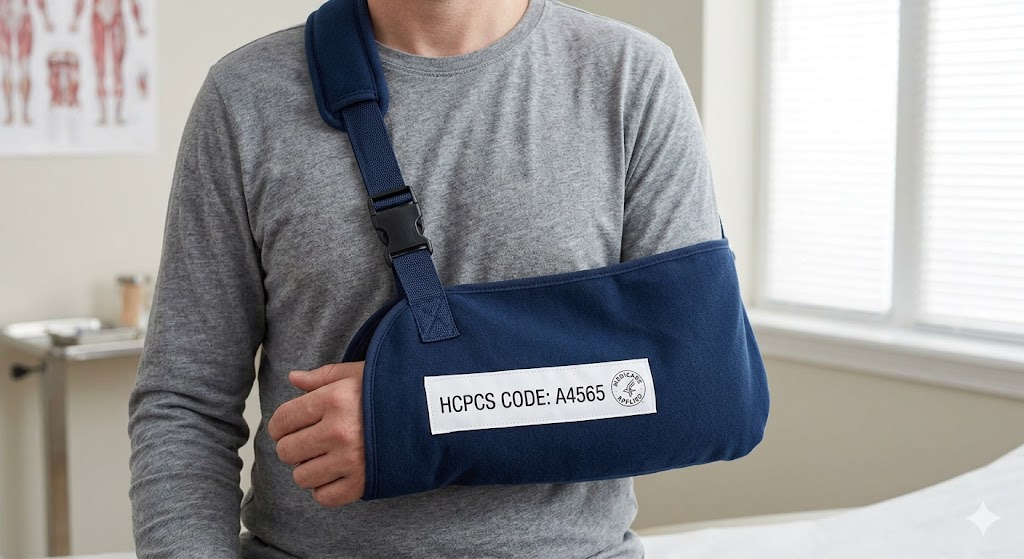
The most direct answer to the query “hcpcs code for arm sling” is almost always A4565. This code lives in the miscellaneous medical supplies section of the HCPCS Level II manual, and its official description is plain: “Sling.”
Payers use A4565 for a standard, generic sling. This is the device you pick off the shelf at a pharmacy. It lacks rigid stays, it does not have a custom-molded plastic shell, and it does not require the expertise of a certified orthotist for fitting. The code is a catch-all for the soft, fabric-based triangular bandage-type sling, as well as the simple envelope-style sling with a basic shoulder strap.
What Falls Under A4565
You should bill A4565 when the device meets these functional criteria. The sling supports the weight of the forearm, wrist, and hand. It does not immobilize the elbow in a fixed, locked position. It allows some degree of passive movement of the arm against the body, even if minimal. The material construction involves cotton, canvas, foam, or a simple nylon blend. There are no rigid plastic or metal structural supports that cross the elbow joint or the wrist.
A typical scenario involves a patient with a distal radius fracture who has undergone a closed reduction. The emergency department physician places the patient in a short arm cast. The nurse then applies a commercial, pre-sewn fabric sling with an unpadded strap. The sling serves one purpose: to elevate the hand, reduce edema, and relieve the pulling weight of the arm on the shoulder. This device is a supply. It provides comfort and support, not therapeutic rigid stabilization. The correct code for billing this sling to the patient’s insurance is A4565.
Documentation Notes for A4565
A4565 is not an expensive code. Its reimbursement value sits low on the fee schedule, and providers who sell or dispense these slings often bulk-bill them or absorb the cost as a minor practice expense. Because of its low reimbursement, the documentation burden is lighter than for custom-fabricated orthotics. However, a prescription or a detailed order from the treating physician remains a mandatory condition of payment under Medicare rules.
The Standard Written Order (SWO) must contain the patient’s name, the prescribing practitioner’s name and National Provider Identifier (NPI), the date of the order, and a clear description of the item. The description “arm sling” or “sling” suffices. You do not need to provide a narrative of medical necessity beyond the ICD-10 diagnosis code that supports medical need. For a simple sling, a diagnosis code like S52.501A (fracture of the lower end of the right radius, initial encounter) or M75.101 (rotator cuff tear, unspecified shoulder) works. The payer reviews the claim to establish that the sling was a reasonable and necessary adjunct to the treatment of the diagnosed condition.
A4565 Reimbursement Landscape
Medicare Administrative Contractors (MACs) typically process A4565 claims without heavy scrutiny when the diagnosis code and provider credentials align. Payment amounts vary by jurisdiction. The national average Medicare allowable for A4565 sits in the range of $5 to $15, depending on the fee schedule locality. Commercial payers often mirror this pricing structure. Given this modest valuation, many orthopedic practices and physical therapy clinics stock a large inventory of these standard slings and provide them as part of the global surgical package or a bundled therapy visit fee, rather than billing them separately.
The Orthotic Distinction: Introducing the L-Codes
The coding pathway changes dramatically the moment the sling offers more than passive support. If the device features rigid components, adjustable locking hinges, a forearm trough made of molded plastic, or a shoulder abduction pillow, the payer views it as an orthotic. You must then leave the A-code territory and enter the L-code range of the HCPCS Level II system.
L3670: Shoulder Orthosis with Abduction Positioning
When a physician orders a sling that holds the arm away from the body, you look to L3670. The code description reads, “Shoulder orthosis, abduction positioning, airplane design, prefabricated, includes fitting and adjustment.”
This device, often called an airplane splint or airplane sling, places the humerus in a fixed degree of abduction and often a degree of forward flexion. The rigid frame usually consists of an adjustable metal or hard plastic strut that sits between the torso and the arm. A soft padded sling supports the forearm. The shoulder rests in a position that reduces tension on a repaired rotator cuff tendon or protects the glenohumeral joint after a stabilization procedure.
You bill L3670 when the patient requires a specific therapeutic shoulder position that a simple A4565 sling cannot provide. The prescription must specify the abduction angle. The supplier or orthotist fits the prefabricated device to the patient, adjusts the telescoping bars, and ensures the pivot points align with the shoulder’s axis of rotation. Medical necessity documentation must reflect why a standard sling fails to meet the clinical objective. A post-operative note for a massive rotator cuff repair would support this code well. The surgeon explicitly writes, “Patient must maintain 30 degrees of abduction in a rigid frame airplane splint for four weeks. No weight bearing, no active motion.”
L3674: Shoulder Orthosis with Upper Arm Container
L3674 describes a “Shoulder orthosis, abduction positioning, with upper arm container, prefabricated, includes fitting and adjustment.” This device goes a step further than L3670. Instead of a simple forearm sling attached to an abduction frame, it incorporates a molded, padded shell that encases the upper arm as well as the forearm. The container provides more secure stabilization of the humerus relative to the scapula.
Conditions that demand this level of control include severe proximal humerus fractures managed non-operatively, complex shoulder girdle injuries, and certain brachial plexus injuries where the flail limb requires protected positioning. The documentation must explain why the extra purchase on the upper arm is clinically necessary. The code covers the fitting and adjustment, which an orthotist or a trained physical therapist performs.
L3675: Shoulder Orthosis, Hard Plastic, Custom Fabricated
L3675 moves into custom fabrication. The code requires the creation of a shoulder orthosis from a patient-specific cast or digital scan. The hard plastic orthosis immobilizes the shoulder in the precise position the physician specifies. The term “custom fabricated” indicates that no prefabricated device was modified to fit the patient. The orthotist took an impression of the limb, created a positive model, and molded the thermoplastic over that model.
This code demands the highest level of documentation. The supplier must retain a detailed fabrication note, the original order, the delivery slip with the date the patient received the device, and proof that a qualified professional performed the fitting. You must also demonstrate why a prefabricated L3670 or L3674 could not address the patient’s needs. This often involves a physical deformity, a volume fluctuation issue, or a complex surgical construct that precludes an off-the-shelf fit.
L3671 and L3677: The Pediatric Distinctions
Children who require shoulder positioning slings generate their own codes. L3671 covers a shoulder orthosis with a soft interface for a child. L3677 covers a custom-fabricated version. Pediatric codes acknowledge that the device must accommodate growth, lighter weight, and different mechanical leverage points. Payers scrutinize pediatric L-code claims to confirm medical necessity distinct from adult codes. The clinical narrative often highlights the need to maintain post-surgical position while protecting the epiphyseal plates or managing congenital shoulder instability.
Comparative Table: A4565 vs. Common L-Codes
A quick-reference table helps differentiate these codes at a glance.
| HCPCS Code | Short Description | Rigid Components | Custom Fabrication | Typical Clinical Use | Fitting Required |
|---|---|---|---|---|---|
| A4565 | Standard arm sling | No | No | Post-cast support, edema control, minor strains | No (basic strap adjustment) |
| L3670 | Airplane splint, prefab | Yes (rigid bar/frame) | No | Rotator cuff repair, glenohumeral stabilization | Yes |
| L3674 | Shoulder orthosis with upper arm container, prefab | Yes | No | Proximal humerus fracture, brachial plexus injury | Yes |
| L3675 | Shoulder orthosis, custom fabricated, hard plastic | Yes | Yes | Complex deformity, non-union, custom post-op positioning | Yes, extensive |
| L3671 | Pediatric shoulder orthosis, soft interface | Variable | No | Post-op congenital condition, fracture | Yes |
| L3677 | Pediatric shoulder orthosis, custom fabricated | Yes | Yes | Severe contracture management, custom post-op | Yes, extensive |
This table offers a clear visual separator. A4565 stands alone in the supply category. The L-codes all share the requirement for professional fitting and the presence of structural, positioning components. If you hold a device in your hand and it has a metal hinge, a rigid plastic cuff, or a fixed-angle bar, you must mentally shift your coding search toward the L-series.
The Critical Role of Modifiers
A correct HCPCS code forms only half of a clean claim. Modifiers tell the payer the full story of the device’s provision and the patient’s anatomical circumstance. Misusing or omitting modifiers is a primary reason claims for arm slings and shoulder orthoses receive denials or trigger audits.
Laterality Modifiers: RT, LT, and 50
A standard arm sling under A4565 typically does not demand a laterality modifier. A sling for the left arm and a sling for the right arm represent the same code and supply item. However, many L-code shoulder orthoses require a left (LT) or right (RT) modifier. Check your MAC’s local coverage determination (LCD). Some contractors mandate laterality modifiers even for certain prefabricated shoulder orthotics, arguing that the device is side-specific.
Always append RT or LT if the code descriptor implies a unilateral device. Billing L3670 with a 50 modifier (bilateral) would raise an immediate red flag. Shoulder abduction orthoses of the airplane type are by nature unilateral. If a rare clinical situation required bilateral airplane splints, you would bill two separate lines with RT and LT modifiers and attach comprehensive documentation and an Advance Beneficiary Notice (ABN) if Medicare eligibility was in question.
KX, GA, GZ, and EY Modifiers
The KX modifier certifies that the supplier has met all medical necessity criteria outlined in a specific LCD and that the supplier holds the necessary documentation. When you submit a claim for L3675 (custom fabricated), appending the KX modifier communicates to the MAC that you have the detailed prescription, the fabrication note, and the delivery documentation on file and that you are prepared to produce them upon request. Submitting an expensive L-code claim without KX almost guarantees a development letter or a denial.
The GA modifier comes into play when you issue an Advance Beneficiary Notice. You attach GA when you believe Medicare may deny the item as not medically necessary but the patient insists on receiving it. The patient signs the ABN, accepting financial responsibility. The GZ modifier signals that you did not issue an ABN but you expect denial. This should be a rare, carefully considered submission.
The EY modifier indicates that no physician’s order exists. This presents a serious compliance problem. You should never bill a Medicare claim for an orthotic using EY unless an exception process applies, which is vanishingly rare. The absence of a valid order is a foundational error that subjects the supplier to overpayment recovery.
Modifiers for Rental vs. Purchase
Arm slings under A4565 are routinely purchased items. You do not rent a simple fabric sling. Many L-code shoulder orthoses also fall into the purchase category, but some expensive custom devices may carry a rental option depending on the MAC’s policy. Always verify the capped rental or purchase designation in the DMEPOS fee schedule file for the specific code. A new modifier such as NU (new equipment purchased) or RR (rental) clarifies the billing intent.
Medical Necessity and LCD Navigation
Local Coverage Determinations are the rulebooks that dictate under what conditions a specific HCPCS code receives reimbursement. Each MAC publishes LCDs that impact orthotics. The LCD for “Shoulder Orthoses” (often associated with policy number L33793 or similar) defines the documentation requirements for L3670 and its related L-codes. You must read the LCD active in your jurisdiction. Do not rely on a neighboring MAC’s policy.
The Key Elements of an LCD for Shoulder Orthoses
A typical shoulder orthosis LCD establishes that the device must be reasonable and necessary for the diagnosis or treatment of an illness or injury. It specifies that a prefabricated orthosis requires minimal self-adjustment and can be fitted without specialized skill, although L3670 and L3674 explicitly state “includes fitting and adjustment.” The LCD further explains that custom-fabricated L3675 is only medically necessary when the patient’s anatomy precludes a proper fit with a prefabricated model, or when the specific clinical immobilization requirement cannot be achieved by adjusting an off-the-shelf device.
The LCD will list supporting ICD-10 codes. Common supported codes include traumatic fractures, surgical aftercare codes, rotator cuff tears, acromioclavicular separations, and adhesive capsulitis post-manipulation. If the patient’s condition does not fall within the listed codes, you may still submit a claim for individual consideration. Attach a thorough narrative explaining the unique medical necessity.
The Narrative of Medical Necessity
Your narrative must answer one question: why does this patient need this specific device? Do not simply state “patient post-op.” Describe the surgical procedure, the specific structural repair, the surgeon’s explicit post-operative protocol, and the mechanical reason the chosen orthosis satisfies that protocol. For a custom L3675, you must document the unsuccessful trial of a prefabricated alternative or clearly explain why a trial was not feasible. A sentence such as, “The patient’s chest wall contour and axillary webbing secondary to burn scarring prevented secure seating of a prefabricated airplane splint,” is a powerful, defensible justification.
A Deep Dive into Supply Code Billing Scenarios
The theoretical coding framework is useful, but real-world application often presents messy, borderline cases. We will walk through several detailed patient scenarios to cement the decision-making process.
Scenario One: The Geriatric Humeral Neck Fracture
An 85-year-old woman falls and sustains a minimally displaced fracture of the surgical neck of the right humerus. The orthopedic surgeon elects non-operative management with a sling. The physician orders a sling and swathe. The nurse applies a standard fabric sling and a separate elastic swathe bandage that wraps around the patient’s torso and secures the arm against the body.
The sling itself is a basic envelope sling with a foam-padded strap. The swathe is a separate piece of elastic with Velcro closures. The billing department correctly submits one unit of A4565 for the sling. The swathe falls under A4466 or another appropriate elastic bandage supply code, depending on the specific item used. This is not a shoulder orthosis because there is no rigid positioning component. The sling and swathe are supplies that provide comfort and gentle limitation of gross movement. The documentation need only connect the items to the fracture diagnosis code S42.201A.
Scenario Two: The Post-Operative Rotator Cuff Protocol
A 58-year-old construction worker undergoes an arthroscopic repair of a full-thickness supraspinatus tear with retraction. The surgeon dictates a post-operative order: “Patient to remain in 15-degree abduction airplane splint at all times except for hygiene and prescribed pendulum exercises. No active motion for six weeks.”
The clinic’s DME supplier fits the patient with an adjustable, prefabricated airplane splint. The orthotist loosens the thoracic straps, adjusts the abduction bar to 15 degrees, and ensures the humeral support cuff aligns properly. The device has a rigid plastic lateral bar, a padded waist belt, and a forearm sling.
The supplier bills L3670-RT. They do not bill A4565, because a simple cloth sling would violate the surgeon’s explicit mechanical requirement. The claim includes the KX modifier, the ICD-10 code M75.121 (complete rotator cuff tear, right shoulder), and the date of surgery. The supplier retains the surgeon’s order, the fitting notes that document the abduction angle setting, and the delivery slip. This claim is strong.
Scenario Three: The Complex Revision with Custom Needs
A 42-year-old woman has undergone a third revision shoulder stabilization procedure. Her humeral head anatomy is distorted from previous surgeries, and she has significant deltoid atrophy. The surgeon orders a custom-fabricated shoulder orthosis that holds the arm in 30 degrees of abduction and neutral rotation. The patient’s axilla has a deep scar depression that prevents a comfortable, stable fit for any prefabricated airplane splint.
The orthotist takes a full-torso and arm cast, noting the specific position the surgeon requires. The fabricated orthosis uses a custom-molded thermoplastic thorax jacket and upper arm shell, connected by an adjustable metal bar. Fitting requires several adjustments to the trim lines.
The supplier bills L3675-LT with KX. The documentation includes a detailed fabrication narrative, photographs of the cast or scan, the prescription specifying the exact degree of abduction and rotation, and a note describing the failed trial of two different prefabricated L3670 models due to the axillary defect. The orthotist’s chart note states: “Prefabricated devices could not be seated without excessive pressure on the axillary scar, risking skin breakdown and patient non-compliance.”
Billing for Pediatric Arm Slings and Orthoses
Coding for children introduces additional layers of nuance. The pediatric L-codes exist because the devices are distinct. A child’s trunk-to-arm ratio, growth velocity, and the force required to achieve therapeutic positioning differ from an adult’s.
The Prefabricated Pediatric Shoulder Orthosis
L3671 describes a prefabricated shoulder orthosis with a soft interface. The device often incorporates softer foam liners, lighter structural components, and a more adjustable growth mechanism than its adult counterpart. The conditions treated range from congenital shoulder instability to post-operative positioning after brachial plexus birth palsy surgery.
When billing L3671, you must document the child’s age, weight, and the specific pediatric medical necessity. Simply billing L3670 for a child because you do not have L3671 in your inventory system is non-compliant. The code exists to reflect the different manufacturing and fitting investment. The reimbursement rate for L3671 is often higher to account for the specialized pediatric design and the additional time required for fitting a non-cooperative or anxious child.
The Custom-Fabricated Pediatric Orthosis
L3677 covers custom-fabricated pediatric shoulder orthoses. This code requires the same fabrication process as L3675, but the clinical and regulatory bar for medical necessity is even more explicit. You must demonstrate that the child’s anatomy cannot be accommodated by a prefabricated pediatric orthosis. Frequent reasons include severe spasticity that requires precise joint positioning to prevent contracture, or congenital limb deficiencies that present with atypical surface geometry.
The documentation must reflect a comprehensive evaluation by an orthotist with pediatric specialty experience. The supplier should retain the original plaster cast or 3D scan files. The orthotist must record the specific fabrication steps, the materials used, and the fitting outcome, noting any immediate adjustments. Payers will scrutinize these high-cost pediatric claims and compare them against the child’s age and diagnosis. A one-year-old with a brachial plexus injury requiring an L3677 will likely face a medical review, and the documentation must be flawless.
Navigating Medicare’s Competitive Bidding Program
The arm sling and shoulder orthosis space intersects with Medicare’s Durable Medical Equipment, Prosthetics, Orthotics, and Supplies (DMEPOS) Competitive Bidding Program in certain geographic areas. A4565 is a supply code that often appears on the competitive bidding list. If you practice in a Competitive Bidding Area (CBA), you must be a contract supplier to bill Medicare for A4565, unless an exception applies.
L-code orthoses, including L3670, L3674, L3675, and the pediatric codes, are generally exempt from competitive bidding. They fall under the “off-the-shelf” or “custom” orthotic category that Medicare has largely carved out of the bidding program. You must still verify each code’s status on the current DMEPOS competitive bidding spreadsheet published by CMS. Bidding status changes periodically.
If you are a treating practitioner, such as a physician or physical therapist, and you provide a sling directly to the patient in your office, you must enroll as a DMEPOS supplier unless you meet the “own use” exception. Simply dispensing a sling from your office’s supply closet and billing the patient’s Medicare Part B can trigger a compliance violation if you lack the appropriate supplier enrollment. Many clinics avoid this by providing the sling as a “free-of-charge” professional courtesy and documenting that the patient received the device without a separate bill. If you cannot absorb the cost, you must refer the patient to an enrolled DME supplier with a prescription.
The Payer Perspective: Commercial Insurance Nuances
Commercial insurance carriers, including UnitedHealthcare, Blue Cross Blue Shield, Aetna, and Cigna, do not always follow Medicare’s coding architecture precisely. Many commercial plans accept the HCPCS Level II codes, but their medical necessity criteria and reimbursement rates differ.
Prior Authorization Requirements
L-codes for shoulder orthoses frequently trigger prior authorization requirements in the commercial sector. A surgeon’s office must contact the payer, provide the surgical notes, the L-code, and the supplier’s information, and receive a formal authorization number before dispensing the device. The timeline for authorization can delay the post-operative fitting, so surgical practices must build this into their pre-operative workflow. The patient’s surgery date can arrive faster than the authorization review. Coordinate with your durable medical equipment provider early.
Crosswalk and Miscellaneous Codes
Some commercial payers reject specific L-codes and instruct suppliers to use a local proprietary code or a “miscellaneous” code. When a payer requests a not-otherwise-classified code, you must include a clear description of the device and an invoice. The supplier sends the claim with the narrative “Airplane splint, prefabricated, right shoulder, equivalent to HCPCS L3670.” The payer’s system then prices the claim manually or based on a percentage of a recognized standard, often the Medicare fee schedule.
Common Documentation Deficiencies and Audit Triggers
Auditors from the Office of Inspector General (OIG), the Supplemental Medical Review Contractor (SMRC), and the Unified Program Integrity Contractors (UPICs) actively review DMEPOS claims. Shoulder orthoses are a target because of the high dollar amount relative to the simple sling supply code. We have compiled a list of the most frequent deficiencies that lead to denials and extrapolated overpayments.
- Missing Standard Written Order: The prescription is not dated prior to delivery. A common error is obtaining a verbal order and delivering the device, then failing to get the signed, dated SWO within the regulatory timeframe. For Medicare, the SWO must be communicated to the supplier before delivery. A signed delivery slip does not replace the order.
- Inadequate Medical Necessity Narrative: The chart note simply states “airplane splint ordered.” It lacks the specific clinical rationale, the required degrees of abduction, and a statement of why a lesser device is insufficient. An auditor will treat this as a failure to establish medical necessity.
- No Proof of Delivery: The supplier must have a delivery slip that the patient or caregiver signed and dated. The slip must list the specific HCPCS code and a brief description matching the code. A generic “sling” on a delivery slip for an L3675 is a fatal discrepancy.
- Improper Use of Custom Code: An orthotist bills L3675 but has actually modified a prefabricated L3674 by adding extra padding or trimming the edges. This constitutes a modified prefabricated orthosis, which does not meet the criteria for custom fabrication. The supplier should bill the prefabricated code with any appropriate addition, or seek a different code. The records will show an off-the-shelf starting device, triggering an overpayment ruling.
- Signature Mismatch or Missing Credentials: The prescribing practitioner’s signature is illegible and does not have an accompanying printed name and credentials. The signature log is not on file. Auditors will invalidate the order.
Additional HCPCS Codes That Intersect With Arm Slings
Our focus remains on the direct sling codes, but ancillary codes often appear on the same claim. Understanding them helps you build a complete and clean submission.
A4566: Shoulder Immobilizer
A4566 is described as a “shoulder immobilizer, includes straps.” This is not a sling, but providers frequently confuse the two. A shoulder immobilizer typically attaches around the waist and the forearm, holding the arm tightly against the torso with a swathe-like design, and often includes a shoulder cap to provide compression or warmth. The code does not possess rigid stays, yet it provides more restrictive positioning than A4565. The patient with anterior shoulder dislocation in a conservative management protocol may receive this device.
L3660: Shoulder Orthosis, Without Joints
L3660 covers a shoulder orthosis that does not have a rigid joint. It may contain a malleable bar. The device bridges the area between the shoulder and the thorax, often used for postoperative positioning after pacemaker insertion or to limit shoulder movement in a specific plane. This code sometimes appears as an alternative to a rigid airplane splint when the physician wants a softer, less restrictive positioning.
L3650: Shoulder Orthosis, Figure of Eight Design
L3650 covers the figure-of-eight clavicle splint, which is primarily a clavicle fracture orthosis. While not a sling, a patient with a clavicle fracture may receive both an A4565 sling and an L3650 orthosis. The payer may bundle these items or require separate medical necessity justification. The provider must explain why the patient needs both supportive devices concurrently.
The Workflow for a Compliant DME Dispensing
Implementing a consistent workflow eliminates most coding and documentation errors. We recommend a six-step process that any clinic or DME supplier can adopt.
- Clinical Evaluation and Prescription: The physician evaluates the patient and determines the specific mechanical needs. The physician writes an order that includes the patient’s diagnosis, the desired device by name and function, the anatomical side, and the duration of use. The order must be signed and dated.
- Device Selection and Code Matching: A certified orthotist, physical therapist with DME authorization, or qualified supplier staff member evaluates the prescription. They select the exact HCPCS code that matches the device’s function and construction. If the order requests a “sling,” they determine if the clinical intention requires A4565 or if the documented positioning requirement forces an L-code decision. When there is doubt, the supplier contacts the prescriber for clarification, documents the conversation, and obtains a revised order.
- Insurance Verification and Authorization: The billing team checks the patient’s benefits. For L-codes, they initiate prior authorization if required. They confirm the code is payable under the patient’s plan and that the diagnosis code appears on the payer’s covered list. They inform the patient of any expected out-of-pocket cost and issue an ABN if necessary.
- Fitting and Patient Education: The clinician fits the device, adjusts all components to the prescribed position, and verifies skin integrity and neurovascular status. The patient or caregiver receives verbal and written instructions on donning, doffing, wearing schedule, and warning signs of pressure injury. The fitting note captures the model, serial number if applicable, and the specific adjustments made.
- Claim Submission with Proper Modifiers: The billing office submits the claim with the correct HCPCS code, modifiers (RT, LT, KX, etc.), diagnosis pointers, and the date of service. They attach the authorization number if required. They maintain a digital copy of the complete order, delivery slip, clinical notes, and authorization in a claim-specific file.
- Post-Delivery Follow-Up: The supplier schedules a follow-up to assess the device’s fit and function, typically within the first week. This visit documents the patient’s compliance, any skin issues, and the device’s ongoing mechanical performance. This note is a critical piece of evidence that the initial provision was appropriate and effective.
A Note on Off-the-Shelf vs. Custom-Fabricated: The Legal Line
The OIG and CMS draw a sharp line between off-the-shelf prefabricated orthoses and custom-fabricated ones. The 2021 and 2024 revisions to the DMEPOS regulations clarified that off-the-shelf orthoses require minimal self-adjustment and do not require expertise in trimming, bending, molding, or assembling. A custom-fabricated orthosis is one that is individually made for a specific patient starting from raw materials, including thermoplastic sheets, metal bars, and soft goods. No other patient could use the device.
A supplier who takes a prefabricated airplane splint and bends the metal bar to 30 degrees using a wrench has not created a custom-fabricated orthosis. They have performed a fitting and adjustment, which is included in the prefabricated code allowance. The difference is profound and subject to intense audit scrutiny. Billing L3675 for a bent prefabricated metal bar is a false claim. Your documentation, including the inventory record showing the starting prefabricated unit, will reveal the truth to an auditor.
International Classification of Diseases: ICD-10 Pairings
Selecting an appropriate diagnosis code to pair with the HCPCS code is a crucial step. The ICD-10 code must support medical necessity. We present a table of common pairings to assist in claim validation.
| Clinical Presentation | Common ICD-10 Code | Justification for Device |
|---|---|---|
| Proximal humerus fracture, closed | S42.209A | Support and edema management, weight relief. |
| Rotator cuff tear, right shoulder | M75.121 | Post-operative protection in abduction. |
| Anterior shoulder dislocation | S43.014A | Immobilization and tissue rest. |
| Acromioclavicular sprain | S43.51XA | Shoulder support and scapular stabilization. |
| Brachial plexus injury, newborn | P14.0 | Positioning for nerve recovery and contracture prevention. |
| Adhesive capsulitis, post-manipulation | M75.02 | Maintaining gained range and protecting joint. |
| Aftercare following joint surgery | Z47.89 | Explicit post-surgical positioning protocol. |
The Z47.89 aftercare code requires special attention. When the acute injury has resolved and the patient enters a strictly post-operative recovery phase, use the aftercare code as the primary diagnosis. This tells the payer that the orthotic is a standard, expected component of the surgical recovery pathway. Pairing an acute injury code with an orthotic delivered weeks after the initial injury may trigger a clinical edit.
Realistic Reimbursement Expectations and Patient Cost
Transparency with patients about their financial responsibility builds trust and reduces billing disputes. We have compiled realistic Medicare national average reimbursement ranges for the key codes in 2024, though individual MAC fee schedules and geographic adjustments apply.
- A4565: $8 to $14 (Purchase). This is a minor expense. Many secondary insurances may cover the 20% copayment.
- L3670: $75 to $120 (Purchase). The prefabricated airplane splint’s allowance covers the device cost and the professional fitting service.
- L3674: $110 to $180 (Purchase). The inclusion of the upper arm container and the more complex mechanical structure drive the allowance higher.
- L3675: $450 to $700 (Purchase). Custom fabrication involves a significant time investment and raw material cost, and the allowance reflects the professional orthotic service.
- L3671: $90 to $150 (Purchase). Pediatric allowance often slightly exceeds adult prefabricated counterparts due to lower production volume and specialized design.
- L3677: $500 to $800 (Purchase). Custom pediatric allowance recognizes the complexity of fitting and fabricating for a small, growing patient.
Commercial insurance payments will vary. Some plans pay a percentage of billed charges, while others have a fee schedule based on a multiplier of the Medicare rate. The supplier’s contract with the payer controls the allowed amount. Always verify the patient’s deductible status and coinsurance percentage before delivery and inform the patient of their estimated responsibility.
The Evolution of Sling and Orthosis Coding
The HCPCS system adapts over time. Codes that once existed have been deleted. New ones have emerged. The evolution toward specific pediatric codes and the tightening of the custom fabrication definition reflect a broader regulatory movement toward accurate coding and anti-fraud measures. Keep your coding database current. Review the quarterly HCPCS updates published by CMS.
One significant trend is the increased use of 3D scanning and digital fabrication in orthotics. As of 2025, CMS has acknowledged that a digital scan qualifies as an impression for a custom-fabricated device, provided the orthotist manages the digital design and fabrication workflow directly. The orthotist cannot simply order the device from a catalog based on a scan. The final device must still be individually fabricated for the patient from raw materials, not merely selected from a pre-made inventory.
Important Notes for Suppliers and Therapists
A collection of critical reminders can keep your practice compliant and profitable.
- Never waive copayments or deductibles for Medicare patients without a documented financial hardship assessment that meets CMS criteria. Routine waiver is a violation of the Anti-Kickback Statute and can result in severe penalties.
- Verify the ordering physician’s NPI and ensure they are not on the CMS exclusion list. Billing for items ordered by an excluded provider results in mandatory denial and potential overpayment liability.
- Keep the SWO, delivery documentation, and clinical notes for a minimum of seven years from the date of service. This is longer than many standard record retention policies.
- If a MAC denies a claim and requests additional documentation, respond within the timeframe specified in the Additional Documentation Request (ADR). A non-response results in an automatic technical denial.
- For L3675 and L3677, maintain photographs of the completed orthosis in the patient’s file. In an audit, a photograph of the custom device on the patient is persuasive evidence that the device was fabricated and fitted uniquely for that individual.
Summary and Conclusion
The HCPCS code for an arm sling splits into two distinct pathways: the supply code A4565 for a basic, off-the-shelf fabric sling, and the L-code series—primarily L3670, L3674, and L3675—for rigid positioning shoulder orthoses that demand professional fitting or custom fabrication. Correct coding depends entirely on the device’s structural components, the therapeutic positioning goal, and the documented medical necessity. The financial, legal, and compliance stakes escalate as you move from a simple sling to a custom abduction orthosis, making detailed documentation, precise modifier use, and strict adherence to the LCD your strongest defense against audit and denial.
A clean claim starts with the prescribing physician’s clear order and a thorough understanding of the mechanical distinction between a soft support and an immobilizing orthotic. Billing A4565 for an airplane splint invites an automatic denial and a potential compliance finding. Billing L3675 for a modified prefabricated device constitutes a false claim. Invest in ongoing education for your intake, clinical, and billing teams. When you align the clinical narrative with the precise HCPCS code and the payer’s medical necessity criteria, you create a seamless path from prescription to delivery to reimbursement, and your patient receives the right device at the right time.
Frequently Asked Questions
What is the primary HCPCS code for a simple cloth arm sling?
The primary code is A4565, which covers a standard, prefabricated sling without rigid components or positioning bars.
When should I use L3670 instead of A4565?
Use L3670 when the physician orders an airplane splint or a sling that holds the shoulder in a fixed degree of abduction using rigid structural components.
Does Medicare require a prescription for a standard arm sling?
Yes, Medicare requires a Standard Written Order from a treating physician for A4565, although the documentation burden is lighter than for L-code orthoses.
Can I bill for a custom shoulder orthosis if I modified a prefabricated one?
No. Bending or trimming a prefabricated device does not create a custom-fabricated orthosis. You must bill the appropriate prefabricated code.
What modifier do I need for a custom shoulder orthosis?
You must append the KX modifier to certify that medical necessity documentation is on file, along with the appropriate laterality modifier (RT or LT).
Additional Resource
For the latest DMEPOS fee schedule and LCD policies, visit the CMS website or your Jurisdiction’s MAC website. A comprehensive, searchable database of HCPCS codes and local coverage determinations is available at the Palmetto GBA JM LCD Search page: https://www.palmettogba.com. This resource provides updated policy articles and medical review guidelines for orthotics and supplies.
Disclaimer: This article provides general coding and billing information intended for professional use. It is not a substitute for the official CMS guidelines, your MAC’s specific Local Coverage Determination, or the advice of a qualified healthcare compliance attorney. CPT and HCPCS codes are updated annually; always verify the current code descriptors and reimbursement rules before submitting claims.