Navigating the world of medical billing can feel like learning a foreign language. You are dealing with patients, insurance companies, and a mountain of paperwork. The last thing you need is a denied claim because of a simple coding error. If you are a respiratory therapist, a durable medical equipment supplier, or a billing specialist, you have likely encountered the Acapella device. This small, handheld tool is a powerhouse for airway clearance. But when it comes time to bill for it, confusion often arises.
This article serves as your definitive guide. We will cut through the noise and provide clear, actionable information. We will focus specifically on the correct HCPCS code for the Acapella flutter valve. You will learn not just the code itself, but the entire ecosystem surrounding it. We will discuss documentation, reimbursement, common denials, and best practices. By the end, you will have a master-level understanding of how to get this device covered for the patients who need it. Let’s dive into the details and make sure your claims stick.
Understanding the Acapella Device and Its Clinical Role
Before we get to the alphanumeric codes, we must understand the device itself. Medical coders and billers cannot accurately do their job without grasping the clinical purpose. Payers want to see medical necessity. If you do not understand how the device works, you cannot effectively argue its necessity.
What Exactly is the Acapella Flutter Valve?
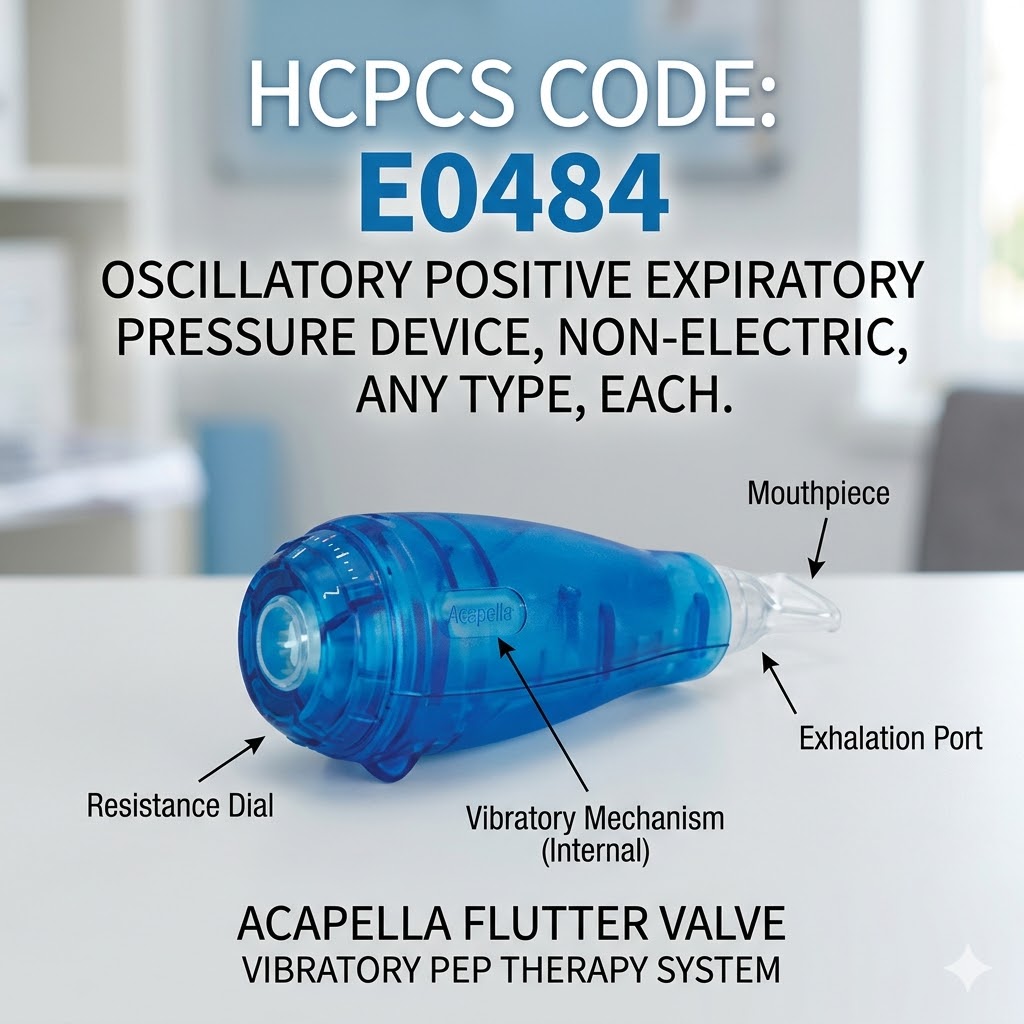
The Acapella is an oscillatory positive expiratory pressure device. That sounds complex, so let’s break it down. It is a small, plastic, medication-delivery-compatible device. The patient exhales into it. The device creates resistance, which is the “positive expiratory pressure” part. This pressure helps hold the airways open. Simultaneously, a counterweighted plug and magnet inside create rapid vibrations. These are the “oscillations.”
These vibrations travel down into the lungs. They physically shake the mucus loose from the airway walls. Think of it as an internal massage for the lungs. The Acapella combines the benefits of PEP therapy and vibration into one single, hands-free operation. Unlike older models, the patient does not need to be in a specific position. It works regardless of the angle. This makes it incredibly user-friendly for a wide range of patients, from young children with cystic fibrosis to elderly patients with COPD. The device facilitates airway clearance and helps improve pulmonary function over time when used consistently.
Clinical Indications: Who Needs This Device?
Why is the HCPCS code for the Acapella flutter valve so frequently searched? Because the patient population is vast. The device treats conditions characterized by mucus hypersecretion and ineffective cough. You will commonly see it prescribed for conditions like chronic obstructive pulmonary disease, particularly the bronchitis phenotype, and cystic fibrosis.
Bronchiectasis, a condition where the airways are permanently widened and mucus pools, is another primary indication. We also see it used in neuromuscular diseases where the cough reflex is weak. Post-operative patients who are at risk for atelectasis, the collapse of lung tissue, also benefit. The goal is always the same: mobilize secretions, improve gas exchange, and prevent recurrent respiratory infections. Payers recognize these indications. Your documentation must clearly link the diagnosis to the therapeutic mechanism of the Acapella. A diagnosis of simple asthma without mucus plugging will likely trigger a denial. The device is for secretion clearance, not just airway dilation.
Acapella Choices: Green vs. Blue
Clinicians also have a choice to make between the low-flow and high-flow models. The industry uses a simple color code system.
- Green Acapella (Low Flow): This model is designed for patients who can sustain an expiratory flow rate of less than 15 liters per minute for at least three seconds. This typically includes pediatric patients, geriatric patients, or those with severe obstructive disease who have very low expiratory force.
- Blue Acapella (High Flow): This model is for patients who can sustain an expiratory flow of 15 liters per minute or greater. The standard adult population usually falls into this category.
From a billing perspective, the HCPCS code for the Acapella flutter valve generally does not change based on the color. Both the green and blue models fall under the same category. However, the medical record should specify why a particular flow rate was chosen. This clinical detail supports the comprehensive nature of the order and proves that the prescribing physician assessed the patient’s specific ventilatory capabilities.
Decoding the HCPCS Landscape for Respiratory Devices
Medical coding has its own hierarchical structure. To pinpoint the exact code, you need to navigate the Healthcare Common Procedure Coding System. HCPCS is divided into two main levels. Level I is the Current Procedural Terminology codes, managed by the American Medical Association. These cover physician services and procedures. Level II is the alpha-numeric system managed by the Centers for Medicare and Medicaid Services. This level covers non-physician services like ambulance rides, prosthetics, medical supplies, and the equipment we are discussing today.
The Acapella falls squarely into Level II. These codes begin with a letter followed by four numbers. The letter identifies the category. Finding the right one requires understanding the durable medical equipment section. We must sift through the “E” codes.
The Primary Code: E0480 and Its Definition
If you need the straight answer, here it is. The most common and specific HCPCS code for the standard Acapella flutter valve is E0480. Let’s look at the official descriptor for this code. It defines a “Percussor, electric or pneumatic, home model.” Wait. Read that again. Does the Acapella plug into the wall? No. Is it a pneumatic vest? No. This discrepancy is the root cause of a massive amount of confusion in the industry.
For years, suppliers have used E0480 because it was the closest available fit. The term “percussor” implies a mechanical device that creates percussion. The Acapella creates internal percussive vibrations. CMS and commercial payers have historically accepted E0480 for oscillatory PEP devices, even though the Acapella is entirely manual and contains no electrical components. This code sits in a “miscellaneous-like” space for manual percussors. You must recognize that using E0480 is a billing convention. It is not a perfect literal description. When you submit this code, you are telling the payer, “This manual device achieves the therapeutic equivalent of a home model percussor.”
Breaking Down the Code: Category and Modality
Let’s dissect E0480 to understand its origin. The “E” prefix places it solidly in the Durable Medical Equipment bucket. The numbers “0480” specify a particular type of respiratory assist device. You will often hear this referred to as a high-frequency chest wall oscillation device in other contexts. However, for manual OPEP devices, E0480 has become the default. Some payers may request a different code, such as E1399, which stands for “Durable medical equipment, miscellaneous.”
You need to avoid E1399 at all costs if possible. Miscellaneous codes trigger manual review. They automatically stop a claim in its tracks. A human must look at it. Processing time skyrockets, and the likelihood of a denial increases. Using E0480 provides a more direct route, even if the descriptor is technically off. It signals to the system that this is a standard, recognized type of respiratory secretion clearance equipment. Always check your local coverage determination, but E0480 is the standard industry starting point.
A Detailed Walkthrough of the Billing Process
Knowing the HCPCS code for the Acapella flutter valve is just step one. You need a robust process. A solid process protects your revenue cycle and ensures patient access. The billing workflow involves front-end verification, accurate claim submission, and aggressive denial management.
Payer Verification and Prior Authorization
Do not assume coverage. Every payer plan has distinct rules. A Medicare Advantage plan might have different criteria than traditional Medicare. Commercial plans like UnitedHealthcare or Aetna might carve out respiratory therapy to a specialty network. Your first task involves verifying the patient’s specific plan benefits. Ask the insurance representative directly: “Is HCPCS E0480 a covered benefit under this plan for the diagnosis of J47.9?” (bronchiectasis).
The prior authorization step is non-negotiable for many insurers. You will need a detailed written order, a chart note documenting the failed trial of conservative therapy, and a copy of the patient’s spirometry. Obtain the authorization number before you dispense the device. Keep it on file. If the payer does not require pre-auth, document the name of the representative who confirmed this, the reference number of the call, and the date. This protects you during an audit. Relying on a verbal “yes” without documentation is a recipe for a costly recoupment.
Essential Documentation for Medical Necessity
The clinical record must tell a compelling story. Payers want proof that the patient needs this specific device over a cheaper alternative. The classic alternative is the incentive spirometer, which lacks the oscillatory component. Your records should show that the patient suffers from retained secretions and an ineffective cough.
A sample documentation checklist includes:
- A prescription dated within 30 days of the delivery.
- A clinical note confirming a diagnosis like cystic fibrosis, bronchiectasis, or chronic bronchitis.
- A statement documenting the failure of or contraindication to cheaper therapies like simple chest physiotherapy or positive expiratory pressure without oscillation.
- Evidence of patient instruction. The clinician must document that they taught the patient how to use the Acapella and that the patient demonstrated an understanding of the technique.
- The frequency of use, often documented as 10 to 15 breaths followed by a huff cough, repeated twice daily.
Without these elements, the payer will argue that the device is not medically necessary. They will state that a less costly alternative exists. Beat them to the punch by including this rationale in the initial submission. You must connect the dots explicitly. Do not assume the medical director reviewing the claim knows why the vibrations matter.
The Technical Submission of the Claim
When you complete the CMS-1500 form or submit an 837P electronic transaction, precision matters. In Box 24D, you apply the HCPCS code. For E0480, you generally do not use a modifier unless a specific situation requires it. The RR modifier indicates a rental, but the Acapella is typically a capped rental or direct purchase item. Medicare usually processes this as a purchase given the device’s low retail cost.
Enter the usual and customary charge in Box 24F. Enter the number of units. Since the device is a single piece of equipment, you usually bill 1 unit. Do not bill one unit per day for a device the patient keeps at home. That will flag as an overpayment. The diagnosis pointer in Box 24E must link to the ICD-10 code in Box 21. Ensure the provider signs Box 31. A missing signature is a technicality that payers love to use for denial. While the electronic process automates much of this, the logic remains the same. Clean data in equals a clean explanation of benefits out.
Navigating Medicare and Commercial Payer Rules
The HCPCS code for the Acapella flutter valve remains constant, but the coverage rules do not. You must navigate a patchwork of local and national policies. Medicare provides a template, but commercial insurers often build upon it. Understanding the nuances between payers will define your reimbursement success rate.
Medicare DME MAC Coverage (HCPCS E0480)
Traditional Medicare provides coverage through the Durable Medical Equipment Medicare Administrative Contractors. They issue Local Coverage Determinations that spell out the rules. The DME MACs have been scrutinizing respiratory devices heavily in recent years. They want to ensure that the Acapella is not simply a comfort item.
Under standard LCDs, a positive expiratory pressure device is covered if the patient has a diagnosis of cystic fibrosis or chronic bronchiectasis. COPD might be covered, but usually, the documentation must show significant mucus production. The key concept is “significant mucous and/or retained secretions.” The medical record must demonstrate that the patient cannot adequately clear these secretions by spontaneous cough. Furthermore, the standard policy often requires a 30-day trial period with a simple, non-oscillating PEP device or chest physiotherapy. If those fail, the Acapella becomes necessary. However, many respiratory therapists bypass the “fail first” rule by documenting that the viscosity and tenacity of the sputum require oscillation immediately. The supplier must keep proof of delivery. A signature from the patient or caregiver confirming receipt is mandatory for Medicare.
The Challenge of the “Miscellaneous” Code: E1399
We touched on this earlier, but it deserves its own warning. Some billing consultants might tell you that E1399 is technically more accurate because E0480 describes an electric percussor. Be extremely cautious here. E1399 (Durable medical equipment, miscellaneous) is the Bermuda Triangle of medical billing. Claims sent here often disappear or return as a denial requiring a lengthy appeal.
When you use E1399, you must provide a detailed narrative description in Box 19 on the paper claim, or the equivalent electronic loop. You write “Manual oscillatory positive expiratory pressure device (Acapella).” This immediately forces a manual review. The reviewer may not have a pricing benchmark. They might compare it to a much cheaper device. They almost certainly will request the entire medical record. Only use E1399 if a specific payer issues a written policy explicitly rejecting E0480. Do not self-delegate to E1399 just because the E0480 descriptor seems imprecise. The industry standard is E0480. Stick to the standard path unless roadblocked.
Reimbursement Insights and Coding Tables
Understanding the theoretical HCPCS code for the Acapella flutter valve does not pay the bills; understanding the reimbursement amount does. The allowable fee for respiratory equipment is a moving target. It depends on the geographical location, the specific fee schedule, and the competitive bidding program.
Comparative Code Overview: HCPCS Options
To fully appreciate the position of the Acapella code, let’s compare it side-by-side with codes for related but distinct respiratory interventions. This clarifies why E0480 is the chosen vessel for this specific device.
| HCPCS Code | Standard Descriptor | Common Device Example | Typical Billing Note |
|---|---|---|---|
| E0480 | Percussor, electric/pneumatic, home model | Acapella (Green/Blue), Aerobika, VibraPEP | Industry standard for manual oscillatory PEP despite “electric” descriptor. |
| E0481 | Intrapulmonary percussive ventilation system | Volara System, MetaNeb | Used for high-velocity aerosolized saline delivery. Takes an active role in lung expansion, distinct from passive exhalation. |
| E0482 | Cough stimulating device, alternating positive and negative airway pressure | VitalCough, CoughAssist (Mechanical Insufflator-Exsufflator) | Designed for neuromuscular weakness. It literally pulls air out, unlike the passive resistance of an Acapella. |
| E0483 | High-frequency chest wall oscillation system | The Vest (Hill-Rom), SmartVest, InCourage System | A wearable vest attached to an air pulse generator. Entirely electric, external, and large-scale. |
| E1399 | Durable medical equipment, miscellaneous | Any unclassified DME | Used only when no specific code exists and a payer rejects E0480. Requires manual review and narrative. |
| A4630 | Replacement supplies for the above | N/A | Generally not used for the Acapella valve itself, as the whole unit is usually replaced, not repaired component-wise. |
This table offers a critical perspective. The Acapella is a purely mechanical, patient-powered device. Its coding placement with E0480 groups it with percussion therapy conceptually, even if the mechanism—manual breathing versus electric power—differs. Billing the more advanced E0483 for a simple plastic valve would be an upcoding violation. Billing E0481 implies a level of active breath delivery that does not occur. Knowing where your device sits on the “complexity ladder” protects you from audit liability.
Understanding the Fee Schedule for E0480
In a non-competitive bidding area, the Medicare fee schedule amount for E0480 historically averages between $60 and $90 for a direct purchase. This varies by state. The fee schedule is calculated using the average commercial pricing for the item, not the Suggested Retail Price. Because the Acapella is a relatively inexpensive device manufactured by companies like ICU Medical (Smiths Medical), the allowable has stabilized.
The competitive bidding program reduces this further. If a patient resides in a Competitive Bid Area, you must be a contract supplier to provide the item. The single payment amount in these areas can be significantly lower, sometimes $40 or less. You must know this before you ship the product. If you are not a contract supplier, you cannot provide the device to a Medicare beneficiary in a CBA unless an exception applies. Commercial insurers often shadow the Medicare fee schedule. You might negotiate a rate based on a percentage of Medicare, such as 110% of the current DME MAC fee. Do not set your private-pay price significantly above the market, as this triggers automatic outlier audits, even from commercial carriers.
Important Note for Providers:
Always verify the current year’s DMEPOS fee schedule file for your specific state or jurisdiction. CMS updates these files quarterly. A code that is payable in January might have a corrected fee or coverage indicator by April. Bookmark the CMS Durable Medical Equipment Fee Schedule look-up tool and use it religiously.
Comparative Analysis: Acapella vs. Other OPEP Devices
The billing landscape does not exist in a vacuum. The Acapella has competitors. Patients often try different devices before finding the one that fits their mouth and provides a therapeutic sensation. From the billing perspective, however, these devices often map to the exact same code. This is crucial information for a supplier. You might dispense the green Acapella today and a gray Aerobika tomorrow. The claim looks identical to the payer.
The Aerobika, VibraPEP, and the Code E0480
The Aerobika Oscillating PEP device from Monaghan Medical is a major competitor. It features a unique one-way valve and a dial for pressure adjustment. Clinically, it provides oscillating positive expiratory pressure. The code? E0480. The VibraPEP, a newer puck-shaped device, also generates oscillations during exhalation. The code? E0480. Even the classic Flutter Valve (a pipe-shaped device with a steel ball) falls under E0480 when supplied as durable medical equipment rather than a disposable hospital item.
This coding parity highlights a fundamental truth: payers do not differentiate between the specific brands of simple mechanical oscillators. The HCPCS code for the Acapella flutter valve is the same group code for its direct competitors. This means your prior authorization does not need to specify the brand down to the Acapella choice unless you are appealing a specific comfort issue. The authorization typically covers the class of device: manual oscillatory PEP. This simplifies the inventory management for DME suppliers. You can choose the device that best fits the patient without worrying about a distinct coding pathway for each manufacturer. The payment remains the same regardless of the branded device you select.
Acapella DH vs. Standard Acapella: A Coding Nuance
There is a distinct variant called the Acapella DH. The “DH” stands for “Dual Housing.” This model is specifically designed for use in-line with a nebulizer. The patient can receive their aerosolized bronchodilator while simultaneously performing their oscillatory PEP therapy. This saves significant time during the daily treatment regimen.
Does the DH variant have a different HCPCS code? No. It still falls under E0480. The base function is identical: oscillatory PEP. The addition of the nebulizer port does not elevate the code to a more complex category. It does not become an electronic nebulizer or a full cough stimulator. However, this is a prime opportunity for medical necessity justification. The prescribing physician must explicitly note why the DH is needed. “Patient requires combination therapy due to time constraints and bronchospasm. Acapella DH allows simultaneous delivery of DuoNeb, enhancing compliance compared to sequential therapy.” This statement in the medical record justifies the (potentially higher) acquisition cost of the DH model versus the standard one. You cannot use a different HCPCS code, but you can attach a stronger medical necessity narrative to your authorization request.
Advanced Billing Scenarios and Modifier Usage
The standard scenario involves an initial dispense to a stable patient. But the real world is messy. Patients lose devices. Devices break. A dog chews on the mouthpiece. These situations require a deep understanding of the HCPCS code for the Acapella flutter valve and the modifiers that control replacement rules.
Billing for Replacement Devices
An Acapella device is exposed to moisture and mucus. The manufacturer recommends replacement every six months for optimal hygiene and oscillation fidelity. Some payers acknowledge this and automatically authorize a replacement at the six-month mark. Others treat the device as a purchase with a reasonable useful lifetime of one to three years. You need to check the frequency limits.
When a patient loses the device, Medicare will not usually pay for a replacement based on convenience. If the patient’s dog damages the device, a standard replacement will be denied unless the patient has specific loss coverage. However, if the device suffers a mechanical failure—the magnet stops rattling or the one-way valve warps—the warranty should cover it. As the supplier, you manage the warranty process with the manufacturer. Do not automatically bill Medicare for a warranty replacement. That constitutes double-dipping. The RA modifier signals a replacement of a DME item. You use it when the payer explicitly authorizes a replacement due to normal wear and tear past the reasonable useful lifetime. Always include a narrative explaining why the replacement is medically necessary. “Original device is six months old and exhibits reduced oscillation amplitude. Patient reports subjective increase in secretion congestion.”
The Rental vs. Purchase Dilemma
For low-cost items like the Acapella, the medical billing world operates on a “capped rental” or “purchase” basis. Medicare usually processes E0480 as a purchase on the first claim. You do not need to submit monthly rental claims. The administrative cost of processing a $60 rental every month exceeds the cost of the device.
However, some commercial insurers have bizarre internal policies. They might classify all respiratory devices as capped rental, meaning you bill monthly for 10 months, after which title transfers to the patient. If the insurer demands a rental, you must use the RR modifier. You bill the monthly allowable—often a tenth of the purchase price—for the stated rental term. Track this carefully. If the patient changes insurance during the rental period, you must close the old claim series and start a new purchase or rental contract with the new insurer. The financial reality means that chasing a $9 monthly rental is a loss-leader. Most DME suppliers push hard for a purchase authorization, even if it means escalating to a peer-to-peer review to explain that the administrative burden of renting a manual plastic valve is counterproductive.
Denial Management and Appeals Strategy
Receiving a denial for E0480 can be frustrating, but it is a predictable part of the revenue cycle. You need a standardized strategy to flip these denials. Most denials stem from a lack of documentation, not a lack of medical necessity. The medical record holds the evidence; you simply failed to transmit it effectively.
Common Denial Reasons for HCPCS E0480
The first step in fixing a problem is identifying its pattern. Here are the recurring rejection reasons you will face.
- Not Medically Necessary: The payer states that secretion clearance could be achieved with gravity-assisted drainage or coughing alone. Your appeal must counter this with spirometry data showing a weak cough peak flow.
- Experimental/Investigational: This is rare for standard OPEP but sometimes appears for the DH model. You must provide peer-reviewed literature showing the efficacy of oscillatory PEP in the relevant diagnosis group.
- Code E0480 Not Covered: Some plans specifically exclude physical medicine or respiratory therapy devices under the “DME” benefit. They might require billing under a home health or outpatient therapy benefit. You need to check the plan’s evidence of coverage.
- No Prior Authorization: The most straightforward denial. Even if the plan says auth is not required, they might retroactively demand it. Always get a pre-determination if prior auth is not available.
- Duplicate Service: The system thinks the patient already has a VEST (E0483) and sees E0480 as overlapping. You must clarify that the Acapella is for travel or spot treatments when the vest is impractical.
Drafting a Winning Appeal Letter
Do not just resubmit the same claim. That will fail. You must write a concise, factual letter that links the HCPCS code for the Acapella flutter valve to the patient’s specific pathophysiology. A great appeal letter tells a story. Start with a bullet-point timeline: date of evaluation, diagnosis, failed therapies. Quote the specific policy language.
Here is a sample excerpt to guide your writing:
“This appeal concerns the denial of HCPCS E0480 for the above-referenced patient. The policy requires evidence of ‘significant retained secretions unresponsive to chest physiotherapy.’ Enclosed you will find the office visit note from Dr. Smith dated 10/01. It documents a PFT showing an FEV1 of 45% predicted and a cough peak flow of 160 L/min. The note states, ‘Patient attempted manual CPT with a caregiver for 14 days without significant sputum expectoration. Secretions remain tenacious and distal.’ The Acapella device has been shown to improve mucociliary clearance by generating rapid vibratory waves reaching the smaller airways, which manual percussion cannot achieve. This patient’s poor cough flow necessitates active oscillatory assistance. Please reverse the denial and issue payment.”
Keep the tone professional and evidence-based. Do not rant about the insurance company. Present the facts. Attach the original prescription, the delivery ticket, and highlight the relevant clinical passages with a yellow marker. If the denial persists, invoke the patient’s right to an independent review organization. External reviews often overturn flimsy payer denials.
Dispensing Models and Billing Variations
Where the patient receives the device also matters. A device dispensed in a physician’s office as an incidental supply codes differently than one delivered to a home via a DME provider. You must understand the setting distinctions to avoid crossing prohibited billing boundaries.
The “Incidental to” Office Supply
Sometimes a pulmonologist keeps a stock of Acapella units in their closet. When a patient needs one, they hand it over and instruct the patient right there. This does not fit the DME model. The physician’s practice is not a licensed DME supplier (unless it is a large health system with a separate DMEPOS accreditation number).
In this case, the practice cannot bill Medicare for the device using E0480. They might try to bill a supply code, such as A9270 (Non-covered item or service) or simply eat the cost as part of the office visit expense. Some commercial payers might allow billing with the general supply code 99070, but this has a very low payment amount and is often included in the practice expense RVU of the Evaluation and Management visit. The physician gives the device away as a “starter kit,” and then the durable replacement must come from a DME supplier using the correct HCPCS code for the Acapella flutter valve. Never try to disguise a DME dispense as an office supply. That is a Stark Law and anti-kickback statute minefield if the patient is a government beneficiary. The physician cannot bill a profit margin on the device.
The Hospital Outpatient Department
When a patient receives an Acapella before discharge from a hospital, the billing rules shift again. The hospital outpatient department bills a CPT code for the instruction and possibly a revenue code for the supply, but often the device cost is folded into the DRG payment for the inpatient stay. If the patient gets the device in outpatient pulmonary rehab, the hospital might bill E0480 on a UB-04 claim form. The revenue code for respiratory therapy supplies is typically 027X or 062X (Medical and Surgical Supplies). The payment rate for the hospital might be different from the DME fee schedule because the Hospital Outpatient Prospective Payment System uses a different methodology. The hospital might receive a packaged payment or an APC payment. This distinction is why DME suppliers sometimes get angry calls from patients saying, “The hospital gave me this free, why are you billing me?” The hospital absorbed the cost under the higher facility fees. The DME supplier does not have that cushion and must bill the insurance correctly.
Ethical Considerations and Fraud Prevention
The search for the right HCPCS code for the Acapella flutter valve can sometimes be driven by a desire to “find the code that pays the most.” That is a dangerous path. Medical coding must reflect the service provided, not the revenue desired. The Office of Inspector General actively pursues durable medical equipment fraud, and respiratory devices are a high-target area.
Avoiding Upcoding: E0483 vs. E0480
The most significant ethical trap involves choosing between a simple manual OPEP device and a high-frequency chest wall oscillation system. The reimbursement difference is massive. An Acapella (E0480) might allow $70. A VEST system (E0483) purchase might allow $5,000 or more. The temptation to bill E0483 for a manual Acapella, or to “rent” an Acapella at a high-cost system rate, is something a compliant provider must categorically reject.
The definitional boundaries are absolute. The VEST includes an air-pulse generator and a garment. The Acapella has no power cord. You bill what the patient uses. If a patient needs both—a VEST for home and an Acapella for travel—that is permissible with appropriate documentation. You can bill both codes. The record must state that the Acapella is for “mobility-related secretion clearance” to avoid the duplicate service denial. But do not bill the high-cost code for the low-cost device. That is not creative coding; it is health care fraud. It results in triple damages, exclusion from federal health programs, and potential criminal charges. No short-term revenue gain is worth that risk.
The Offer of “Free” Devices and Inducements
As a DME provider, you might want to market to referral sources. You might think, “I’ll give the doctor’s office a few free Acapella samples for their patients.” Stop. This constitutes an inducement under the Federal Anti-Kickback Statute. Providing an item of value to a referral source to induce referrals for federally funded patients is illegal.
You cannot give away free devices to a clinic expecting them to refer billable units back to you. You can provide a demonstration unit for the clinic to use for teaching purposes. This demo unit must be marked “Not for Patient Use” and remain the property of the DME company. It cannot be given to a specific patient. The safe harbor is extremely narrow. If the clinic wants to keep a stock of devices to dispense directly for convenience, they must purchase them at fair market value from the supplier. You must charge the same price you charge any other bulk purchaser. A clean, transparent financial relationship protects both the physician practice and the DME supplier. When in doubt, consult a health care attorney specializing in regulatory compliance.
The Future of Respiratory Code Billing
The coding structure for respiratory devices is not static. The technology evolves, and the coding system tries to catch up. Payers and professional societies are currently discussing potential changes to how manual oscillatory devices are categorized. The current reliance on E0480, an electric percussor code, is widely acknowledged as an imperfect administrative fix.
The Push for a Unique Oscillatory PEP Code
Respiratory therapy associations have advocated for a dedicated Level II HCPCS code that specifically describes “Manual oscillatory positive expiratory pressure device.” This code would cleanly separate the Acapella class from the electric percussor class. Why hasn’t it happened yet? The CMS HCPCS workgroup requires a critical mass of applicants and cost differentiation. If the manual device and the electric device are paid at vastly different rates, a unique code is justified. Because the low-cost manual device is often paid near its acquisition cost, a new code might not change the payment drastically. However, a distinct code would solve the descriptive accuracy problem.
We might see a new “E” code in a future quarterly Alpha-Numeric HCPCS release. You should monitor CMS public meetings. If a new code appears, the industry will need to pivot quickly. E0480 will not disappear; it will remain for electric percussors. Your billing software will need updating. Old claims will remain on the old code, but new claims will require the new specific descriptor. This is a positive evolution. It aligns the coding language with the physical reality. Until then, you must work within the E0480 framework, using strong documentation to bridge the descriptive gap.
Conclusion: Mastering the Acapella Coding Cycle
Successfully navigating the HCPCS code for the Acapella flutter valve requires you to accept the code E0480 as the current standard, despite its imperfect definition of an electric percussor. The key to consistent reimbursement lies not just in using the right code, but in proactively building a clinical narrative that proves the medical necessity of oscillation over simple PEP therapy. By integrating strict payer verification, comprehensive documentation of failed conservative measures, and ethical billing practices, you transform a simple supply claim into an approved medical intervention. Stay vigilant for policy updates and always tie the device directly to the patient’s functional lung deficit to ensure compliance and payment.
Frequently Asked Questions (FAQ)
What is the exact HCPCS code for the Acapella green flutter valve?
The specific code is E0480. This code covers both the green (low flow) and blue (high flow) models, as well as the Acapella DH combination variant. The billing code does not change based on the color of the device.
Is the Acapella flutter valve covered by Medicare?
Yes, Medicare Part B covers the Acapella as durable medical equipment under code E0480. However, coverage requires documented medical necessity, typically for diagnoses like bronchiectasis or cystic fibrosis with significant retained secretions, and the supplier must be enrolled in the Medicare program.
Why does E0480 describe an electric percussor when the Acapella is manual?
E0480 is used as a “closest fit” administrative billing code for manual oscillatory PEP devices. Although the Acapella has no electrical components, its therapeutic percussive effect fits this category better than any other specific code. Payers accept this convention pending the creation of a dedicated OPEP code.
Do I need prior authorization for an Acapella device?
You often need prior authorization, especially for Medicare Advantage and commercial insurance plans. Traditional Medicare usually does not require prior authorization for capped rental or purchased DME, but you must meet the Medical Necessity criteria documented in the Local Coverage Determination. Always verify benefits.
Can a patient own an Acapella, or is it only a rental?
The Acapella is typically billed as a direct purchase (capped rental) on the first claim. Due to its low cost compared to the administrative burden of monthly rentals, Medicare and most insurers process it as a one-time purchase, transferring ownership to the patient immediately.
Additional Resource:
To verify current coverage parameters and coding updates, visit the official CMS website’s DME Center: CMS Durable Medical Equipment Center