Navigating the world of respiratory billing can feel like learning a foreign language. You are dealing with insurance portals, doctor’s notes, and complex medical terminology. At the center of this puzzle sits a simple combination of letters and numbers: the HCPCS code. If you are a patient struggling with sleep apnea, a caregiver managing a loved one’s health, or a medical biller in a provider’s office, finding the correct HCPCS code for a BiPAP machine is the first critical step to securing coverage and avoiding massive out-of-pocket expenses.
This article serves as your all-in-one reference. We will move beyond simply listing the code. We will dive deep into the nuances of E0470 and E0471, unpack the clinical differences between BiPAP and CPAP, break down Medicare’s strict coverage criteria, and provide a roadmap for compliant documentation. By the end of this guide, you will have a master-level understanding of how to ensure a BiPAP claim gets paid the first time.
Understanding HCPCS Level II: The Language of Durable Medical Equipment
Before we zoom in on BiPAP specifically, we must understand the system that governs it. Many people confuse CPT codes (Current Procedural Terminology) with HCPCS codes. They serve different masters. CPT codes, maintained by the American Medical Association, primarily describe the procedures performed by doctors and clinicians—things like office visits, surgeries, and sleep studies.
HCPCS Level II codes, managed by the Centers for Medicare & Medicaid Services (CMS), specifically identify products, supplies, and services not covered by CPT codes. This includes ambulance rides, prosthetics, and, critically for our topic, Durable Medical Equipment (DME).
What Makes a Device “Durable Medical Equipment”?
For Medicare to cover a BiPAP machine under a HCPCS code, the device must meet the definition of DME. This definition is strict and non-negotiable. The equipment must:
- Be able to withstand repeated use.
- Primarily and customarily serve a medical purpose.
- Generally not be useful to a person in the absence of an illness or injury.
- Be appropriate for use in the home.
A BiPAP machine ticks every one of these boxes. It is built to run for thousands of hours, it treats a diagnosed medical condition like Obstructive Sleep Apnea (OSA) or hypoventilation, it has no practical use for a healthy individual, and it is designed for bedside use in a domestic setting. Because it fits this definition perfectly, CMS assigns it a dedicated HCPCS code. This code tells the payer, in a standardized shorthand, exactly what piece of equipment the provider is asking them to pay for.
Important Note: Medical coding is an evolving field. CMS updates HCPCS codes quarterly. Always verify the current year’s Alpha-Numeric HCPCS File on the CMS website to ensure no deletions or modifications have occurred since this writing.
The Primary HCPCS Codes: E0470 and E0471 Demystified
When billing for non-invasive positive pressure ventilation, you will predominantly encounter two codes. They look almost identical, but the clinical and financial difference between them is vast. Selecting the wrong one results in a denied claim 100% of the time.
HCPCS Code E0470: The Standard Respiratory Assist Device (RAD)
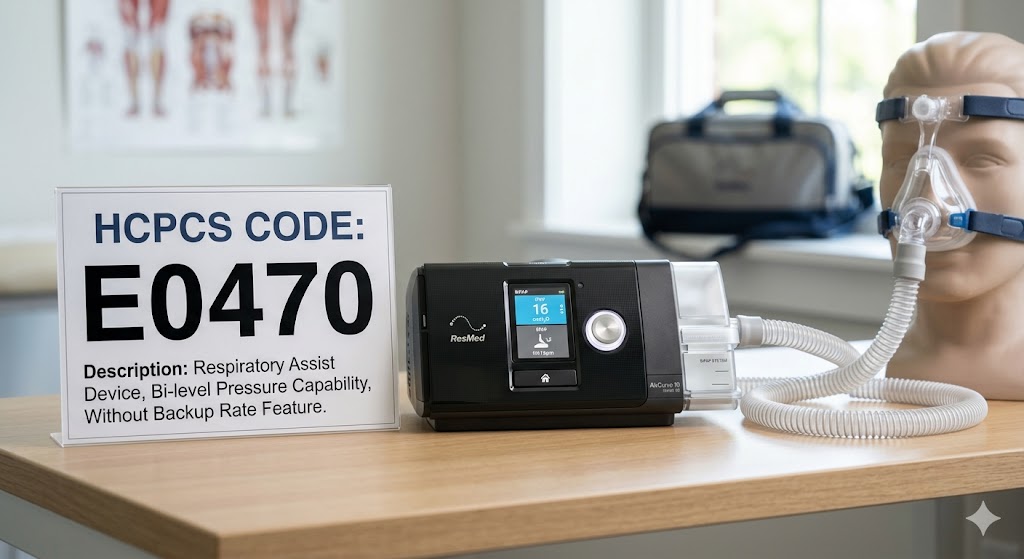
E0470 represents a respiratory assist device, specifically a bi-level pressure device without a backup rate. Think of this as the standard BiPAP. The machine delivers two distinct air pressures: a higher pressure during inhalation (IPAP) and a lower pressure during exhalation (EPAP).
The critical defining feature of E0470 is the phrase “without backup rate.” This means the machine relies entirely on the patient to initiate a breath. If a patient stops breathing during an obstructive event or central apnea, the E0470 device will wait for the patient’s spontaneous effort. It will not trigger a mandatory breath. This is the most common code used for treating standard Obstructive Sleep Apnea (OSA) in patients who cannot tolerate traditional one-pressure CPAP.
Key characteristics of E0470:
- Bi-level pressure (IPAP and EPAP).
- Spontaneous mode (S-mode).
- Used for patients who can consistently initiate their own breaths.
- Often the first step after CPAP failure.
HCPCS Code E0471: The Advanced RAD with Backup Rate
E0471 represents a respiratory assist device, bi-level pressure, with a backup rate. This is often referred to as a BiPAP ST (Spontaneous/Timed) or an advanced non-invasive ventilator. The machine works identically to E0470 in terms of bi-level pressure delivery, but it possesses a critical safety net.
If the patient’s spontaneous breathing rate drops below a clinician-set threshold, the machine takes over and delivers a machine-triggered breath. This feature makes E0471 essential for patients with central sleep apnea, complex sleep apnea, or restrictive thoracic disorders where the central drive to breathe might be unstable.
Clinician’s Insight: “Think of E0470 as a comfort device for upper airway obstruction. Think of E0471 as a life-support device for a patient with an unstable respiratory drive. The backup rate is the defining line in the sand.”
Key characteristics of E0471:
- Bi-level pressure with spontaneous and timed modes (S/T mode).
- Delivers mandatory breaths if the patient becomes apneic.
- Used for central apnea, hypoventilation syndromes, and severe COPD.
- Requires much stricter documentation and clinical justification.
Comparative Analysis: E0470 vs. E0471
Confusing these two codes is a common billing error. The table below provides a direct side-by-side comparison to cement the distinctions.
| Feature | E0470 (Standard BiPAP) | E0471 (BiPAP with Backup Rate) |
|---|---|---|
| Common Name | BiPAP, Bi-Level without Backup | BiPAP ST, Non-invasive Ventilator |
| Breathing Modes | Spontaneous (S) | Spontaneous/Timed (S/T), Timed (T) |
| Backup Rate | Absent | Present (mandatory breaths) |
| Typical Indications | OSA not responsive to CPAP, hypoventilation with stable drive | Central Sleep Apnea, Complex Apnea, COPD with hypoventilation, neuromuscular disease |
| Patient Dependency | Patient must initiate all breaths | Device supports or replaces ventilation during apneas |
| Medicare Reimbursement | Lower monthly rental | Higher monthly rental |
| Documentation Burden | Moderate (CPAP failure documentation) | High (ABG results, specific SpO2 levels) |
The Clinical Bridge: Diagnoses That Drive the HCPCS Code
A billing department cannot simply choose E0471 because it pays more. The HCPCS code must be a mirror reflection of the patient’s medical record. The International Classification of Diseases (ICD-10) diagnosis code justifies the hardware.
Diagnoses Supporting E0470
If a patient carries the diagnosis of G47.33 (Obstructive Sleep Apnea), they will almost always map to E0470—initially. The standard progression starts with a trial of CPAP (E0601). Only when the patient fails CPAP due to intolerance of high pressure, difficulty exhaling, or persistent symptoms does E0470 enter the conversation. Other diagnosis codes may include G47.30 (Unspecified Sleep Apnea) in rare cases, but the specific “G47.33” is the payer’s expectation.
Diagnoses Supporting E0471
To unlock coverage for E0471, the patient’s record must demonstrate something beyond simple airway collapse. The diagnosis must suggest a neurological or mechanical failure of the respiratory pump. Look for these ICD-10 codes:
- G47.31 (Primary Central Sleep Apnea)
- R06.81 (Apnea, not elsewhere classified – often used for complex apnea)
- G47.37 (Central Sleep Apnea in conditions classified elsewhere)
- J96.1 (Chronic Respiratory Failure)
- G71.0 (Muscular Dystrophy)
Submitting a claim for E0471 with a lone diagnosis of OSA (G47.33) will virtually always be denied unless there is extensive documentation proving a component of central apnea or emergent hypoventilation.
Medicare Coverage Criteria: The Gatekeeper to HCPCS Billing
Private insurers often take their lead from Medicare. If you meet Medicare’s Local Coverage Determination (LCD) for a BiPAP device, a commercial plan will likely follow suit. Understanding these criteria is non-negotiable for a clean claim.
Criteria for E0470 (Bi-Level Without Backup Rate)
You cannot walk into a sleep lab and immediately receive a BiPAP machine (E0470). Medicare requires a “fail-first” approach with CPAP (E0601). The patient must have a documented failed trial of CPAP. This failure must be explicit in the medical record.
Qualifying failures include:
- Intolerance of high pressure: The patient finds the fixed high pressure of CPAP unbearable, leading to mask removal.
- Difficulty exhaling: The patient complains of claustrophobia or the sensation of “wind-blast,” preventing sleep onset.
- Inadequate response: The Apnea-Hypopnea Index (AHI) remains above the therapeutic threshold despite optimal CPAP settings.
When the provider documents this failure and the patient has a face-to-face clinical evaluation, the switch to E0470 is medically reasonable. The order must be written within 6 months of the qualifying sleep study.
Criteria for E0471 (Bi-Level With Backup Rate)
The bar is significantly higher for E0471. It is reserved for clinical scenarios involving a failure to ventilate, not just a failure to maintain airway patency. Medicare MACs (Medicare Administrative Contractors) generally require the following hard clinical data points:
Option 1: The Arterial Blood Gas Route
A recent arterial blood gas (ABG) must show a partial pressure of carbon dioxide (PaCO2) greater than or equal to 45 mmHg. This is the hallmark of hypoventilation.
Option 2: The Overnight Oximetry Route
If ABG is not performed, an overnight pulse oximetry must demonstrate oxygen saturation (SpO2) less than or equal to 88% for a cumulative duration of at least 5 minutes while breathing at the patient’s prescribed FiO2 (usually room air). This is not an AHI score; this is a measure of gas exchange failure.
The Central Apnea Caveat
If the patient has a primary diagnosis of central apnea or complex apnea where central events dominate, and a standard BiPAP (E0470) fails to resolve those central events, the backup rate of E0471 becomes a medical necessity. The documentation must show significant central or mixed apnea on the initial sleep study. We generally define “significant” as a central apnea index (CAI) greater than 5 per hour, where central events represent more than 50% of the total events.
The Reimbursement Landscape: Rental vs. Purchase
A HCPCS code for DME usually falls into a specific payment category. For patients wondering “Will I own this machine?” the answer lies in the categorization.
The Capitated Rental Model
Most BiPAP machines are classified under the “Capped Rental” item payment methodology. This means Medicare does not pay for the device in one lump sum immediately. Instead, the supplier bills a monthly rental fee for a period of 13 continuous months. During this rental period, the supplier retains ownership of the machine and is responsible for all maintenance, repairs, and necessary supplies (tubing, filters).
After the 13th month of continuous use is paid for, the ownership of the BiPAP machine transfers to the beneficiary. This is a critical milestone. The patient becomes the official owner. Once ownership transfers, Medicare will no longer pay for routine maintenance service contracts on that specific device. However, the beneficiary still qualifies for replacement supplies (masks, tubing) and, eventually, a new machine if the current one has reached the end of its Reasonable Useful Lifetime (RUL)—typically 5 years.
Purchase Option for Nursing Home Residents
There is a distinct exception. If the patient is a permanent resident of a skilled nursing facility (SNF) where Part A coverage has exhausted, the supplier might bill for a lump-sum purchase rather than monthly rentals. This is rare for BiPAP but common for simpler devices. The key takeaway here is that the “place of service” code on the claim form dictates the payment methodology.
Detailed Claim Submission: Getting the Form Right
A successful claim relies on more than just the correct HCPCS code. The CMS-1500 claim form or the electronic equivalent (837P) requires specific modifiers and narrative details.
Essential Modifiers
Modifiers supply additional context to the HCPCS code. For BiPAP claims, the most frequent modifiers are:
- RR (Rental): This modifier indicates the provider is billing for a rental month, not a sale.
- KH (Initial Claim): Used for the very first claim for a capped rental item.
- KI (Second or Third Month Rental): Used for months two and three.
- KJ (Months Four to Thirteen Rental): Used for the remaining capped rental months.
- KX (Medical Necessity Met): This is the most powerful modifier. By appending the KX modifier, the supplier certifies that all coverage criteria outlined in the LCD have been met and the documentation is on file. Without KX, the claim stops for a manual review (development) and is frequently denied.
The Narrative Field
Electronic claims have a 240-byte narrative field (NTE 02 segment on line 19 of the paper form). Do not leave this blank. Use it to paint a quick summary picture for the payer’s reviewer. A strong narrative might read: “Pt with OSA, G47.33. Failed CPAP at 12cm H2O due to expiratory intolerance. AHI 3.7 on E0470 per titration. KX modifier appended.”
For E0471, the narrative is essential to pass the medical review. Include the specific PaCO2 value or oxygen saturation nadir and duration. *”PaCO2 52mmHg on room air ABG 03/15/2026. Initiated E0471 with ST mode, rate 12. KX modifier appended.”*
Billing Scenarios: Real-World Applications
To solidify these concepts, let’s walk through three patient profiles and assign the correct HCPCS code.
Scenario 1: The Simple OSA CPAP Failure
Mark is a 54-year-old male with severe OSA (AHI 45/hr). He tried CPAP at a fixed pressure of 14 cm H2O. He complains he cannot exhale against the “hurricane” of air. He ripped the mask off nightly. The doctor orders a BiPAP titration at 16/10 cm H2O, and Mark sleeps soundly for the first time in years.
Assigned Code: E0470.
Reasoning: Mark has documented expiratory intolerance to CPAP. His breathing drive is intact. He requires a reduction of pressure during exhalation only. No backup rate is needed.
Scenario 2: The Overlap Syndrome Patient
Lisa is a 62-year-old female with a history of severe COPD and daytime hypercapnia. Her pulmonary function tests show a restrictive pattern. She does not snore significantly. Her overnight oximetry on room air shows an SpO2 of 85% for a cumulative 12 minutes. Her physician wants to provide non-invasive ventilation at night to rest her diaphragm and blow off CO2.
Assigned Code: E0471.
Reasoning: While she may not have pure central apnea, she has documented hypoventilation with severe oxygen desaturation. The backup rate ensures that if her hypercapnia blunts her respiratory drive during REM sleep, the machine will deliver a mandatory breath.
Scenario 3: The Emergent Central Apnea
James has a baseline diagnostic study showing primarily obstructive events. He is placed on an Auto-BiPAP (E0470). However, the compliance download shows a phenomenon called “treatment-emergent central apnea.” The pressure blows off too much CO2, confusing the brain’s respiratory center. The machine records a persistent Central Apnea Index of 15/hour.
Assigned Code: E0471.
Reasoning: E0470 is causing or unmasking central apnea. The patient now requires a device with a backup rate (ASV or ST mode) to stabilize the breathing pattern. E0471 is the logical code if moving to BiPAP ST, though Adaptive Servo-Ventilation (ASV, E0472) might also be considered in complex cases.
The Compliance Time Bomb: The 90-Day Rule
A common pitfall involves the timing of the order and the clinical evaluation. Medicare’s rules for the face-to-face evaluation are strict. The treating practitioner must evaluate the patient in a visit specifically for the sleep disorder. This visit must occur no more than 6 months prior to the delivery of the device, but crucially, the detailed written order (DWO) prior to delivery must be obtained within a specific window.
More critically, suppliers often confuse the “refill” and initial order requirements. For initial setups, the sleep test must be current. A sleep study is considered recent if performed within the prior 12 months. If a patient presents a 5-year-old sleep study saying, “I need a new BiPAP,” Medicare technically requires a new sleep study, unless the supplier can make a case for a “treatment-justifying” repeat study waiver, which is rare. Expect a medical review and potential denial without a recent study.
Documentation Checklist: The “Gold Standard” File
Before submitting a claim for E0470 or E0471, assemble a “Gold Standard” file. If a RAC (Recovery Audit Contractor) auditor comes knocking, the following documents must be present, signed, and dated:
- The Recent Sleep Study: A full technical summary of the polysomnography (PSG) or Home Sleep Test (HST). The HST must be a Type III device at minimum if used for BiPAP titration consideration.
- The CPAP Failure Note (For E0470): A clinical note from the physician stating why CPAP failed.
- The Detailed Written Order (DWO): This must specify:
- The specific machine (e.g., “Bi-Level Positive Airway Pressure, Spontaneous Mode”).
- The HCPCS code (E0470).
- The specific pressures (IPAP/EPAP).
- The physician’s signature and date.
- Proof of Face-to-Face Visit: The clinical evaluation note within the 6-month window.
- ABG or Oximetry Report (For E0471): The actual lab slip or polysomnography summary highlighting the PaCO2 > 45mmHg or SpO2 ≤ 88% for 5 minutes.
- Delivery Ticket: Signed by the patient or caregiver, confirming the date the machine entered the home.
- The KX Continuity: Ensure the KX modifier is visibly appended to the claim.
Common Denial Reasons and How to Correct Them
Even with perfect knowledge, denials happen. Here is a troubleshooting guide for the most frequent rejection codes.
| Denial Code/Reason | The Root Cause | The Fix |
|---|---|---|
| CO-50 (Not Medically Necessary) | The documentation failed to prove the patient tried and failed CPAP first. | Submit a redetermination with the CPAP compliance download showing high leak or low usage, plus the physician’s “intolerance” note. |
| CO-109 (Service not covered with this diagnosis) | The claim used a generic ICD-10 code like R06.00 (Dyspnea) instead of G47.33. | Verify linkage. Cancel and rebill with the correct ICD-10 code mapped to the specific sleep study diagnosis. |
| CO-151 (Frequency limitation) | The supplier billed for a replacement machine when the current one is less than 5 years old. | Provide a certificate of medical necessity for a “destruction” or “irreparable damage” report. Otherwise, wait for the 5-year RUL to expire. |
| CO-16 (Lack of Information) | The KX modifier is missing or the narrative is blank on a high-utilization code like E0471. | Immediately submit an “unsolicited” voluntary demand bill with the complete medical records, even if not formally requested yet. |
Navigating the Prior Authorization Maze
As part of an effort to curb fraud and overutilization, CMS has periodically placed certain HCPCS codes on a “Master List” requiring Prior Authorization (PA) as a condition of payment. While CPAP and standard BiPAP have often been exempt from this in recent years, the regulatory landscape shifts.
Before delivering an E0471 device, specifically, confirm if your MAC jurisdiction requires PA. If required, you cannot just ship the device and bill later. You must submit the preliminary documentation to the MAC, receive a Provisional Affirmation Decision, and only then deliver the device. Delivery without a PA number when one is mandated results in automatic non-payment, and the supplier cannot balance-bill the patient.
Critical Alert: Always check the CMS “DME Prior Authorization List” for the current calendar year. The HCPCS code for BiPAP with backup rate (E0471) has previously been a candidate for inclusion in demonstration projects.
The VA and Private Insurance: A Different Playing Field
This article focuses heavily on Medicare because it is the national standard. However, a brief note on other payers is vital.
The Department of Veterans Affairs (VA) uses a different formulary. While they use HCPCS codes internally for inventory, a veteran seeking care for a service-connected sleep condition does not “bill” in the traditional sense. The VA prosthetics department dispenses the BiPAP machine based on the VA clinician’s order. They may use terms like “CPAP/BiPAP Clinician Order Menu” but the backend stock numbers differ.
For commercial payers like Blue Cross Blue Shield or UnitedHealthcare, their policies mirror Medicare LCDs with subtle tweaks. Some commercial plans skip the “capped rental” model entirely and require an outright purchase. The allowed amount will be a negotiated rate. Crucially, commercial plans often explicitly exclude E0471 if the central apnea is “idiopathic” and not accompanied by heart failure. Always check the specific payer’s medical policy bulletin for the code “E0471” before submitting.
Building a Long-Term Compliance Strategy
Managing a BiPAP HCPCS code is not a one-time event. It is a 13-month journey that extends to 5 years. Here is a timeline for DME suppliers and conscientious patients:
Month 1: Document the face-to-face visit, perform the delivery, obtain signature, bill with KH modifier.
Month 2: Bill with KI modifier. No clinical contact strictly required for billing, but good practice suggests a check-in call.
Month 3: Bill with KI modifier.
Months 4-13: Bill with KJ modifier.
Day 91: Medicare requires a compliance download. The patient must have used the device for at least 4 hours per night on 70% of nights within a consecutive 30-day period during the first 90 days. If the patient fails this adherence requirement, the payer may discontinue rental payments, and the machine may be retrieved by the supplier.
Month 13: Ownership transfers. Provide the patient with a formal letter of ownership.
Year 5: Initiate the replacement process. The old machine’s Reasonable Useful Lifetime is met. A new sleep study or clinical evaluation may be required to restart the capped rental cycle.
Understanding the Differences: Radiant Heater Codes and BiPAP Codes
In the world of HCPCS, codes exist for vastly different products. It is easy to search for a “radiant heater code” and end up confused by the similarity of the alphanumeric structure. While this guide focuses on respiratory equipment, the logic applies across the board. The HCPCS code is a precise identifier. Just as E0470 identifies a specific bi-level pressure machine, codes E0200-E0210 identify specific radiant heaters and warming cabinets for infusion therapy.
The lesson is universal: never guess a code. The difference between a basic heating device and a thermostatically controlled one is a single digit, just as the difference between a standard BiPAP and a ventilator with a backup rate is a single digit (E0470 to E0471). Coding errors in radiant heaters result in denied facility claims, just as coding errors in BiPAP machines result in denied DME claims. The sanctity of the code is paramount in all DME categories.
The Future of BiPAP Coding: Artificial Intelligence and Telemedicine
The landscape of respiratory care is shifting. The COVID-19 public health emergency permanently loosened telemedicine restrictions for face-to-face evaluations. CMS now allows face-to-face evaluations for DME via telehealth, provided the practitioner uses an audio-video interactive platform.
Artificial Intelligence (AI) is also entering the billing arena. New software assists coders by scanning clinical notes for keywords like “hypercapnia,” “PaCO2,” or “CPAP failure.” These AI-driven audit tools then map the documentation to E0471, suggesting the KX modifier. While AI reduces human error, the final certification of medical necessity remains a human, legal attestation by the supplier.
We may soon see new codes emerge. As Adaptive Servo-Ventilation (ASV) and Volume-Assured Pressure Support (VAPS) modes become more distinct clinically, CMS may create more granular codes to separate simple BiPAP ST (E0471) from advanced non-invasive ventilation algorithms. Staying current with the quarterly HCPCS updates is the only way to future-proof your billing department.
Empowering Patients: Your Rights and Responsibilities
If you are a patient, the maze of HCPCS codes and modifiers can feel overwhelming and impersonal. However, you hold significant rights. The “Prohibition on Balance Billing” in the Medicare law states that a participating DME supplier must accept the Medicare allowed charge as payment in full, less your 20% coinsurance and the Part B deductible. They cannot bill you for the difference between their retail price and the Medicare fee schedule.
Your Pre-Delivery Checklist
Before you accept a BiPAP machine, ask your supplier:
- “Did you obtain a Prior Authorization from Medicare, if required?”
- “Can I see the Detailed Written Order from my doctor?”
- “Are you a participating provider with Medicare?”
If the supplier cannot show you the KX-modifier-backed approval (often called a “Valid PA Number”), do not accept the device. If the delivery occurs and Medicare later denies the claim for lack of medical necessity, and the supplier did not provide you with a properly executed Advance Beneficiary Notice of Noncoverage (ABN), you hold zero financial liability.
An ABN is a specific waiver form. It must describe the item (BiPAP machine), list the reason the supplier believes Medicare will deny it, and allow you to select an option to accept or refuse financial liability. Without a signed ABN before delivery, the supplier must eat the cost of a denied claim.
Frequently Asked Questions (FAQ)
Q: Can I bill E0471 for a patient who just doesn’t like the feeling of CPAP?
A: No. Discomfort alone points to a trial of E0470. E0471 requires documented evidence of respiratory failure (high CO2 or low oxygen) or central apnea. Billing E0471 for comfort invites a fraud audit.
Q: What if my doctor orders a “BiPAP Auto”? What code is that?
A: An auto-titrating BiPAP that adjusts pressures automatically but has no backup rate usually still falls under E0470. The key is the absence of the timed backup rate. If the auto-BiPAP has an ST mode with a fall-back rate, it is coded as E0471.
Q: Do HCPCS codes for BiPAP machines expire?
A: HCPCS codes themselves don’t “expire” annually, but they can be discontinued (deleted) or revised by CMS. The code E0470 has been stable for over a decade. The coverage policies (LCDs) surrounding them, however, are updated frequently.
Q: Why does my rental bill show a modifier I don’t understand?
A: You are likely seeing the “RR” modifier, which strictly indicates this is a monthly rental charge, not a purchase installment. This is mandatory for Medicare to process the capped rental logic correctly.
Q: Is the HCPCS code for a BiPAP machine the same as a ventilator code?
A: No. BiPAP with backup rate (E0471) is a “non-invasive ventilator” in colloquial terms, but in HCPCS coding, true life-support ventilators (invasive) use codes like E0465 and E0466. BiPAP codes (E0470, E0471) describe non-invasive interfaces only.
Additional Resource Link
For the definitive, up-to-the-minute legal requirements, always refer directly to the source. Do not rely solely on third-party summaries.
CMS Durable Medical Equipment Center
Conclusion
Mastering the HCPCS code for a BiPAP machine hinges on distinguishing between the comfort and safety net provided to the patient. E0470 addresses expiratory intolerance and obstructive sleep apnea in patients with a reliable respiratory drive, while E0471 serves as a critical non-invasive ventilator for those with central apnea, hypoventilation, or neuromuscular weakness. Securing reimbursement requires meticulous documentation of clinical necessity, strict adherence to the fail-first CPAP protocol for E0470, and hard blood gas or oximetry evidence for E0471, all sealed by the certifying power of the KX modifier. By enforcing the 13-month capped rental timeline and safeguarding claims against denials, both suppliers and patients can navigate the complex DME landscape to achieve successful, sustainable respiratory care outcomes.