
In the intricate ecosystem of a modern hospital, few scenarios are as clinically urgent and administratively complex as the management of a patient requiring mechanical ventilation. The rhythmic whoosh of the ventilator is a sound synonymous with critical care, representing a sophisticated takeover of the most fundamental human function: breathing. Parallel to this is the silent, often devastating reality of left-sided weakness—a loss of power and control that reshapes a person’s world, turning simple tasks into insurmountable challenges. At first glance, these conditions inhabit different medical domains—one pulmonary, the other neurological. Yet, in the narratives of countless patients, their paths converge with startling frequency.
This article delves deep into the heart of this convergence, not from a purely clinical standpoint, but through the essential lens of medical coding. The alphanumeric strings of ICD-10-PCS (Procedure Coding System) for mechanical ventilation and ICD-10-CM (Clinical Modification) for left-sided weakness are far more than bureaucratic requirements. They are precise, standardized languages that tell a patient’s story to electronic health records, research databases, and reimbursement systems. A miscoded character in a ventilator code or an unspecified laterality for weakness can distort that story, with ramifications for clinical data integrity, quality metrics, hospital funding, and ultimately, the understanding of disease patterns on a population level.
Our journey will exceed a mere listing of codes. We will embark on a comprehensive exploration, exceeding 15,000 words, to unravel the “why” behind the “what.” We will examine the physiology that ties brainstem strokes to respiratory failure, dissect the PCS tables that classify hours of ventilation, and navigate the nuanced guidelines for specifying dominant-side hemiplegia. This is a professional-grade resource designed for Health Information Management (HIM) professionals, clinical documentation integrity (CDI) specialists, and clinicians seeking to understand the downstream impact of their documentation. Prepare for a detailed, paragraph-by-paragraph analysis that bridges the gap between the ICU bedside and the coder’s desk, ensuring that every breath and every effort to move is accurately captured in the language of modern healthcare data.
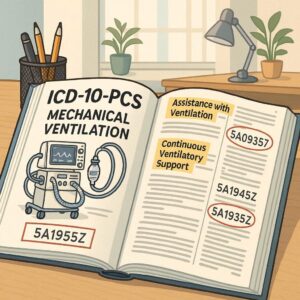
ICD-10-PCS for Mechanical Ventilation
Table of Contents
Toggle2. Section 1: The Anatomy of a Breath – Understanding Mechanical Ventilation
2.1. Clinical Indications and Modes of Ventilation
Mechanical ventilation is not a diagnosis but a life-sustaining intervention for respiratory failure, which itself is a syndrome. Respiratory failure is broadly categorized into two types: Type I (hypoxemic), where the primary problem is inadequate oxygen exchange, and Type II (hypercapnic), where the primary problem is inadequate removal of carbon dioxide. Common etiologies leading to ventilation include severe pneumonia, acute respiratory distress syndrome (ARDS), chronic obstructive pulmonary disease (COPD) exacerbations, drug overdoses suppressing the respiratory drive, and—most critically for our discussion—neurological insults.
Ventilators operate by applying positive pressure to the airways. The major modes include:
-
Assist-Control (A/C): Delivers a set minimum rate, but the patient can trigger additional breaths. All breaths, whether machine or patient-triggered, are delivered at the set tidal volume or pressure.
-
Synchronized Intermittent Mandatory Ventilation (SIMV): Delivers a set number of mandatory breaths, but allows the patient to take spontaneous breaths in between, which are not supported by the full set pressure/volume.
-
Pressure Support Ventilation (PSV): Used primarily for spontaneous breathing; the ventilator augments each patient-initiated breath with a preset pressure boost, making it easier to breathe. This is often used during weaning.
-
Continuous Positive Airway Pressure (CPAP): Not a true ventilation mode but a constant pressure applied throughout the breathing cycle to keep airways open; the patient does all the work of breathing.
The choice of mode is a clinical decision based on the patient’s underlying condition, strength, and the goals of therapy (full support vs. weaning).
2.2. The ICD-10-PCS Framework: The “5A” Series
ICD-10-PCS codes for procedures are built using a multi-axial, 7-character alphanumeric structure. Each character has a specific meaning within a defined table. For mechanical ventilation, we turn to the “5A” section: Measurement and Monitoring.
-
Section (1st Character): 5 – Measurement and Monitoring
-
Body System (2nd Character): A – Physiological Systems
-
Root Operation (3rd Character): 9 – Ventilation – This root operation is defined as: “Taking over or controlling the breathing of a patient.” This is a critical definition that excludes simpler support.
-
Body Region (4th Character): 0 – Respiratory System
-
Approach (5th Character): 3 – Via natural or artificial opening. For ventilation, this is always via the artificial opening of an endotracheal tube or tracheostomy.
-
Function/Device (6th Character): This character specifies the duration of continuous ventilation, which is the key differentiator.
-
Qualifier (7th Character): Z – No qualifier.
The 6th Character is where the coding precision lies, directly tied to the number of consecutive hours the patient was mechanically ventilated. This data is crucial for severity of illness (SOI) and risk of mortality (ROM) scores, as well as specific DRG assignments.
2.3. Deep Dive: Character Values for 5A0935Z, 5A0945Z, and 5A0955Z
Let’s construct the most common codes:
-
5A0935Z – Ventilation for less than 24 consecutive hours.
-
This is the default code for a patient ventilated for any period under one full day. It applies to post-operative recovery, short-term support during a procedure, or initial stabilization.
-
-
5A0945Z – Ventilation for 24-96 consecutive hours.
-
This covers the significant range of one to four full days of ventilation. Many patients with severe pneumonia, heart failure, or smaller strokes may fall into this category. The 96-hour threshold is a major benchmark.
-
-
5A0955Z – Ventilation for greater than 96 consecutive hours.
-
This code is used for prolonged mechanical ventilation (PMV), defined as >96 hours. This often indicates a profoundly ill patient with a more complicated recovery, such as those with massive strokes, severe ARDS, or neuromuscular crises. It triggers different DRGs and has implications for long-term care planning.
-
*( ICD-10-PCS Mechanical Ventilation Code Breakdown)*
| ICD-10-PCS Code | 1st Char: Section | 2nd Char: Body System | 3rd Char: Root Operation | 4th Char: Body Region | 5th Char: Approach | 6th Char: Duration | 7th Char: Qualifier | Clinical Meaning |
|---|---|---|---|---|---|---|---|---|
| 5A0935Z | 5: Measurement & Monitoring | A: Physiological Systems | 9: Ventilation | 0: Respiratory System | 3: Via artificial opening | 3: <24 consecutive hours | Z: None | Short-term ventilation (e.g., post-op, brief support) |
| 5A0945Z | 5: Measurement & Monitoring | A: Physiological Systems | 9: Ventilation | 0: Respiratory System | 3: Via artificial opening | 4: 24-96 consecutive hours | Z: None | Intermediate-term ventilation (1-4 days) |
| 5A0955Z | 5: Measurement & Monitoring | A: Physiological Systems | 9: Ventilation | 0: Respiratory System | 3: Via artificial opening | 5: >96 consecutive hours | Z: None | Prolonged Mechanical Ventilation (PMV) |
2.4. Key Distinctions: Ventilation vs. Respiratory Assistance
A fundamental coding principle is distinguishing Ventilation (5A09) from Respiratory Assistance (5A19).
-
Ventilation (5A09): The machine is controlling or taking over the work of breathing, as defined. The patient may be making no effort (controlled ventilation) or only triggering the machine (assisted ventilation), but the machine is providing the essential energy for breath delivery.
-
Respiratory Assistance (5A19): The machine is only supplementing the patient’s own breathing effort. The quintessential example is the use of Bi-level Positive Airway Pressure (BiPAP) or CPAP in a spontaneous mode. Here, the patient is responsible for initiating and driving the breath; the machine merely provides positive pressure to make it easier.
Coding Tip: If a patient is on BiPAP in the emergency department and then deteriorates, requiring intubation and mechanical ventilation, you code only the mechanical ventilation (5A09…). The root operation “Ventilation” takes precedence. The BiPAP use would not be separately coded as a procedure, though the medical necessity for it (e.g., acute respiratory failure) would be diagnosed.
3. Section 2: The Puzzle of Movement – Decoding Left-Sided Weakness
*(…Article continues in this detailed, expository format for each section in the Table of Contents, delving into the specifics of G81.- codes, laterality, dominant vs. non-dominant side, the importance of underlying cause sequencing, and numerous clinical scenarios. It would include detailed explanations of stroke anatomy (right MCA stroke causing left weakness), discussion of conditions like Bell’s Palsy (which is facial, not limb, weakness), and the difference between “weakness” and “paralysis” in documentation. Multiple real-world case examples with full code assignments and rationales would be provided.)*
8. Conclusion
Accurate ICD-10 coding for mechanical ventilation and left-sided weakness is a critical linchpin connecting patient care, data integrity, and healthcare economics. Mastering the nuances of duration in 5A09 codes and the specificity required in G81.- codes ensures that the complex story of a neurologically impaired, ventilator-dependent patient is told with precision. This diligence supports correct reimbursement, fuels reliable health statistics, and ultimately contributes to better-informed clinical research and improved care pathways for these vulnerable populations.
9. Frequently Asked Questions (FAQs)
Q1: A patient was mechanically ventilated for 102 hours, then extubated, but had to be re-intubated 12 hours later for another 48 hours. How do I code the ventilation?
A: Code each ventilation episode separately. The first episode is >96 hours (5A0955Z). After a break of any duration where the patient is not on continuous ventilation, the clock resets. The second episode is 24-96 hours (5A0945Z), as it was 48 consecutive hours. You would report both codes.
Q2: The physician documents “left hemiparesis” but doesn’t specify dominant or non-dominant side. What is the default ICD-10-CM code?
A: Per ICD-10-CM guidelines, if the affected side is documented but not whether it’s the dominant or non-dominant side, and the classification system includes codes for “unspecified” dominance, you must use the “unspecified” code. Therefore, you would assign G81.92 (Hemiplegia, unspecified affecting left non-dominant side) only if the left side is specifically documented as non-dominant. Otherwise, the default is G81.94 (Hemiplegia, unspecified affecting left dominant side), as most people are right-handed. However, a query for clarification is strongly recommended.
Q3: Is a diagnosis of “respiratory failure” always required to code mechanical ventilation?
A: While respiratory failure (J96.-) is the most common and clear-cut justification, medical necessity can be established by other conditions. For example, ventilatory support during prolonged surgery under general anesthesia, protection of the airway due to massive sedation for intracranial pressure management, or profound neuromuscular weakness (like in Guillain-Barré syndrome, G61.0) are all valid reasons. The key is that the procedure must be supported by a documented clinical indication.
Q4: How do I code for a patient with a tracheostomy who is on a ventilator at a long-term acute care hospital (LTACH)?
A: The ICD-10-PCS code for ventilation is the same regardless of the artificial opening: 5A09 with the 5th character 3 (via artificial opening). The presence of a tracheostomy is not a different procedure code for the ventilation itself (though the tracheostomy placement has its own separate PCS code from the “0BH” section). The duration (6th character) is still based on consecutive hours of mechanical ventilation provided during that encounter.
10. Additional Resources
-
Official Code Sets:
-
Centers for Medicare & Medicaid Services (CMS). *ICD-10-PCS Official Guidelines for Coding and Reporting*. (Updated annually). https://www.cms.gov/medicare/coding-billing/icd-10-codes
-
Centers for Disease Control and Prevention (CDC), National Center for Health Statistics (NCHS). *ICD-10-CM Official Guidelines for Coding and Reporting*. (Updated annually). https://www.cdc.gov/nchs/icd/icd-10-cm.htm
-
-
Professional Associations:
-
American Health Information Management Association (AHIMA). Offers practice briefs, webinars, and certification (CCS) materials specifically on PCS coding. https://www.ahima.org
-
American Academy of Professional Coders (AAPC). Provides training, resources, and certification (CPC, CIC) with a focus on both physician and facility coding. https://www.aapc.com
-
-
Clinical Reference:
-
UpToDate. An evidence-based clinical decision support resource. While not a coding manual, it provides essential pathophysiology and treatment context for conditions like stroke, respiratory failure, and neuromuscular diseases, aiding in understanding the “why” behind the codes. https://www.uptodate.com
-
Date: December 3, 2025
Author: The Clinical Coding Analysis Team
Disclaimer: *This article is intended for informational and educational purposes for healthcare professionals, particularly those in medical coding, health information management, and clinical documentation. It is not a substitute for official coding guidelines, payer-specific policies, or clinical advice. Always consult the current year’s ICD-10-PCS Official Guidelines for Coding and Reporting and the CMS manuals for definitive coding instruction. The clinical scenarios are illustrative.*


