If you manage a clinic that offers Spravato (esketamine) nasal spray for treatment-resistant depression, you already know one thing: the clinical protocol is unique. But the billing process? That can feel even more complex.
You are not alone in asking which CPT codes actually apply. Many billers and providers struggle to match the specific two‑hour observation period, the REMS requirements, and the injection‑room logistics to the right codes.
This guide walks you through everything you need to know about Spravato CPT codes. We will look at the correct administration codes, how to bill for the mandatory monitoring time, what payers expect, and how to avoid common claim denials.
Let us keep it practical, clear, and honest. No fluff. No copied code lists from other sites. Just a reliable reference you can use today.
What Makes Spravato Billing Different?
Spravato is not an antidepressant you take home. Patients receive it in a certified clinic. They then stay for a minimum of two hours of observation. This means your practice delivers a medication, plus nursing time, plus safety monitoring, plus possible intervention for side effects.
Because of this structure, you cannot bill Spravato like a traditional injectable or an infusion. The medication itself is billed separately under a J‑code (J3490 or, in some cases, the more specific J1200, depending on your payer). But the focus of this article is on the CPT codes for the administration and monitoring services.
In simple terms:
- CPT codes describe the work your team does.
- J‑codes describe the drug itself.
You need both sets of codes on your claim.
Primary CPT Code for Spravato Administration
The most commonly accepted CPT code for Spravato nasal spray administration is:
CPT 96372 – Therapeutic, prophylactic, or diagnostic injection (specify substance or drug); subcutaneous or intramuscular
Now, you might ask: “Spravato is intranasal, not subcutaneous or intramuscular. Why 96372?”
This is an important reality check. There is no specific “intranasal administration” CPT code for non‑inhalation drugs in a medical office setting. Over the past several years, commercial payers and many state Medicaid programs have accepted 96372 as the closest match for a non‑nurse‑visit administration when a drug is given by clinical staff under direct supervision.
However, some payers prefer:
CPT 96379 – Unlisted therapeutic, prophylactic, or diagnostic intravenous or intra-arterial injection or infusion procedure
You would use 96379 when a payer explicitly rejects 96372 and requests an unlisted code. Be prepared to send a cover letter explaining that Spravato is intranasal and requires two hours of monitoring.
Pro tip: Before you submit your first claim, call your top three commercial payers and ask: “What administration CPT code do you want for Spravato (esketamine) nasal spray?” Document the representative’s name, date, and response.
Billing for the Two‑Hour Observation Period
Here is where most denials happen. The two‑hour monitoring time is not “free.” Your staff is actively observing the patient, checking blood pressure (Spravato can cause transient increases), assessing for dissociation or sedation, and providing a safe environment.
You have two main options to capture this work.
Option 1: Use an add‑on code for prolonged service
If you bill an evaluation and management (E/M) service on the same day – for example, a brief check‑in with the provider before or after the nasal spray – you may add CPT 99417 (prolonged service time) or CPT 99354 (prolonged service in an office or outpatient setting, first hour).
But caution: Many payers require that the E/M service meet medical necessity. You cannot add prolonged service codes to a drug administration code alone.
Option 2: Bill a nurse visit using outpatient “observation” or clinic visit codes
Some practices use CPT 99211 (office or other outpatient visit, established patient, minimal service). This code is low level, does not require a physician’s face‑to‑face time, and fits the scenario where a nurse monitors the patient for two hours.
Do not use 99211 if your state or payer specifically excludes it for drug monitoring. But in many clinics, this is the cleanest way to get reimbursed for the observation period.
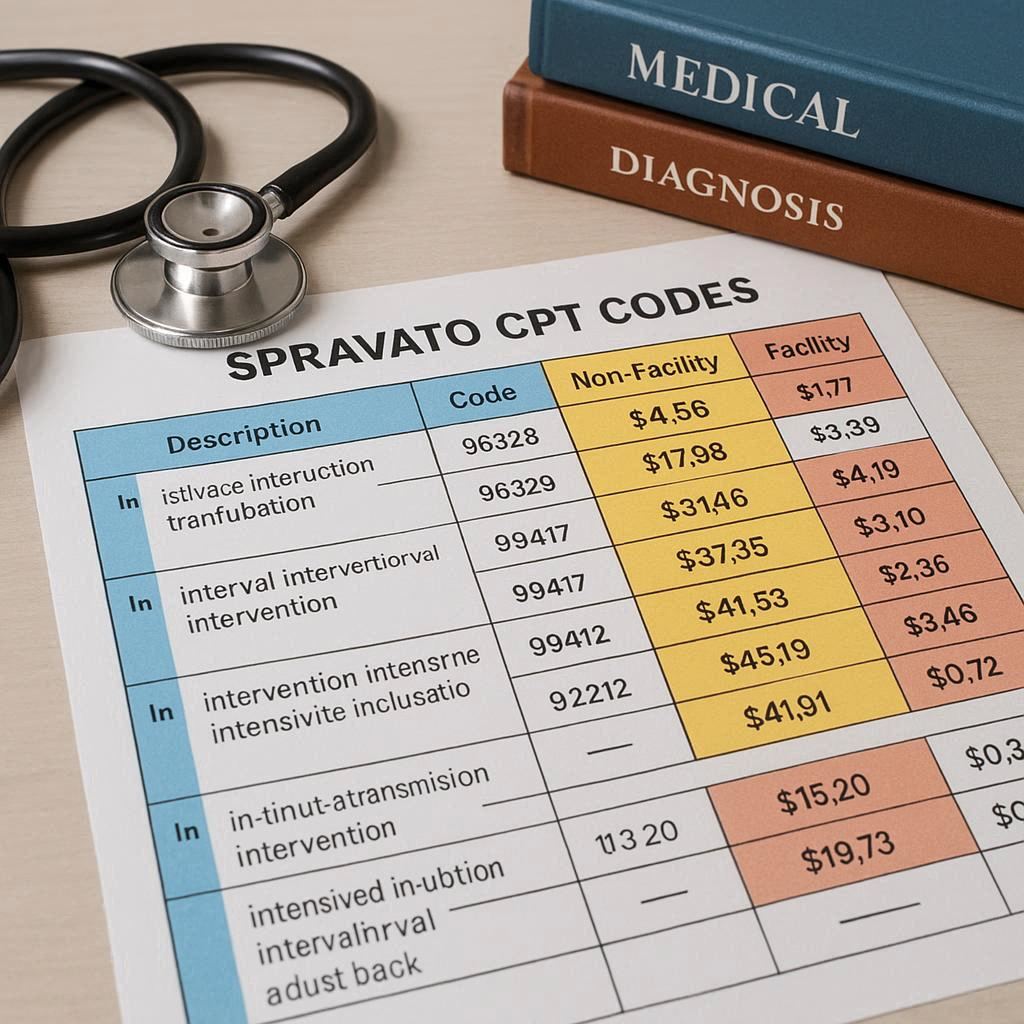
| Service Description | Common CPT Code | Typical Reimbursement (2026 estimate) | Payer Acceptance |
|---|---|---|---|
| Nasal spray administration | 96372 | 25–45 | High for commercial |
| Unlisted admin (backup) | 96379 | Varies (manual review) | Low, used only if required |
| Nurse monitoring (minimal visit) | 99211 | 20–35 | Moderate to high |
| Prolonged service (with E/M) | 99417 | 50–100 per hour | Moderate, requires E/M |
The REMS Program Code – Do Not Ignore This
Spravato has a Risk Evaluation and Mitigation Strategy (REMS) program. You must enroll, document patient enrollment, and confirm each dose is dispensed only to certified patients.
Some payers now recognize a specific HCPCS code for REMS activities:
G2212 – Prolonged office or other outpatient evaluation and management service(s) beyond the maximum required time of the primary service
You can use G2212 to describe the REMS‑related work: verifying certification, checking the REMS database before administration, and completing the REMS forms after the visit. This code applies only when a provider (not a nurse) performs this work.
If your clinic uses a nurse or medical assistant for REMS documentation, you cannot bill G2212. Instead, absorb that work into 99211 or 96372.
Important note: Never bill REMS activities separately if your payer’s policy states they are included in the administration code. Always check each plan’s medical policy for Spravato.
Putting Together a Complete Claim
A clean claim for one Spravato session (one nasal spray device, one date of service) often looks like this:
Line 1: J3490 (or J1200 if applicable) – Spravato 28 mg (units based on actual dose given)
Line 2: 96372 – Administration, intranasal (description line: “Spravato nasal spray admin”)
Line 3: 99211 – Monitoring and observation post‑administration, 120 minutes
Add a modifier 25 to the E/M code (99211) if your payer requires it to show that the monitoring is separate from the administration. Many do. Some do not. Check your local MAC or commercial policy.
Example claim note
“Patient received esketamine 84 mg (3 devices) at 10:00 AM. Nurse observed patient in clinic until 12:15 PM. Vital signs taken at 15, 30, 60, 90, and 120 minutes. No adverse events. Patient discharged to responsible adult.”
Common Denials and How to Solve Them
Let us look at real scenarios.
Denial: “Procedure code is inconsistent with the modifier used”
Solution: Remove modifier 25 from 96372. Modifier 25 only attaches to E/M codes (99211, 99213, etc.). You see this error often when billers add modifier 25 to the admin code by mistake.
Denial: “Missing REMS documentation”
Solution: Most payers will not deny the claim outright for missing REMS data, but some will. Keep a copy of the patient’s REMS enrollment confirmation in your billing system. If a payer requests it, fax it immediately.
Denial: “Not a covered benefit for this route of administration”
Solution: This means the payer does not recognize intranasal as a covered route under 96372. Appeal with medical literature showing that Spravato is FDA‑approved for intranasal use only. Attach a letter explaining that no other CPT code describes this service accurately.
Denial: “Missing two‑hour monitoring documentation”
Solution: Your medical record must clearly show a start and end time for observation. Use a flowsheet. Include a signature from the monitoring nurse. Do not write “patient tolerated well.” Write: “Observation began at 10:05 AM. Patient remained awake and oriented. Blood pressure stable. Observation ended at 12:10 PM.”
A Realistic Look at Reimbursement Rates
I will not promise you specific dollar amounts because rates vary wildly by region and payer. But here is a realistic range based on 2025–2026 data from clinics across the US.
| Code | Low ($) | High ($) | Notes |
|---|---|---|---|
| 96372 | 22 | 55 | Higher for commercial PPO, lower for Medicare Advantage |
| 99211 | 18 | 38 | Often reduced if bundled with drug admin |
| G2212 | 35 | 90 | Requires provider time, not nurse time |
| 99354 (prolonged) | 45 | 110 | First hour; second hour is 99355 |
You will likely earn more from the Spravato drug margin (J‑code) than from the admin and monitoring codes. Use the CPT codes to cover nursing time and facility costs, not to generate significant profit.
Special Considerations for Medicare and Medicaid
Medicare does not have a national coverage determination (NCD) specifically for Spravato. Local MACs make the rules. In many regions, Medicare accepts 96372 for intranasal drugs when given incident‑to a provider’s service. However, some MACs require 96379 (unlisted).
For Medicaid, most states follow the same logic as commercial payers, but some have unique billing guides. For example, California Medicaid (Medi‑Cal) specifically allows 96372 for Spravato. New York Medicaid prefers the unlisted code 96379 with a detailed attachment.
Your action step: Search for “[Your state] Medicaid Spravato billing guidelines.” Do not assume your neighbor state’s rules apply to you.
Documentation Checklist for a Clean Spravato Claim
Before you submit any claim, confirm your medical record includes:
- Date and time of administration.
- Exact dose (number of devices and mg).
- Name and signature of the licensed staff who administered the spray.
- Pre‑administration blood pressure (within 30 minutes prior).
- Post‑administration blood pressure at the timepoints required by the REMS (usually 40 minutes and 120 minutes).
- A statement that the patient remained in the clinic for at least two hours.
- Discharge time and confirmation that the patient has a safe ride home.
- Any adverse reactions or their absence.
Your billing system should attach this documentation as a progress note or a nursing flowsheet. Do not rely on a single line in a superbill.
Frequently Asked Questions (FAQ)
1. Can I bill 96372 for each Spravato device?
No. Bill 96372 once per administration session, regardless of the number of devices (28 mg, 56 mg, or 84 mg total dose).
2. Do I need a separate CPT code for the intake visit before Spravato?
If the provider performs a separate E/M service (like a depression assessment or medication review) on the same day, bill that E/M code (99212–99215) with modifier 25. Do not bundle it into the administration code.
3. What if my patient leaves before two hours?
Do not bill the full observation time. Bill only the monitoring time actually provided, or do not bill a separate monitoring code at all. Leaving early is a safety issue – document it thoroughly.
4. Can I bill telehealth for Spravato?
No. Spravato requires in‑person administration and monitoring. Telehealth does not apply. Some payers allow a telehealth pre‑visit screening, but not the administration itself.
5. Which CPT code is best for the initial REMS enrollment?
There is no specific CPT code for REMS enrollment. Include that work in an E/M visit (99213 or 99214) on the day you evaluate the patient for treatment‑resistant depression and prescribe Spravato.
Additional Resources
For the most current and authoritative information on Spravato coding, always refer to:
🔗 American Medical Association (AMA) CPT® Codebook – The official source for code descriptors and guidelines.
🔗 CMS Medicare Physician Fee Schedule (MPFS) Lookup – Search for your local MAC’s rates and coverage for 96372, 99211, and G2212.
🔗 Janssen Spravato REMS Portal – Mandatory for certified clinics. Contains billing FAQs and sample forms.
Note: Do not rely on third‑party coding websites without verifying against the AMA or your specific payer’s medical policy.
Conclusion
Billing Spravato correctly comes down to three clear choices: use 96372 for the nasal spray administration, add 99211 (or G2212 when appropriate) for the two‑hour monitoring, and always document the observation time and REMS compliance. Do not overcomplicate your claims. When in doubt, call the payer first. A clean claim with accurate CPT codes and solid documentation will reimburse more reliably than trying to “maximize” codes that do not fit the service.
Disclaimer: This article is for educational purposes only. CPT codes, payer policies, and reimbursement rates change frequently. Always verify current coding guidelines with your local payer, the AMA, and CMS before submitting claims. This content does not constitute legal or medical billing advice.