Medical billing can feel like navigating a maze without a map. The language is dense, the rules change frequently, and a single wrong digit on a claim form can lead to costly denials. Among the most common tests ordered in cardiology, the echocardiogram stands out as a vital diagnostic tool. Yet, for medical coders, billers, administrators, and even curious patients, a simple question often arises: what is the CPT code for an echocardiogram?
The short answer is that no single code covers every type of echo. The correct Current Procedural Terminology (CPT) code depends on the specific approach, the complexity of the study, and whether additional elements like Doppler or stress testing form part of the procedure. A basic resting transthoracic echocardiogram carries a different code than a transesophageal echo performed during surgery. A stress echo completed on a treadmill carries a different code than one using medication to elevate the heart rate.
Understanding these distinctions matters. Accurate coding ensures proper reimbursement, maintains compliance with payer policies, and contributes to clean medical records. This comprehensive guide walks you through every relevant CPT code for echocardiography, explains the clinical scenarios where each one applies, and offers practical tips to avoid common billing pitfalls.
Understanding the Fundamentals of Echocardiography
Before diving into the specific numerical codes, the anatomy of an echocardiogram itself deserves attention. An echocardiogram uses sound waves to produce images of the heart. Think of it as a sonar for the cardiovascular system. These images allow cardiologists to assess chamber size, wall thickness, valve function, blood flow patterns, and the overall pumping strength of the heart muscle.
The technology has evolved significantly since its inception. Modern echocardiography includes several distinct modalities. Two-dimensional imaging provides the structural picture of the heart in real-time. M-mode offers a one-dimensional view excellent for precise measurements. Doppler ultrasound analyzes the speed and direction of blood flow, colorizing it to reveal leaks or obstructions in the valves. More advanced techniques, such as strain imaging and three-dimensional reconstruction, add further layers of diagnostic information.
From a coding perspective, each of these components may or may not be bundled into a single code. The coding system generally organizes echocardiogram codes by the access point used to visualize the heart. The three primary categories are transthoracic, transesophageal, and stress echocardiography. Intracardiac echocardiography represents a less common but important fourth category used during certain invasive electrophysiology procedures.
The Primary CPT Codes for a Standard Transthoracic Echocardiogram
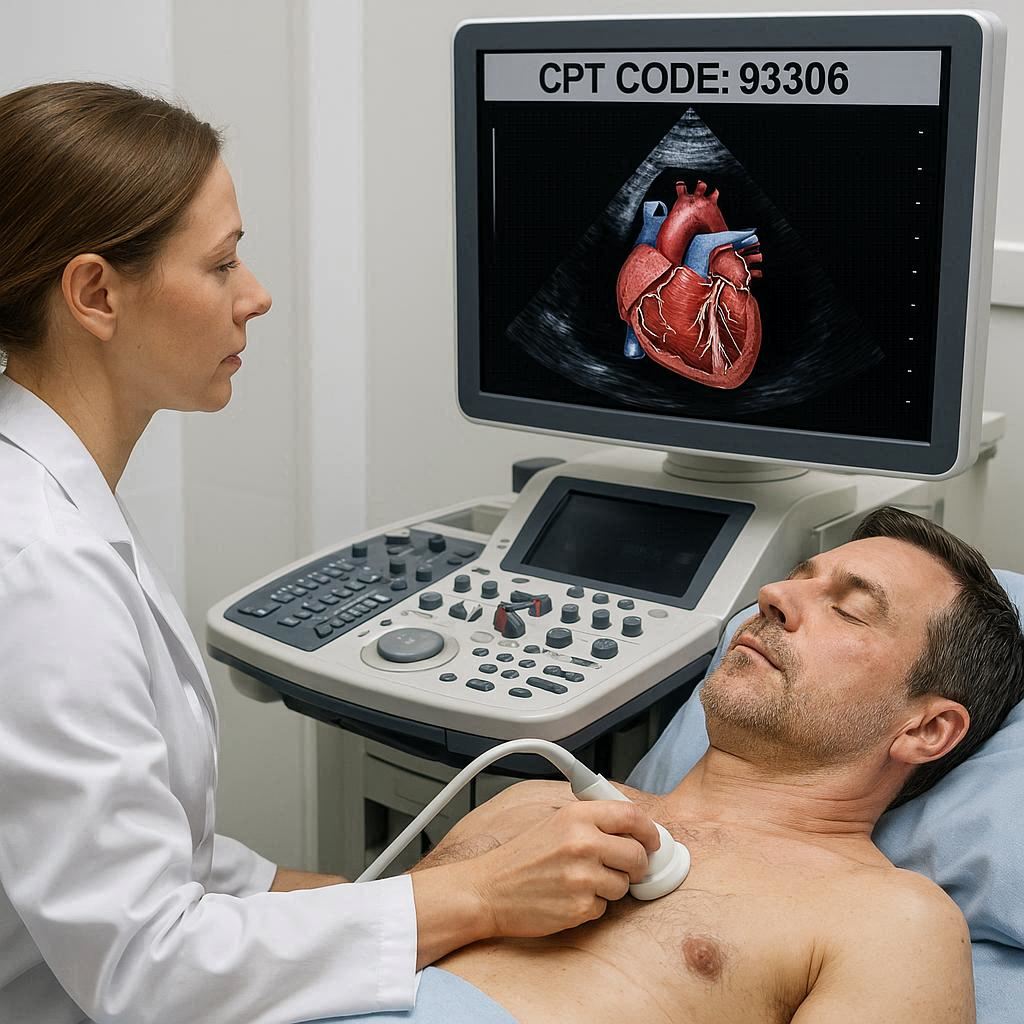
When most clinicians refer to a routine echocardiogram, they mean a transthoracic echocardiogram (TTE). The sonographer places a transducer on the patient’s chest wall to acquire the images. This test is non-invasive, painless, and typically takes between 30 and 60 minutes. The CPT codes for a complete TTE are 93306, and the newer bundled codes that emerged from the 2009 code restructuring remain the industry standard today. However, a significant update relevant to current billing deserves careful attention.
CPT 93306: The Complete Study
The workhorse code for a comprehensive transthoracic echocardiogram is 93306. This code represents a complete study that includes real-time two-dimensional imaging, M-mode recording when performed, and spectral and color flow Doppler echocardiography. The physician interprets the images, compares them to prior studies if available, and generates a detailed written report.
The key components bundled into 93306 are important to recognize. The code covers obtaining the images, performing the Doppler evaluations, and the physician’s interpretation. You do not bill separately for the technical component and professional component unless a specific arrangement splits those services between two entities. In a hospital outpatient setting, the billing process often splits, but in a physician office with owned equipment, the global service applies.
The descriptor for 93306 emphasizes a complete study. A complete study visualizes all major cardiac structures, including the left and right ventricles, the atria, the pericardium, the valves, and the great vessels. If the sonographer captures only a limited set of images, a different code applies.
CPT 93307: The Limited Study
Sometimes, a full comprehensive echo is unnecessary. A physician may want to recheck a single finding, assess for pericardial effusion quickly, or evaluate a known abnormality without repeating the entire examination. In these instances, CPT 93307 applies. This code describes a focused, limited transthoracic echocardiogram.
The distinction between complete and limited rests on the scope of the examination, not the quality or duration. A limited study answers a targeted clinical question. The documentation must clearly state the reason for the limited nature and which structures were evaluated. Payers scrutinize 93307 claims closely because the reimbursement is lower, and the medical necessity must support the choice not to perform a complete study.
CPT 93308: Follow-Up or Serial Limited Study
A specific subset of limited studies uses code 93308. This code applies when performing serial, follow-up transthoracic echocardiograms for the same patient to monitor a previously identified condition over time. For example, an oncologist may order serial echocardiograms to monitor left ventricular ejection fraction in a patient receiving potentially cardiotoxic chemotherapy. Rather than billing the initial limited code, the follow-up limited study code better reflects the clinical scenario.
The documentation for 93308 should reference the prior study, specify the reason for the serial follow-up, and include a comparison of the current findings with previous results. Without these elements, a payer might downcode the claim to 93307 or deny it outright.
Transesophageal Echocardiogram CPT Codes
A transesophageal echocardiogram (TEE) takes a different approach. Instead of placing the transducer on the chest, the physician guides a specialized probe down the esophagus. Because the esophagus sits directly behind the heart, TEE provides much clearer images of posterior cardiac structures, the left atrium, the atrial septum, and prosthetic valves. The test is semi-invasive, requiring sedation and sometimes anesthesia support.
CPT 93312: The Basic Probe Placement and Study
The primary code for a complete transesophageal echocardiogram is 93312. This code includes placing the probe, acquiring the images, and performing all necessary Doppler and color flow evaluations. The physician then interprets the study and provides a report.
The descriptor for 93312 specifies a complete study. A complete TEE examines all structures visible from the esophageal and gastric windows. The probe passes through the esophagus into the upper stomach to obtain transgastric views of the ventricles. If only a limited view is obtained, the documentation should clearly state why, and a different code set applies.
CPT 93313: TEE for Congenital Cardiac Anomalies
When the patient has a known or suspected congenital heart defect, the TEE becomes more complex. The physician must assess unusual anatomy, surgical repairs, and shunts. Code 93313 captures this additional work. The documentation must support the congenital nature of the study, and the report should detail the evaluation of the specific anomaly.
CPT 93314: Limited TEE
A limited TEE uses code 93314. This scenario arises when the physician performs a focused assessment, such as checking for a left atrial appendage thrombus before cardioversion. The probe is placed, the specific structure is interrogated, and the study concludes. The report must clearly indicate the limited scope and the clinical question answered.
CPT 93315: TEE During Congenital Surgery
Cardiac surgeons often request intraoperative TEE during repairs of congenital heart defects. The echocardiographer or anesthesiologist performs the TEE before and after the surgical repair to confirm the adequacy of the correction. CPT 93315 captures this specialized intraoperative service. This code is distinct from the intraoperative TEE used in adult cardiac surgery, which uses a different coding framework.
Stress Echocardiogram CPT Codes
Stress echocardiography combines ultrasound imaging with a cardiac stress test. The goal is to evaluate how the heart responds to increased workload. Areas of the heart muscle that receive inadequate blood supply may contract less vigorously under stress, revealing coronary artery disease that might not be apparent at rest. The stress can be induced through exercise on a treadmill or bicycle, or pharmacologically using medications like dobutamine.
CPT 93350: Stress Echo with Continuous Monitoring
The fundamental code for stress echocardiography is 93350. This code covers the complete service: supervising the stress test, acquiring echocardiographic images before, during, and after stress, and interpreting the results. The physician must be present for the entire test, providing continuous monitoring of the electrocardiogram and the patient’s clinical status.
The coding for 93350 assumes the physician performs both the stress portion and the echo interpretation. If a non-physician provider supervises the stress test, different modifier and coding rules come into play. The documentation must include the stress protocol, the achieved heart rate and blood pressure responses, the reason for termination, and a detailed comparison of the resting and stress images.
CPT 93351: Limited Stress Echo
When a full stress echo protocol is not completed, or when the study only evaluates a limited number of wall segments, CPT 93351 applies. This code is far less common and payers require strong medical necessity documentation to support its use. Most commercially available insurance and Medicare policies expect a complete study when a stress echo is ordered.
Pharmacologic Stress Agents and Add-On Codes
Medications such as dobutamine or Lexiscan can be used when a patient cannot exercise adequately. The CPT codes for the echocardiogram itself do not change when using pharmacologic stress. However, the administration of the drug may be separately billable depending on the payer and the setting. Additionally, continuous electrocardiographic monitoring and the professional work of the supervising physician remain bundled into 93350.
Doppler and Color Flow Coding: An Essential Distinction
A common area of confusion involves whether Doppler echocardiography is billed separately. The simple answer is no. The complete echocardiogram codes 93306, 93312, and 93350 already include spectral Doppler and color flow Doppler. Billing a separate code for Doppler on top of a complete echo is incorrect and will result in a denial.
The limited echo codes 93307, 93308, and 93314 also include all necessary Doppler evaluations performed during that limited study. The principle is clear: the primary echo code bundles the Doppler service. Only when performing a stand-alone Doppler study, without structural two-dimensional imaging, would a separate Doppler code come into play. That scenario is exceptionally rare in adult cardiology.
Modifiers That Affect Echocardiogram Billing
Modifiers are two-digit codes appended to the CPT code to provide additional information about the service. For echocardiography, several modifiers appear frequently and are essential for clean claims.
Professional and Technical Component Modifiers
When a physician interprets an echocardiogram performed in a facility they do not own, they bill only for the professional component. The modifier -26 attaches to the CPT code to indicate this. Conversely, if a facility owns the equipment and employs the sonographer but the physician reading the study is not part of the facility’s billing entity, the facility bills the technical component with modifier -TC. When the same entity provides both the equipment and the physician interpretation, the global service is billed without either modifier.
Repeat Testing Modifiers
Sometimes, a physician must repeat an echocardiogram on the same day. Perhaps the initial images were suboptimal, or the patient’s clinical status changed dramatically. Appending modifier -76 indicates that the same physician repeated the procedure. Modifier -77 indicates a repeat by a different physician. Documentation must clearly explain why the repeat was medically necessary.
Laterality Modifiers
While the heart is a midline organ, some limited echocardiograms evaluate structures that are lateralized, such as peripheral vascular ultrasound studies. In those cases, modifiers -RT (right side) and -LT (left side) apply, but they rarely come into play for standard cardiac echocardiography.
The Impact of the National Correct Coding Initiative (NCCI) on Echo Claims
The Centers for Medicare and Medicaid Services (CMS) maintains the National Correct Coding Initiative to prevent improper payments for services that should not be billed together. NCCI edits directly affect echocardiogram coding.
Many echo codes are designated as comprehensive components, while other cardiovascular codes are considered component services. Billing a comprehensive code with a component code on the same day, for the same patient, by the same provider, will trigger an NCCI edit and denial unless a modifier is appropriately applied.
For example, the NCCI bundles limited transthoracic echocardiogram (93307) into the complete study (93306). If a provider performs a limited study and then converts it to a complete study, only the complete code is billable. Understanding these bundles prevents costly billing errors.
Medicare and Payer-Specific Policies
While CPT codes are universal in the United States, payer interpretations are not. Medicare Administrative Contractors (MACs) publish Local Coverage Determinations (LCDs) that specify when they consider an echocardiogram medically necessary. These LCDs outline approved diagnoses, documentation requirements, and frequency limitations.
For instance, many MACs limit screening echocardiograms to specific conditions and may not cover routine screening in asymptomatic individuals. Similarly, serial echocardiograms for monitoring mild valve disease may face frequency edits, such as once every 12 months unless clinical status changes.
Commercial insurers often follow Medicare guidelines but reserve the right to impose stricter rules. Prior authorization requirements have become increasingly common for echocardiography. The coders and billers must verify the patient’s specific plan rules before the procedure.
Common Denial Reasons and How to Avoid Them
Despite the best intentions, echocardiogram claims face denials. Knowing the most frequent triggers allows proactive prevention.
Insufficient Medical Necessity Documentation
The most common denial reason for echocardiogram claims is a failure to establish medical necessity. The ordering physician must document signs, symptoms, or conditions that justify the test. A murmur, suspected heart failure, evaluation of syncope, or monitoring of known valve disease are standard acceptable reasons. A vague statement like “check heart” will not suffice.
Code Bundling Errors
Submitting separate claims for Doppler or color flow alongside a complete echo triggers a bundling denial. Training coders and billers to recognize that 93306, 93312, and 93350 already include these services eliminates this problem.
Modifier Misuse
Incorrect modifier application remains a top cause of claim rejections. Appending modifier -26 when the physician owns the equipment, or failing to append it when only the interpretation was provided, leads to denials or overpayments that may later be recouped on audit.
Mismatched Diagnosis Codes
The ICD-10-CM diagnosis code paired with the CPT code must support the type of echocardiogram performed. A limited echocardiogram for evaluating a known small pericardial effusion is appropriate. Using a limited code for a new-onset heart failure workup would likely be challenged as insufficient.
Table: Quick Reference of Primary Echocardiogram CPT Codes
| CPT Code | Descriptor | Typical Clinical Use |
|---|---|---|
| 93306 | Complete transthoracic echocardiogram with Doppler and color flow | Initial evaluation, comprehensive follow-up |
| 93307 | Limited transthoracic echocardiogram | Focused recheck, effusion evaluation |
| 93308 | Serial limited transthoracic echocardiogram | Chemotherapy monitoring, serial effusion checks |
| 93312 | Complete transesophageal echocardiogram | Pre-cardioversion TEE, endocarditis evaluation |
| 93313 | TEE for congenital anomalies | Adult congenital heart disease assessment |
| 93314 | Limited TEE | Left atrial appendage thrombus check |
| 93315 | TEE during congenital cardiac surgery | Intraoperative surgical guidance |
| 93350 | Stress echocardiogram with continuous monitoring | Coronary artery disease evaluation |
| 93351 | Limited stress echocardiogram | Incomplete or limited protocol, rare use |
This table serves as a quick reference. Always verify current code descriptors in the official CPT manual, as the American Medical Association updates codes annually.
The Role of Documentation in Accurate Echo Coding
Behind every correctly coded echocardiogram claim lies a clear, detailed, and properly structured physician report. The report does not exist solely for billing. It serves as a clinical document that communicates findings to the referring provider. However, auditors and payers use the report to verify that the billed code matches the service performed.
A complete echocardiogram report should contain specific elements. The indication for the study must be stated clearly. All cardiac structures must be evaluated, or a reason for limited evaluation must be documented. Measurements of chamber sizes, wall thickness, and ejection fraction should appear in the report. Doppler findings, including any valvular stenosis or regurgitation, require quantification. The conclusion should directly answer the clinical question posed by the referring clinician.
When a limited study is billed, the report must explicitly state the limited nature. Phrases such as “This limited echocardiogram was performed to assess for pericardial effusion” satisfy this requirement. The statement should align with the medical necessity documented in the order.
Pediatric and Congenital Echocardiogram Considerations
Children and adults with congenital heart disease present unique coding challenges. The anatomical complexity and the presence of surgical repairs often require more extensive imaging and interpretation. While the CPT codes for transthoracic and transesophageal echocardiograms are the same, the documentation and medical necessity must reflect the increased complexity.
Some payers, including many state Medicaid programs, recognize a separate set of codes for congenital echocardiography. However, under CPT, the standard codes apply, and the physician’s work is captured by the interpretation component. The American College of Cardiology has long advocated for greater recognition of the additional time and expertise required for congenital echo interpretation, but coding differentiation remains limited in the current system.
Three-Dimensional Echocardiography and Emerging Technologies
Three-dimensional echocardiography has transitioned from a research tool to a mainstream clinical asset. It provides superior visualization of valve pathology, guides interventional procedures, and improves the accuracy of ventricular volume measurements. Despite its clinical value, 3D echocardiography does not have a unique CPT code in the adult setting.
The acquisition and interpretation of 3D images are bundled into the primary echo code. If a physician spends additional time reconstructing and analyzing 3D data sets, that work is not separately billable under current CPT rules. The same principle applies to strain imaging and myocardial contrast echocardiography. These advanced techniques enhance the diagnostic yield but do not generate additional reimbursement.
Awareness of this coding reality is important for budgeting and resource allocation in echo laboratories. The investment in 3D-capable machines and the training required for sonographers and readers brings clinical benefits but no incremental procedural payment.
Contrast Echocardiography Coding
Ultrasound-enhancing agents, often called contrast agents, improve endocardial border definition and can salvage an otherwise suboptimal study. These agents are injected intravenously during the echocardiogram. While the contrast material itself is separately billable as a supply under HCPCS Level II codes, the echocardiogram CPT code does not change.
The most common contrast agent codes are Q9956 or Q9957, depending on the specific product. The use of contrast must be supported by documentation indicating that standard non-contrast images were inadequate. Payers have been known to audit contrast usage heavily, so clear statements about suboptimal image quality prior to contrast injection are essential.
How the Place of Service Affects Coding
The location where the echocardiogram is performed influences billing significantly. In a physician’s office with owned equipment, the global service is billed. This means the practice receives payment for both the technical and professional components.
In a hospital outpatient department, the hospital typically bills the technical component while the cardiologist bills the professional component using modifier -26. The reimbursement for the technical component in a hospital setting is generally higher than in a physician’s office due to the facility fee structure. Understanding this split is crucial for accurate revenue cycle management.
Telemedicine and Remote Echocardiogram Interpretation
The rise of telemedicine has touched echocardiography interpretation. A sonographer in a rural clinic acquires the images, and a cardiologist at a distant academic center interprets them. From a CPT coding perspective, the interpretation is billed with modifier -26, and the place of service is reported as the location where the patient received the test.
No separate telemedicine-specific codes exist for echo interpretation. The standard professional component billing applies. However, the ordering and follow-up consultations may use telehealth evaluation and management codes if performed remotely.
Coding for Multiple Echocardiograms on the Same Day
Situations arise where a patient needs more than one echocardiogram on the same calendar day. A common example is a transthoracic echocardiogram followed by a transesophageal echocardiogram. In this case, both 93306 and 93312 may be billed, but modifier -59 or the more specific -XU modifier distinguishes them as distinct procedural services.
The documentation must demonstrate that both studies were medically necessary and not simply a repetition of the same service. The TEE might have been required because the TTE was inconclusive, or to guide an interventional procedure. Linking each code to its own diagnosis pointer on the claim form helps the payer understand the need for both.
Table: Modifier Usage in Echocardiogram Billing
| Modifier | Meaning | When to Use |
|---|---|---|
| -26 | Professional component only | Physician interprets echo performed at a hospital or independent facility |
| -TC | Technical component only | Facility bills for equipment and staff when physician billing separately |
| -76 | Repeat procedure by same physician | Same physician repeats the echo due to clinical change |
| -77 | Repeat procedure by different physician | Different physician repeats the echo |
| -59 | Distinct procedural service | Separate echo type performed on same day, e.g., TTE and TEE |
| -XU | Unusual non-overlapping service | More specific version of -59 for CMS claims |
Selecting the correct modifier is as critical as selecting the correct CPT code. Training staff on modifier definitions and payer-specific preferences ensures cleaner claims.
The Importance of Diagnosis Code Linkage
No echocardiogram claim succeeds without a properly matched diagnosis code. The ICD-10-CM system provides thousands of diagnostic options, and choosing the most specific one matters. For a murmur evaluation, R01.1 (cardiac murmur, unspecified) may suffice, but a more specific code like I35.0 (aortic valve stenosis) better supports medical necessity when the echo findings confirm the diagnosis.
Linking the diagnosis code to each billed CPT code line item is a straightforward but often overlooked step. When billing multiple procedures, ensure each one has its own justified diagnosis pointer. This linkage tells the payer, “This specific test addressed this specific clinical question.”
Preparing for an Audit: Echo Documentation Checklist
An audit-ready echocardiogram file contains several key components. The signed order from the referring provider establishes medical necessity. The sonographer’s worksheet or digital acquisition log shows what images were obtained. The physician’s interpretation report details findings and conclusions. The billing record demonstrates that the correct code and modifier were selected and that the diagnosis code supports the procedure.
Proactive internal audits catch errors before payers or government auditors do. A quarterly review of a random sample of echocardiogram claims against the medical record reveals patterns of under-coding, overcoding, or documentation gaps. Correcting these issues reduces compliance risk and improves revenue integrity.
The Future of Echocardiogram Coding
The CPT code set undergoes annual review and revision. The American Medical Association’s CPT Editorial Panel evaluates proposals for new codes or modifications. As echocardiography technology advances, the coding system may adapt.
Artificial intelligence-assisted echocardiogram interpretation is gaining regulatory approval for certain applications, such as automated ejection fraction calculation. Currently, AI does not change coding, as the physician remains responsible for the final interpretation. However, future coding changes might address scenarios where AI provides a preliminary reading or where the physician reviews an AI-generated report rather than interpreting raw images.
Similarly, the growing use of handheld ultrasound devices by non-cardiologists raises coding questions. A hospitalist evaluating volume status at the bedside with a pocket-sized device performs a limited study. The coding of this service under CPT 93307 or as part of the evaluation and management service remains a topic of active discussion among professional societies.
Practical Steps to Improve Echo Coding Accuracy
Improving coding accuracy requires a systematic approach. Start with education. Ensure that every coder and biller working on cardiology claims understands the anatomy of the echocardiogram codes and the clinical scenarios they represent. Regular training sessions with input from cardiologists bridge the gap between clinical medicine and billing rules.
Second, invest in documentation improvement. Work with physicians to standardize report templates that include all required elements for each echo type. A template that automatically includes a statement about the completeness of the study, the indication, and the comparison to prior studies reduces the chance of an auditor questioning the code selection.
Third, leverage technology wisely. Electronic health record systems can be configured to suggest appropriate codes based on the documentation, but these suggestions require human oversight. A coder should always verify the code against the full report, not simply accept a computer-generated recommendation.
Patient Perspective: What You Should Know About Your Echo Bill
Patients receiving an echocardiogram often focus on the clinical results, not the billing intricacies. However, understanding the basics helps patients navigate insurance coverage and anticipate costs. If you are scheduled for an echo, verify with your insurance company whether prior authorization is required. Ask whether the facility and the interpreting physician are in-network, as both may bill separately.
After the procedure, you may receive an explanation of benefits showing a charge for a complete echocardiogram. This typically corresponds to CPT 93306 for a standard chest echo. If you see multiple charges, it could represent the technical and professional components billed separately, not duplicate billing. Review the descriptions carefully and contact your provider’s billing office if you have questions.
The Indispensable Nature of the CPT Manual and Official Guidelines
Every serious coder and biller maintains direct access to the current year’s CPT manual. Online code lookup tools offer convenience, but they cannot replace the official source. The manual includes parenthetical notes, instructional guidelines, and coding tips that clarify appropriate use. For instance, the note under 93306 explicitly states “Do not report 93306 in conjunction with 93307, 93308, 93320, 93321, 93325.” These instructions prevent bundling errors.
The American Medical Association also publishes CPT Assistant, a monthly newsletter that provides official guidance on challenging coding scenarios. Subscribing to this resource or accessing archived articles resolves disputes and educates coding staff on nuanced applications.
Navigating Payer Audits of Echo Claims
An audit letter from a payer or a government contractor can be unsettling. The most effective response is thorough, organized documentation. Gather the order, the report, the sonographer’s log, and any prior echo reports used for comparison. Prepare a cover letter that explains, in clear terms, why the billed code was appropriate based on the documented service.
If the auditor alleges overcoding, such as billing a complete echo when documentation only supports a limited study, review the report carefully. The definition of a complete study hinges on evaluation of all structures. If the report assesses all chambers, valves, and the pericardium, even if normal, the complete code is justified. Defend the code with citations from the CPT manual and professional society guidelines.
If the auditor identifies an underpayment or bundling error in the provider’s favor, honesty demands disclosure and correction. Maintaining compliance credibility is more valuable than any single payment.
Table: Common Diagnosis Codes Paired with Echocardiograms
| ICD-10-CM Code | Diagnosis | Echo Code Typically Billed |
|---|---|---|
| I50.9 | Heart failure, unspecified | 93306 |
| I35.0 | Nonrheumatic aortic valve stenosis | 93306 |
| I48.91 | Atrial fibrillation, unspecified | 93312 (pre-cardioversion TEE) |
| R06.02 | Shortness of breath | 93306 |
| Z51.11 | Encounter for antineoplastic chemotherapy | 93308 (serial monitoring) |
| I25.10 | Atherosclerotic heart disease without angina | 93350 (stress echo) |
| I71.2 | Thoracic aortic aneurysm | 93306 (with attention to aorta) |
This pairing illustrates logical associations. Always code the diagnosis confirmed by the echo findings to the highest specificity available.
Special Section: Intracardiac Echocardiography (ICE) Codes
Intracardiac echocardiography represents a specialized technique used primarily during electrophysiology procedures like atrial fibrillation ablation or left atrial appendage closure. A catheter with an ultrasound transducer at its tip is inserted through the venous system into the heart. This provides real-time imaging of cardiac structures without the need for general anesthesia or a TEE probe.
The CPT codes for ICE are 93662 for the professional interpretation. This code is often used in conjunction with the ablation procedure codes and is not interchangeable with standard TEE codes. The equipment is significantly more expensive, and the clinical application is highly specific. Coders working in electrophysiology must be particularly attentive to NCCI edits pairing ICE with other imaging codes.
The Role of Professional Societies in Echo Coding Guidance
The American Society of Echocardiography and the American College of Cardiology devote significant resources to coding education. These organizations publish position statements, offer webinars, and maintain coding hotlines for members. Their recommendations, while not legally binding, carry substantial weight in payer discussions and audits.
When a payer denies a claim based on a disputed coding interpretation, citing an ASE or ACC guideline in the appeal letter strengthens the provider’s position. Courts and administrative law judges have referenced these society guidelines in deciding coverage and coding disputes.
Common Misconceptions About Echocardiogram Coding
Several myths circulate in the coding community. One persistent error holds that Doppler is always separately billable. This was true decades ago, before the code restructuring, but it is absolutely false today. Another misconception suggests that 3D echocardiography justifies a higher-level code. The current coding structure does not support this.
Some providers believe that a limited echocardiogram performed in the emergency department on a crashing patient can be billed as a complete study because the clinical scenario was critical. The coding does not depend on patient acuity. If only limited images were obtained, only the limited code applies, regardless of the intensity of the clinical situation.
How to Stay Current with Echocardiogram CPT Changes
The CPT code set changes annually on January 1. The American Medical Association releases the new codes in the preceding fall. Successful practices assign a team member to review cardiovascular coding updates each year. Attending the annual coding update sessions offered by the ACC or ASE provides early insight into changes affecting echocardiography.
Additionally, the CMS Medicare Physician Fee Schedule final rule, released each November, provides the national payment rates and any policy changes for the coming year. Reviewing the sections relevant to cardiology ensures that billing systems are updated before the effective date.
Conclusion
This article has provided a thorough exploration of what the CPT code for an echocardiogram is, detailing the specific codes for transthoracic, transesophageal, stress, and limited studies. Accurate echocardiogram coding safeguards reimbursement, ensures compliance, and reflects the true complexity of the service provided. Mastering the distinctions between 93306, 93312, 93350, and their related codes is foundational for every cardiology coder and biller.
Frequently Asked Questions
What is the most common CPT code for a routine echocardiogram?
The most common code is 93306, which represents a complete transthoracic echocardiogram with Doppler and color flow.
Can you bill Doppler separately from the echocardiogram?
No. Modern complete echocardiogram codes, including 93306 and 93312, bundle spectral and color Doppler into the primary procedure code.
What modifier is used when a physician only interprets the echo?
Append modifier -26 to the CPT code to bill the professional component only. The facility bills the technical component with modifier -TC.
Does a transesophageal echocardiogram use the same code as a transthoracic echo?
No. TEE uses codes from the 93312-93315 range, distinct from the transthoracic codes 93306-93308.
How do I code a stress echocardiogram?
Use CPT 93350 for a complete stress echocardiogram with continuous monitoring. This includes all imaging before, during, and after stress.
Is 3D echocardiography separately billable?
Currently, 3D echocardiography is bundled into the primary echo code and is not separately reimbursed.
Additional Resource
For official CPT code descriptions and the latest updates, visit the American Medical Association’s CPT website: https://www.ama-assn.org/practice-management/cpt
Disclaimer: This article provides general educational information about CPT coding and is not a substitute for professional coding advice. CPT codes and reimbursement policies change frequently. Always consult the current year CPT manual, payer-specific policies, and a qualified certified professional coder for decisions about specific claims.