Navigating the world of laboratory billing can feel like learning a foreign language. You encounter numbers, modifiers, and rules that seem to shift every year. Among these, certain codes stand out because they do not describe a single, straightforward test. They require deeper understanding. CPT code 80299 falls squarely into this category.
This guide exists to give you clarity. Whether you are a laboratory professional, a coder, a biller, or a healthcare provider, you need reliable information about this code. You want to know what it measures, when to use it, how to document it, and what pitfalls to avoid. We will walk through every detail, leaving no stone unturned.
We will explore the clinical context, the billing mechanics, and the compliance landscape. By the end, you will hold a comprehensive, realistic, and practical understanding of CPT code 80299.
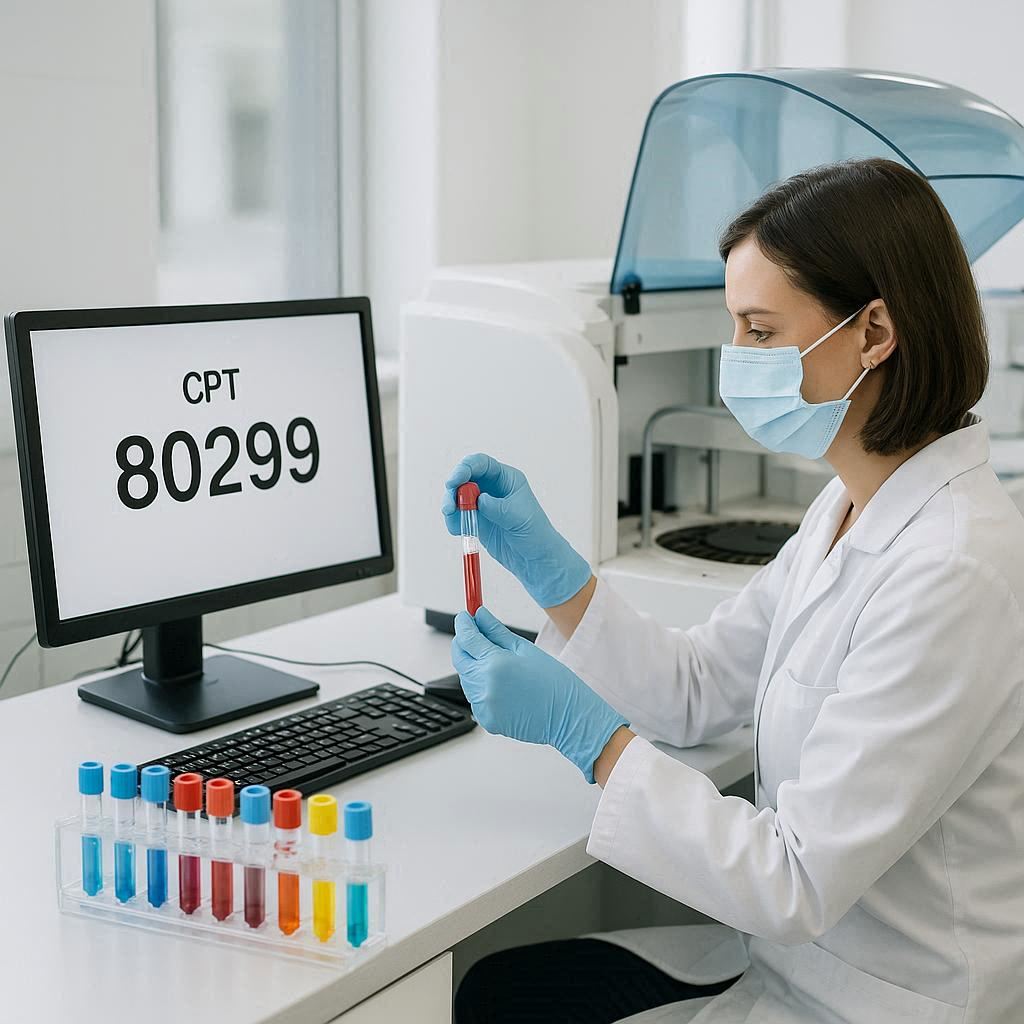
Understanding the Basics of CPT Code 80299
Most codes in the Current Procedural Terminology (CPT) set describe specific, well-defined procedures. Code 80299 does not follow that pattern. It sits in a special category. You must grasp this fundamental nature before you can use the code correctly.
What Does CPT Code 80299 Describe?
The official descriptor reads: “Quantitation of drug class, not elsewhere classified.” This language is both specific and broad. It tells you the code covers measuring the amount of a drug belonging to a particular class. However, the key phrase is “not elsewhere classified.”
If a more specific CPT code exists for quantifying that exact drug or drug class, you cannot use 80299. You must choose the specific code. This code acts as a safety net. The American Medical Association (AMA) created it to capture quantitative drug tests that do not yet have a dedicated code.
Think of it this way. A laboratory performs a quantitative test to determine the precise concentration of an anticonvulsant. If a dedicated code exists for that specific anticonvulsant, the lab bills that code. If no such code exists, the lab turns to 80299.
Why “Quantitation” Matters
The word “quantitation” is critical. It means the test yields a numerical result—a specific concentration, often expressed in nanograms per milliliter (ng/mL). This distinguishes it from presumptive tests, which often yield positive or negative results.
Presumptive drug testing typically falls under codes like 80305-80307. Definitive drug testing, which identifies and often quantifies specific drugs, usually uses codes starting with 80320. Code 80299 lives in the “Chemistry” section of the CPT manual (specifically the Therapeutic Drug Assays subsection), but its spirit overlaps with definitive testing. It specifically quantitates a drug class when no other quantitative chemistry code applies.
You must remember this distinction. Billing a presumptive test code when you performed a quantitative analysis is incorrect. Using 80299 when a more specific quantitative code exists is also incorrect.
A Closer Look at “Not Elsewhere Classified”
This phrase puts a significant responsibility on you. Before you select 80299, you must thoroughly search the CPT manual. You need to confirm that no other code describes the procedure you performed.
For example, you quantify a tricyclic antidepressant. A specific code does not exist for quantifying the entire class, but codes might exist for specific drugs within that class (like amitriptyline or nortriptyline). If you test for a single drug, use the specific code. If you truly perform a class quantitation and no code captures that service, 80299 becomes appropriate.
This requirement protects the coding system from ambiguity. It ensures that standard tests get reported consistently, while still allowing innovation in laboratory medicine.
Important Note: Always check the latest CPT manual and any local coverage determinations (LCDs) from your Medicare Administrative Contractor (MAC). Payer policies often provide specific guidance on when they consider 80299 medically necessary.
Clinical Context: When Do Laboratories Use CPT Code 80299?
Laboratories do not perform tests in a vacuum. Physicians order them to answer clinical questions. Understanding these clinical scenarios helps you see the big picture. It justifies the medical necessity that payers demand.
Therapeutic Drug Monitoring (TDM)
The most common context for quantitative drug class testing is therapeutic drug monitoring. Physicians prescribe medications with a narrow therapeutic index. The difference between a therapeutic dose and a toxic dose is small. Patients metabolize drugs differently based on genetics, age, liver function, and interactions with other medications.
A physician needs to know the exact concentration of the drug in a patient’s system. They use this number to adjust the dose, ensuring efficacy while avoiding toxicity.
Common drug classes monitored this way include certain antiarrhythmics, antiepileptics, and immunosuppressants. When a specific code does not exist for a newer drug within these classes, 80299 bridges the gap.
Pain Management and Compliance Monitoring
Pain management specialists often use quantitative drug testing. They need to confirm that a patient is taking prescribed medications and not diverting them. They also need to confirm the absence of non-prescribed, illicit substances.
Quantitative results provide an objective record. A physician can see if the drug concentration falls within the expected range for compliance. Low levels might suggest diversion or rapid metabolism. High levels might suggest overuse. The quantitative data is invaluable for clinical decision-making and legal documentation.
In this setting, laboratories may use 80299 to quantify a synthetic opioid or a designer benzodiazepine for which a dedicated CPT code has not yet been established.
Emerging Drugs of Abuse
The landscape of substance use disorders changes constantly. Illicit drug manufacturers create new synthetic compounds to evade detection and legal restrictions. These new psychoactive substances (NPS) often belong to broad drug classes like synthetic cannabinoids, cathinones (“bath salts”), or novel opioids.
The AMA’s CPT process takes time to create and publish new codes. By the time a new code exists, the drug may have already faded, replaced by another variant. Laboratories use 80299 to quantify these emerging drugs when they fall into a known pharmacological class but lack a specific code.
This application is vital for public health surveillance and clinical toxicology. It allows hospitals to track and treat overdoses caused by newly identified substances.
Billing and Coding Mechanics: A Step-by-Step Guide
Using CPT code 80299 correctly requires methodical attention. You cannot approach it casually. A systematic checklist protects your revenue cycle and ensures compliance.
Step 1: Verify the Test Methodology
First, confirm the test is truly quantitative. Review the assay methodology. Techniques like liquid chromatography-tandem mass spectrometry (LC-MS/MS) or gas chromatography-mass spectrometry (GC-MS) inherently produce quantitative results when run with calibrators. Immunoassays can sometimes be quantitative if designed that way.
If your report gives a specific numerical concentration, not just a qualitative positive/negative, you meet the definition of quantitation.
Step 2: Confirm the Drug Class, Not a Single Analyte
The code descriptor specifies a “drug class.” You should be quantifying a structural or pharmacological group of drugs. Testing for a single, specific drug and reporting it as a class quantitation may be inaccurate unless your methodology truly reflects the entire class.
For instance, an immunoassay might claim to measure “opiates,” but technically it has high cross-reactivity with morphine and codeine while having low reactivity with oxycodone. Understanding your assay’s true analytical scope is an ethical and coding necessity.
Step 3: Exhaust All Specific Codes
This is the critical compliance step. Open the CPT manual. Review the Therapeutic Drug Assays (80143-80299) section. Check the definitive drug testing codes (80320-80377). Is there any code that describes the exact drug or drug class you quantified?
Imagine you perform a quantitative test for pregabalin. There is no specific CPT code for pregabalin quantitation. It falls into a category for which no code exists. 80299 is your correct selection.
Imagine instead you perform a quantitative test for carbamazepine. CPT code 80156 exists for carbamazepine. You cannot use 80299. Using 80299 for a test with a dedicated code is a certain way to face a denial or audit risk.
Step 4: Append Modifiers Correctly, If Applicable
Generally, modifiers are not routinely required with 80299 unless specific payer policies dictate. However, you must consider the setting. For example, if a CLIA-waived test somehow applies here (unlikely for quantitative class testing, but possible), a modifier like QW might be necessary.
More commonly, you may use modifiers to distinguish professional from technical components (26, TC), though lab tests usually are billed globally by the performing laboratory.
Documentation Requirements for CPT Code 80299
Payers scrutinize unspecified codes. They want proof that the test was necessary and that no more specific code existed. Your documentation tells the story. A strong record makes the difference between payment and denial.
Key Elements in the Medical Record
The ordering physician’s medical record should clearly answer several questions:
- What was the clinical indication? Document the signs, symptoms, or diagnosis that made the test necessary. For example, “Patient on gabapentinoid therapy for neuropathic pain; require quantitative level to assess compliance and adjust dose to therapeutic range.”
- What specific question did the test answer? “Quantification of pregabalin concentration to correlate with clinical response.”
- What is the result, and what action was taken? “Pregabalin level: 5.2 mcg/mL. Maintain current dose, reassess in 30 days.”
Without this narrative, an auditor may conclude the service was not medically necessary, regardless of the code used.
The Laboratory’s Internal Documentation
Your laboratory information system (LIS) should maintain robust records. Document the specific methodology used. State the analytical measurement range. Record the calibration and quality control data.
Most importantly, document the rationale for choosing code 80299. An internal note stating, “CPT code checked on [Date]. No specific code for quantitative [Drug Class] assay. 80299 selected per AMA CPT guidelines,” is a powerful shield during an audit.
Test Requisition Clarity
The requisition form itself should guide the ordering provider. It should list tests with their accurate names and, where possible, the likely CPT codes. When a test must be billed as 80299, a clear description helps the ordering provider understand what they are ordering and why it is an unlisted procedure.
Comparative Table: 80299 vs. Other Drug Testing Codes
Confusion often arises because multiple code families exist for drug testing. The table below clarifies the differences.
| CPT Code / Range | Descriptor Type | Analytical Output | Example Test |
|---|---|---|---|
| 80305-80307 | Presumptive Drug Class Screening | Qualitative (Positive/Negative) | Urine cup for benzodiazepines |
| 80320-80377 | Definitive Drug Testing (single or multiple drug classes) | Qualitative or Quantitative | LC-MS/MS for a panel of specific opioids and metabolites |
| 80143-80202 | Therapeutic Drug Assays (Specific Drugs) | Quantitative (e.g., ng/mL) | Blood test for valproic acid (80164) |
| 80299 | Quantitation of Drug Class (Unlisted) | Quantitative (e.g., ng/mL) | Quantitative test for total synthetic cannabinoid class |
This table highlights the unique placement of 80299. It represents quantitative class testing without a specific home. It is the “none of the above” option for quantitative drug class work.
Navigating Payer Policies and Medical Necessity
Medicare, Medicaid, and commercial insurers each have their own view on unlisted codes. Knowing their tendencies helps you set realistic expectations.
Medicare Administrative Contractors (MACs)
MACs often publish Local Coverage Determinations (LCDs) for drug testing. These documents frequently list “non-covered” indications or specifically exclude unlisted codes without a detailed narrative. Before billing 80299 to Medicare, you must check your jurisdictional MAC’s website.
If an LCD exists for the drug class you are testing, follow it strictly. If not, you are in a gray area. Prepare a strong clinical narrative. Expect potential development requests or redeterminations.
Commercial Payers
Commercial payers vary widely. Some mirror Medicare’s policies. Others maintain an internal list of reimbursable codes, and 80299 may be automatically flagged. Prior authorization can be a useful, though burdensome, tool. Obtaining pre-approval documents the payer’s acknowledgment of the service’s necessity.
Medical Necessity Framework
To establish medical necessity for 80299, you should frame the service around a few core principles:
- The drug has a narrow therapeutic window. The patient can easily be under- or over-treated.
- The clinical decision hinges directly on the numerical result. The physician cannot simply rely on clinical signs.
- No other code exists. This is a procedural necessity, not a convenience.
Common Scenarios and Case Studies
Theory makes more sense with practical examples. Let’s look at realistic situations.
Case 1: Monitoring a Gabapentinoid
A 55-year-old patient with diabetic neuropathy takes a high dose of a prescription medication. The physician is concerned about renal clearance and wants a quantitative level.
- Analogy Test: The lab develops and validates a quantitative LC-MS/MS assay for the active metabolite.
- Coding Investigation: No specific CPT code for this drug or the gabapentinoid class. The therapeutic drug assay codes do not list it. Definitive drug testing codes primarily target drugs of abuse, not this therapeutic class assay.
- Billing: The lab bills 80299 with a diagnosis reflecting diabetic neuropathy and a note specifying the drug.
- Rationale: The service is therapeutic drug monitoring for an unlisted drug class.
Case 2: Synthetic Cannabinoid Quantitation
An emergency department patient presents with agitated delirium. A urine drug screen is negative for routine substances. The toxicologist orders a quantitative test for synthetic cannabinoids.
- Analogy Test: The lab performs LC-MS/MS for a panel of JWH-018, JWH-073, and AB-FUBINACA metabolites, reporting individual and total class quantitation.
- Coding Investigation: No specific code exists for “synthetic cannabinoids.” Neither the therapeutic drug assay nor the definitive section has a listing. Because the output is quantitative and represents a class, 80299 fits the technical definition.
- Billing: The lab bills 80299. They prepare to submit full clinical records, as payers frequently challenge toxicology on unlisted codes.
- Rationale: Clinical management of novel intoxicants requires this emerging test.
Key Insight: In both cases, the lab did not reach for 80299 first. They searched first. The selection of 80299 was a last resort based on a coding gap.
Compliance Risks and Audit Triggers
Unlisted codes naturally attract attention. Using 80299 places you in a higher risk category. Preparing for scrutiny protects your organization.
Audit Trigger 1: High Volume of 80299
If your lab submits a disproportionate number of claims with 80299 compared to your peers, data analytics will flag you. Review your test menu. Have you really created unique assays, or are you miscoding standard tests? Be honest.
If you truly offer innovative tests, accept the audit as a cost of doing business. Maintain impeccable documentation. You will be ready.
Audit Trigger 2: Missing Medical Records
Payers routinely request records for unlisted procedures. A missing or incomplete physician order will result in a swift denial and a potential overpayment request. Ensure your requisition forms capture signatures, indications, and diagnoses. Ensure your billing department can quickly obtain the medical record from the ordering provider.
Audit Trigger 3: Inconsistent Diagnosis Coding
Linking a specific, severe diagnosis to a test billed as 80299 can sometimes backfire. For example, a patient with a common headache getting an experimental class drug test will look suspect. The diagnosis must justify the advanced, unlisted procedure.
The Role of NCCI Edits and CCI Edits
The National Correct Coding Initiative (NCCI) places rules on code pairs. Because 80299 is an unlisted chemistry code, it rarely has specific, established Procedure-to-Procedure (PTP) edits with other lab codes.
However, you must still apply logical bundling. You should not bill 80299 alongside another code if the 80299 service is inherently part of the other procedure. For example, billing a generic therapeutic drug assay (80190) and 80299 for the same drug on the same date would be incongruent. The Medically Unlikely Edits (MUEs) might also limit the units of 80299 you can bill on a single date.
Always use the free, official NCCI lookup tool on the CMS website to verify any edit pairs before claim submission. Ignorance is never a defense.
Appeals and Denials Management for 80299
Denials for 80299 will happen. They are not the end of the road. A robust appeals process recovers revenue you are rightfully owed.
Building the Appeal Package
When a payer denies 80299 for medical necessity or as a “non-covered service,” your appeal must be a masterpiece of clarity. Include:
- A cover letter from the laboratory director or pathologist. The letter should explain the test, its clinical utility, and the coding rationale (the absence of a specific CPT code).
- A redacted copy of the test order showing the physician’s intent.
- The relevant pages of the patient’s medical record demonstrating the clinical context.
- A peer-reviewed article or clinical guideline supporting the use of quantitative levels for this drug class.
- A copy of the AMA CPT manual pages showing the absence of a specific code.
This package educates the payer’s medical reviewer. Often, the initial denial comes from an automated system or a reviewer unfamiliar with the niche application. Your documentation changes the conversation from an automated decision to a clinical one.
Persistence and Policy Change
Repeated appeals for the same test, with strong clinical support, can sometimes influence a payer’s policy. MACs and insurers occasionally update their LCDs and coverage policies when they see a preponderance of well-documented, medically necessary services. Your persistent advocacy shapes future access.
Future Outlook: Will 80299 Become Obsolete?
The CPT code set is dynamic. The AMA continually creates new codes for emerging technologies and tests. Several current uses of 80299 will eventually receive dedicated Category I codes.
The process requires a formal application, supported by evidence of widespread use and clinical efficacy. If your laboratory performs a test frequently using 80299, track the volume and outcomes. You may someday contribute to a new code application, or the clinical community at large will drive the change.
In the meantime, 80299 remains a vital placeholder. It ensures that clinically valid quantitative drug class testing can be performed, reported, and billed. The code supports innovation by providing a legitimate billing pathway, even if it requires extra administrative effort.
Best Practices Summary Checklist
Use this quick-reference list to ensure proper usage of CPT code 80299.
- Verify the Service: Confirm a truly quantitative result (numerical concentration) is generated.
- Check for Specific Codes First: Meticulously review all relevant CPT sections (Therapeutic Drug Assays, Definitive Drug Testing) for a more applicable code.
- Match the Drug Class: Ensure the assay measures a class, and the report reflects this class quantitation.
- Document Clinical Necessity: Require the ordering physician to clearly state why the quantitative class level is needed for patient management.
- Prepare Internal Coding Notes: Document in your LIS why 80299 was selected for each specific assay.
- Monitor Payers: Regularly review LCDs and commercial policies for changes impacting unlisted chemistry codes.
- Build a Strong Appeal Packet: Have a template ready, including clinical studies and coding rationale, to challenge denials swiftly.
- Use Sparingly: If 80299 becomes a top-volume code in your lab, audit yourself. The volume should match the uniqueness of your testing portfolio.
Summary and Concluding Thoughts
CPT code 80299 serves a unique, essential purpose as the quantitation code for drug classes when no other specific code exists. Its appropriate use demands rigorous documentation, a comprehensive search for specific codes, and a clear demonstration of medical necessity. Laboratories and billers must treat this code as a last resort, not a convenience, to ensure compliance and withstand payer scrutiny. By mastering its nuances, you protect revenue and support vital clinical care that falls into coding gray areas.
Frequently Asked Questions (FAQ)
What is the main difference between 80299 and the 80320 series?
The 80299 code describes the quantitation of a drug class in the chemistry section, typically for therapeutic monitoring, while the 80320 series covers definitive drug testing, often for multiple drugs or classes in the context of substance use or pain management. Always look for a specific 80320-series code before resorting to 80299.
Can I bill 80299 for a qualitative screen?
No. The descriptor explicitly states “quantitation.” Qualitative, presumptive screens must be coded from the 80305-80307 range or other appropriate codes. Reporting a presumptive test with 80299 is a coding error.
Do Medicare and Medicaid always reimburse CPT 80299?
Not always. Reimbursement is not guaranteed. It depends on the MAC’s policy, the state’s Medicaid plan, and the medical necessity documented. These payers often scrutinize unlisted codes more carefully, so advance verification is wise.
What documentation do I need to avoid an audit failure?
You need the ordering physician’s order with a clear clinical indication, the laboratory’s report showing the quantitative result, and an internal record proving you searched for a more specific CPT code and found none. Together, these documents establish the medical and coding necessity.
What should I do if a payer repeatedly denies my 80299 claims?
Stop resubmitting the same claim. Instead, build a comprehensive appeal package. Contact the provider relations representative. Offer to provide clinical evidence and speak with a medical director to discuss the test’s value. Systematic education can shift payer policy over time.
Additional Resource:
For the most current coding information, access the official AMA CPT code set search tool and guidelines:
AMA CPT Coding Resources