The discovery that fluoride prevents tooth decay is considered one of the greatest public health achievements of the 20th century. It has led to a dramatic decline in cavities worldwide, saving billions of dollars in dental treatment costs and sparing countless people from pain and tooth loss. But this breakthrough did not happen overnight. It was the result of decades of careful observation, scientific curiosity, and rigorous research by a series of dedicated investigators.
The story of fluoride is not the tale of a single “Eureka!” moment by one scientist. Instead, it is a fascinating narrative of how a dental mystery in the American West led to a global health revolution. This guide explores the key figures who determined fluoride’s role in preventing tooth decay, tracing the path from a strange observation about stained teeth to the widespread fluoridation of public water supplies.
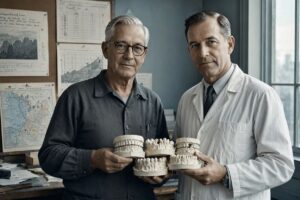
Who Determined Fluoride Prevents Tooth Decay?
The Initial Observation: “Colorado Brown Stain”
The story begins not in a laboratory, but in the small towns of the American West. In the early 1900s, dentists practicing in areas like Colorado Springs, Colorado, noticed a peculiar phenomenon. Many of their patients had permanent, dark brown stains on their teeth—a condition locally known as the “Colorado Brown Stain.”
While the stains were unsightly, dentists made another, more surprising observation: these same patients were remarkably resistant to dental caries (cavities). The connection between the stain and the resistance was a mystery.
The First Key Figure: Dr. Frederick McKay
Dr. Frederick McKay, a young dentist who moved to Colorado Springs in 1901, is the first major figure in this story. He was fascinated by the “Colorado Brown Stain” and dedicated his career to understanding it.
-
His Investigation: McKay spent nearly three decades studying the condition. He mapped its occurrence across different towns, analyzing water supplies and looking for a common thread. He worked with other researchers, most notably Dr. G.V. Black, a prominent dentist of the era. Together, they ruled out dietary factors and ethnicity, pinpointing something in the local water as the likely cause.
The Identification of the Culprit: Fluoride
The work of McKay and others was crucial, but they could not identify the specific element in the water causing the stain. That breakthrough came from a different direction.
The Second Key Figure: Dr. H. Trendley Dean
Dr. H. Trendley Dean was a dental scientist working for the U.S. Public Health Service (PHS). In the 1930s, he took over the investigation into the “Colorado Brown Stain,” now formally known as dental fluorosis.
-
The Discovery: Building on the work of McKay and others, Dean and his team used advanced chemical analysis to determine that the culprit was fluoride, a naturally occurring mineral, present in high concentrations in the water supplies of the affected areas.
-
The “Dean Index”: Dean developed a classification system for fluorosis, ranging from mild (barely visible white spots) to severe (heavy staining and pitting). This was a critical step, as it allowed researchers to measure the effects of fluoride more precisely.
The “Threshold” Hypothesis: Finding the Safe Level
Dean was not just interested in the stain; he was interested in the cavity resistance. The community that had observed stained teeth also had fewer cavities. The question was: could you have the cavity-fighting benefit without the staining?
Dean formulated a hypothesis. He proposed that there was a “threshold” level of fluoride in water—around 1 part per million (ppm)—that would provide significant protection against cavities but would not cause noticeable or severe fluorosis.
-
The “21 Cities” Study: To test this, Dean and his colleagues conducted an enormous epidemiological study known as the “21 Cities” study. They examined the teeth of over 7,000 children in 21 cities across the United States, each with a different level of fluoride in its water.
-
The Result: The study, published in 1942, confirmed Dean’s hypothesis. The data showed a clear inverse relationship: as the fluoride level in water increased (up to about 1.0 ppm), the rate of cavities decreased significantly. The level of dental fluorosis at that concentration was considered mild and often barely detectable. The “optimal” level of 1 ppm was established.
The First Clinical Trial: Proving the Theory
While the “21 Cities” study provided strong observational evidence, a controlled clinical trial was needed to prove definitively that adding fluoride to a water supply would reduce cavities.
The Third Key Figures: The Grand Rapids Study
In 1945, under the leadership of the U.S. Public Health Service, the city of Grand Rapids, Michigan, became the first city in the world to adjust its water supply to the optimal level of 1 ppm fluoride.
-
The Design: The study was a controlled trial. Grand Rapids was the “test” city. The nearby city of Muskegon, Michigan, which had no fluoride in its water, served as the “control” group.
-
The Results: After 15 years of follow-up, the results were dramatic and undeniable. The children in Grand Rapids had a 60-65% reduction in tooth decay compared to the children in Muskegon. This landmark study provided the definitive proof that fluoride, at the right concentration, was a safe and powerful weapon in the fight against cavities.
The Legacy of the Discovery
The determination that fluoride prevents tooth decay was the result of a chain of scientific progress.
-
Dr. Frederick McKay established the link between something in the water, the stained teeth, and the cavity resistance.
-
Dr. H. Trendley Dean and his team identified that “something” as fluoride and proposed the safe, effective “optimal” level.
-
The Grand Rapids-Muskegon study provided the final, conclusive proof through a long-term, controlled clinical trial.
Following this success, community water fluoridation spread rapidly across the United States and the world. It is now recognized by the Centers for Disease Control and Prevention (CDC) as one of the ten great public health achievements of the 20th century.
The Mechanism: How Fluoride Works
Today, we understand the science behind the discovery. Fluoride works in several key ways:
-
Strengthens Enamel: Before teeth erupt, fluoride incorporated into the developing enamel makes it more resistant to acid.
-
Remineralization: After teeth erupt, fluoride in saliva helps to repair (remineralize) the very early stages of tooth decay, before a cavity forms.
-
Inhibits Bacteria: Fluoride interferes with the ability of plaque bacteria to produce acid, reducing the destructive acid attack on teeth.
Conclusion
The credit for determining that fluoride prevents tooth decay belongs not to one person, but to a series of pioneering researchers. Dr. Frederick McKay made the initial clinical observations, Dr. H. Trendley Dean led the scientific investigation that identified fluoride and established its safe dose, and the Grand Rapids study provided the definitive proof. Their combined work transformed dentistry and brought the benefits of better oral health to billions of people around the world.
FAQ
Q: Was fluoride invented in a lab?
A: No. Fluoride is a naturally occurring mineral found in rocks, soil, and water. The discovery was that people who drank water with naturally occurring fluoride had fewer cavities. Scientists then determined the optimal level and began adjusting water supplies to match it.
Q: What is dental fluorosis?
A: Dental fluorosis is a change in the appearance of the tooth enamel caused by consuming excessive fluoride during tooth development (from birth to age 8). In its most common form, it appears as faint white streaks or spots. At the optimal level of 1 ppm, severe fluorosis is rare.
Q: How much did the Grand Rapids study cost, and who paid for it?
A: The Grand Rapids study was funded by the U.S. Public Health Service. The cost of adding fluoride to the water supply was minimal—just a few cents per person per year. The return on investment was massive, saving millions of dollars in dental treatment costs.
Q: Is water fluoridation still considered effective today?
A: Yes. Even in the modern era of fluoride toothpaste and other products, the CDC continues to recognize community water fluoridation as an effective, cost-saving public health measure. It provides a baseline level of protection for everyone in a community, regardless of their ability to access dental care.
Additional Resource
For a detailed history of fluoridation, visit the National Institute of Dental and Craniofacial Research (NIDCR): https://www.nidcr.nih.gov/