
Living with a missing tooth or struggling with uncomfortable dentures can drain your confidence and make everyday pleasures like eating and smiling feel like challenges. You are not alone, and a permanent, life-changing solution is within reach. This comprehensive guide explores why so many people in Leland, North Carolina, are turning to dental implants as their preferred tooth replacement option. We will walk you through the local advantages of choosing this treatment in the Leland area, the transformative benefits of the procedure, and what you can expect from the process. Our goal is to provide you with a realistic, trustworthy, and deeply informative resource that helps you make a confident decision about your oral health.
Understanding the Value of a Permanent Solution
Traditional tooth replacement methods like bridges and dentures have served patients for decades, but they come with inherent compromises. A bridge requires your dentist to file down perfectly healthy adjacent teeth to serve as anchors. This irreversible process can weaken those teeth over time and make them more susceptible to decay and failure. Dentures, while non-invasive, rest on top of your gums and can slip, click, or cause sore spots. They do not preserve the underlying jawbone, which begins to resorb the moment a tooth is lost. This bone loss gradually alters the shape of your face, leading to a sunken, aged appearance.
Dental implants represent a fundamentally different philosophy. An implant is a small, biocompatible titanium post that a skilled surgeon places directly into your jawbone in the exact position of your missing tooth root. Over a few months, your bone fuses to this post in a process called osseointegration. This creates a prosthetic tooth root that is as stable and solid as a natural one. The implant stands alone. It does not rely on or damage neighboring teeth. It stimulates your jawbone every time you chew, preserving your facial structure and preventing the bone deterioration that occurs with tooth loss. This is the critical difference: an implant restores the entire tooth structure, from root to crown, mimicking nature’s design.
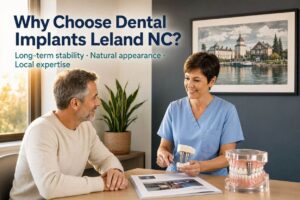
Why Choose Dental Implants Leland NC?
The Local Advantage: Personalized Care in a Growing Community
Choosing a dental implant provider in Leland, NC, offers distinct advantages over traveling to a large, impersonal clinic in a major city. Leland has cultivated a community of skilled dental professionals who prioritize long-term patient relationships over high-volume, transactional care. When you choose a Leland implant dentist, you are more likely to see the same doctor and the same team at every visit. They get to know your face, your medical history, and your specific aesthetic goals. This continuity of care is invaluable during a process that can span several months from surgical placement to the delivery of your final crown.
Leland’s location in the dynamic Brunswick County area means your implant team is deeply integrated into the local medical community. If you have complex medical needs requiring coordination with a primary care physician or a specialist in Wilmington, your Leland dentist likely has established professional relationships to facilitate seamless communication. The convenience factor is substantial. You can schedule your implant consultation, surgery, and follow-up appointments without battling cross-town traffic, finding expensive parking, or taking an entire day off work. High-quality, advanced implant dentistry is available right in your backyard, delivered with a personal touch that is the hallmark of a close-knit community practice.
The Comprehensive Benefits of Dental Implants
Dental implants provide a constellation of benefits that address far more than just the visible gap in your smile. The most immediate and impactful benefit is the restoration of full chewing function. An implant-supported crown is anchored in bone, just like a natural tooth. It can withstand the full force of your bite. You can eat steak, apples, corn on the cob, and all the crunchy, nutritious foods you love without hesitation or fear of dislodging a denture. This functional freedom has a direct positive impact on your nutrition and your overall health. You are no longer restricted to a soft-food diet.
The preservation of jawbone mass is a benefit you cannot see but is profoundly important. The roots of your natural teeth constantly stimulate the alveolar bone that surrounds them. When a tooth is lost, that stimulus disappears, and the body begins to resorb the bone, mistaking it for unneeded tissue. This resorption is rapid in the first year and continues throughout life. A dental implant restores that internal stimulation, signaling to your body that the bone is still needed. This halts the resorption process and maintains the density and volume of your jaw. This is why implant patients maintain a youthful facial contour, while long-term denture wearers often develop a characteristic sunken look around the mouth.
The Emotional and Psychological Restoration
The technical benefits of implants are easily measured, but the emotional transformation is often what patients describe as truly life-changing. A missing tooth, especially one visible when you smile, can become a source of deep insecurity. You may find yourself covering your mouth when you laugh, smiling with your lips closed, or avoiding social situations and photographs altogether. This constant, low-grade self-consciousness is exhausting. It chips away at your natural spontaneity and confidence.
An implant-supported crown is designed to be virtually indistinguishable from your natural teeth. A skilled cosmetic and restorative dentist will match the shape, shade, and translucency of the porcelain to blend seamlessly with your smile. When you look in the mirror, you see a complete, natural-looking smile. You forget you ever had a missing tooth. This psychological liberation is profound. It allows you to smile without thinking, laugh openly, and engage in social and professional interactions with the authentic confidence that comes from feeling whole. This is the unspoken, deeply personal benefit of choosing dental implants.
The Dental Implant Procedure in a Leland Practice
Understanding the sequence of events demystifies the implant process and alleviates anxiety. It begins with a comprehensive consultation and examination. Your Leland dentist will perform a thorough oral exam, review your full medical and dental history, and, most importantly, take a 3D cone beam computed tomography scan. This advanced imaging is non-negotiable for proper implant planning. It provides a three-dimensional, high-resolution map of your jawbone, nerves, sinuses, and adjacent teeth. The dentist uses this scan to precisely measure your bone volume and density, determine the exact optimal position for the implant, and identify any anatomical structures that must be avoided, such as the inferior alveolar nerve.
This digital planning process is often the most critical phase of the entire treatment. In many modern Leland practices, the 3D scan data is used to create a custom surgical guide. This is a 3D-printed stent that fits over your teeth and has a precisely engineered sleeve that directs the implant drill to the exact pre-planned location, angle, and depth. This guided surgery approach dramatically increases the precision, safety, and predictability of the placement. It often allows for a less invasive, flapless surgical technique, which means less post-operative discomfort, minimal swelling, and faster healing for you. This commitment to digital technology is a key sign of a top-tier implant provider.
The Surgical Phase and Healing Period
The day of implant placement surgery is often less daunting than patients anticipate. The procedure is typically performed in the dental office under local anesthesia. Your Leland dentist will ensure you are completely numb and comfortable. Sedation options, ranging from oral conscious sedation to intravenous sedation, are also available for patients with significant dental anxiety. The dentist follows the surgical guide to create a small, precisely sized channel in the bone. The sterile, biocompatible titanium implant is then threaded into this site with meticulous torque control to ensure primary stability. A healing cap or a small cover screw is placed on top, and the gum tissue is allowed to heal over it or is sutured closed.
The next phase is osseointegration, the biological marvel that makes implants work. Over the course of three to six months, your living bone cells grow directly onto the surface of the titanium implant, creating a microscopic mechanical and chemical bond. You must be patient during this phase. Your dentist will place you on a soft-food diet and provide specific oral hygiene instructions to protect the surgical site. You will return for periodic short check-ups so the dentist can monitor your healing. You should not feel any pain or movement from the implant site during this time. Any such sensations must be reported immediately. Once osseointegration is confirmed, you return for the final restorative phase, where your dentist takes an impression, and a custom, lifelike porcelain crown is fabricated and securely attached to the implant.
Comparing Implants to Other Tooth Replacement Options
To make an informed decision, you need a clear, honest comparison between dental implants and the other treatments available. The table below provides a direct, side-by-side evaluation of the key factors that matter most to patients. This comparison does not gloss over the realities of each option but presents them fairly so you can weigh the pros and cons based on your personal priorities and clinical situation.
Comprehensive Comparison: Implants vs. Bridges vs. Dentures
| Feature | Dental Implant | Fixed Bridge | Removable Partial/Full Denture |
|---|---|---|---|
| Effect on Adjacent Teeth | No impact; self-supporting | Requires filing down healthy neighbor teeth | May use metal clasps that can stress anchor teeth |
| Jawbone Preservation | Stimulates bone, prevents resorption | No stimulation; bone loss occurs under pontic | No stimulation; accelerates bone loss over time |
| Stability and Function | Fixed, permanent; feels like a natural tooth | Fixed; but food can trap underneath pontic | Removable; may slip, click, or move while eating |
| Longevity | 25+ years to lifetime with good care | 5 to 15 years on average | 5 to 8 years before typically needing replacement |
| Oral Hygiene | Floss and brush like a natural tooth | Requires threading floss under the false tooth | Must be removed and cleaned separately after meals |
| Aesthetic Result | Highly realistic, indistinguishable from natural teeth | Can be excellent, but gum ridge may collapse over time | Aesthetic quality varies; can look artificial |
| Initial Cost | Higher upfront investment | Moderate upfront cost | Lower upfront cost |
The comparison highlights that while the initial financial investment for a dental implant is higher, the long-term value proposition is exceptionally strong. A bridge that fails at year ten due to decay on the anchor teeth will require replacement, often with even more extensive and costly treatment. A denture that accelerates bone loss may eventually become impossible to wear comfortably, necessitating costly relines or a switch to implant-supported options years later. The implant, by preserving bone and standing alone, often represents the most cost-effective and least invasive solution over a patient’s lifetime.
Addressing the Cost of Dental Implants in Leland
The cost of dental implants is the most common concern patients raise, and it is a topic that deserves a transparent, realistic discussion. There is no single fixed price. The total fee is determined by a combination of factors that are specific to your individual case. The number of implants you need is the primary driver. A single implant to replace one tooth is the most straightforward scenario. Replacing a full arch with an implant-supported denture requires multiple implants and a more complex prosthetic, increasing the total cost. The type of restoration placed on the implant—a single crown, a bridge, or a denture—also significantly affects the final investment.
The quality and quantity of your existing bone are critical variables. If you have been missing a tooth for years, your jawbone may have atrophied to the point where it cannot support an implant of standard dimensions. In this case, you will need a bone grafting procedure to rebuild the volume of bone before or at the time of implant placement. Bone grafting is a separate, skill-intensive surgical procedure that adds to the total treatment time and cost. A sinus lift, which raises the floor of the maxillary sinus to create more bone height in the upper back jaw, is another advanced preparatory procedure that may be needed. Your Leland dentist will identify these needs during your 3D scan evaluation and provide a complete, itemized treatment plan so there are no financial surprises.
The Long-Term Value Equation
When you evaluate the cost of dental implants, frame it not just as an expense but as a long-term investment in your health, function, and quality of life. A high-quality bridge might have a lower initial price tag, but it carries a predictable timeline to failure. The anchor teeth are at increased risk of decay and root canal problems. When the bridge fails, you now have to address not only the original missing tooth but also the damaged anchor teeth, often requiring multiple implants. The total lifetime cost of the bridge path can easily exceed the cost of a single implant placed correctly the first time.
A dental implant, maintained with regular brushing, flossing, and professional hygiene visits, has the potential to last for the rest of your life. The crown may wear over decades and eventually need replacement, but the implant post itself, deeply integrated into your bone, is designed to be a permanent structure. This longevity, combined with the preservation of your jawbone and the absence of collateral damage to healthy teeth, is what makes implants the most cost-effective solution for many patients over the long arc of their lives. Many Leland dental practices also offer financial solutions, including third-party payment plans and phased treatment timelines, to make this invaluable investment manageable for your household budget.
Choosing the Right Implant Dentist in Leland
The success of your dental implant is not just a matter of the brand of implant used; it is overwhelmingly dependent on the skill, experience, and meticulousness of the dentist who plans and places it. When you are researching providers in the Leland area, you should look for a dentist who has pursued significant post-doctoral training in implantology. Credentials matter. Ask if the dentist is a Diplomate of the American Board of Oral Implantology/Implant Dentistry, or a Fellow or Associate Fellow of the American Academy of Implant Dentistry. These credentials indicate a commitment to the highest standards of the field and rigorous, peer-reviewed examination of their knowledge and surgical skills.
Do not hesitate to ask direct questions during your consultation. Ask the dentist how many years they have been placing implants and how many they place annually. A provider who places implants every week has a level of practiced, intuitive skill that a provider who only places one per month cannot match. Ask to see before-and-after photos of their actual patients, not stock images. A confident, skilled implant dentist will have an extensive portfolio of cases similar to yours. Read online reviews, specifically looking for patient comments about the implant experience. Look for themes of gentle care, a comfortable surgical experience, clear communication, and beautiful, lasting results. Your choice of implant provider is the single most important decision you will make in this process.
The Power of Advanced Technology in a Local Practice
A top-tier implant practice in Leland distinguishes itself through its investment in advanced dental technology. The single most important piece of technology is cone beam computed tomography. A practice that uses 3D CBCT imaging for every implant case is practicing at the standard of care. This technology virtually eliminates the risk of nerve damage and other surgical misadventures. Another key technology is the intraoral digital scanner. Instead of messy, uncomfortable physical impressions for your crown, a digital scanner creates a perfectly accurate 3D model of your mouth in minutes, improving the fit and longevity of your final restoration.
An in-house milling unit represents another level of commitment. This technology allows the practice to design and fabricate your custom porcelain crown right in their office, sometimes on the same day as your implant is placed. This is known as “teeth-in-a-day” or same-day implant dentistry for qualified candidates. While not every case is suitable for immediate loading, an in-house milling unit demonstrates a practice’s investment in providing patients with the most efficient, state-of-the-art care possible. When you choose a Leland dentist who has invested in these technologies, you are choosing a professional who is serious about delivering predictable, precise, and comfortable outcomes.
The Implant-Supported Denture: A Life-Changing Option
Many Leland residents who currently wear full removable dentures suffer in silence. Their dentures rock, slide, and make eating an embarrassing chore. They cope with denture adhesives that are messy and unreliable. What they may not know is that a relatively small number of strategically placed dental implants can completely transform their experience and their quality of life. An implant-supported overdenture uses two to four implants to anchor a custom denture securely to the jaw. The denture snaps firmly onto the implants, eliminating all movement during eating and speaking. It can still be removed for cleaning, but it will never slip out of place unexpectedly.
For those seeking the ultimate in stability and a more permanent, non-removable solution, a full-arch fixed restoration, often called All-on-4, uses four to six implants to support a complete arch of beautiful, custom teeth that is fixed in place permanently. Only your dentist removes it for routine maintenance visits. This option most closely replicates the feel and function of having a full set of natural, healthy teeth. It eliminates the palate coverage of a traditional upper denture, restoring your full sense of taste and the natural feel of food. For a patient who has suffered with dentures for decades, this is not just a dental procedure; it is a restoration of a fundamental part of their humanity and social confidence.
Conclusion
Choosing dental implants in Leland, NC, is a decision to invest in the most complete, permanent, and health-preserving tooth replacement solution available today. You gain a stable, functional bite that allows you to eat a full, nutritious diet, and you protect your jawbone and facial structure from the inevitable deterioration that follows tooth loss. By selecting a skilled, technologically advanced local implant dentist, you secure a lifetime of confident smiles and a treatment experience rooted in personalized, community-focused care.
Frequently Asked Questions
Is the dental implant surgery painful?
The surgery is performed under profound local anesthesia, so you will feel pressure but no sharp pain. Post-operative discomfort is typically well-managed with over-the-counter or prescribed pain medication and resolves within a few days.
How long does the entire implant process take from start to finish?
A straightforward single implant case typically takes about 4 to 8 months from the day of placement to the delivery of the final crown. The majority of this time is the healing and osseointegration phase where you are going about your normal life.
Does dental insurance in North Carolina cover implants?
Many dental insurance plans now offer some level of implant coverage, though it is often limited. Your Leland implant practice will perform a benefits check and provide you with a clear financial breakdown before beginning treatment.
Am I too old to get dental implants?
Age itself is rarely a disqualifying factor. The critical determinants are your overall health and the quality and quantity of your jawbone. Many healthy patients in their eighties and nineties successfully receive and enjoy dental implants.
What if I have been told I don’t have enough bone for implants?
Bone loss is a common consequence of missing teeth, but it is rarely a permanent barrier. Advanced bone grafting and sinus lift procedures can rebuild the necessary bone volume to support implants. A 3D scan will determine the exact extent of bone loss and the grafting options available to you.
Additional Resource
The American Academy of Implant Dentistry (AAID) provides a wealth of credible, patient-focused information on dental implant procedures, benefits, and finding a qualified implant dentist. You can explore their comprehensive patient resources at: https://www.aaid.com/


