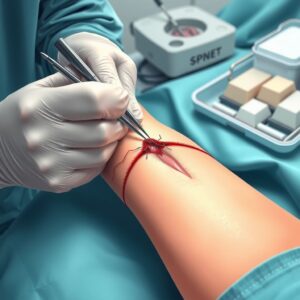
Imagine a busy emergency department on a Saturday night. A carpenter arrives with a deep gash on his palm from a slipped chisel. A child is brought in after a fall, with a jagged cut above her eyebrow. An elderly patient has a skin tear on her forearm from a simple bump against a table. Each of these patients presents with a laceration, but the approach to repairing them—and crucially, how these services are coded and billed—differs dramatically. The clinical skill required to suture a delicate eyelid is not the same as closing a straightforward linear cut on a knee. The CPT (Current Procedural Terminology) coding system for laceration repair exists to capture this very spectrum of complexity, skill, and time.
Mastering the nuances of laceration repair codes (12001-13160) is not merely an administrative task; it is a fundamental competency for ensuring accurate reimbursement, maintaining compliance with payer policies, and avoiding costly audit findings. Miscoding can lead to underpayment for legitimately complex work or, worse, allegations of upcoding and fraud. This comprehensive guide moves beyond basic code definitions to provide a deep, practical understanding of how to accurately select, document, and justify laceration repair codes. We will dissect the layers of simple, intermediate, and complex repairs, explore the impact of anatomical location, delve into the critical importance of documentation, and navigate the complex rules of bundling and modifiers. Whether you are a seasoned coder, a new provider, or a practice manager, this article aims to be your definitive resource for transforming the challenge of laceration coding into a precise and compliant science.
CPT Codes for Laceration Repair
2. The Foundational Principles of Laceration Repair Coding
Before selecting a single code, it is essential to understand the philosophical framework of the CPT system for wound repair. The codes are not based solely on the length of the wound or the number of sutures used. Instead, they are hierarchically structured to reflect the physician’s work, which includes the technical skill, time, and medical judgment required to achieve a closure that restores function and aesthetics.
Defining the Key Components: Simple, Intermediate, and Complex
The CPT manual divides repair codes into three distinct categories:
-
Simple Repair (CPT 12001-12021): Used when the wound is superficial, involving primarily the epidermis, dermis, or subcutaneous tissues without significant involvement of deeper structures. This is a single-layer closure. The key concept is that it requires minimal physician effort. Examples include simple suturing, tissue adhesive (e.g., Dermabond), or steri-strips for a wound that is not contaminated, under no significant tension, and does not require deep sutures.
-
Intermediate Repair (CPT 12031-12057): This category requires the closure of one or more of the deeper layers of subcutaneous tissue and non-muscle fascia, in addition to the skin (epidermal and dermal) closure. The defining factor is the need for layered closure. This is often necessary to eliminate dead space, minimize tension on the skin, and reduce the risk of hematoma or seroma formation. It always implies a more complicated wound than a simple repair, often requiring more time and skill. The closure of the skin itself can be with sutures, staples, or adhesive.
-
Complex Repair (CPT 13100-13153): This goes far beyond a layered closure. Complex repair requires additional techniques such as:
-
Extensive undermining (e.g., > 2-3 cm in any direction from the wound edge).
-
Stented or retention sutures.
-
Placement of drains.
-
Debridement of devitalized tissue.
-
Scar revision.
-
Wound excision (e.g., traumatic wound).
-
Complex configuration: This is a critical element. Wounds that are stellate (star-shaped), highly contused, contain avulsed flaps, or have beveled edges that require extensive sculpting to close often qualify as complex.
-
Anatomy of a Wound: Key Factors Influencing Code Selection
When a provider assesses a laceration, they are evaluating numerous factors that directly dictate the correct CPT code. Coders must learn to read the documentation with this clinical perspective in mind.
-
Depth: A shallow scrape (abrasion) is not coded as a repair. A cut into the fat layer may be simple or intermediate. A cut exposing muscle fascia or bone is more severe.
-
Contamination: A clean cut from a new knife is different from a wound contaminated with dirt, gravel, or organic matter. Contaminated wounds require more extensive irrigation and debridement, which can influence the code selection (e.g., necessitating a separate debridement code).
-
Tension: Wounds over joints or on convex surfaces are under high tension. Closing them requires more skill to avoid dehiscence (re-opening) and may require deep sutures (intermediate repair) or advanced techniques (complex repair).
-
Configuration: Linear lacerations are the most straightforward. Nonlinear lacerations (e.g., stellate, curved, with flaps) are more difficult to close cosmetically and functionally.
-
Location: The anatomic site is built directly into the code families. Repairs on the face, ears, eyelids, and mucous membranes are grouped separately from those on extremities and trunk due to the heightened complexity and cosmetic importance.
Core Characteristics of Laceration Repair Categories
| Feature | Simple Repair | Intermediate Repair | Complex Repair |
|---|---|---|---|
| CPT Code Range | 12001-12021 | 12031-12057 | 13100-13153 |
| Layers Closed | Skin only (epidermis, dermis) | Subcutaneous + Skin | Requires advanced techniques beyond layered closure |
| Key Technique | Single-layer suturing, adhesive, staples | Layered closure | Undermining, stents, retention sutures, debridement |
| Wound Type | Non-contaminated, low tension, linear | May be contaminated, under tension | Contaminated, traumatic, avulsed, stellate |
| Physician Work | Minimal | Moderate | Extensive |
3. A Deep Dive into Simple Repair (12001-12021)
The codes for simple repair are perhaps the most frequently used but are also commonly misapplied. The term “simple” refers to the method of repair, not the nature of the wound. A 10 cm long, superficial scalp laceration repaired with staples is a simple repair, even though the wound is large.
Code Structure and Application
The simple repair codes are grouped by anatomical location and the total length of all repairs in that group.
-
12001-12007: Simple repair of superficial wounds of scalp, neck, axillae, external genitalia, trunk, and/or extremities (including hands and feet).
-
12011-12018: Simple repair of superficial wounds of face, ears, eyelids, nose, lips, and/or mucous membranes.
The codes are further subdivided by the cumulative length of the wounds repaired in that specific anatomic group:
-
12001: 2.5 cm or less
-
12002: 2.6 cm to 7.5 cm
-
12004: 7.6 cm to 12.5 cm
-
…and so on, up to 12007 for 30.1 cm or more.
The same logic applies to the face codes (12011 for 2.5 cm or less, up to 12018 for 30.1 cm or more).
Crucial Rule: You must add together the lengths of all simple repairs within the same anatomic group. For example, if a patient has a 4 cm simple laceration on an arm and a 3 cm simple laceration on the leg, you would code 12002 (because 4 cm + 3 cm = 7 cm, which falls within the 2.6 cm to 7.5 cm range for the trunk/extremities group).
Common Clinical Scenarios and Coding Examples
-
Scenario 1: A child falls and has a 1.5 cm linear, superficial laceration on the forehead. The provider cleans it and closes it with tissue adhesive.
-
Coding: 12011. The forehead is part of the “face” anatomic group. The length is 2.5 cm or less.
-
-
Scenario 2: A construction worker has a 5 cm linear cut on his forearm and a 2 cm linear cut on his shin. Both are superficial, only requiring sutures to the skin.
-
Coding: 12002. Both wounds are on extremities. The total length is 7 cm, which falls into the 2.6 cm to 7.5 cm range.
-
-
Scenario 3: A patient has a 10 cm laceration on the back that is closed with staples.
-
Coding: 12004. The back is part of the trunk. 10 cm falls into the 7.6 cm to 12.5 cm range.
-
What is NOT a Simple Repair?
-
Any wound that requires layered closure (move to Intermediate).
-
Any wound closed with adhesive strips (e.g., Steri-Strips) alone. This is considered part of an E/M service and is not separately billable as a “repair.”
4. Decoding Intermediate Repair (12031-12057)
Intermediate repair is the bridge between basic suturing and complex reconstructive techniques. The linchpin of this category is the documentation of a layered closure.
The Critical Role of Layered Closure
A layered closure means that the physician places sutures in one or more deeper tissue layers (e.g., subcutaneous fat, deep dermal layer) before closing the skin. The purpose is to:
-
Absorb tension: The deep sutures hold the tensile strength of the wound, allowing the skin edges to be approximated without stress, which leads to a better cosmetic result.
-
Eliminate dead space: Closing the potential space where fluid can accumulate prevents seromas and hematomas, reducing the risk of infection.
-
Provide support: It creates a stronger closure less likely to dehisce.
The material used for the deep layer is typically an absorbable suture like Vicryl or Chromic Gut. The skin can then be closed with non-absorbable sutures (e.g., nylon, prolene), staples, or adhesive.
Documentation Requirements and Clinical Examples
The medical record must explicitly state that a layered closure was performed. Phrases like “deep sutures were placed,” “the wound was closed in layers,” or “subcutaneous tissue was re-approximated with 3-0 Vicryl” are mandatory. You cannot assume a layered closure was done based on wound depth alone.
The code structure mirrors the simple repair codes:
-
12031-12037: For intermediate repairs of wounds of the scalp, axillae, trunk, and/or extremities (excluding hands and feet).
-
12041-12047: For intermediate repairs of wounds of the neck, hands, feet, and/or external genitalia.
-
12051-12057: For intermediate repairs of wounds of the face, ears, eyelids, nose, lips, and/or mucous membranes.
Again, you must sum the lengths of all intermediate repairs within the same anatomic group.
-
Scenario 1: A deep 3 cm laceration on the forearm from a piece of glass. The note states: “Wound was irrigated. Deep dermal sutures placed with 4-0 Vicryl. Skin closed with 5-0 Nylon.”
-
Coding: 12032 (Intermediate repair, extremities, 2.6 cm to 7.5 cm).
-
-
Scenario 2: A 1.5 cm deep laceration on the chin. The note states: “The muscle layer was closed with interrupted 5-0 Vicryl. The skin was closed with a running 6-0 Prolene.”
-
Coding: 12051 (Intermediate repair, face, 2.5 cm or less).
-
-
Scenario 3: A patient has a 4 cm intermediate repair on the hand and a 5 cm intermediate repair on the neck.
-
Coding: Both the hand and neck fall under the same anatomic group for intermediate codes (12041-12047). Total length is 9 cm. Code 12044 (7.6 cm to 12.5 cm).
-
5. Navigating the Nuances of Complex Repair (13100-13153)
Complex repair codes represent the highest level of wound closure service. They are reserved for situations where the wound itself is complicated or the repair requires techniques that are distinctly more involved than a standard layered closure.
Beyond Layered Closure: What Makes a Repair Complex?
According to CPT guidelines, a complex repair includes “the repair of wounds requiring more than layered closure,” such as:
-
Scar Revision: If the repair includes the excision of an old scar (e.g., a traumatic laceration through an old surgical scar), it may be coded as complex.
-
Debridement: Extensive debridement of devitalized tissue is a hallmark of complex wounds. (Note: Limited debridement is included in the repair code. Extensive debridement may be separately reportable using codes 11042-11047; see section 6).
-
Retention Sutures: These are large, strong sutures (often using bolsters) that provide extra strength to a wound under extreme tension.
-
Extensive Undermining: This involves freeing the skin and subcutaneous tissue from the underlying fascia for a significant distance (often several centimeters) to allow tissue advancement and tension-free closure.
-
Scarring from Injury: The wound itself is from a severe crushing injury, has extensive tissue loss, or is grossly contaminated.
-
Complex Configuration: Stellate (star-shaped) lacerations, severe crush injuries, and avulsions (where a flap of skin is torn loose) almost always qualify for complex repair.
Debridement, Scar Revision, and Other Complexities
It is vital to understand the interplay between debridement and repair. CPT states that “debridement is considered a separate procedure only when gross contamination requires prolonged cleansing, when appreciable amounts of devitalized or contaminated tissue are removed, or when debridement is carried out separately without immediate primary closure.”
If the debridement is “extensive,” you may report it separately with add-on codes 11042-11047. The documentation must support that the debridement was above and beyond what is normally required for a closure. Merely rinsing gravel from a wound is not separately billable debridement.
The code structure for complex repair is slightly different. The codes are grouped by anatomic site, but the size thresholds are larger, reflecting the more extensive nature of these repairs.
-
13100-13103: Complex repair of trunk
-
13120-13123: Complex repair of scalp, arms, and/or legs
-
13131-13133: Complex repair of forehead, cheeks, chin, mouth, neck, axillae, genitalia, hands, and/or feet
-
13150-13153: Complex repair of eyelids, nose, ears, and/or lips
-
Scenario: A farmer caught his arm in a piece of machinery, resulting in a 6 cm stellate, heavily contaminated laceration with a 4×3 cm avulsed skin flap and exposed muscle fascia. The physician documented: “Extensive debridement of devitalized fat and muscle performed. Wound was irrigated with 3L of saline. The skin flap was undermined approximately 4 cm circumferentially to allow for mobilization. Closure was achieved in multiple layers with 3-0 Vicryl for the deep fascia and subcutaneous tissue. Due to significant tension, three retention sutures were placed. Skin was closed with interrupted 4-0 Nylon.”
-
Coding: This is a textbook complex repair. The stellate configuration, avulsion, extensive debridement, undermining, and use of retention sutures all qualify. You would report 13121 (Complex repair, arm, 2.6 cm to 7.5 cm). If the debridement was truly extensive and well-documented, you might also report a separate debridement code (e.g., 11043 for debridement of muscle).
-
6. Additional Repair and Destruction Codes
Laceration management often involves more than just suturing. Two critical additional code sets are Adjacent Tissue Rearrangement and Debridement.
Adjacent Tissue Rearrangement (CPT 14000-14350)
This family of codes, often referred to as “plastic surgery” codes, is used when the wound cannot be closed by simple mobilization of tissue edges. It involves the creation of local flaps (e.g., advancement, rotation flaps) or Z-plasties to redistribute tension and improve cosmetic and functional outcomes. These codes are typically used instead of complex repair codes for larger defects and are based on the square centimeter area of the defect.
Debridement Codes (11042-11047)
These codes are used to report the removal of devitalized, contaminated, or infected tissue to create a healthy wound bed. They are add-on codes, meaning they are always reported in conjunction with another procedure (like a repair).
-
11042: Debridement, subcutaneous tissue
-
11043: Debridement, muscle
-
11044: Debridement, bone
-
11045-11047: Each additional 20 sq cm (reported with 11042-11044)
Table 2: Key Differences: Complex Repair vs. Adjacent Tissue Rearrangement
| Aspect | Complex Repair (13100-series) | Adjacent Tissue Rearrangement (14000-series) |
|---|---|---|
| Primary Goal | Close a traumatic wound with advanced techniques. | Rearrange local tissue to close a defect, often for cosmetic/functional optimization. |
| Typical Wound | Acute, traumatic laceration. | May be traumatic, but also surgical excision defects or chronic wounds. |
| Basis of Code | Length of the wound (in cm). | Surface area of the defect (in sq cm). |
| Techniques | Undermining, retention sutures, extensive debridement. | Creation of defined flaps (rotation, advancement, transposition), Z-plasty. |
7. Coding for Specific Anatomical Sites: A Practical Guide
Anatomic location is a primary driver of code selection. The codes are explicitly grouped to reflect the increased work and precision required for certain areas.
Face, Ears, Eyelids, and Mucous Membranes
Repairs in these areas are grouped together and have their own code series (e.g., 12011-12018 for simple, 12051-12057 for intermediate) because they require exceptional precision, fine instruments, and specialized suture material to preserve function and cosmesis. Even a small facial laceration may be more work-intensive than a larger one on the thigh.
Extremities, Trunk, and Scalp
These are generally grouped together in the “non-facial” categories. However, note the special grouping for hands, feet, neck, and external genitalia in the intermediate repair series (12041-12047), acknowledging the increased complexity of repairs in these functional and sensitive areas. Repairs on joints (knee, elbow) are often under higher tension.
8. The Critical Intersection of Documentation and Medical Necessity
The most accurate coding is meaningless without bulletproof documentation. The medical record is the only source of truth for auditors and payers.
What Must Be in the Medical Record
For every laceration repair, the documentation should include:
-
Location: Precisely where on the body the wound is located.
-
Size: Length (and depth, if relevant) in centimeters.
-
Description: Configuration (linear, stellate, flap), contamination (clean, dirty, presence of foreign bodies), tissue involvement (skin, subcutaneous fat, muscle, bone).
-
Preparation: Details of irrigation (e.g., “irrigated with 500ml normal saline”) and debridement (“limited debridement of devitalized tissue edges performed”).
-
Anesthesia: Type and amount used (e.g., “infiltrated with 5ml of 1% Lidocaine with epinephrine”).
-
Repair Details (The Most Important Part):
-
For Intermediate: “Closed in layers. Deep dermal sutures placed with 4-0 Vicryl. Skin closed with running 5-0 Prolene.”
-
For Complex: “Wound edges undermined 3 cm circumferentially. Extensive debridement of non-viable muscle performed. Closed in multiple layers including fascia. Retention sutures placed due to tension.”
-
-
Materials: Suture types and sizes used for each layer.
-
Final Result: “Wound closed without complication.”
Linking Diagnosis to Procedure for Clean Claims
The diagnosis code (ICD-10-CM) must justify the medical necessity of the procedure performed.
-
A simple suturing of a finger cut would be linked to S61.221A (Laceration with foreign body of right index finger with damage to nail, initial encounter).
-
A complex repair of a degloving injury on the leg would be linked to a more severe code like S81.812A (Laceration with foreign body of right lower leg, initial encounter) and perhaps T14.8XXA (Other injury of unspecified body region, initial encounter) if the injury is extensive.
Using an unspecified code like S81.819A (Laceration without foreign body of unspecified lower leg) can lead to denials, as it lacks specificity.
9. Avoiding Common Pitfalls and Audit Triggers
Even experienced coders can stumble into these common errors.
Bundling Issues and the NCCI Edit System
The National Correct Coding Initiative (NCCI) contains edits that prevent unbundling—the practice of separately reporting services that are considered integral to a primary procedure.
-
Local Anesthesia: The administration of local anesthesia is always included in the repair code and is never separately billable.
-
Supplies: Routine supplies (suture material, gauze, gloves) are included in the practice expense component of the repair code.
-
Simple vs. Intermediate/Complex: You cannot bill a simple repair code and an intermediate/complex code for the same wound. You must choose the single code that represents the entirety of the repair.
-
Wound Exploration: Exploration of a wound (CPT 20100-20103) is bundled into the repair code unless it is a penetrating wound (e.g., from a gunshot or stab) that requires exploration of a body cavity (e.g., abdomen, chest) beyond the course of the wound itself.
Modifier Use: -51, -59, and -X{EPSU}
Modifiers are essential for clarifying unusual circumstances.
-
Modifier -51 (Multiple Procedures): Used when multiple distinct procedures are performed on the same day. The primary procedure is listed first without a modifier, and subsequent procedures are appended with -51. Most practice management software automatically applies this.
-
Modifier -59 (Distinct Procedural Service): This powerful modifier is used to indicate that a procedure or service was distinct or independent from other services performed on the same day. It is used to bypass NCCI edits. However, its use is highly scrutinized. A more specific subset of -59 modifiers now exists:
-
-XE (Separate Encounter)
-
-XS (Separate Structure)
-
-XP (Separate Practitioner)
-
-XU (Unusual Non-Overlapping Service)
Use the most specific modifier possible. For example, if you repair a complex laceration on a patient’s arm and a simple laceration on their leg, you might use -XS on the simple repair code to indicate it was performed on a separate anatomical structure.
-
10. Frequently Asked Questions (FAQs)
Q1: Can I bill for both a simple repair and an intermediate repair on the same patient?
A: Yes, but only if they are on different anatomic groups. For example, a simple repair on the face (12011-12018 group) and an intermediate repair on the arm (12031-12037 group) are separately reportable. You must use the appropriate modifier (e.g., -59 or -XS) on the lesser-valued procedure.
Q2: How do I code for a wound that is partially closed with sutures and partially closed with adhesive strips?
A: You code only for the portion that was sutured. The adhesive strip closure is considered part of the E/M service. You cannot add the lengths together to choose a code. For example, if you suture 3 cm of a 5 cm wound and use steri-strips for the remaining 2 cm, you code only for a 3 cm repair.
Q3: A physician documents “deep stitches.” Is this enough to code an intermediate repair?
A: It is highly suggestive, but not ideal. The best practice is to query the provider for clarification. Ideal documentation specifies the layer (e.g., “subcutaneous,” “deep dermal”) and the suture material used for that layer.
Q4: Is there a global period for laceration repairs?
A: Yes. Like most minor surgical procedures, laceration repairs have a 10-day global period. This means any related follow-up care within 10 days of the procedure is included in the reimbursement for the repair itself and is not separately billable.
Q5: How do I code for a repair that requires removing a foreign body (like a piece of glass)?
A: This is a common scenario. If the foreign body removal requires significant additional work (e.g., enlarging the wound, dissection, time), you may report it separately with codes from the 10120-10121 series (Incision and removal of foreign body). You must append a modifier (like -59) to the removal code to indicate it was a distinct procedure. However, if the foreign body is simply plucked from the surface during irrigation, it is not separately billable.
11. Conclusion
Accurate laceration repair coding hinges on a deep understanding of CPT’s hierarchy of complexity, from simple to complex. Meticulous physician documentation that details layered closure and advanced techniques is the non-negotiable foundation for correct code selection. Finally, navigating bundling rules with NCCI edits and appropriate modifiers is essential for achieving compliant reimbursement and avoiding audit penalties. By synthesizing clinical understanding with precise coding rules, professionals can ensure this common procedure is reported with integrity and accuracy.
12. Additional Resources
-
AMA CPT® Professional Edition: The definitive source for code descriptors, guidelines, and parenthetical notes. Updated annually.
-
CMS National Correct Coding Initiative (NCCI) Policy Manual: Chapter 9 covers Integumentary System coding policies and edits. https://www.cms.gov/medicare/coding-billing/national-correct-coding-initiative-ncci
-
American Academy of Professional Coders (AAPC): Offers certifications, training modules, webinars, and a community forum for coding professionals. https://www.aapc.com
-
Local Carrier Determinations (LCDs): Check your Medicare Administrative Contractor’s (MAC’s) website for any locality-specific rules regarding wound repair and debridement.