The human knee is a marvel of biomechanical engineering, a complex hinge joint that bears immense loads while facilitating a remarkable range of motion. At the heart of this system lies a small, seemingly insignificant bone: the patella, or kneecap. Often overlooked, the patella is far more than a simple protective cap. It functions as a vital fulcrum, amplifying the force generated by the powerful quadriceps muscles by increasing the lever arm of the extensor mechanism. This mechanical advantage is crucial for fundamental activities like walking, running, climbing stairs, and rising from a seated position. Without a properly functioning patella, the efficiency of the quadriceps muscle is reduced by up to 30%, turning everyday tasks into monumental challenges.
When this critical bone is fractured, the impact on a patient’s life is immediate and profound. The knee buckles, intense pain erupts, and the ability to extend the leg voluntarily is often lost—a telling sign known as an “extensor lag.” Treating these fractures is not merely about repairing a broken bone; it is about restoring a fundamental biomechanical function. Among the various surgical techniques available, Open Reduction and Internal Fixation (ORIF) stands as the gold standard for displaced patellar fractures. This procedure, meticulously described in the American Medical Association’s Current Procedural Terminology (CPT) code 27524, is a life-altering intervention that demands surgical precision, dedicated rehabilitation, and precise medical coding. This article serves as an exhaustive guide for healthcare professionals, medical coders, students, and patients seeking to understand every facet of CPT code 27524 and the journey of patellar fracture repair.
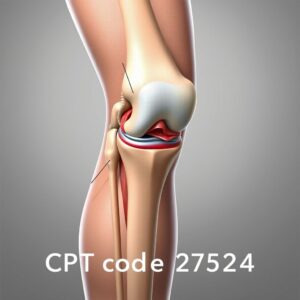
CPT Code 27524
2. Understanding Patellar Fractures: Mechanisms and Classifications
To fully appreciate the ORIF procedure, one must first understand the injury it aims to fix. Patellar fractures account for approximately 1% of all skeletal injuries, but their significance is disproportionate to their incidence.
Mechanisms of Injury:
The most common cause of a patellar fracture is direct trauma, often from:
-
A Direct Blow: A fall directly onto the knee, such as on a hard surface or a dashboard in a motor vehicle accident.
-
A Forceful Contraction of the Quadriceps: This indirect mechanism occurs when a person trips or stumbles and the quadriceps muscle fires violently in an attempt to prevent the fall. The powerful tensile force can avulse (tear away) a portion of the patella or cause a transverse fracture.
-
A Combination of Forces: Many fractures result from a mix of direct impact and quadriceps pull.
Classification of Fractures:
Patellar fractures are classified based on their pattern and displacement, which directly influences treatment decisions. The primary classifications include:
-
Non-displaced Fractures: The bone pieces remain in anatomical alignment. These can often be treated non-surgically with casting or bracing.
-
Displaced Fractures: The fracture fragments are separated, often by more than 2-3 millimeters, or there is a step-off in the articular cartilage of more than 2 mm. This displacement disrupts the extensor mechanism and the smooth articular surface of the knee joint, necessitating surgical intervention. Patterns include:
-
Transverse Fractures: A horizontal break across the patella, often the result of an indirect tensile force. This is the most common pattern requiring ORIF.
-
Comminuted Fractures: The patella is broken into three or more pieces, typically from high-energy direct trauma.
-
Vertical or Longitudinal Fractures: A less common fracture that often runs from the superior to the inferior pole.
-
Pole (Superior/Inferior) Avulsion Fractures: A fragment is pulled off by the patellar tendon (inferior pole) or the quadriceps tendon (superior pole).
-
The goal of ORIF is to address displaced fractures by anatomically reconstructing the joint surface and restoring the continuity of the extensor mechanism.
3. What is Open Reduction and Internal Fixation (ORIF)?
Open Reduction and Internal Fixation is a surgical procedure whose name precisely describes its components:
-
Open Reduction: “Open” refers to the surgical incision made to visualize the fracture site directly. “Reduction” is the orthopedic term for the manipulative process of realigning the fractured bone fragments into their correct anatomical position.
-
Internal Fixation: This involves the application of implants—such as screws, plates, wires, pins, or a combination of these devices—to hold the reduced fragments in place during the healing process. This hardware provides mechanical stability until the bone can heal itself through the natural process of callus formation and remodeling.
ORIF is distinct from closed reduction (manipulation without an incision) and external fixation (where pins are placed in the bone and connected to an external frame). For the patella, the unique biomechanical challenge is managing the tremendous distracting forces of the quadriceps that constantly pull the fragments apart. The fixation must be robust enough to counteract this force.
4. A Deep Dive into CPT Code 27524: The Specifics
The CPT coding system is the universal language for describing medical, surgical, and diagnostic services in the United States. Accuracy is paramount for reimbursement, data tracking, and avoiding audit issues.
CPT Code 27524: Open treatment of patellar fracture, with internal fixation and/or partial or complete patellectomy and soft tissue repair.
This code is a “surgical package.” According to CPT and Medicare guidelines, it includes not only the procedure itself but also:
-
Local infiltration, metacarpal/digital block, or topical anesthesia
-
Subsequent to the procedure, usual postoperative follow-up care
-
The operation
-
Necessary exposure
-
Removal of loose or free fragments
-
Debridement of the fracture edges
-
Irrigation of the surgical site
-
The internal fixation
-
Repair of the ruptured retinaculum and other soft tissues
-
Layered closure of the surgical wound
Key Inclusions and Exclusions:
-
Includes Partial/Complete Patellectomy: If the fracture is so severely comminuted that it cannot be reconstructed, the surgeon may perform a partial removal (e.g., of the inferior pole) or, in rare cases, a complete removal of the patella. This is included in 27524 and is not coded separately.
-
Includes Soft Tissue Repair: The fracture invariably tears the medial and lateral retinaculum (the supportive tissues on the sides of the patella). Repair of these structures is an integral part of restoring the extensor mechanism and is bundled into 27524.
-
Excludes Diagnostic Arthroscopy: If a diagnostic arthroscopy is performed to evaluate the articular cartilage of the femur or tibia, it may be separately reportable with modifier 59 (if distinct procedural service) if documented thoroughly. However, using an arthroscope to assist in the open fracture reduction itself is not separately billable.
-
Excludes Treatment of Other Injuries: If the patient has other injuries (e.g., a femoral fracture or tibial plateau fracture), those are coded separately.
Modifiers: Common modifiers used with 27524 include:
-
Modifier 58 (Staged Procedure): If a subsequent procedure (e.g., hardware removal) is planned or related to the original surgery.
-
Modifier 59 (Distinct Procedural Service): To indicate that another procedure performed on the same day was independent and distinct.
-
Modifier 78 (Unplanned Return to OR): If the patient must return to the operating room for a related procedure during the postoperative period (e.g., for a surgical site infection).
5. The Surgical Procedure: A Step-by-Step Walkthrough
The performance of an ORIF for a patellar fracture is a meticulous process. Here is a detailed, step-by-step overview:
Step 1: Preoperative Preparation and Anesthesia
The patient is placed supine on the operating table. General or regional (spinal/epidural) anesthesia is administered. A tourniquet is applied high on the thigh to create a bloodless surgical field. The entire leg is prepped and draped in a sterile fashion.
Step 2: Surgical Approach
A longitudinal midline incision is most common, providing excellent exposure and minimizing risk to sensory nerves. Alternatively, a transverse incision may be used. The incision is carried down through the skin and subcutaneous tissue.
Step 3: Fracture Exposure and Debridement
The hematoma (collection of blood) around the fracture is evacuated. The fracture ends are carefully exposed, irrigated, and debrided of any small, non-viable bone fragments or soft tissue interposition.
Step 4: Reduction
The surgeon meticulously reduces the major fracture fragments using bone clamps (e.g., Weber clamps) or pointed reduction forceps. The reduction is assessed both visually and by palpation of the articular surface through the fracture line or a small arthrotomy (incision into the joint) to ensure the joint surface is perfectly smooth.
Step 5: Internal Fixation
The choice of fixation construct depends on the fracture pattern. The goal is to achieve stable, compressive fixation that can resist quadriceps pull.
-
For Transverse Fractures: The Tension Band Wiring technique is the classic and most biomechanically sound method. Two parallel Kirschner wires (K-wires) are drilled longitudinally across the fracture line. A figure-of-eight wire is then passed anteriorly over the K-wires and tightened, converting the distracting tensile forces on the anterior surface into compressive forces at the articular surface. The ends of the K-wires are bent and impacted into the bone to prevent migration.
-
For Comminuted Fractures: A Cannulated Screw with Tension Band construct may offer more stability than K-wires alone. Alternatively, a plate and screw system specifically designed for the patella may be used. These low-profile, anatomically contoured plates can stabilize complex, multi-fragmentary fractures.
-
For Inferior Pole Avulsions: Suture anchor fixation is often employed. Strong, non-absorbable sutures are passed through the patellar tendon and secured back to the patella using screws or anchors, re-establishing the connection.
Step 6: Repair of the Retinaculum
The torn medial and lateral retinacular tissues are identified and repaired with heavy, non-absorbable sutures. This is a critical step to restore extensor mechanism stability.
Step 7: Irrigation and Closure
The surgical site is copiously irrigated with saline to remove any debris. The wound is closed in layers: the deep fascia, subcutaneous tissue, and finally the skin with staples or sutures. A sterile dressing and a well-padded knee splint locked in extension are applied.
6. Postoperative Care and Rehabilitation: The Road to Recovery
The success of an ORIF is equally dependent on the surgery and the postoperative rehabilitation protocol, which is tailored to the quality of fixation and the patient’s individual factors.
Immediate Postoperative Phase (0-2 weeks):
-
The leg is immobilized in a knee splint or brace locked in full extension.
-
Focus is on edema control (ice, elevation), pain management, and monitoring the incision for signs of infection.
-
Patients are typically non-weight-bearing or toe-touch weight-bearing with crutches or a walker.
-
Ankle pumps and gentle quadriceps sets (isometric contractions) are initiated early to maintain muscle tone and promote circulation.
Early Mobilization Phase (2-6 weeks):
-
Sutures/staples are removed.
-
The patient is transitioned to a hinged knee brace, which may be unlocked for controlled range-of-motion (ROM) exercises during physical therapy sessions.
-
Weight-bearing status may be gradually advanced to partial weight-bearing as pain subsides and healing progresses.
-
Physical therapy focuses on active-assisted and gentle active knee flexion, maintaining full knee extension, and continuing strengthening exercises.
Intermediate Phase (6-12 weeks):
-
As radiographic healing becomes evident, weight-bearing is progressed to full.
-
The hinged brace is often discontinued.
-
Therapy becomes more aggressive, focusing on restoring full active ROM, improving strength (leg presses, stationary cycling), and beginning proprioceptive and balance training.
Advanced and Return-to-Activity Phase (3-6+ months):
-
Full strength and endurance training.
-
Higher-impact activities, running, and sport-specific drills are introduced gradually.
-
The timeline for return to full activity, including sports and heavy labor, is highly variable, often taking 4-6 months or longer.
7. Potential Complications and Risk Management
As with any major surgery, ORIF of the patella carries risks. Informed consent and vigilant postoperative care are essential.
-
Hardware Irritation: The most common complication. The hardware, particularly the tension band wire, is subcutaneous and can be prominent, causing pain, especially when kneeling. This is a common reason for subsequent hardware removal after the fracture has fully healed.
-
Post-traumatic Osteoarthritis: Even with a perfect anatomic reduction, the initial injury can damage the articular cartilage, leading to progressive joint pain and stiffness years later.
-
Loss of Reduction and Fixation Failure: If the fixation is not robust enough or rehabilitation is too aggressive, the hardware can break, bend, or loosen, causing the fracture to re-displace. This may require a revision surgery.
-
Stiffness and Loss of Motion: Prolonged immobilization or extensive scar tissue formation (arthrofibrosis) can lead to a permanent loss of knee flexion or extension. This underscores the importance of early controlled motion.
-
Surgical Site Infection: Risk is minimized with sterile technique and prophylactic antibiotics but can range from a superficial cellulitis to a deep joint infection (septic arthritis), which is a serious complication.
-
Nonunion and Malunion: A nonunion is when the fracture fails to heal. A malunion is when it heals in a non-anatomic position. Both are rare with modern techniques but can occur, especially with smoking, diabetes, or poor nutrition.
8. Coding and Billing Deep Dive: Navigating the Nuances
Accurate coding requires a thorough review of the operative report. The coder must identify:
-
The Correct Code: Confirm that the procedure described matches CPT 27524 (open treatment, internal fixation, possible patellectomy, soft tissue repair).
-
Separately Reportable Services:
-
Diagnostic Arthroscopy (29870/29871): Only if performed to diagnose and treat a separate, unrelated intra-articular condition (e.g., a meniscal tear) and well-documented as such. It cannot be used merely to assist in the reduction of the fracture.
-
Treatment of a Concomitant Fracture: If the surgeon also fixes a tibial plateau fracture (e.g., CPT 27535), it is separately reportable.
-
Application of a Cast or Splint (29425/29505): The application of the initial cast or splint is included in the global surgical package. However, if a cast or splint is applied in the emergency department prior to the decision for surgery, it may be billed separately with modifier 58.
-
-
Global Period: CPT 27524 has a 90-day global period. All related postoperative care within those 90 days is included in the reimbursement for the surgery.
ICD-10-CM Coding: The diagnosis code must support medical necessity. Common codes include:
-
S82.001A: Fracture of unspecified patella, closed, initial encounter
-
S82.002A: Fracture of unspecified patella, open, initial encounter
-
S82.011A: Displaced osteochondral fracture of right patella, initial encounter
-
S82.012A: Displaced osteochondral fracture of left patella, initial encounter
-
More specific codes exist for the type and laterality of the fracture.
Table 1: Common Fixation Techniques and Their Applications
| Fracture Pattern | Preferred Fixation Technique | Key Biomechanical Principle | Potential Advantages/Disadvantages |
|---|---|---|---|
| Transverse | Tension Band Wiring (K-wires + figure-8 wire) | Converts tensile force to compressive force | Adv: Biomechanically strong, cost-effective. Dis: High rate of hardware irritation. |
| Comminuted | Plate and Screw Fixation | Neutralization and buttressing of multiple fragments | Adv: Stable fixation for complex fractures. Dis: More expensive, larger dissection required. |
| Inferior Pole Avulsion | Suture Anchor Repair or Screw Fixation | Re-attachment of tendon to bone | Adv: Secure fixation for small fragments. Dis: Risk of fragment comminution during screw placement. |
9. The Patient’s Perspective: Life Before and After Surgery
Understanding the human experience is crucial. The injury is often sudden and traumatic. The immediate aftermath involves severe pain, an inability to walk normally, and a loss of independence. Surgery brings hope but also anxiety.
The postoperative journey is a test of patience. The initial weeks are defined by dependence on others for basic needs, frustration with mobility limitations, and managing pain. The rehabilitation process is physically demanding and can be emotionally draining. Setbacks are common. However, milestones—the first time the brace is unlocked, the first full weight-bearing step, the ability to climb a stair normally—are monumental victories.
Long-term outcomes are generally good. Most patients achieve functional ROM and return to their daily activities and occupations. However, many will have some lingering stiffness, occasional aching (especially in cold weather), and the common complaint of inability to kneel comfortably due to hardware. Open communication between the patient, surgeon, and physical therapist is the cornerstone of a successful psychological and physical recovery.
10. Conclusion: Synthesizing the Journey of Healing
CPT code 27524 encapsulates a sophisticated orthopedic procedure vital for restoring knee function after a debilitating patellar fracture. Its success hinges on precise surgical technique, a well-structured rehabilitation protocol, and meticulous attention to coding and billing details. From the initial trauma to the final step of rehabilitation, the journey of ORIF is a collaborative effort between surgeon, patient, and the entire healthcare team, ultimately aiming to return individuals to their active lives.
11. Frequently Asked Questions (FAQs)
Q1: How long will the hardware from my ORIF surgery stay in my knee?
A: Hardware is typically permanent unless it causes problems. It is not routinely removed. The most common reason for a second surgery (hardware removal) is pain and irritation from the subcutaneous wires, which affects a significant number of patients.
Q2: When will I be able to drive after surgery?
A: This depends on several factors: which knee was operated on (right vs. left), your pain level, and your surgeon’s protocol. If you have an automatic transmission and had surgery on your left knee, you may drive once you are off narcotic pain medication and can comfortably control the vehicle. For right knee surgery, driving is typically delayed for 4-6 weeks until you have regained sufficient reaction time and strength for braking.
Q3: Will I develop arthritis in my knee because of this fracture?
A: There is an increased risk of post-traumatic osteoarthritis following any intra-articular fracture (where the break lines extend into the joint surface). Even with a perfect surgical reduction, the initial cartilage damage can lead to arthritis over time. Maintaining a healthy weight and strong quadriceps muscles is the best way to protect the knee long-term.
Q4: As a coder, what is the single most important document for coding 27524 correctly?
A: The operative report is the definitive source. You must carefully read the surgeon’s narrative to confirm the open approach, the method of internal fixation, any mention of patellectomy, and the repair of the retinaculum/soft tissues to ensure it matches the code description.
Q5: Can I bill for a diagnostic arthroscopy separately from 27524?
A: It is possible but heavily scrutinized. The arthroscopy must be documented as being performed for a distinct and separate reason from the fracture repair (e.g., to debride a pre-existing chondral lesion on the femoral condyle). Using the arthroscope to simply visualize the reduction of the patellar fracture is not separately billable. Modifier 59 would be required, and the medical record must strongly support the necessity of two separate procedures.
12. Additional Resources
-
American Academy of Orthopaedic Surgeons (AAOS): Provides patient education materials on patellar fractures and recovery. www.aaos.org
-
American Medical Association (AMA): The publisher of the CPT code set. Offers official resources and training for proper coding. www.ama-assn.org
-
National Institutes of Health (NIH) – PubMed: A database of medical literature for in-depth research on surgical techniques and outcomes. pubmed.ncbi.nlm.nih.gov
-
Orthopaedic Trauma Association (OTA): A professional society for orthopedic trauma surgeons, with resources on fracture classification and treatment. www.ota.org
13. Disclaimer
This article is intended for informational and educational purposes only. It does not constitute medical advice, coding advice, or legal advice. The information provided is not a substitute for professional clinical judgment, individualized treatment plans from a qualified healthcare provider, or certified professional coder (CPC) guidance. Medical coding is complex and constantly evolving; always consult the most current, official CPT codebook and payer-specific guidelines for accurate billing and reimbursement. The author and publisher disclaim any liability for any loss or damage resulting from reliance on the information contained herein.