If you are managing a remote patient monitoring (RPM) program, you are likely watching the calendar closely. As we move through 2026, the billing landscape continues to shift. Keeping up with the CPT codes for RPM feels like a moving target, but do not worry. We are going to walk through everything you need to know together.
The world of healthcare reimbursement loves change. Every year, the American Medical Association (AMA) releases updates, and 2026 is no exception. Some codes are staying. Some are going away. And a few have new rules attached to them.
This guide is designed to be your reliable roadmap for rpm 2026 cpt codes. We will keep the language simple, the examples clear, and the advice practical. Whether you are a biller, a practice manager, or a clinician launching a new program, you will find what you need here.
A Quick Refresher: What is Remote Patient Monitoring?
Before we dive into the specific rpm 2026 cpt codes, let us make sure we are on the same page about what RPM actually is. Remote patient monitoring is not the same as telehealth. Telehealth involves live video visits. RPM involves collecting health data outside of a traditional clinical setting.
Think of a patient with high blood pressure using a Bluetooth cuff at home. The readings go to you, the provider. You review the data, maybe adjust medication, and bill for the time and technology involved. That is RPM.
In 2026, RPM remains a vital tool for managing chronic conditions, reducing hospital readmissions, and keeping patients engaged in their own care. The codes we use to bill for this service have matured, and payers are looking closely at compliance.
The Core RPM CPT Codes for 2026
Let us get straight to the heart of the matter. The AMA has maintained the general structure of RPM coding for 2026, but with critical updates. Below are the primary codes you will use.
Code 99457: The Workhorse of RPM
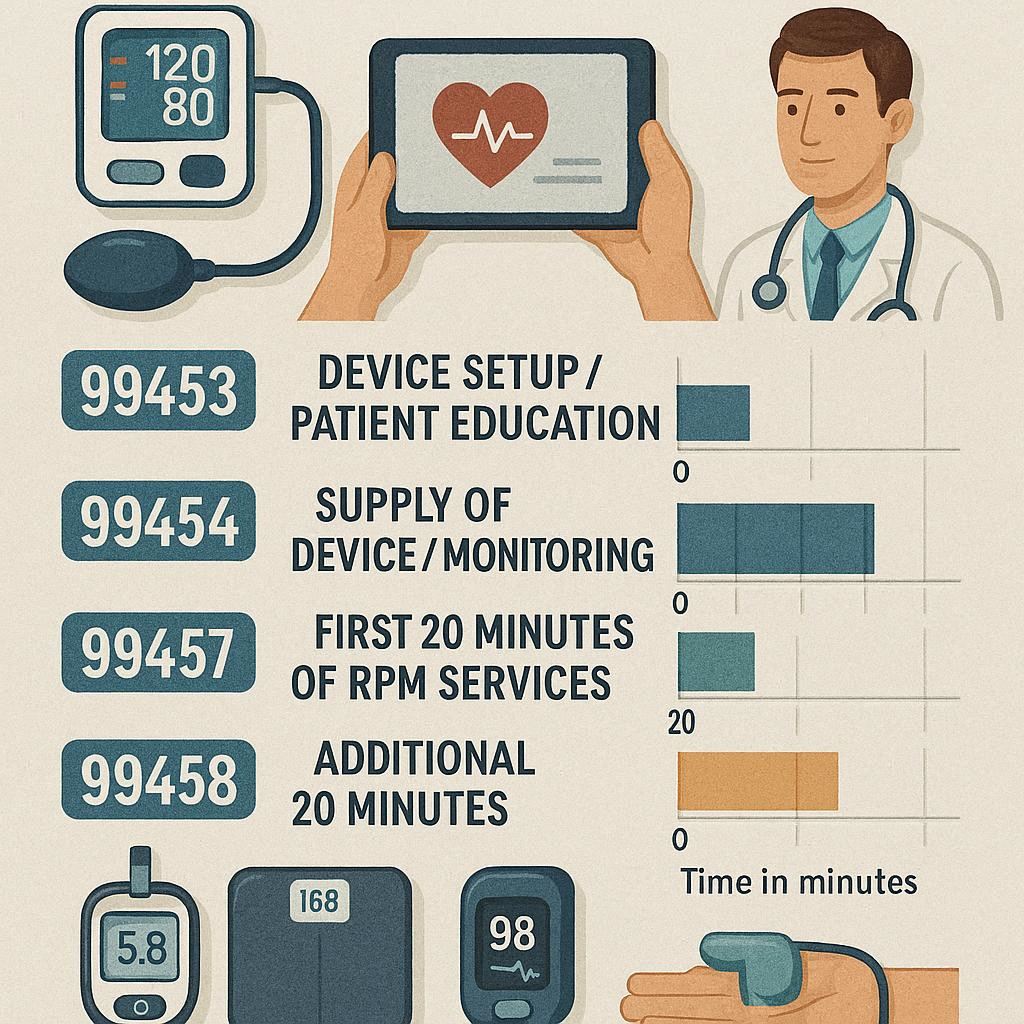
99457 is likely your most frequently used code. It covers the first 20 minutes of remote monitoring treatment management services in a calendar month. This is not just about looking at numbers. It requires interactive communication with the patient or caregiver.
In 2026, the definition of “interactive communication” remains specific. A simple automated text message does not count. You or your clinical staff must spend time:
- Reviewing the transmitted data.
- Adjusting a care plan.
- Calling the patient to discuss a reading.
- Answering questions via a secure portal.
Remember, 99457 covers the first 20 minutes. If you go over that time, you move to the next code.
Code 99458: The Add-On Code
99458 is an add-on code. You use it in conjunction with 99457. This code covers each additional 20 minutes of remote monitoring treatment management services per calendar month.
Here is the rule for 2026. You cannot bill 99458 without first billing 99457. They work as a pair. If you spend 40 minutes total with a patient in a month, you would bill one unit of 99457 and one unit of 99458. If you hit 60 minutes, you bill one unit of 99457 and two units of 99458.
Most payers have a cap on how many units of 99458 you can bill per patient per month. In 2026, that cap generally remains at three or four additional units, depending on the specific contract. Always check your payer policies.
Code 99454: The Device and Data Code
99454 is your supply and data collection code. You bill this code once per calendar month. It covers:
- The provision of a medical device (like a blood pressure cuff or glucose meter).
- The daily electronic transmission of patient data.
- The initial setup and patient training on the device.
Important note for 2026: Documentation requirements for 99454 have tightened. You must now clearly note the date the device was provided to the patient. You must also show that data is being transmitted on at least 16 days of the month. Without that data log, you cannot justify the code.
Code 99453: The Initial Setup Code
99453 covers the initial setup of the device and the first patient education session. This is a one-time code per episode of care. You bill it only in the first calendar month of RPM services.
In 2026, payers are strictly enforcing the rule that 99453 cannot be billed in the same month as 99454 for the same patient. Think of it this way. Month one is setup. Month two is monitoring. You can bill 99453 in month one. You bill 99454 starting in month two once the data is flowing.
Code 99091: The Often-Forgotten Code
99091 is still on the books for 2026, but it is used less frequently than the 9945X series. This code covers the collection and interpretation of physiological data by a physician or other qualified health care professional. It requires at least 30 minutes of time.
Why do practices choose 99091 over 99457? There is a key difference. 99091 does not require interactive communication with the patient. It is purely data review and interpretation. However, reimbursement rates for 99091 are generally lower. Most practices prefer the 99457/99458 pathway because it pays better and encourages patient engagement.
Summary Table of RPM 2026 CPT Codes
Here is a visual reference to keep handy. This table summarizes the main rpm 2026 cpt codes you will use.
| CPT Code | Description | Time Requirement | Frequency |
|---|---|---|---|
| 99453 | Initial device setup and patient education | Face-to-face, time varies | One-time per episode |
| 99454 | Device provision + daily data transmission | No time requirement; requires 16 days of data | Once per calendar month |
| 99457 | First 20 minutes of treatment management | 20 minutes of interactive communication | Once per calendar month |
| 99458 | Each additional 20 minutes | 20 minutes each (add-on to 99457) | Up to 4 times per month (typically) |
| 99091 | Data review without interactive communication | 30+ minutes | Per calendar month |
What is New for 2026? Key Changes and Deletions
If you were billing RPM codes in 2025, you need to pay attention to 2026. The AMA made a few significant adjustments.
Deletion of G-Codes
For several years, many Medicare contractors accepted temporary G-codes for RPM services. These were transitional codes. For 2026, the vast majority of those G-codes have been deleted. You must now use the permanent CPT codes listed above.
If you were accustomed to billing G2012 or similar remote monitoring codes, those days are over. Transition fully to 99453, 99454, 99457, and 99458. Billing a deleted G-code in 2026 will result in an immediate denial.
Clarification on “Interactive Communication”
The AMA issued a clarification for 2026 regarding what counts as “interactive communication” for 99457. The language now explicitly states that the communication must be real-time and bidirectional.
Passive review of data does not count. A portal message that takes the patient three days to read does not count. You need synchronous interaction. This can be a phone call, a video chat, or a secure chat session where both parties are actively participating at the same moment.
New Documentation Requirements for Device Data
Effective January 1, 2026, you must keep a log of daily transmissions in the patient’s medical record. A simple note saying “data reviewed” is no longer sufficient.
You need to prove at least 16 days of data transmission in a 30-day period to bill 99454. For 2026, many auditors are specifically looking for this log. Save yourself a headache. Use your RPM software’s reporting feature or keep a dated spreadsheet in the chart.
Step-by-Step Billing Guide for 2026
Let us walk through a practical billing scenario. This will help you apply the rpm 2026 cpt codes correctly.
Month One: Enrollment and Setup
Your patient, Mr. Jones, has uncontrolled hypertension. He agrees to enroll in your RPM program.
- You provide him with a cellular-enabled blood pressure cuff. You spend 30 minutes on a video call showing him how to use it.
- Bill this: CPT 99453 (one-time setup).
- Do not bill: 99454 yet. There is no data for the month because you are still setting up.
Month Two: Active Monitoring
Mr. Jones has been using his cuff for four weeks. He transmits data on 22 days of the month.
- Your nurse reviews the data. She sees elevated readings. She calls Mr. Jones and spends 21 minutes discussing lifestyle changes and medication adherence.
- Bill this: CPT 99454 (device and data for the month).
- Also bill: CPT 99457 (first 20 minutes of treatment management).
- Consider: CPT 99458 would not apply here because the nurse spent 21 minutes total. The first 20 minutes are covered by 99457. That extra one minute is not billable. You need a full 20-minute increment for the add-on code.
Month Three: Ongoing Care
Mr. Jones is doing well. Your clinical staff spends 45 minutes total with him this month.
- Data shows 18 days of transmission. Bill 99454.
- First 20 minutes of clinical time. Bill 99457.
- Remaining 25 minutes of clinical time. Bill one unit of 99458 (covers the next 20 minutes). The remaining 5 minutes are not billable.
- Total codes for month three: 99454, 99457, 99458 (x1).
A Note for Readers:
Time-based coding is precise but not punishing. You do not need to account for every single second. Round to the nearest minute. But never bill for time you did not truly spend. Compliance is everything in 2026.
Common Billing Mistakes to Avoid in 2026
Even experienced billers make errors. Here are the most common pitfalls with rpm 2026 cpt codes to watch out for.
Mistake #1: Billing 99453 and 99454 in the Same Month
You cannot do this. CMS and commercial payers are clear. The setup month is separate from the monitoring month. If you bill them together, the second code will be denied. Some payers will deny the entire claim.
Mistake #2: Forgetting the 16-Day Rule for 99454
This is the number one reason for RPM claim denials in 2026. You need 16 days of data. Not 15. Not 14. Sixteen. If the patient goes on vacation and only transmits 12 days, you cannot bill 99454 for that month. You can still bill 99457 if you provided management, but 99454 is off the table.
Mistake #3: Billing 99458 Without 99457
Your system might allow this. Your clearinghouse might accept it. But the payer will deny it. Code 99458 is an add-on. It has no independent existence. Always pair it with 99457 on the same claim.
Mistake #4: Counting Automated Messages as “Interactive Communication”
A reminder text is not interactive. An automated “your reading is high” alert is not interactive. For 99457, you need two-way conversation. A five-minute phone call counts. A secure message thread where the patient replies within a few minutes counts. A chatbot does not count. Document the conversation.
Mistake #5: Using the Wrong Modifiers
In 2026, RPM codes generally do not require place of service (POS) modifiers like -95 (synchronous telemedicine). However, some commercial payers still want them. Check your local payer policies. When in doubt, add a -93 modifier for asynchronous telecommunications if the interaction was not live video. For phone calls, no modifier is typically needed for Medicare, but verify this with your Medicare Administrative Contractor (MAC).
Reimbursement Rates for RPM in 2026
Let us talk about money. The actual dollar amount you receive for each code depends on your location, your payer contracts, and the Medicare Physician Fee Schedule (MPFS). The rates below are estimates based on the proposed 2026 MPFS. They are for educational purposes. Always verify your own contracted rates.
Estimated Medicare Reimbursement (Facility vs. Non-Facility)
Medicare pays differently depending on where you practice. Non-facility rates (independent offices) are usually higher because they include practice expenses.
| CPT Code | Non-Facility Rate (Est. 2026) | Facility Rate (Est. 2026) |
|---|---|---|
| 99453 | 45−55 | 25−35 |
| 99454 | 55−65 | 40−50 |
| 99457 | 50−60 | 35−45 |
| 99458 | 40−48 | 30−38 |
To put this in perspective, a typical month of RPM for one patient (setup completed, 20 minutes of management) might look like this:
- 99454: $60
- 99457: $55
- Total monthly reimbursement: Approximately $115
If you add one unit of 99458 for 40 minutes of management, add another 44.Thatbringsthetotaltoabout159 per patient per month. Multiply that by 100 patients, and you see the financial potential of a well-run RPM program.
Important Note:
Commercial payers often reimburse higher than Medicare. Some contracts pay $120 or more for 99457 alone. Negotiate your contracts. RPM is a valuable service. Do not undervalue it.
Documentation Best Practices for Auditors
Auditors love RPM. Why? Because it is relatively new, and errors are common. In 2026, you should expect more audits, not fewer. Protect yourself with solid documentation.
The Four Pillars of RPM Documentation
For every patient, every month, your medical record must include four things.
- Consent: A signed consent form from the patient agreeing to RPM services. This can be a separate form or part of your intake packet. Date it.
- Device Log: Proof of device provision (for 99453) and proof of 16 days of transmission (for 99454).
- Time Log: A record of the minutes spent on interactive communication (for 99457/99458). Include the date, the start and end time, the staff member’s name, and a summary of the conversation.
- Clinical Summary: A note showing that the data was reviewed and that a clinical decision was made (or no change was needed). This connects the technical work to the patient’s care plan.
Sample Documentation Note
Here is a clean example of compliant documentation for 99457.
Date of Service: April 15, 2026
Staff: RN Jane Smith
Time: 10:00 AM to 10:22 AM (22 minutes)
Activity: Patient called to report three consecutive days of systolic readings over 160. Reviewed home blood pressure log. Instructed patient on relaxation techniques prior to reading. Adjusted lisinopril dose from 10mg to 20mg per standing order. Patient verbalized understanding. Follow-up call scheduled for April 18.
CPT Code: 99457 applies for first 20 minutes. Not billing additional time.
This note covers the time, the interaction, the clinical decision, and the care plan. It is audit-proof.
RPM vs. RTM: Do Not Confuse the Two
A frequent source of confusion is the difference between Remote Patient Monitoring (RPM) and Remote Therapeutic Monitoring (RTM). In 2026, both exist. They use different code sets.
RPM is for physiological data. Think heart rate, blood pressure, weight, blood glucose, oxygen saturation.
RTM is for therapeutic data. Think medication adherence, pain scores, therapy session completion, musculoskeletal system response.
If you try to use RPM codes for RTM services, you will get denials. Here is a quick comparison.
| Feature | RPM (Physiological) | RTM (Therapeutic) |
|---|---|---|
| Data Type | Blood pressure, glucose, weight, O2 | Pain scores, medication log, therapy reps |
| Device Type | Cuff, meter, scale, pulse ox | App, log, wearable for movement |
| Main Startup Code | 99453 | 98980 |
| Main Monthly Code | 99454 | 98981 |
| Time-Based Code | 99457 / 99458 | 98980 / 98981 (same code numbers but different category) |
Do not mix the two families. Choose the category that matches the data you are collecting.
Payer-Specific Policies to Watch in 2026
Not all payers follow Medicare’s rules exactly. Here is what you need to know about different types of insurance.
Medicare (CMS)
Medicare is the most predictable. Follow the 2026 MPFS. Use only the CPT codes 99453, 99454, 99457, 99458. No G-codes. No telehealth modifiers for phone calls. Ensure 16 days of data. Document time precisely. Medicare is also strict about the “incident to” rule. Non-physician staff can perform RPM services under general supervision (the physician does not need to be in the room but must be available).
Medicare Advantage (Part C)
These are private plans that replace traditional Medicare. They must cover what Medicare covers, but they can add their own rules. Some Medicare Advantage plans in 2026 require prior authorization for 99454. Others cap the total RPM minutes at 40 per month (so only one unit of 99458). Always check your specific plan contract.
Commercial Payers (Blue Cross, Aetna, UnitedHealthcare, Cigna)
Commercial payers are variable. In 2026, most major commercial insurers cover RPM, but they may not follow Medicare’s time increments. Some use a flat monthly rate for RPM. Others require the use of specific HCPCS codes instead of CPT codes.
Here is a general rule. If you are billing a commercial payer, call their provider line and ask for their RPM medical policy. Ask these three questions:
- Which CPT codes do you accept for RPM?
- Do you require interactive communication (like Medicare)?
- What is your documentation requirement for days of data?
Medicaid
Medicaid varies wildly by state. Some states have robust RPM coverage. Others have none. In 2026, approximately 35 states cover RPM for at least some conditions (typically diabetes and hypertension). Check your state’s Medicaid fee schedule. Do not assume coverage.
How to Start an RPM Program in 2026
If you are new to RPM, the rpm 2026 cpt codes might feel intimidating. But starting a program does not have to be hard. Follow these five steps.
Step 1: Choose Your Technology Partner
You need RPM software. Look for a platform that does three things automatically:
- Tracks days of data transmission (for 99454 compliance).
- Logs staff time spent on interactive communication.
- Integrates with your electronic health record (EHR).
Do not buy a device-only solution. You need the software layer to support your billing.
Step 2: Train Your Staff
RPM is a team sport. Your medical assistants, nurses, and care coordinators will be the ones spending time on the phone with patients. Train them on:
- How to document time accurately.
- What counts as interactive communication.
- How to escalate concerning readings to a physician.
Step 3: Identify Your First Patients
Start small. Choose 10 to 20 patients with a single chronic condition, like uncontrolled hypertension or diabetes. Explain the program to them. Get written consent. Provide devices.
Step 4: Bill Your First Month
Follow the step-by-step guide earlier in this article. Month one: bill 99453. Month two: bill 99454 and 99457. See what happens. If you get paid, expand. If you get a denial, figure out why and correct it.
Step 5: Track Your Metrics
Run a monthly report. Look at:
- How many patients have 16+ days of data?
- What is your average time spent per patient per month?
- What is your denial rate for 99454?
Use these numbers to improve your workflows.
The Future of RPM Beyond 2026
The AMA is already looking ahead. While we focus on rpm 2026 cpt codes, the industry expects further changes in 2027 and beyond.
Artificial intelligence is entering RPM. Soon, AI will analyze data and alert clinicians only when needed. This will change how we bill for “time.” Will we still bill for 20 minutes of review if the AI does the first 10 minutes? The AMA is currently studying this question.
We also expect a push for more asynchronous RPM codes. Not every patient wants a phone call. Some prefer secure messaging. The 2026 rules still favor real-time interaction, but that may relax in the future.
For now, master the 2026 codes. Build strong documentation habits. Stay subscribed to your MAC’s listserv for mid-year changes. RPM is here to stay. It is a powerful tool for improving outcomes and generating revenue. Use it wisely.
Conclusion
Remote patient monitoring billing in 2026 relies on five core CPT codes: 99453, 99454, 99457, 99458, and 99091. The most common pathway to reimbursement involves billing 99453 for setup, 99454 for monthly device and data (requiring 16 days of transmission), and the pair 99457/99458 for interactive clinical time. Avoid deleted G-codes, document every minute and every data transmission, and always verify payer-specific policies to keep your revenue cycle healthy.
Frequently Asked Questions (FAQ)
Q1: Can I bill RPM codes for a patient who only has 15 days of data in a month?
No. For CPT 99454, you need at least 16 days of data transmission within a 30-day calendar month. If you have less than 16 days, you cannot bill 99454. You may still bill 99457 if you provided interactive management.
Q2: Does a physician have to personally perform the 20 minutes for 99457?
No. Under Medicare’s “incident to” rules, clinical staff (nurses, medical assistants, care coordinators) can perform the interactive communication under the general supervision of a physician or qualified NPP. The physician must be available, but not physically present.
Q3: What is the difference between a G-code and a CPT code for RPM in 2026?
G-codes were temporary transitional codes used in previous years. For 2026, the AMA has deleted most RPM-related G-codes. You must now use the permanent CPT codes: 99453, 99454, 99457, and 99458. Billing a deleted G-code will result in a denial.
Q4: Can I bill both 99457 and 99091 for the same patient in the same month?
Technically, yes, but it is not recommended. Both codes describe remote monitoring management. Billing both would likely be considered double billing for the same work. Choose the pathway that matches your service (99457 with interaction, 99091 without interaction). Do not bill both.
Q5: Do I need a separate telehealth modifier for RPM phone calls in 2026?
For traditional Medicare, no. For most commercial payers, also no. However, some commercial payers still require modifier -93 (asynchronous) or -95 (synchronous). Check your specific payer contract. When in doubt, contact your payer’s provider relations department.
Q6: How long does a patient have to be enrolled in RPM to make it profitable?
Most practices find that a patient needs to stay enrolled for at least three to four months to cover the cost of the device and the staff time. The first month (99453 only) is low revenue. Profitability typically starts in month two and is strongest for patients who remain on the program for six months or longer.
Additional Resource
For the most current and official information on rpm 2026 cpt codes, including mid-year corrections and local coverage determinations (LCDs), visit the CMS Medicare Learning Network at:
https://www.cms.gov/medicare/medicare-learning-network (Direct link to RPM resources).