In the intricate world of modern healthcare, the journey of a patient’s care is documented not just in clinical notes, but in a complex language of alphanumeric codes. For a procedure as common and crucial as a punch biopsy, understanding this language is paramount. CPT code 11104 is far more than a mere billing tool; it is a precise descriptor of a specific medical service, a key that unlocks appropriate reimbursement, and a critical data point for tracking disease and treatment outcomes. This article delves beyond the surface, offering an exhaustive exploration of CPT code 11104 for punch biopsy. We will bridge the gap between clinical practice and administrative precision, providing physicians, coders, billers, and healthcare administrators with the knowledge to ensure accuracy, compliance, and optimal patient care. Whether you are a seasoned dermatologist, a family physician adding a new skill, a medical student, or a coder navigating the nuances of integumentary system coding, this guide aims to be your definitive resource.
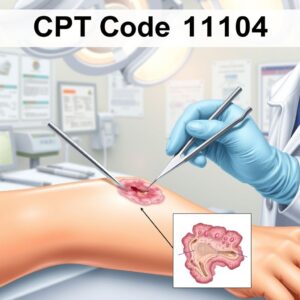
CPT Code 11104
2. Understanding the Punch Biopsy: A Clinical Foundation
Before a code can be accurately assigned, one must fully understand the procedure it represents. Medical coding is not an abstract exercise; it is the translation of medicine into data.
What is a Punch Biopsy?
A punch biopsy is a minimally invasive surgical procedure used to obtain a full-thickness sample of skin for diagnostic purposes. It utilizes a circular blade, or “punch,” which resembles a tiny cookie cutter, ranging in size from 1.5 mm to 8 mm in diameter (with 3 mm and 4 mm being most common for diagnostic biopsies). The punch is rotated downward through the epidermis and dermis, and often into the subcutaneous fat, to retrieve a cylindrical core of tissue. This sample provides a complete cross-section of the skin layers, allowing the pathologist to assess the architectural relationship between cells, which is essential for diagnosing a wide array of conditions.
Clinical Indications: When is a Punch Biopsy Warranted?
A physician will recommend a punch biopsy when a visual examination is insufficient for a definitive diagnosis. Common indications include:
-
Suspicious skin lesions: To rule out or confirm skin cancers such as basal cell carcinoma, squamous cell carcinoma, or melanoma.
-
Inflammatory skin diseases: To diagnose conditions like psoriasis, lichen planus, or cutaneous lupus erythematosus by examining the pattern of inflammation.
-
Infectious processes: To identify fungal infections (deeper than a superficial scraping can detect), bacterial infections like atypical mycobacteria, or viral infections.
-
Bullous disorders: To diagnose autoimmune blistering diseases (e.g., pemphigus vulgaris, bullous pemphigoid) by determining the level at which the blister forms.
-
Cosmetic or traumatic concerns: To evaluate scar tissue, alopecia (hair loss), or pigmentary disorders.
The Punch Biopsy Procedure: A Step-by-Step Walkthrough
-
Informed Consent: The physician explains the procedure, its risks (bleeding, infection, scarring, incomplete diagnosis), benefits, and alternatives, obtaining the patient’s written consent.
-
Preparation: The biopsy site is selected, often photographed for the record. The area is cleaned with an antiseptic solution like alcohol or chlorhexidine.
-
Local Anesthesia: Using a small-gauge needle, a local anesthetic (e.g., lidocaine with or without epinephrine) is injected into the skin around the lesion, creating a wheal that numbs the area completely.
-
The Biopsy: The physician selects an appropriately sized punch tool. The instrument is placed perpendicular to the skin’s surface and pressed downward with firm, rotating pressure until it penetrates the subcutaneous fat.
-
Specimen Retrieval: The cylindrical core of tissue is gently lifted with forceps or a needle to avoid crushing artifacts, and the base is severed with fine scissors or a scalpel.
-
Hemostasis: Bleeding is typically controlled by applying pressure, using aluminum chloride solution, or electrocautery. For larger punches, a single suture may be required to close the wound and control bleeding.
-
Specimen Handling: The tissue sample is placed in a container of formalin solution to preserve it for pathological processing and analysis.
-
Post-Procedure Care: The wound is covered with a bandage, and the patient is given instructions on keeping the area clean and dry, signs of infection to watch for, and when to return for suture removal if necessary.
Punch Biopsy vs. Other Biopsy Techniques: A Comparative Analysis
-
Shave Biopsy (CPT 11102, 11103): A superficial technique using a scalpel or razor blade to slice off a lesion protruding above the skin. It does not provide a full-thickness sample and is unsuitable for diagnosing deep inflammatory processes or assessing the invasive depth of a melanoma.
-
Incisional Biopsy (CPT 11106): Involves using a scalpel to remove a wedge-shaped portion of a larger lesion. It provides full-thickness skin but is a more involved procedure than a punch biopsy.
-
Excisional Biopsy (CPT 11400-11446): The complete removal of an entire lesion, including a margin of normal skin, both for diagnosis and treatment. It is the most definitive but also the most surgically complex of the common skin biopsy techniques.
Comparison of Common Skin Biopsy Techniques
| Technique | CPT Code Range | Depth of Sample | Best For | Pros | Cons |
|---|---|---|---|---|---|
| Shave | 11102, 11103 | Partial-thickness (epidermis and superficial dermis) | Elevated lesions, suspected superficial BCC | Quick, minimal scarring, no sutures | Incomplete for deep lesions, cannot stage depth of cancer |
| Punch | 11104, 11105 | Full-thickness (to subcutaneous fat) | Inflammatory diseases, deep lesions, diagnosing rashes | Excellent diagnostic yield, minimal equipment needed | May require a suture, small risk of scarring |
| Incisional | 11106 | Full-thickness (wedge) | Large lesions where full excision is difficult | Provides good sample of a specific area | More invasive than punch, requires sutures |
| Excisional | 11400-11446 | Full-thickness with margins | Potential melanomas, definitive treatment | Both diagnostic and therapeutic | Most invasive, requires sutures, largest scar |
3. Navigating the CPT® Universe: A Deep Dive into Code 11104
The Current Procedural Terminology (CPT®) code set, maintained by the American Medical Association (AMA), is the standardized system for reporting medical procedures and services to payers.
Demystifying the CPT® Code Set
CPT codes are five-digit numeric codes that describe everything from office visits to complex surgery. The Integumentary System section (10030-19499) contains the codes for biopsies. It is vital to use the most current year’s code set, as codes and descriptors are updated annually.
CPT 11104: The Specifics of Punch Biopsy Coding
The official CPT descriptor for code 11104 is: “Punch biopsy of skin (including simple closure, when performed); single lesion.”
Let’s break down the critical components of this definition:
-
“Punch biopsy of skin”: This explicitly defines the technique.
-
“including simple closure, when performed”: This is a crucial parenthetical statement. It means that if the wound is closed with a simple suture(s) or other simple means (e.g., adhesive strips), it is considered a inherent part of the biopsy procedure. You cannot separately bill for a simple repair (12001-12021) when performing a punch biopsy.
-
“single lesion”: This is the primary determinant of code selection. Code 11104 is reported once, regardless of the number of punches taken from a single lesion. For example, if a physician takes two punches from one large, irregular mole to ensure sampling a representative area, only 11104 is reported.
The “Single or Separate” Lesion Conundrum: A Critical Distinction
This is the most common area of confusion and potential coding error.
-
CPT 11104: Used for a punch biopsy of one distinct lesion.
-
CPT 11105: Used for each additional separate and distinct lesion biopsied during the same session. This is an “add-on” code, meaning it must always be reported in conjunction with 11104; it cannot be used alone.
What defines a “separate and distinct” lesion?
The determination is clinical, not anatomical. Two lesions on the same arm are separate. Two lesions on the same cheek are separate. The key factors are:
-
Different Diagnoses (Suspected): A punch of a rash on the elbow and a separate punch of a rash on the knee are almost always separate lesions, as they may represent different disease processes.
-
Anatomically Non-Contiguous: Even if the same condition is suspected (e.g., psoriasis), a plaque on the scalp and a plaque on the shin are separate lesions.
-
Discrete Morphology: Two clearly separate moles, even if close together, are distinct lesions.
Example: A patient presents with three separate suspicious nevi: one on the back, one on the chest, and one on the leg. The physician performs a punch biopsy on each.
-
Code the first biopsy (e.g., the back): 11104
-
Code the second and third biopsies: 11105 x 2
-
Do not report 11104 three times. This is incorrect and will likely lead to a denial or audit.
Modifiers: The Fine-Tuning Tools of Medical Billing
Modifiers are two-digit codes appended to a CPT code to provide additional information about the service without changing the code’s definition.
-
Modifier -59 (Distinct Procedural Service): Used to indicate that a procedure was distinct or independent from other services performed on the same day. This might be necessary if billing 11105 for a biopsy on a lesion that is very close to another but is, in the provider’s clinical judgment, a separate lesion. Its use is strictly regulated.
-
Modifier -LT (Left Side) and -RT (Right Side): Used to specify the anatomic site if laterality is applicable (e.g., a biopsy on the left forearm and one on the right forearm).
-
Modifier -25 (Significant, Separately Identifiable Evaluation and Management Service): This is critically important. If on the same day as the biopsy, the physician performs a separately identifiable E/M service (e.g., a full skin exam for a new patient with multiple concerns, one of which leads to the decision for a biopsy), modifier -25 is appended to the E/M code to indicate it was above and beyond the usual pre-pro workup included in the biopsy.
4. Coding Scenarios and Case Studies: From Theory to Practice
Let’s apply the rules to realistic patient encounters.
Scenario 1: The Single Suspicious Nevus
-
Presentation: A 45-year-old patient points out a changing mole on their shoulder during a routine physical.
-
Action: The physician examines the mole, agrees it is suspicious, discusses options, and obtains consent. After anesthesia, a 4mm punch biopsy is performed. The wound is closed with one simple suture.
-
Coding: 11104. The simple closure is included. An E/M code (e.g., 99212-99214) with modifier -25 may also be billable if the documentation supports a separate, significant E/M service.
Scenario 2: Multiple Rashes of Unknown Origin
-
Presentation: A patient presents with a chronic, itchy rash on both elbows and both knees. The physician suspects either psoriasis or eczema.
-
Action: To make a definitive diagnosis, the physician decides to biopsy a plaque on the right elbow and a plaque on the left knee.
-
Coding: The biopsies are from two separate anatomical sites for the same generalized condition. Report 11104 for the first biopsy (e.g., right elbow) and 11105 for the second biopsy (left knee). Modifiers -RT and -LT may be used for clarity.
Scenario 3: The Punch Biopsy with a Twist (Repair)
-
Presentation: A large, deep sebaceous cyst on the back becomes inflamed.
-
Action: The physician performs a 6mm punch biopsy to drain and sample the cyst. Due to the size and depth of the defect, a layered closure (involving sutures in the subcutaneous tissue and the skin) is required.
-
Coding: Code 11104 for the punch biopsy. Because the closure is intermediate (layered closure of subcutaneous and superficial tissues) or complex (involving more complex techniques), it is not included in the biopsy code. The physician can separately report the appropriate repair code (12031-12057 for intermediate repair, 13100-13153 for complex repair) with modifier -59 to indicate it was distinct from the biopsy. Documentation must clearly detail the medical necessity for the complex repair.
Scenario 4: The Same Lesion, Different Days
-
Presentation: A punch biopsy of a cheek lesion returns with a pathology report of “atypical melanocytic proliferation, recommend re-excision for definitive diagnosis.”
-
Action: One week later, the physician performs a second, deeper punch biopsy of the same site to obtain more tissue.
-
Coding: This is a biopsy of the same lesion. Therefore, only 11104 is reported for the second procedure. The global period of the first surgery does not apply to a new biopsy. The medical record must clearly document the reason for the repeat biopsy, referencing the prior pathology report.
5. The Crucial Link: ICD-10-CM Diagnosis Coding
A CPT code describes what was done; an ICD-10-CM code describes why it was done. The linkage between the two is the foundation of medical necessity.
The Principle of Medical Necessity
Payers will only reimburse services that are deemed medically necessary. A biopsy performed for a cosmetic concern alone is typically not covered. The diagnosis code justifies the procedure.
Common ICD-10-CM Codes for Punch Biopsy
The diagnosis code should be as specific as possible based on the physician’s clinical assessment before the biopsy.
-
Suspected Malignancy:
-
D48.5: Neoplasm of uncertain behavior of skin
-
C43.-: Malignant melanoma of skin (e.g., C43.9 for unspecified site)
-
C44.-: Other malignant neoplasms of skin (e.g., C44.92 for squamous cell carcinoma of unspecified skin)
-
-
Inflammatory Conditions:
-
L40.0: Psoriasis vulgaris
-
L43.9: Lichen planus, unspecified
-
L93.0: Discoid lupus erythematosus
-
L20.9: Atopic dermatitis, unspecified
-
-
Infections:
-
B35.-: Dermatophytosis (e.g., B35.6 for tinea cruris)
-
B37.2: Candidiasis of skin and nail
-
-
Signs and Symptoms (Use if no definitive diagnosis is suspected):
-
R21: Rash and other nonspecific skin eruption
-
L98.9: Disorder of skin and subcutaneous tissue, unspecified
-
R19.4: Change in bowel habit (if biopsied for Hirschsprung’s)
-
Linking Diagnosis to Procedure: Telling the Patient’s Story
The claim form must tell a logical story. The diagnosis code listed for the CPT code 11104 must align with the location and reason for the biopsy documented in the patient’s chart.
6. Billing, Reimbursement, and Compliance: Navigating the Financial Landscape
Accurate coding is useless if the billing process fails.
Understanding the RBRVS: How Payment is Calculated
Medicare and most payers use the Resource-Based Relative Value Scale (RBRVS) to determine payment. A procedure’s fee is based on three components:
-
Physician Work (PW): The time, skill, and intensity required to perform the service.
-
Practice Expense (PE): The overhead cost (e.g., equipment, nursing staff, supplies).
-
Malpractice (MP): The cost of professional liability insurance.
Each CPT code is assigned Relative Value Units (RVUs) for each component. These are multiplied by a geographic adjustment factor and a dollar conversion factor to calculate the final payment.
Payer Policies: The Devil is in the Details
Every insurance company publishes its own policy for billing biopsy services. These policies may:
-
Specify which diagnosis codes they consider medically necessary.
-
Have frequency limitations (e.g., how many biopsies per session they will cover without additional documentation).
-
Define their own rules for what constitutes a “separate” lesion.
It is imperative to check the specific payer’s policy before submitting claims.
Audit-Proofing Your Documentation: If It Isn’t Written, It Wasn’t Done
Robust documentation in the patient’s medical record is the best defense in an audit. The note should include:
-
Indication: The reason for the biopsy (e.g., “3mm asymmetrical nevus with color variegation on the mid-back, changing per patient”).
-
Informed Consent: A note that risks, benefits, and alternatives were discussed.
-
Procedure Details: The anatomic location(s), size of punch tool used, anesthesia used, description of the specimen, method of hemostasis (e.g., “hemostasis achieved with light electrocautery”), and type of closure (e.g., “closed with one simple 4-0 nylon suture”).
-
Specimen Handling: A note that the specimen was sent to pathology, often with a note on the requisition form indicating the clinical diagnosis and site.
Common Denials and How to Avoid Them
-
Denial: “Bundled service.” (Billing 11104 and a simple repair code).
-
Solution: Never bill a simple repair with 11104. It is included.
-
-
Denial: “Medical necessity not met.” (Using an unspecified diagnosis code when a more specific one is available).
-
Solution: Code to the highest specificity. Use symptoms (R-codes) only when no clinical diagnosis is documented.
-
-
Denial: “Duplicate service.” (Reporting 11104 three times for three lesions).
-
Solution: Report 11104 for the first lesion and 11105 for each additional lesion.
-
7. The Future of Biopsy Coding: Trends and Innovations
The field of medical coding is dynamic. Future trends that may impact punch biopsy coding include:
-
Increased Specificity: CPT may introduce more granular codes based on lesion size or complexity.
-
Artificial Intelligence (AI): AI tools are being developed to assist with code selection based on clinical documentation, reducing human error.
-
Value-Based Care: Reimbursement may increasingly be tied to patient outcomes (e.g., timely diagnosis of melanoma) rather than purely on the volume of procedures performed.
-
Genetic and Molecular Testing: As biopsies are increasingly used to obtain tissue for genetic marker testing, coding for the biopsy and the molecular pathology tests will need to be carefully coordinated.
8. Conclusion
Mastering CPT code 11104 for punch biopsy requires a synergy of clinical knowledge and coding expertise. It transcends mere reimbursement, touching upon patient safety, diagnostic accuracy, and regulatory compliance. By understanding the precise definition of the code, the critical distinction between single and multiple lesions, the proper use of modifiers, and the indispensable link to accurate ICD-10-CM diagnosis codes, healthcare providers and their administrative teams can ensure they are appropriately compensated for their vital work while maintaining the highest standards of professional integrity. In the detailed language of healthcare, precision is everything.
9. Frequently Asked Questions (FAQs)
Q1: If I take two punches from one large lesion, do I bill 11104 and 11105?
A: No. CPT guidelines are clear: code 11104 is reported for a punch biopsy of a single lesion, regardless of the number of punches taken from that same lesion to sample it adequately. Code 11105 is only for separate and distinct lesions.
Q2: Can I bill an office visit (E/M) on the same day as a punch biopsy?
A: Yes, but only if the E/M service is significant and separately identifiable from the work required to perform the biopsy. For example, if a new patient comes in for a full-body skin exam and during that exam you identify and biopsy one lesion, you can bill both the E/M code (with modifier -25) and 11104. The documentation must support the separate E/M service.
Q3: The punch biopsy site required a complex closure. How is that coded?
A: The punch biopsy code (11104) includes only a simple closure. If the medical record documents the medical necessity of an intermediate (layered closure) or complex closure (e.g., involving undermining, retention sutures, etc.), you may report the appropriate repair code (from the 12031-12057 or 13100-13153 series) in addition to 11104. Append modifier -59 to the repair code to indicate it was a distinct procedure.
Q4: What is the difference between a shave biopsy and a punch biopsy in terms of coding?
A: They are fundamentally different techniques with different codes. Shave biopsies (11102, 11103) are superficial and are coded based on whether the lesion is benign or malignant. Punch biopsies (11104, 11105) are full-thickness and are coded based on the number of lesions biopsied, regardless of the suspected pathology.
Q5: Where can I find the most official and up-to-date coding guidelines?
A: The primary source is the American Medical Association’s (AMA) annual CPT® Professional Edition codebook. Additionally, the Centers for Medicare & Medicaid Services (CMS) and your local Medicare Administrative Contractor (MAC) websites provide payer-specific guidance and policies.
10. Additional Resources
-
American Medical Association (AMA): For purchasing the CPT codebook and accessing official CPT guidelines and updates.
-
American Academy of Dermatology (AAD): Offers excellent coding and practice management resources specifically for dermatologic procedures.
-
American Academy of Professional Coders (AAPC): A premier organization for medical coders, offering certifications, training, webinars, and forums for coding professionals.
-
Centers for Medicare & Medicaid Services (CMS): The official source for Medicare coverage policies, National Correct Coding Initiative (NCCI) edits, and fee schedules.
-
Local Medicare Administrative Contractor (MAC) Websites: Provide jurisdiction-specific billing articles and policies (e.g., Novitas Solutions, First Coast Service Options, etc.).
11. Disclaimer
This article is intended for informational and educational purposes only. It is not a substitute for professional medical coding, billing, or legal advice. The information provided is based on current guidelines as of the date of writing but is subject to change. CPT is a registered trademark of the American Medical Association. The author and publisher are not affiliated with the AMA. For accurate coding and reimbursement, always consult the most current official CPT codebook, ICD-10-CM guidelines, and individual payer policies. The ultimate responsibility for correct coding lies with the healthcare provider.